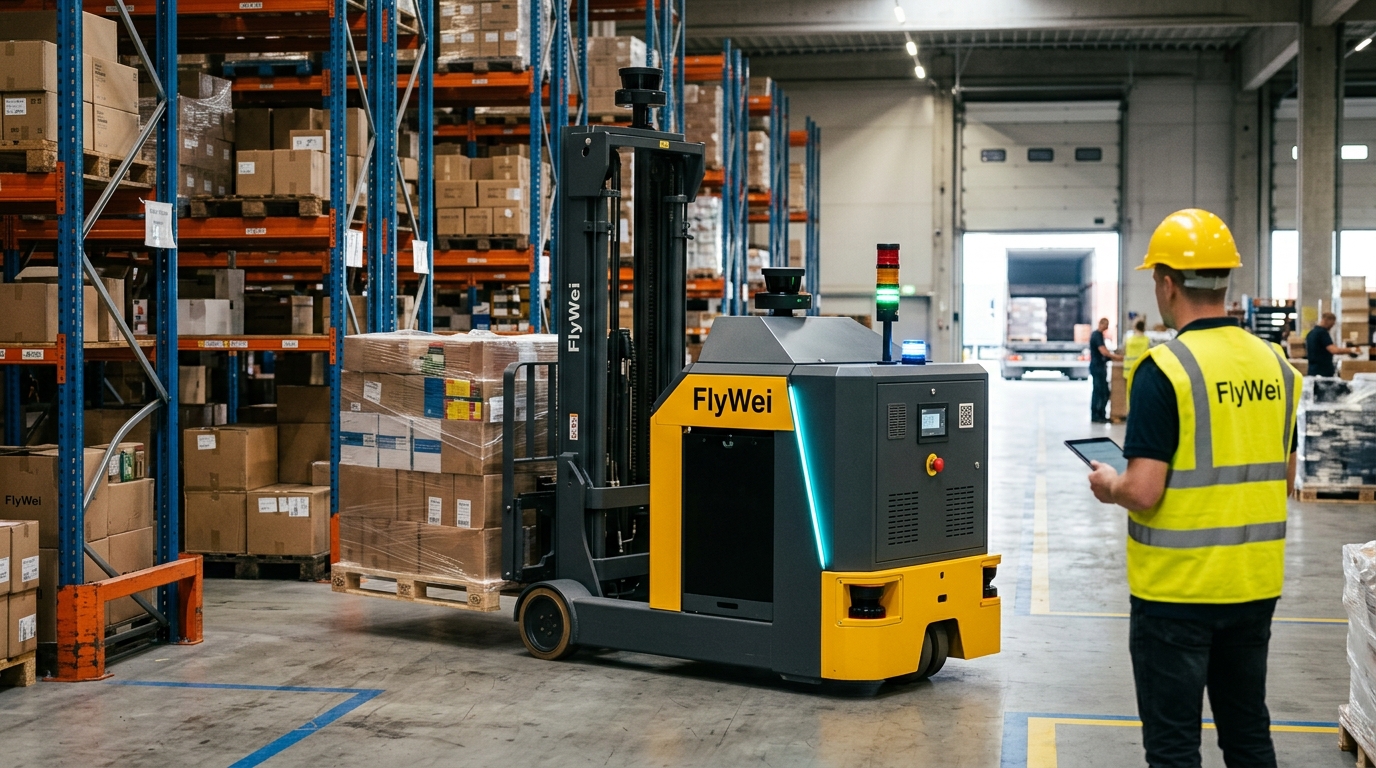
Autonomous forklifts Europe-wide are giving third-party logistics operators in the Benelux and DACH markets a way to lift throughput in weeks rather than committing to a multi-year integration programme. For a warehouse manager running a contract-logistics site near Rotterdam, Antwerp or Duisburg, the pressure is familiar: peak volumes climb, qualified counterbalance and reach-truck operators are scarce, and the obvious fix, a full automated storage and retrieval rebuild, lands as a seven-figure capital decision with an 18-to-36-month delivery window. The result is that the throughput problem this quarter gets answered with a project that finishes two budget cycles from now.
Why the integration project keeps winning, and keeps disappointing
The reason 3PL operators default to the large integration project is structural, not irrational. Contract logistics runs on tight, capped margins, and a big automated rebuild is easy to present to a capital committee as a single, legible number with a single accountable supplier. The trouble is the mismatch between that decision's shape and the business it serves.
A 3PL site rarely controls its own demand. Contracts turn over on three-to-five-year cycles, client SKU profiles shift, and a site that handles palletised drinks this year may be running mixed e-commerce cartons next year. A fixed cube-storage or vertical AS/RS grid is engineered around one of those profiles. When the contract changes, the operator is left with a seven-year capital commitment optimised for a business that no longer exists. The Eurostat transport statistics show how mobile European freight flows have become; warehouse capital has not kept pace with that mobility.
There is also a delivery-risk gap. A legacy integration programme couples civil works, steel, software and commissioning into one critical path. A delay in any one strand moves the go-live date for all of them, and the throughput shortfall the project was meant to solve stays unsolved in the meantime. For a warehouse manager measured on service levels this peak, that is the part that hurts.
The three levers that actually move throughput this quarter
Operational lever: retrofit into the racking you already run
Autonomous forklifts (counterbalance, reach and pallet-mover variants) are designed to operate on a site's existing conventional racking and existing floor. There is no grid to pour, no mezzanine to rebuild, no structural survey gating the start date. A 3PL can take a single aisle or a single dock-to-stock loop, put autonomous trucks on it, and measure the result before committing the next aisle. Deployment to a live first aisle typically runs eight to twelve weeks. Just as important, the trucks are not bolted down: when a contract ends, the fleet redeploys to another site or another client. The capital decision stays reversible, which is the single biggest thing a fixed grid cannot offer a contract-logistics business.
Technical lever: orchestrate over an open interface, not a closed stack
The durable part of any automation decision is the orchestration layer, not the chassis. A fleet manager that speaks the open VDA 5050 interface lets a 3PL run a mixed aisle, autonomous trucks and manned trucks working the same lanes, and keeps the option open to add hardware from more than one source later. A closed, single-vendor AS/RS stack forecloses that option on day one. For an operator whose client base changes every few years, the open interface is not a technical nicety; it is the thing that protects the investment when the business underneath it moves.
Regulatory lever: one compliance framework across four markets
A 3PL running sites across Germany, the Netherlands, Belgium and Austria does not want four compliance regimes. Autonomous industrial trucks placed on the European market are governed by EN ISO 3691-4 for driverless industrial trucks and by the EU Machinery Regulation (EU) 2023/1230, which applies uniformly across the single market without national derogation. CE marking against that framework is recognised in every Benelux and DACH market a 3PL is likely to operate in. Standardising on equipment certified to ISO and EU Machinery Regulation requirements turns a per-country compliance headache into a single, portable assurance, and the documentation moves with the fleet when the fleet redeploys.
What FlyWei does here
FlyWei supplies and integrates autonomous forklifts for European 3PL operators across the Benelux and DACH markets. The model is built around the contract-logistics reality described above: FlyWei deploys autonomous counterbalance, reach and pallet-mover trucks onto a site's existing racking, live on a first aisle in eight to twelve weeks, with no civil works. Fleet orchestration runs through FlyWei M4, which speaks the open VDA 5050 interface so manned and autonomous trucks share aisles and the operator is never locked to one hardware source. FlyWei fleet dispatch software handles task dispatch against the operator's existing flow. Every truck is CE-marked against EN ISO 3691-4 and the EU Machinery Regulation, so a multi-country 3PL standardises on one assurance framework. The point is not that FlyWei is cheaper than a rebuild: it is that the decision stays reversible while the throughput problem gets solved this quarter. Operators weighing the options can compare deployment routes or talk to FlyWei directly.
For a 3PL whose client base turns over every three to five years, the value of an autonomous forklift fleet is not just throughput: it is that the capital decision can be undone when the business underneath it changes.
Frequently asked questions
How long does it take to get autonomous forklifts live in a European 3PL site?
A single first aisle or dock-to-stock loop typically goes live in eight to twelve weeks, because the trucks run on the site's existing racking and floor: there are no civil works on the critical path.
Do autonomous forklifts need a warehouse rebuild or special racking?
No. Autonomous counterbalance, reach and pallet-mover trucks are designed for conventional racking and existing floors. That is the core difference from a fixed AS/RS grid, which requires civil works and locks the site into one storage profile.
Can autonomous and manned forklifts work the same aisles?
Yes, when the fleet is orchestrated over the open VDA 5050 interface. A mixed manned-and-autonomous aisle is a normal operating mode and lets a 3PL automate incrementally rather than all at once.
What compliance applies to autonomous forklifts in the Benelux and DACH markets?
EN ISO 3691-4 governs driverless industrial trucks, and the EU Machinery Regulation (EU) 2023/1230 applies uniformly across the EU single market. CE marking against that framework is recognised in Germany, the Netherlands, Belgium and Austria without national derogation.
What happens to the fleet when a logistics contract ends?
Because autonomous forklifts are not fixed to the building, the fleet can be redeployed to another site or another contract. This is the reversibility a fixed cube-storage or vertical AS/RS grid cannot offer a contract-logistics operator.
Why choose autonomous forklifts over a full integration project?
An integration project couples civil works, steel, software and commissioning onto one critical path with an 18-to-36-month delivery window, and it optimises the site for one demand profile. Autonomous forklifts solve the throughput problem this quarter, keep the capital decision reversible, and do not assume the client base stays still.
Does FlyWei lock a 3PL into one hardware vendor?
No. FlyWei M4 orchestrates over the open VDA 5050 interface, so the operator keeps the option to add hardware from more than one source and is not foreclosed into a closed stack.
Talk to FlyWei about a single-aisle autonomous forklift pilot at your Benelux or DACH site: book a throughput review.