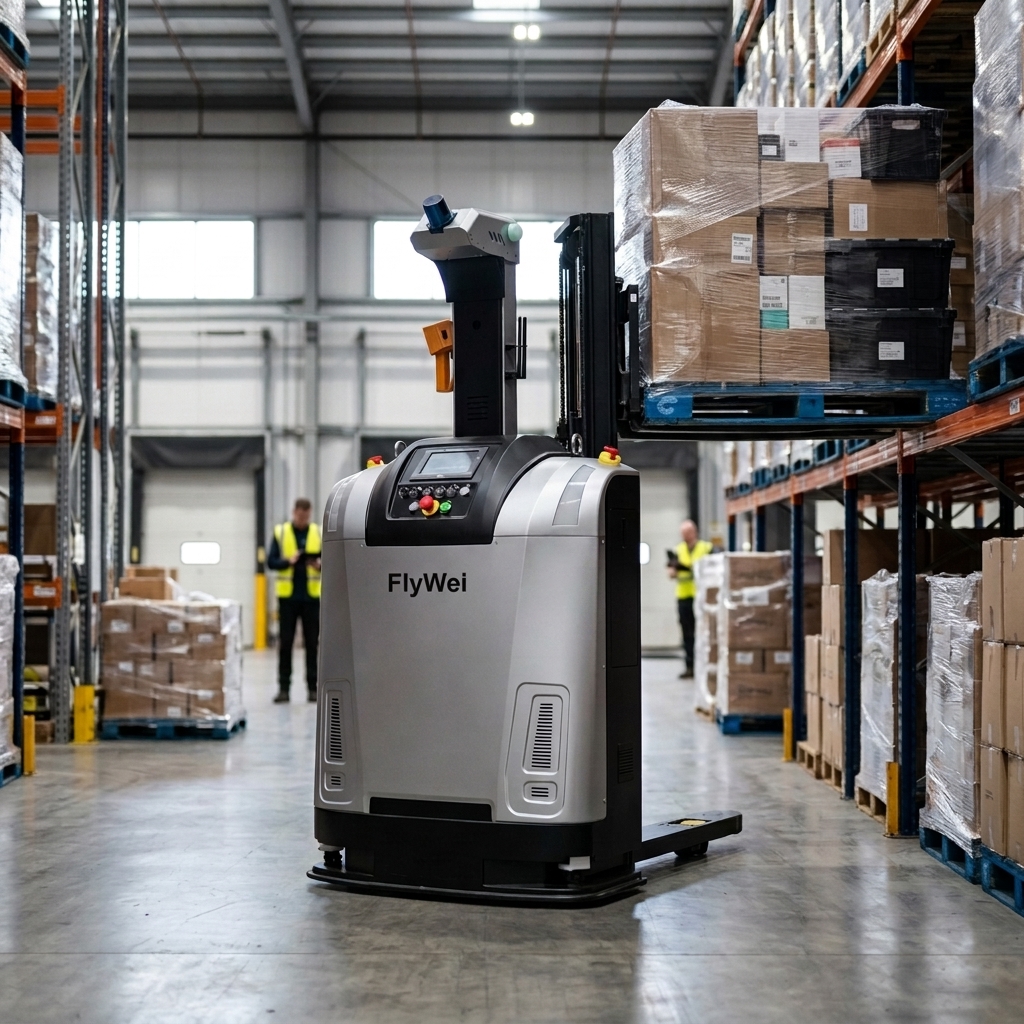
Autonomous forklifts in the Hungary–Slovakia automotive corridor are driverless industrial trucks — counterbalanced and pallet-truck variants navigating by LiDAR-SLAM and orchestrated by a fleet manager — that move stamped panels, engine sub-assemblies and finished sub-frames between line-side stations, sequencing buffers and inbound docks across OEM and Tier-1 plants. The UK's Health and Safety Executive records that around a quarter of all workplace fatalities each year involve transport in or near workplaces — a pattern that repeats across continental manufacturing and that no automotive Operations Director can absorb at takt speed. For a director running three to five plants on the Györ–Trnava–Bratislava–Žilina axis, the pressure this quarter is concrete: a thinning bench of qualified forklift drivers, takt-time tightening from a new EV programme, and counterbalanced-truck leasing rates renewed before the chip-shortage capex was fully absorbed. This article maps the specific operational levers that move autonomous forklifts from a German-plant case study into a working Hungarian or Slovak production system.
Why the corridor is hitting an automotive forklift wall now
Three forces are converging on Operations Directors in the corridor. First, supply: the central European labour pool that staffed the Györ, Esztergom, Trnava and Žilina plants through the 2010s is shrinking and ageing, while Logistics UK's transport employment briefings tracked the same skilled-driver shortfall reaching forklift, reach-truck and counterbalanced operators across western and central Europe. Second, demand: the EV transition is changing what those plants build — battery trays, e-motor stators and high-voltage looms are heavier, more thermally sensitive, and need shorter buffers than the engine blocks they replaced. Third, regulation: the move toward harmonised use of ISO 3691-4 means every fleet manager has a paper trail in front of the auditor that is materially harder to fudge.
The result is that the old fix — pay more overtime, lease more counterbalanced trucks, hire from a wider catchment — is reaching the point of diminishing return. A Director running five plants on the Györ-Trnava axis cannot fix a 22% shortage of qualified forklift drivers by paying 6% more, because the local pool simply does not contain the people. A leased counterbalanced truck running 14 hours a day at 70% utilisation under a tired operator is, on a board pack, indistinguishable from one running 22 hours a day at 92% utilisation under a fleet manager.
The driverless option is not new. What is new is that the unit economics now favour it inside automotive, not just inside the calmer 3PL flows where the technology earned its first credibility. Counterbalanced and stacker variants are paying back inside 36 months, even at corridor labour rates.
Lever 1 — Sequence line-side empties before the body shop calls for them (operational)
The first lever is operational, and it is older than automation itself. Automotive plants run on takt; the body shop's call for the next stamping is on a timer it does not negotiate. Yet in many corridor plants, an empty rack returning from the line still waits for a manual forklift dispatched by radio, queue, or shouted instruction. The result is a pull that becomes a push and a buffer that grows and empties in two-minute saw-tooth cycles. A driverless forklift fleet, orchestrated by a real fleet manager, pre-positions empties on a sliding window matched to the takt — not because the trucks are faster (they are not) but because they do not stop being predictable. A 60-second predictable cycle beats a 35-second variable one every shift, and it removes the supervisor's most expensive call: which flow to dispatch when two want the same lane. Codify the rule once in the fleet manager and the lever holds across all four corridor plants without re-training the supervisor bench. M4 is the orchestration layer FlyWei deploys for this in practice; the principle is independent of vendor.
Lever 2 — Standardise the corridor truck profile and route the controllers, not the trucks (technical)
The second lever is the one most often missed in the first wave of automotive automation. A plant in Györ and a plant in Trnava are not the same building, but their forklift duties are very similar: 1.5–2 tonne palletised loads, low-bay racking up to 6 metres, line-side moves of 80–200 metres, periodic dock-to-line. Specifying a single counterbalanced variant across both plants — typically a 2-tonne automated forklift with the same battery profile and the same controller firmware — collapses the maintenance footprint, makes spares interchangeable across the corridor, and lets one fleet engineer cover four sites by remote-supervising the controllers rather than the trucks. The technical glue is ISO 3691-4 for safety, VDA 5050 for orchestration messaging, and a shared SCADA tap into the line. Where the corridor cannot standardise — paint-hall trucks, body-in-white sub-frame moves — the rule becomes "different truck, same controller, same orchestration"; never different orchestration. The agv forklift discipline that 3PL operators learned in the 2010s now belongs to automotive.
Lever 3 — Close the PUWER and ISO 3691-4 paper trail before the auditor asks (regulatory)
The third lever is the one that quietly decides whether the first two stay live in year two. Driverless trucks are still trucks under PUWER 1998 on the UK leg of the corridor and under the directly equivalent national transpositions across Hungary and Slovakia, and they are autonomous industrial trucks under ISO 3691-4:2020 everywhere. The reading is that the duty-holder cannot delegate safe-use determination to the vendor; the duty stays with the plant. In practice this means three artefacts must exist before the truck moves a single sub-frame: a site-specific risk assessment, a defined safety-rated zone (with floor markings, audible warnings, and a stop authority that physically cuts the truck), and a maintenance record proving the LiDAR scanners and emergency-stop circuits have been verified to BSI-aligned periodic checks. Build the paper trail in the fleet manager, not in a spreadsheet — when the auditor lands on a Wednesday morning, the answer to "show me yesterday's safety-stop log for truck 14" should take 30 seconds, not 30 minutes.
| Lever | Indicative capex impact | Indicative annualised saving | Payback window |
|---|---|---|---|
| Sequence line-side empties via fleet manager | Software seat; no truck capex | 3–6% takt reclaim across body shop | Within 12 months |
| Corridor-wide truck profile + shared controller firmware | ~7% premium over single-plant spec | One fleet engineer covers four plants instead of two | 18–24 months |
| PUWER + ISO 3691-4 paper trail in the fleet manager | None beyond software licence | Audit findings reduced; insurance positioning improved | First audit cycle |
| Lease driverless rather than buy a 13th truck-plus-driver | Off-balance-sheet via 3- or 5-year lease | One driver-equivalent reclaimed per truck-shift | From day one of contract |
Around a quarter of all UK workplace fatalities each year involve transport in or near workplaces — a pattern that repeats across continental automotive manufacturing, and no Operations Director on the Hungary–Slovakia corridor can absorb it at takt speed.
What FlyWei does for an automotive Operations Director in the corridor
FlyWei designs, supplies and integrates driverless counterbalanced and pallet-truck fleets for UK and EU industrial sites, including OEM and Tier-1 automotive plants. In the Hungary–Slovakia automotive corridor, the typical FlyWei deployment is a standardised 2-tonne autonomous forklift profile — one variant for line-side empties and one for finished sub-frame buffer-to-stage moves — orchestrated by the FlyWei M4 fleet manager and dispatched by RDS. The fleet manager pulls live status from the plant's existing line SCADA, so a body-shop call for the next stamping moves a truck inside two takt cycles, not five. FlyWei's UK-based engineering team handles the site-specific risk assessment to ISO 3691-4, defines the safety-rated zones, and builds the periodic-check schedule that satisfies the equivalent of PUWER on each national leg. Leasing is structured as 3-, 5- or 7-year terms so the truck sits off the plant's capex line and lines up with the EV programme funding gate. Where the corridor's labour profile means one fleet engineer cannot cover four plants on foot, FlyWei provides remote supervision of the M4 instance and on-site response inside an agreed window. Because the corridor fleet shares controller firmware, a spare from stock fits the next-door plant; the operator's existing ERP and WMS still own the order. Documented automotive deployments comparable to a corridor rollout are described in our case studies.
Frequently asked questions
Is an autonomous forklift legal in a Hungarian or Slovak automotive plant?
Yes. Driverless industrial trucks are governed by ISO 3691-4 across the EU, with national transpositions in both countries equivalent in substance to the UK's PUWER and LOLER regimes. The duty-holder remains the plant operator, not the vendor.
How long does deployment take in a live OEM environment?
A standardised counterbalanced fleet of 8–12 trucks across a single building typically takes 10–14 weeks from order to first revenue move, assuming the site is willing to do the safety-zone marking in parallel.
Can autonomous forklifts run on a takt-driven body shop?
Yes, provided the fleet manager has a SCADA link to the line and is permitted to pre-position empties on a takt-matched schedule. The trucks are not faster than a skilled human operator; they are predictable, which is the property the body shop actually needs.
What is the right financing structure for a corridor-wide rollout?
Most corridor Operations Directors are using a 3- or 5-year operating lease rather than a capex purchase, so the trucks land in the plant inside the same funding gate as the EV programme they support.
How do we maintain four plants with one fleet engineer?
Standardise the truck profile and the controller firmware so spares are interchangeable across the corridor, and run the fleet manager from a single supervised instance with remote dashboards for each plant.
What is the safety case for ISO 3691-4 in a paint or body shop environment?
The standard imposes specific requirements on detection zones, emergency-stop authority and audible warnings; the plant risk assessment closes the gap to the local environment such as paint-solvent ATEX zones and body-shop sparks. The paper trail lives in the fleet manager, not a spreadsheet.
If a 22% shortage of qualified forklift drivers across your corridor is already on your Q3 risk register, the fastest read on whether driverless trucks fit your line-side flow is a structured feasibility pass on your highest-volume body-shop-to-buffer move.
Get a 48-hour feasibility read on your highest-volume flow from a FlyWei engineer, or compare 3-, 5- and 7-year terms on the FlyWei autonomous forklift leasing page.
UK-based engineers · no obligation · reply within one business day.