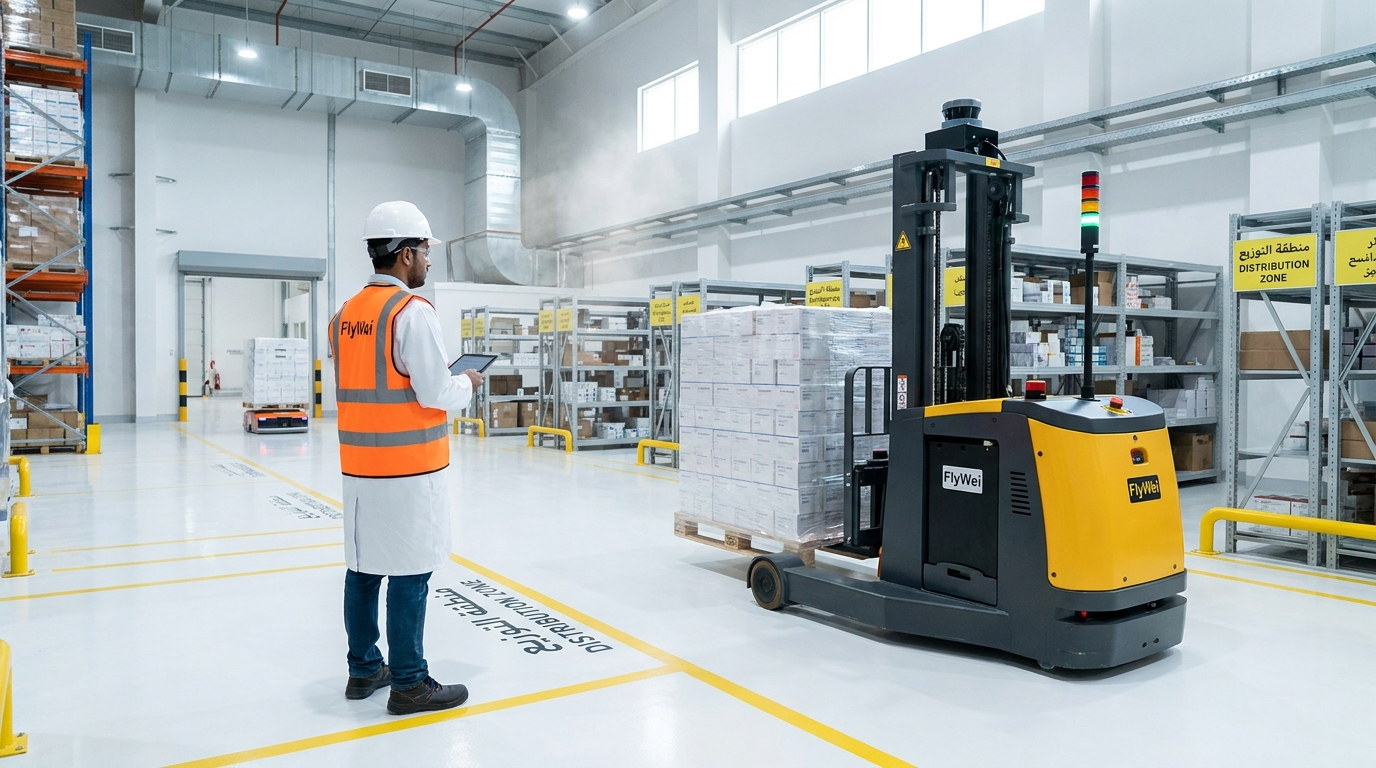
Autonomous forklifts for Saudi Arabia pharmaceutical distribution centres now sit on every Vision 2030 procurement shortlist, and the decisive question is no longer whether a robot can lift a tote. It is whether the fleet will survive a no-notice PIC/S inspection without forcing operators to halt picking for forty-eight hours. For a Head of Procurement steering a Capex committee toward a thirty- or fifty-truck deployment across Riyadh, Jeddah and a new King Abdullah Economic City facility, the gap between an automation business case and an audit-ready fleet is where six months of build schedule and an eight-figure project either land on time or quietly slip into the next financial year.
An autonomous forklift fleet that holds GDP-compliant temperature, route and operator-handover logs at the asset level can shorten PIC/S audit-pack assembly from six weeks to under five working days.
Why GCC pharmaceutical procurement breaks on autonomous forklifts
The Kingdom's pharmaceutical sector is on a faster scale curve than the warehouse-automation supply chain can comfortably absorb. Saudi Vision 2030 targets a substantial expansion of domestic biopharma and generics manufacturing, NEOM Bay and King Abdullah Economic City are bringing new finished-goods distribution centres into service, and the Saudi Food and Drug Authority is in parallel tightening its enforcement of GDP guidance aligned to PIC/S and the WHO Annex 9 model guidance on time-and-temperature-sensitive pharmaceutical products. The collision point sits squarely on the warehouse floor.
Three structural pressures land on procurement at the same time. First, the pool of qualified GDP-trained forklift operators inside the Kingdom is shallow, and Saudisation rules tighten the supply further. Second, ambient temperatures in unconditioned dock zones routinely exceed 45 °C in summer, which derates standard European-specification autonomous forklifts faster than vendor datasheets imply. Third, regulators expect end-to-end traceability (operator identity, route taken, time at temperature, hand-off chain-of-custody) to be auditable on demand. Spreadsheet-and-stickered-pallet logging belongs to the old DC; it does not belong to a Vision 2030 facility being inspected by an SFDA team that already runs against a PIC/S Annex 15 playbook.
For procurement, the practical consequence is that the conventional bill of materials no longer matches the contract risk. A truck that is technically BS EN ISO 3691-4 conformant on the Hannover show floor is not automatically a truck that holds its certified safety distances at +45 °C, IP54 dust ingress and a fleet density of one robot every nine square metres. The buyer's job has shifted from evaluating the truck to evaluating the fleet under GCC conditions for a regulated product.
Lever 1: Lock the regulatory envelope at RFQ stage, not at FAT
The single most cost-effective decision a procurement committee can make is to write the regulatory envelope into the request-for-quotation rather than the factory-acceptance-test plan. That envelope has four lines: BSI-certified BS EN ISO 3691-4:2023 conformance with a documented safety-function residual-risk register; SFDA GDP traceability mapped to WHO Annex 9 storage-and-transport guidance; a PIC/S Annex 15 qualification approach with IQ, OQ and PQ protocols pre-drafted by the supplier; and a clear allocation of duties between the supplier's commissioning team and the operator's qualified person. Anything left to FAT becomes a change order, and change orders during pharmaceutical commissioning are the line item that quietly doubles project cost.
Lever 2: Make every autonomous forklift its own audit witness
Every truck on a pharma fleet should write three data streams, at the asset level, to an orchestration layer the operator owns: a temperature-and-humidity stream from a calibrated on-board sensor (not the building BMS; the truck's own data plane); a route-and-time stream tagged to each pallet identifier; and an operator-handover stream that captures the qualified person's authorisation event at every exception point. The orchestration layer is FlyWei M4: vendor-agnostic, VDA 5050-aligned, and built so that a future second robot type (a stacker variant, a latent-jacking AMR) joins the same audit trail rather than spawning a parallel one. When an inspector asks for proof a particular vial pallet held below 25 °C through its 11:42 dock-to-zone-C move, a single report, pulled in under five minutes, replaces six weeks of CCTV review and paper logs.
Lever 3: Specify GCC-environment derating, not European-datasheet derating
A pharmaceutical distribution centre in Riyadh or Jeddah typically presents three environmental conditions a European-built autonomous forklift was not originally specified for: ambient air to 45 °C in dock corridors; fine particulate ingress from sand and dust during the early summer months; and floor-flatness tolerances inherited from a building specification calibrated to local pour standards rather than UK TR34-class finishes. FlyWei autonomous forklifts in the pharmaceutical configuration are specified with IP54 sealed drive electronics, a thermal envelope rated to 50 °C continuous operation, and a floor-tolerance calibration sweep performed during commissioning that maps each aisle to a confidence-weighted speed profile. The procurement difference is a single line on the technical schedule; the operational difference is the avoidance of a six-week summer downtime window during peak dispatch.
Lever 4: Build orchestration as the contract, not the bundle
The most damaging clause a procurement committee can sign is a single-vendor bundle that ties the orchestration layer to one robot SKU. Within eighteen months almost every pharma operator wants a second robot type, typically a latent-jacking AMR for goods-to-person trolley moves alongside the counterbalanced autonomous forklift fleet. If the orchestration layer is locked to one vendor, the second deployment either runs as a parallel fleet (doubling integration burden and breaking the audit trail) or forces a rip-and-replace. The mitigation is to write a separate orchestration contract that names the FlyWei M4 layer as the fleet manager, with a VDA 5050 conformance clause that obliges every future supplier, including the original, to publish to that layer. Procurement gains the leverage; the audit trail stays single-source. Logistics UK reaches the same conclusion for UK 3PL operators in its recent automation work: the orchestration layer, not the robot, is the strategic asset.
| Procurement decision | If specified at RFQ | If left to project |
|---|---|---|
| BS EN ISO 3691-4 + PIC/S Annex 15 | Single-source IQ/OQ/PQ protocols | Change order, 4 to 6 weeks slip |
| 45 °C derating + IP54 sealing | In factory build, warranted | Field retrofit, warranty void |
| VDA 5050 orchestration clause | Multi-vendor leverage retained | Single-vendor lock-in |
| Asset-level GDP telemetry | Audit pack in 5 working days | Audit pack in 6+ weeks |
What FlyWei does for a Vision 2030 pharmaceutical distribution centre
FlyWei supplies and integrates GCC-rated autonomous forklift fleets for pharmaceutical and healthcare distribution centres across Saudi Arabia, the UAE, Qatar and Kuwait. Three things sit inside every deployment by default: a fleet of FlyWei autonomous forklifts specified for 50 °C continuous operation and IP54 sealed electronics; the FlyWei M4 fleet manager as the VDA 5050-aligned orchestration layer that holds the asset-level temperature, route and handover record an SFDA or PIC/S inspector expects to see; and the FlyWei fleet dispatch software that schedules dock-to-zone moves against the operator's existing ERP and WMS without forcing a rip-and-replace of the host system.
For procurement specifically, FlyWei provides three artefacts at RFQ stage rather than at FAT: a BS EN ISO 3691-4 residual-risk register against the operator's actual site survey; a PIC/S Annex 15 qualification approach pre-drafted in IQ/OQ/PQ format; and a costed delivery plan that names the GCC service-engineer footprint, the spares-holding location and a four-hour response-time SLA. The full FlyWei product range (counterbalanced autonomous forklifts, stackers, reach trucks and latent-jacking AMRs) is engineered to publish to the same M4 orchestration layer, so the second robot type added in year two joins the existing audit trail rather than spawning a parallel one. The FlyWei Middle East programme sets out the regional engineering, support and bilingual documentation positions in detail. For a UK cross-reference of the same regulatory architecture, see the FlyWei UK pharmaceutical warehouse automation guide.
Frequently asked questions
Can autonomous forklifts hold SFDA GDP compliance in a Vision 2030 pharmaceutical distribution centre?
Yes, provided the orchestration layer logs temperature, route and operator-handover data at the asset level, the trucks are conformant with BS EN ISO 3691-4, and the supplier provides a PIC/S Annex 15 qualification approach in IQ/OQ/PQ format.
What ambient-temperature rating should a GCC procurement specification require?
For pharmaceutical distribution centres in Riyadh, Jeddah, Dammam, Dubai, Abu Dhabi or Doha, a continuous-duty rating of 50 °C with IP54 sealed drive electronics is the practical baseline. European 35 °C datasheets derate too aggressively in summer.
How long does PIC/S audit-pack assembly take with asset-level fleet logging?
For deployments built on the FlyWei M4 orchestration layer, audit-pack assembly typically completes in under five working days against a PIC/S inspection notice; conventional paper-and-CCTV operations report six to eight weeks.
Does the procurement committee need to specify VDA 5050 conformance, and why?
Yes. VDA 5050 is the open interface specification that lets the operator's chosen orchestration layer talk to any conformant robot. Specifying it at RFQ stage prevents single-vendor lock-in and preserves multi-vendor leverage for the second robot type pharma operators add within eighteen months.
How does the autonomous-forklift business case work against Saudisation labour rules?
The fleet displaces unskilled manual handling and shifts the human role to fleet supervision, qualified-person handover and exception management: roles that fit Saudisation targets and pay scales more naturally than the heavy-lift forklift operator role they replace.
What UK regulatory references should a GCC pharma procurement team cross-check?
MHRA good-distribution-practice guidance, HSE PUWER ACOP L117 for autonomous industrial trucks, and BSI certification routes for BS EN ISO 3691-4 align cleanly with the Kingdom's SFDA programme via PIC/S.
Talk to FlyWei
If you are sizing a Vision 2030 pharmaceutical distribution centre and want a costed, audit-ready autonomous forklift programme rather than a bundled robot SKU, the FlyWei team publishes a regional engineering and qualification pack on request. The shortest route to a Capex-paper-ready proposal is to bring the RFQ envelope, site survey and host WMS specification to a single working session: FlyWei will return a costed BS EN ISO 3691-4 and PIC/S Annex 15 approach inside two weeks.