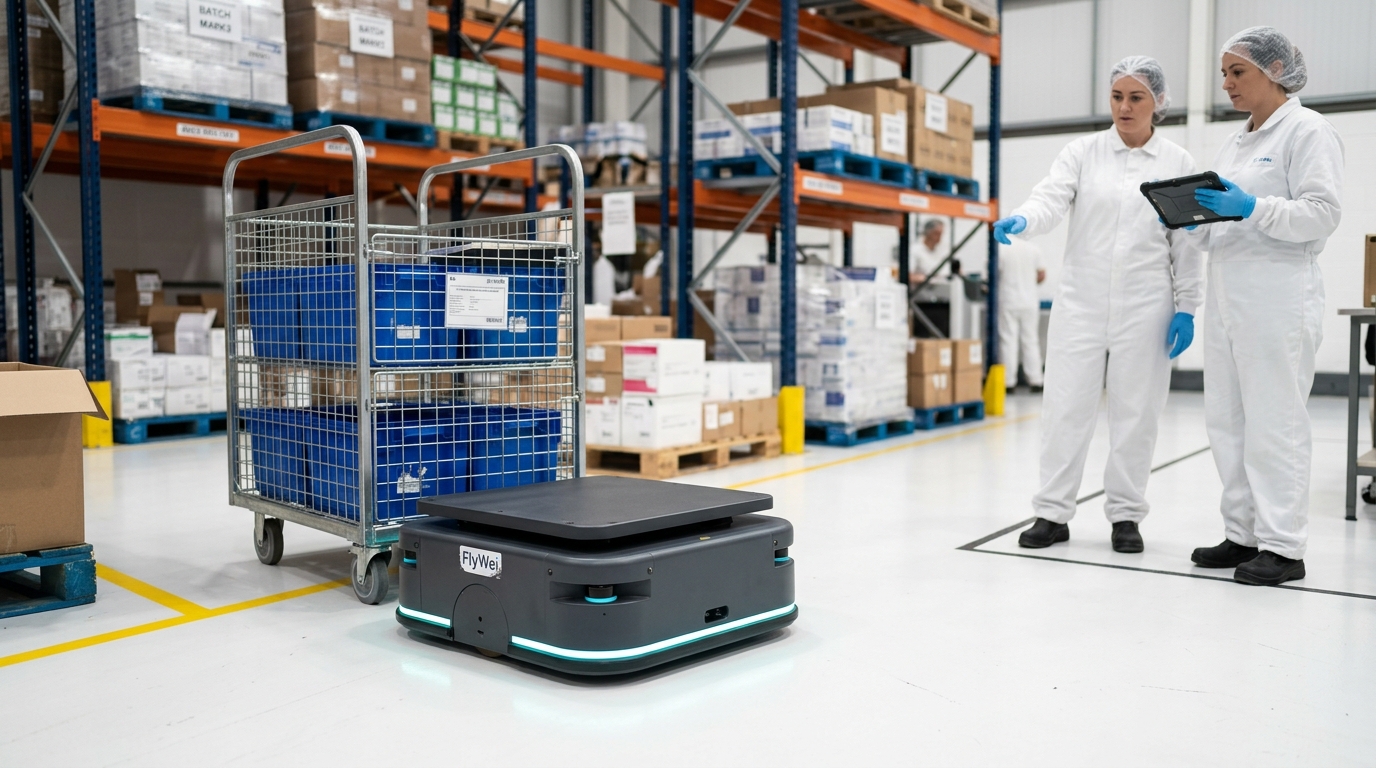
Pharmaceutical warehouse automation in the UK is no longer a 2028 capex line: it is the practical answer for a warehouse manager whose qualified VNA-driver headcount has churned by a quarter while MHRA serialisation throughput targets keep rising. FlyWei autonomous forklifts handle continuous put-away and replenishment inside GDP-regulated racking through M4 fleet manager orchestration and the open VDA 5050 standard, so a Macclesfield, Manchester or Cambridge-corridor warehouse manager can stand the picking line back up without ripping out the validated WMS. This article sets out the four levers a UK pharmaceutical warehouse manager should pull this quarter and where FlyWei autonomous forklifts, the M4 fleet manager and fleet dispatch fit into the answer.
Why UK pharmaceutical warehouses are losing throughput, not just drivers
Pharma warehousing is one of the hardest UK shed roles to staff and the hardest to keep validated. Four forces have combined since 2024 to make the gap acute on Manchester-corridor sites.
The first is regulatory load. The UK's MHRA-administered Good Distribution Practice guidance requires documented, validated handling of medicinal products from intake to dispatch, including environmental control, training records and a deviation trail. Every additional SKU and every additional temperature band carries a documentation tail your manager either staffs or fails an audit on.
The second is serialisation throughput. UK pharma DCs scan, verify and dispatch FMD-legacy 2D-coded packs at line rate, and volume per shift has crept up year on year as community-pharmacy returns and parallel-import flows have grown. Logistics UK skills tracking shows the qualified VNA-driver pool servicing Manchester, Macclesfield and Cambridge pharma sheds has tightened post-Brexit, while build-to-rent ambient sheds around Magna Park and DIRFT pull applicants away from the gowned, audited environments pharma operators run.
The third is incident exposure. PPE-laden operators handling 1,200 kg pharmaceutical pallets in VNA racking at line rate make more mistakes per shift; HSE RIDDOR returns on pharma DC sites cluster around pedestrian-MHE near misses and racking impacts. Insurance loading, audit findings and CAPA workload all sit on the warehouse manager's desk when those happen.
The fourth is the calendar. UK pharmaceutical inbound flow lifts unevenly (winter respiratory peak, flu and vaccine campaigns, parallel-import surges) forcing overtime in exactly the cycles people leave to escape. The result is a self-reinforcing loop where the warehouse manager loses throughput precisely when the MHRA audit pipeline gets noisiest.
FlyWei autonomous forklifts run validated put-away cycles inside GDP-regulated UK pharmaceutical warehouses, holding throughput stable when VNA-driver churn exceeds 20% on the Manchester corridor.
The four levers a UK pharmaceutical warehouse manager should pull this quarter
1. Operational lever: zone the DC by GDP risk, not by SKU velocity
The first move is free and structural. Map your DC by GDP-risk bands rather than by velocity: licensed-medicine cold (2 to 8°C), licensed-medicine ambient (15 to 25°C), controlled-drug cage, returns quarantine and consumables. Each band gets its own MHE pool, its own picking pattern and its own deviation register. The point is not to add headcount; it is to stop using the same VNA operators across temperature and risk bands, which is what breaks competence currency and starts the leavers list. Pair zoning with a documented competence-refresh cadence under ACOP L117 that counts as productive time on the operator's tag rather than as unpaid training: your retained operators stay when refresher hours are paid. Combined with autonomous coverage on the longest, most repetitive licensed-medicine ambient cycles, the residual human cycles become tolerable, audit-competence currency holds, and retention recovers within two quarters on most Manchester-corridor sites.
2. Technical lever: autonomous forklifts, M4 and the validated WMS question
The lever that actually moves the throughput dial is removing the human from the longest validated cycle. FlyWei autonomous forklifts handle continuous put-away, replenishment and picking-face top-up inside GDP-regulated racking at the same throughput a competent VNA operator achieves at line rate, without break cycles or competence drift, with a clean machine-readable audit trail. Orchestration sits in the M4 fleet manager, which talks to the trucks over the open VDA 5050 standard. The validated WMS, typically already qualified for MHRA inspection and tied to your serialisation hub, never has to be replaced. M4 sits between the trucks and the WMS, takes orders, schedules moves, and writes execution evidence back so the audit trail stays inside one validated system of record. Fleet dispatch handles real-time priority calls from the floor: a returns-quarantine operator presses a request, fleet dispatch software routes the move to the nearest available autonomous forklift, and the move is executed with a timestamped, operator-IDed log entry. Mixed fleets work side by side because VDA 5050 is hardware-agnostic, so autonomy phases in by zone and the validation effort phases in with it.
3. Regulatory lever: PUWER, BS EN ISO 3691-4, ACOP L117 and MHRA GDP
The regulator does not exempt autonomous trucks from a GDP-regulated environment; it changes who carries which duty. Under PUWER 1998 the warehouse manager remains the duty-holder for safe equipment use, training and supervision of the manned fleet sharing the same aisles; the autonomous-truck supplier carries the design and conformity duty. The relevant safety standard is BS EN ISO 3691-4 on driverless industrial trucks, supplied via BSI, and any UK pharma deployment should be specified to it in the contract with the supplier's technical file delivered at acceptance. ACOP L117 on rider-operated lift trucks still governs the manned fleet sharing the same aisles. On top of that, MHRA's UK GDP guidance requires the autonomous-fleet validation evidence to live inside your quality management system: plan the IQ/OQ/PQ documentation set early, not at acceptance. TR34 floor flatness matters more, not less, with autonomous trucks, because navigation drift inside narrow GDP-zoned aisles reads as a CAPA finding on the operator rather than the supplier; brief facilities and book the slab survey alongside the kit survey.
4. Workforce lever: redeploy validated operators, do not replace them
The mistake most pharma warehouse managers make is treating autonomy as a headcount-reduction project. In a UK GDP-regulated DC the competent, validated operator is the asset; the seat in the truck is not. Move retained VNA-qualified operators into fleet supervision, deviation handling and CAPA closure: work that grows under MHRA inspection and that an autonomous fleet generates more of, not less. Pair this with a competence-currency programme that keeps ACOP L117 certification live on a smaller manned pool, so the residual manned moves stay covered without erosion. The financial argument lands once you roll attrition write-off, agency cover, competence-refresh hours and overtime premium into one labour line: the validated-operator pay band stops being a cost centre and starts being the audit-evidence engine that keeps the MHRA file clean. The retained operators stay because the work gets cleaner and better-paid, and your audit window narrows in the next inspection cycle.
| Cost line | Manned VNA pharma DC | FlyWei autonomous forklift |
|---|---|---|
| VNA-qualified wage and shift premium | £32k to £42k per year per shift seat | n/a |
| Attrition write-off (training + ramp) | £5k to £9k per leaver at ~20% attrition | n/a |
| Competence-refresh unpaid hours | ~6% of paid shift hours | 0 |
| CAPA cost from pedestrian-MHE near misses | Rising; insurer-loaded | Reduced |
| Capex / lease | Lower up-front | Higher up-front, 5 to 7 year amortisation |
| Validated service and uptime SLA | Variable, multi-vendor | FlyWei UK service contract |
What FlyWei does for UK pharmaceutical warehouse managers
FlyWei supplies and integrates autonomous forklifts engineered for continuous, validated operation inside UK pharmaceutical DCs, with the M4 fleet manager and fleet dispatch as the orchestration layer above them. For a warehouse manager on a Macclesfield, Manchester or Cambridge-corridor site, the practical scope of work is concrete: FlyWei surveys the slab and racking against TR34, specifies the truck count and zone coverage to BS EN ISO 3691-4, integrates M4 to the validated WMS over VDA 5050 and the standard interface set, and runs commissioning while the existing manned fleet keeps the site live and MHRA-compliant. Fleet dispatch software goes in alongside so returns-quarantine, controlled-drug-cage and ambient-licensed operators can call moves from the floor without breaking competence currency. The full picture sits inside the FlyWei solutions stack, built for UK industrial and regulated sites rather than retro-fitted from an overseas reference. UK service is held by the FlyWei team rather than dropped into a multi-vendor stack, which matters when a GDP-regulated DC cannot afford a four-hour wait. The aim is not to remove every job: it is to remove the worst, most repetitive cycles from a high-skill regulated workforce and let the retained, validated operators stay. Managers evaluating this against ambient-warehouse benchmarks should also read the UK cold-store autonomous forklift playbook and the UK 3PL ops director guide for the comparable business cases.
Frequently asked questions
Can autonomous forklifts work inside an MHRA-inspected, GDP-regulated UK pharma DC?
Yes. The autonomous forklift becomes a piece of validated equipment in your QMS, with IQ/OQ/PQ evidence supplied at acceptance. MHRA GDP requirements on training, environmental control and traceability still apply: they apply to the autonomous fleet too, and the M4 fleet manager produces machine-readable evidence that auditors prefer to manual logs.
Will my validated WMS need to be requalified?
No. The M4 fleet manager talks to the trucks over the open VDA 5050 standard and integrates to your validated WMS through its standard interfaces. The WMS keeps owning stock state, GDP zoning rules and serialisation reconciliation; M4 owns truck scheduling and execution. Most UK pharma deployments retain the validated WMS already in place.
How do autonomous forklifts change our PUWER 1998 duties as the warehouse manager?
PUWER duty stays with you for safe use, training and supervision of the manned fleet sharing the aisles. The conformity, design and UKCA duty for the autonomous trucks sits with the supplier. Specify to BS EN ISO 3691-4 in the contract and require the supplier's technical file at acceptance: your CAPA workload drops once that documentation set is in place.
Do we still need ACOP L117 training for the remaining VNA operators?
Yes. ACOP L117 governs your rider-operated lift trucks unchanged. Refresh competence regimes, pedestrian segregation and supervisor coverage before the autonomous fleet goes live, because the mixed-fleet phase is where most pharma DC incidents and audit findings happen.
What about TR34 slab tolerance in an older pharma DC?
TR34 floor flatness matters more, not less, with autonomous trucks. Older pharma DC slabs frequently drift out of TR34 tolerance around expansion joints and cold-room thresholds; FlyWei's site survey identifies the affected aisles and the remediation needed before commissioning so navigation accuracy is auditor-defensible.
How fast can a UK pharmaceutical DC site go live?
Typical UK GDP-regulated DC commissioning runs 16 to 24 weeks from contract to first autonomous shift, including site survey, validated WMS integration, IQ/OQ/PQ documentation, mixed-fleet operator training under ACOP L117 and acceptance testing under BS EN ISO 3691-4. Phased zone-by-zone go-live keeps the MHRA-compliant site running throughout.
What is the realistic payback period for a UK pharma DC deployment?
Most UK pharmaceutical DC business cases break even at 30 to 44 months once attrition write-off, competence-refresh unpaid hours, insurance loading, CAPA cost and overtime premium are rolled into the labour line, rather than just the headline wage. Sites with above-average VNA churn pay back faster because the human exposure cost is highest there.
Talk to FlyWei about your pharmaceutical DC
If you run a UK MHRA-regulated pharma DC and your VNA-driver attrition is making the throughput line unpredictable, the most useful next step is a site survey. Talk to FlyWei: flywei.co.uk/contact.