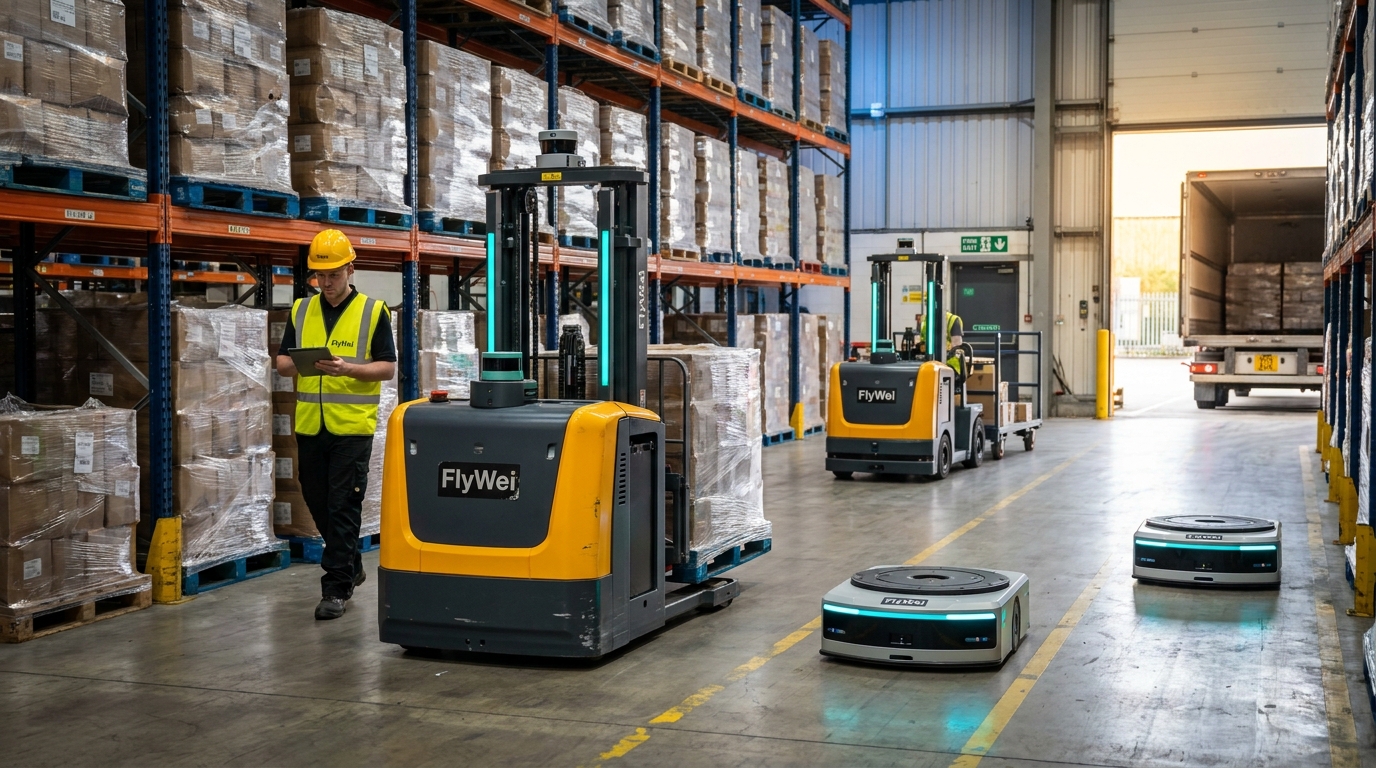
In 2026, the autonomous forklifts UK 3PLs deploy will divide into two camps: programmes that scale across every shed in a Supply Chain Director's portfolio (Midlands flagship, home-counties spillover, regional satellites) and programmes that stall at site one. The Health and Safety Executive reports lift trucks are involved in about a quarter of all workplace transport accidents in Great Britain, which moves autonomous forklift adoption out of the productivity column and into the safety, insurance and capital-discipline column. This is a board-level call, not a pilot.
Why the AGV vs AMR question keeps stalling UK distribution boards
The Midlands corridor (Magna Park Lutterworth, DIRFT Daventry, SEGRO East Midlands Gateway, the Burton-on-Trent ring) handles a disproportionate share of UK pallet movement, and home-counties spillover sites in Bedfordshire, Northamptonshire and Hertfordshire pick up the overflow. Logistics UK's 2025 industry assessment puts the sector at £170 billion of GVA and around 8% of the UK workforce, with 2024 logistics warehouse take-up totalling 21.3 million sq ft. Most of that floor space still runs on counterbalance and reach trucks operated by people, on shifts that buyers expect to extend without expanding the labour pool.
The conventional question: "AGV or AMR?" : frames autonomy as a hardware shootout. AGVs follow predefined paths set by reflectors, magnets or trained SLAM routes; AMRs replan dynamically based on warehouse state. In practice, modern autonomous forklifts in UK distribution centres blur the line: most use deterministic SLAM with planner-level dynamic re-routing, which is closer to AGV behaviour than vendor brochures admit. The hardware question is not the binding constraint. The constraint is orchestration. A 3PL running four sheds across the Midlands and home counties does not buy autonomous forklifts once; it buys the spine that will manage every robot it adds for the next decade. Get the spine wrong and every subsequent shed renegotiates its own integration with its own WMS connector. Get it right and the marginal cost of automating shed five is mostly commissioning, not a re-platforming exercise.
UK regulatory pressure compounds this. ISO 3691-4:2023, adopted as BS EN ISO 3691-4, sets the safety baseline for driverless industrial trucks. Provision and Use of Work Equipment Regulations (PUWER) 1998 plus the rider-operated lift-truck approved code of practice HSE ACOP L117 still apply where humans share the floor. A 3PL that procures hardware ahead of the orchestration and compliance plan typically discovers the gap during the first FLT-pedestrian near-miss audit, not in the bid pack.
| Decision factor | AGV-class autonomous forklifts | AMR-class autonomous forklifts | What it means for a UK 3PL |
|---|---|---|---|
| Path planning | Predefined routes, deterministic | Dynamic, replanned in real time | Most modern UK deployments are hybrid; ask vendors for SLAM behaviour proof, not slide claims |
| Floor preparation | Often requires reflectors or magnets | Reflector-free SLAM | Greenfield Midlands sheds favour AMR; legacy home-counties sites can suit either |
| Throughput predictability | High under fixed flow | High under variable flow | 3PL multi-tenant sheds with flow variance lean AMR |
| Pedestrian interaction | Engineered with strict zoning | Dynamic detection with safety scanners | Both must meet BS EN ISO 3691-4; verify, do not assume |
| Fleet orchestration | Vendor-specific or VDA 5050 | Vendor-specific or VDA 5050 | VDA 5050 conformance is the mandatory question on every bid |
Lever one, the operational case: pallet flow density before robot count
Operational decisions in UK distribution centres turn on pallet flow density, not robot count. A Midlands flagship illustratively moving 12,000 to 18,000 pallets a week through inbound, putaway, replen and outbound has a different autonomous forklift envelope to a 4,000-pallet home-counties spillover shed running e-commerce returns. The first lever, before any vendor demo, is to map every pallet movement by zone, by shift and by aisle conflict. Where do reach trucks queue? Where do counterbalance trucks block aisles during dock-door turns? Where does manual labour double-handle pallets because the WMS cannot see real-time slot availability?
The output of that mapping is a robot envelope: how many autonomous forklift hours per shift, in which zones, with what payload mix. If a vendor cannot answer "what would my robot count be in your warehouse next Tuesday at 14:00?" with a simulator running on your real WMS data, they are selling hardware. A previous FlyWei analysis covered why scanning-only stacks fail this test. Make this lever non-negotiable before site visits.
Lever two, the technical case: orchestration, not navigation
The technical lever that scales is not the navigation stack of any single robot. It is the fleet orchestration layer. VDA 5050 is the open communication interface between fleet managers and AMRs, and it is the only realistic mechanism for a UK 3PL to mix robot vendors across sheds without quadrupling its integration cost. A board that locks into a single proprietary fleet manager today buys hardware-vendor lock-in tomorrow.
FlyWei's M4 fleet manager implements VDA 5050 alongside the operator's existing ERP and WMS via REST and message-bus connectors, and FlyWei fleet dispatch software handles millisecond-grade task assignment across mixed-vendor fleets. Together they let a Supply Chain Director run autonomous forklifts in the Midlands flagship and lifting robots in a home-counties returns shed under one operational console. For a buyer evaluating FlyWei autonomous forklifts, the question to ask every other vendor is: what is your VDA 5050 conformance status, and which third-party fleet managers can you accept tasks from? If the answer is "ours only", you are buying a silo, not a platform.
Lever three, the regulatory case: ISO 3691-4 and PUWER are board-level concerns
Regulatory readiness is the lever that decides which programmes survive a serious incident. BS EN ISO 3691-4:2023 sets the safety requirements for driverless industrial trucks: presence detection, dynamic safety zones, fail-safe braking, emergency stop circuits and verification methods. UK customers should require BS EN ISO 3691-4 conformance evidence on hardware, not vendor assurances on a slide.
On the operating side, PUWER 1998 and HSE ACOP L117: rider-operated lift trucks govern how trucks share floors with people. The HSE managing lift trucks guidance is explicit on segregation, supervision and operator training. Even where a fleet is fully driverless, mixed-traffic zones, charging bays and maintenance areas all attract PUWER duties. The procurement deliverable is a single compliance dossier per site that maps every regulation to a control: ISO 3691-4 to hardware, PUWER and ACOP L117 to operations, UKCA marking to placing-on-market evidence, and TR34 floor flatness to high-bay autonomous forklift suitability. Ask for that dossier in the bid response and the field thins fast.
Lever four, the commercial case: capex modelling that respects existing ERP and WMS
The commercial lever distinguishes a board-grade autonomous forklift programme from a pilot that stalls. The capex model has to assume that the operator's existing ERP and WMS stay in place. Rip-and-replace WMS programmes alongside robotics deployments are how UK 3PL automation projects miss their go-live by two quarters. Insist on connector-level integration: REST or message-bus into the WMS, OPC-UA into MES where engineering parts handling is involved, and a clean event stream from the fleet manager into the ERP for asset-utilisation reporting. A prior FlyWei capex playbook walks through the unit economics for ecommerce DCs and the same logic applies to multi-tenant 3PL contracts in the Midlands and home counties.
Match the commercial structure to the contract length: a 3-year 3PL contract should not carry 7-year hardware capex; lease, RaaS or capex-with-buyback structures all fit. Build a sensitivity table on labour cost, downtime cost and pallet throughput, and stress-test against a one-shift loss. The buyer who walks into the capex committee with that table wins faster sign-off than one who walks in with a vendor brochure.
What FlyWei does for UK 3PL distribution operations
FlyWei supplies and integrates autonomous forklift fleets, lifting robots and AMRs for UK distribution operators. For a Supply Chain Director running a Midlands flagship plus home-counties spillover sites, the FlyWei stack is built to give you a single orchestration spine that scales across sheds.
FlyWei autonomous forklifts handle counterbalance and stacker duties with multi-modal SLAM navigation: no floor magnets, no reflectors. FlyWei smart forklifts cover assisted-manual operation in zones where full autonomy is uneconomic. The platform extends beyond distribution into mixed-use facilities: see FlyWei hospitality and service robots for the full breadth. The M4 fleet manager implements VDA 5050 and integrates into the operator's existing ERP and WMS via REST. FlyWei fleet dispatch software assigns tasks across mixed-vendor fleets in real time. Site survey, parallel-run testing, BS EN ISO 3691-4 conformance evidence, PUWER compliance documentation and UK-based ongoing technical support are part of the engagement, not bolt-on. Browse FlyWei sector solutions or read FlyWei UK for engineering footprint and references.
UK distribution autonomy in 2026 is not a forklift purchase: it is the orchestration spine that will manage every robot a 3PL adds for the next decade.
Frequently asked questions
What is the difference between AGV and AMR autonomous forklifts in a UK distribution centre?
AGVs follow predefined paths set by markers, reflectors or trained SLAM routes; AMRs replan in real time based on warehouse state. In a UK DC, the practical difference between modern systems is small: most autonomous forklifts use deterministic SLAM with planner-level dynamic re-routing. The decision driver is fleet orchestration.
Which UK regulations apply to autonomous forklifts in 2026?
BS EN ISO 3691-4:2023 sets safety requirements for driverless industrial trucks. PUWER 1998 and HSE ACOP L117 govern operation in shared workplaces. UKCA marking is required for placing equipment on the market in Great Britain. TR34 governs floor flatness for high-bay applications. Each is a separate compliance line item in the procurement dossier.
Do FlyWei autonomous forklifts integrate with our existing ERP and WMS?
Yes. FlyWei M4 connects via REST API and message bus into enterprise WMS and ERP platforms, and via OPC-UA into MES where engineering use cases require it. Integration is a connector-level project, not a WMS replacement. Typical integration in a UK distribution centre runs 3 to 6 weeks alongside parallel-run testing.
How many autonomous forklifts does a Midlands distribution centre typically need?
Robot count is a function of pallet flow density, not floor area. As a working assumption, a 200,000 sq ft 3PL flagship moving 12,000 pallets a week typically benefits from 8 to 15 autonomous forklifts plus assisted-manual smart forklifts in mixed-traffic zones. Always size from a simulator running on your real WMS data.
What is VDA 5050 and why does it matter for a 3PL fleet?
VDA 5050 is the open communication interface between fleet managers and autonomous mobile robots. For a UK 3PL adding sheds over time, VDA 5050 conformance lets you mix robot vendors across sites without separate integration projects per vendor. It is the most important technical question to ask in a bid.
What does ROI look like on autonomous forklifts in a UK 3PL contract?
UK 3PL deployments illustratively pay back in 12 to 24 months on a multi-shift operation, driven by labour redeployment, reduced damage rates, 24/7 capacity and lower workplace-transport incident exposure. The variable that swings ROI most is shift pattern: single-shift sites see slower payback than 2-shift or 24/7 operations.
Talk to FlyWei about an autonomous forklift programme for your UK 3PL operation: site survey, simulation against your real pallet flow, and a connector-level integration plan that respects your existing ERP and WMS. Book a discovery call.