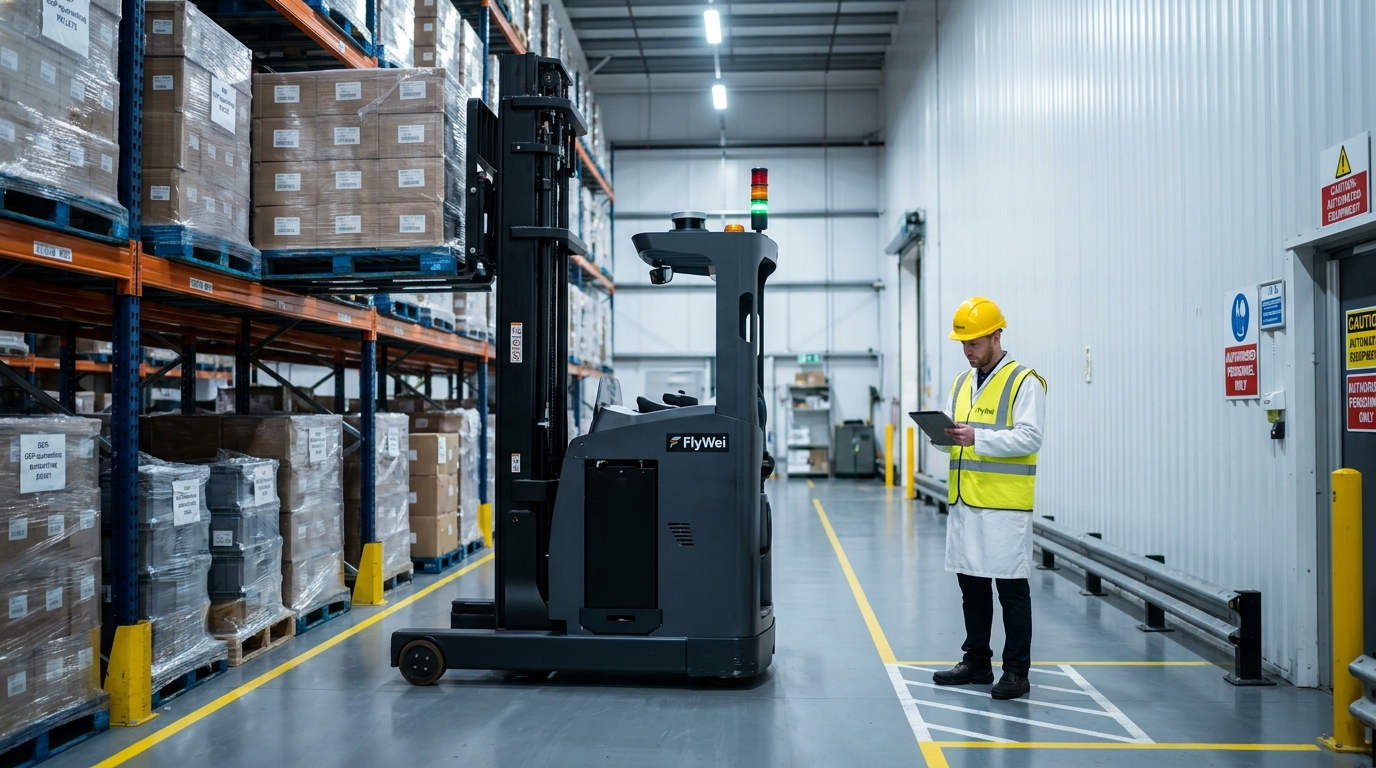
Autonomous forklifts for UK pharmaceutical warehouse operators are driverless industrial trucks (counterbalance, reach and stacker variants) that move pharmaceutical pallets under fleet orchestration, MHRA Good Distribution Practice (GDP) audit trails and BS EN ISO 3691-4:2023 functional safety. For a Wholesale Dealer's Licence holder, they are how operator-shift variability is removed from MHRA-audited pallet movement. Britain's pharmaceutical supply chain is squeezed from three sides at once. HSE data attributes around 25% of all UK workplace transport injuries to lift trucks, and every one of those incidents has to be evidenced in the Wholesale Dealer's Licence holder's MHRA file. Logistics UK continues to flag warehouse operator vacancies in the double digits across the East Midlands pharma cluster. For a Supply Chain Director running an NHS Supply Chain-linked distribution centre out of Magna Park, Burton-on-Trent or DIRFT, the question is no longer whether to automate pallet handling: it is which pallet moves to automate first without risking the next MHRA inspection.
Why pharmaceutical DCs are stuck
The headline pain a UK pharmaceutical Supply Chain Director feels every quarter is throughput inelasticity. Each Wholesale Dealer's Licence holder must move every pallet under a documented, GDP-compliant chain of custody. Every receipt, putaway and pick must be traceable down to operator, asset and timestamp. When the operator pool shrinks, and the East Midlands pharma cluster has been the worst-hit corner of UK logistics by labour churn, the only available levers historically have been overtime and agency shifts. Neither makes the audit trail cleaner.
Three forces collide at once. First, the operator shortage. Recent Logistics UK reporting confirms warehouse and HGV operator vacancies remain materially above the pre-pandemic baseline, with regional clusters around Daventry, DIRFT and Magna Park among the tightest. Second, MHRA inspectors are asking more searching questions during GDP inspections, including how the operator evidences that a particular pallet was moved, by whom, and within what window. Third, NHS Supply Chain contracts and the wider hospital framework have effectively zero tolerance for missed slots; a missed dock window in pharma is not the same financial event as a missed dock window in FMCG.
The structural answer most boards have arrived at is to remove the operator-shift variable from pallet movement entirely, without trading floor space, racking density, or the comfort of an established MHRA-registered footprint. That is exactly the gap autonomous forklifts close.
The four levers that fix it
1. Decouple pallet movement from operator headcount
Run a 12-week movement audit of your DC. In most UK pharmaceutical DCs the audit reveals that the heavy, repetitive, regulation-sensitive moves (inbound pallet from goods-in to bonded quarantine, finished pallets from production to bulk racking, replenishment from bulk to pick-face) are 65 to 75% of total truck-hours but only a fraction of the variability. These are the moves to automate first. They are slow, regulated and high-volume, exactly what an autonomous reach truck or counterbalance forklift is engineered for. Reserve human operators for the small set of exception moves: damaged pallets, recall picks, quarantine re-stages and engineering bays. The change to weekly throughput is visible within four weeks of go-live; the change to audit cleanliness is visible at the next MHRA inspection.
2. Orchestrate the fleet with M4 (technical lever)
An autonomous forklift on its own is just a single robot. A fleet that talks to your M4 fleet manager over VDA 5050, and through M4 into your existing warehouse management and ERP environment, is a system. M4 manages traffic, handovers, charging windows and dock-door allocation in a way no human dispatcher can sustain across three shifts. It also writes the audit trail GDP inspectors will ask for: who (which asset), what (which pallet), where (which slot), when (timestamp), and under what fleet directive. For SC directors comparing FlyWei to an enterprise warehouse management vendor's own automation add-on, the practical difference is that M4 is a fleet manager first and a system of records second: the orchestration layer lives where the robots live, not in a remote ERP cloud.
3. Evidence safety to MHRA, HSE and your insurer (regulatory lever)
Three UK regulations matter here, and an autonomous fleet must evidence all three. BS EN ISO 3691-4:2023 sets the functional safety baseline for driverless industrial trucks; speed limiting, person detection, emergency stop performance, software safety lifecycle. PUWER 1998 demands suitability, training, inspection and maintenance evidence on every piece of work equipment. LOLER 1998 adds the thorough-examination regime for any equipment used for lifting loads, with intervals of no more than 12 months. An autonomous fleet generates the maintenance, fault, near-miss and thorough-examination data your HSE file needs, automatically. The point the Wholesale Dealer's Licence holder cares about is that the same data stream feeds MHRA GDP inspections: chain-of-custody and equipment-fitness-for-purpose are evidenced by the system rather than reconstructed from clipboards.
4. Build a TCO case the board can sign (commercial lever)
The CapEx committee question is not "how clever is the robot": it is "what is the five-year, risk-adjusted TCO compared to status quo, and what is the recovery profile if NHS Supply Chain demand spikes by 15%?" The numbers that move pharmaceutical boards are: shift coverage cost displaced, agency labour avoided, MHRA inspection-readiness cost, throughput-resilience premium (the value of not missing a dock slot), and the avoided cost of a single mis-handled pallet in a regulated lane. A useful framing is that one mis-handled controlled-drug pallet is more expensive than the per-asset CapEx of an autonomous reach truck. FlyWei autonomous forklifts deploy in 8 to 14 weeks from confirmed order, so the recovery window is measured in months rather than the multi-year horizon of a vertical-grid retrofit.
| Pallet-movement profile | Operator-led | FlyWei autonomous fleet on M4 |
|---|---|---|
| GDP chain-of-custody evidence | Clipboard + handheld scan, reconstructed at audit | System-of-record, generated in real time |
| Operator-shift variability | High (sickness, turnover, agency mix) | Removed for the automated lanes |
| PUWER + LOLER documentation | Manual paper trail | Auto-generated maintenance and inspection log |
| NHS Supply Chain dock-slot resilience | Vulnerable to roster gaps | Continuous across shifts |
| Deployment horizon | n/a | 8 to 14 weeks from confirmed order |
What FlyWei does for UK pharmaceutical distribution
FlyWei supplies and integrates autonomous forklifts for UK pharmaceutical distribution centres. For an MHRA-registered DC running a mix of bulk pallet racking and pick-face replenishment, the typical fleet is a small number of autonomous reach trucks for high-bay pallet moves to and from bonded storage, paired with autonomous counterbalance trucks for goods-in and dispatch. The M4 fleet manager handles VDA 5050 traffic management and writes the GDP-grade audit trail directly into your existing WMS and ERP. FlyWei's fleet dispatch software handles the staged onboarding so that the first wave of pallet moves goes live without disrupting the Wholesale Dealer's Licence footprint. Across the engagement, FlyWei delivers the conformity pack (BS EN ISO 3691-4 declaration, PUWER and LOLER documentation, HSE risk assessment template) so that the SC director's MHRA file is audit-ready on day one. See FlyWei pharmaceutical solutions and about FlyWei for the full UK pharmaceutical deployment profile.
In UK pharmaceutical distribution, autonomous forklifts are no longer a productivity story: they are an audit-trail story. The Wholesale Dealer's Licence holder who automates regulated pallet movement first will be the operator whose next MHRA GDP inspection is shortest.
Frequently asked questions
Are autonomous forklifts compliant with MHRA Good Distribution Practice?
Yes. MHRA GDP is evidence-based, who handled what pallet, in what condition, and at what time. An autonomous fleet operated under M4 generates that evidence in real time, which is materially cleaner than reconstructing the same chain of custody from paper or hand-held scanners. FlyWei supplies the conformity pack mapping autonomous fleet records to GDP evidence requirements.
What UK regulations apply to autonomous forklifts in a pharmaceutical warehouse?
Three matter most: BS EN ISO 3691-4:2023 for the functional safety of driverless industrial trucks, PUWER 1998 for work equipment suitability and maintenance, and LOLER 1998 for thorough examination of lifting equipment. All three are covered by FlyWei's standard documentation pack.
Can autonomous forklifts operate in NHS Supply Chain DCs?
Yes. NHS Supply Chain partners and their 3PL providers can deploy autonomous forklifts inside DCs serving the framework, provided the equipment is BS EN ISO 3691-4 compliant and the operator maintains the PUWER and LOLER documentation chain. FlyWei provides both.
How long does deployment take?
Typical FlyWei autonomous forklift deployments in UK pharmaceutical distribution complete in 8 to 14 weeks from confirmed order, including site survey, conformity documentation, M4 fleet manager integration, operator training and go-live.
Will autonomous forklifts integrate with our existing warehouse management system?
Yes. The FlyWei M4 fleet manager exposes a REST API and supports VDA 5050 fleet orchestration. M4 integrates with the operator's existing enterprise WMS and ERP: no rip-and-replace.
What is the typical TCO recovery period?
UK pharmaceutical DCs typically reach TCO crossover inside 24 to 30 months on displaced operator shifts, agency labour and MHRA inspection-readiness costs alone: before counting the dock-slot resilience benefit.
Do autonomous forklifts require fixed-path infrastructure?
No. FlyWei autonomous forklifts navigate by laser SLAM and do not require magnetic strips, floor tape or QR markers. This makes brownfield retrofit straightforward inside an MHRA-registered Wholesale Dealer's Licence footprint.
Talk to FlyWei about your pharmaceutical DC. Our UK team will run a free 60-minute pallet-movement audit and return a deployment shortlist mapped to your MHRA Wholesale Dealer's Licence footprint, your NHS Supply Chain SLAs and your CapEx envelope.