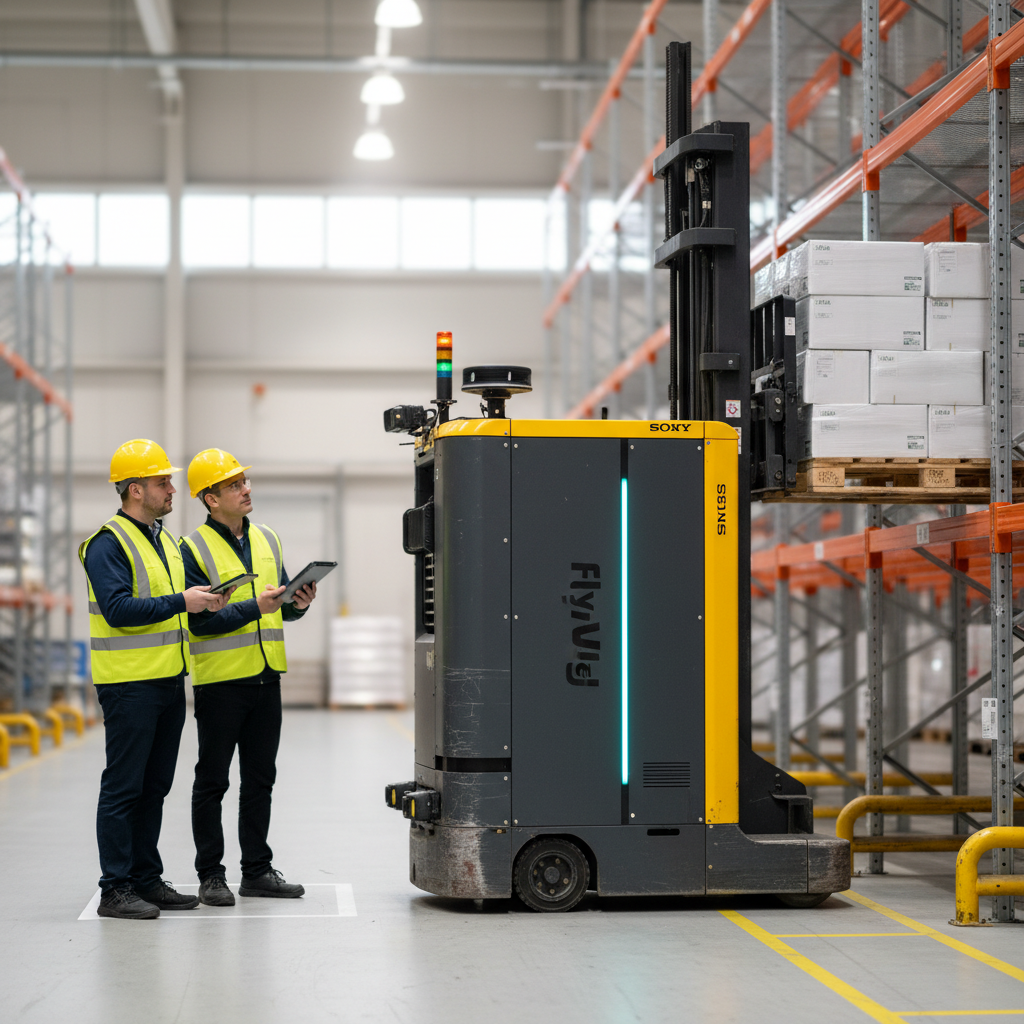
Autonomous forklifts Europe-wide give supply chain directors a way to lift peak-season throughput without committing a distribution centre to a 36-month civil-works rebuild. The decision facing most European DCs in 2026 is no longer "robot or no robot": it is whether to tear out the racking and replace it with a fixed cube-shuttle grid, or to drop autonomous forklifts into the conventional racking the site already runs. The wrong call locks in seven years of capital that could have been spent on three additional DC nodes.
Why European DCs face this fork in 2026
Three pressures push the decision onto the desk of every European supply chain director in 2026. The first is land. New greenfield warehouse capacity in DACH, Benelux, Poland and Iberia is being permitted slowly: planning timelines in the Netherlands and parts of northern Germany now exceed two years, which forces operators to wring more throughput from sites that already exist. The second is the cost of capital. Three years of higher European interest rates have made any seven-figure civil-works programme harder to defend in front of a board that wants returns inside a single budget cycle. The third is the labour market: the European 3PL sector has reported persistent shortages of qualified counterbalance and reach-truck drivers, and night-shift premiums are still climbing in the Ruhr, Łódź and the Randstad.
Together, these pressures squeeze the practical choice down to two architectures. One is a vertical-grid AMR shuttle system: a purpose-built aluminium grid with shuttles riding the top, designed for split-case e-commerce throughput at floor level. The other is a fleet of autonomous forklifts that work the existing racking. The published comparisons most procurement teams pick up still treat these as alternatives inside the same project envelope. They are not. They are different categories of capital decision, with different risk profiles and very different exit options if the business mix shifts.
Four levers that fix the decision
Lever 1: Run a rack-compatibility audit before shortlisting any robot
The decision is decided by the racking, not by the robot. Before any vendor pitch lands, instruct your operations team to map every aisle by clear width, beam height, frame depth, floor flatness to TR34-equivalent tolerances and racking-load certification age. A cube-shuttle grid replaces all of this; an autonomous forklift fleet inherits it. If your conventional racking is less than eight years old and certified, a rebuild forfeits an asset that already works. If the racking is end-of-life and the site genuinely needs more vertical density than current beam heights allow, a cube grid becomes a defensible spend. The audit takes a fortnight and saves the next six months of vendor presentations from anchoring on the wrong question.
Lever 2: Treat fleet orchestration as the durable layer
Inside a modern European DC, the brand on the chassis matters less than the orchestration layer that dispatches it. FlyWei's M4 fleet manager and fleet dispatcher are designed around VDA 5050, the open communication standard between AGV and AMR fleets and a master control system. The practical effect: autonomous forklifts on the floor today, low-profile pallet movers added next quarter and a future scissor-lift AMR for a new sub-assembly cell can all share one traffic-management layer and one map. Operators who buy a closed AS/RS rebuild lose this option: the grid talks only to the vendor's warehouse execution system. Procurement teams should write a fleet-agnostic clause into every shortlist invitation: anything that cannot speak VDA 5050 belongs in a different bracket of risk.
Lever 3: Anchor the regulatory case in EN ISO 3691-4 and the EU Machinery Regulation
Driverless industrial trucks placed on the EU market must comply with the BSI-published EN ISO 3691-4 (industrial trucks: safety requirements for driverless industrial trucks and their systems), and from 2027 with the new EU Machinery Regulation 2023/1230, which replaces Directive 2006/42/EC. Both apply across Germany, the Netherlands, France, Poland, Spain, Italy and Sweden without national derogation. In Great Britain the equivalent test is UKCA marking against the Supply of Machinery (Safety) Regulations 2008, with PUWER 1998 governing use. Insist that any shortlisted autonomous forklift carries documentary CE evidence against the current 3691-4 edition, not the superseded one, and that the vendor's technical file is European and held inside the EEA. The regulatory layer is also where AMR cube grids and autonomous forklifts diverge: a grid is a single piece of installed machinery requiring its own EU Declaration of Conformity, whereas autonomous forklifts are placed on the market as discrete trucks with their own CE certificates and a clean route to redeployment.
Lever 4: Model three-year TCO against the right benchmark
The right TCO benchmark is not the per-pallet-move cost of either system in isolation: it is the option value of being able to redeploy the asset. Autonomous forklifts can be moved between DCs in a single weekend, re-mapped onto a new site within a working week and resold into a secondary market that pays a meaningful share of original capital for healthy units at three years old. A cube-shuttle grid is bolted to the floor of one warehouse and is worth a fraction of its installed cost if the business mix moves to a different region or a different SKU profile. For a supply chain director carrying responsibility for a multi-DC European footprint, the optionality embedded in a forklift fleet is itself a capital saving. Logistics UK publishes useful directional benchmarks for pallet-handling cost-per-move that operators can use to anchor the floor of the model before vendor-specific numbers land.
What FlyWei delivers inside a European DC
FlyWei supplies and integrates autonomous forklifts for European distribution centres across Germany, the Netherlands, France, Poland, Spain, Italy and Sweden. Every FlyWei autonomous forklift is CE-marked against EN ISO 3691-4 and ships with a European technical file. The M4 fleet manager and fleet dispatcher coordinate counterbalanced, reach-truck and pallet-truck variants, handling EUR pallets up to two tonnes through high-bay racking, and expose a clean VDA 5050 interface to leading enterprise WMS and ERP platforms. FlyWei deploys end-to-end without a site rebuild: the typical European programme runs eight to twelve weeks from order to live throughput, and slots into the operator's existing racking and dock layout. Sites that need cold-chain reach (frozen storage down to −28°C) or paper-mill duty can pick the variant that matches the duty without giving up the orchestration layer. Talk to FlyWei via flywei.co.uk/contact for a European DC feasibility assessment, and walk the autonomous forklift product range against your racking spec.
FlyWei autonomous forklifts retrofit into the racking a European DC already owns and run on a VDA 5050 orchestration layer, while an AMR cube-shuttle grid requires a civil-works rebuild that commits the site to a single vendor's warehouse execution system for the next decade.
FAQ
What is the difference between an autonomous forklift and an AMR shuttle for a European DC?
An autonomous forklift is a driverless industrial truck that handles full pallets in conventional racking up to roughly seven metres. An AMR cube-shuttle system is a purpose-built vertical grid running floor-level shuttles for sub-pallet e-commerce items. The first retrofits into the racking you already own; the second replaces it.
Are FlyWei autonomous forklifts CE-marked for the EU market?
Yes. Every FlyWei autonomous forklift is CE-marked against EN ISO 3691-4 and is supplied with a European technical file. From 2027 the platforms are aligned to the EU Machinery Regulation 2023/1230, which replaces Directive 2006/42/EC.
How long does an autonomous forklift deployment take in a European warehouse?
FlyWei runs European deployments in eight to twelve weeks from purchase order to live throughput. There is no civil-works programme: the trucks are mapped onto your existing racking and dock layout.
Can autonomous forklifts and floor-level AMRs share the same DC?
Yes. The M4 fleet manager and fleet dispatcher use the open VDA 5050 communication standard, so autonomous forklifts and floor-level AMRs can share a single traffic-management layer without aisle conflicts.
What is the regulatory standard for driverless industrial trucks in Europe?
EN ISO 3691-4 sets the baseline safety requirements for driverless industrial trucks across all EU member states. From 2027 the EU Machinery Regulation 2023/1230 applies; in Great Britain UKCA marking and PUWER 1998 apply.
What integration does FlyWei support with enterprise WMS platforms?
FlyWei autonomous forklifts integrate with leading enterprise WMS and ERP platforms via REST API and standard VDA 5050 connectors. Specific integration patterns are confirmed during the feasibility assessment for your site.
Which European countries does FlyWei deploy in?
FlyWei delivers autonomous forklift programmes for distribution centres in Germany, the Netherlands, France, Poland, Spain, Italy and Sweden, alongside the UK home market.
Talk to FlyWei about an autonomous-forklift feasibility assessment for your European DC: flywei.co.uk/contact. Walk the full range at /products/autonomous-forklifts, browse the FlyWei product index or our European DC resources, see warehouse solutions and the lifting robots family, or return to the FlyWei homepage.