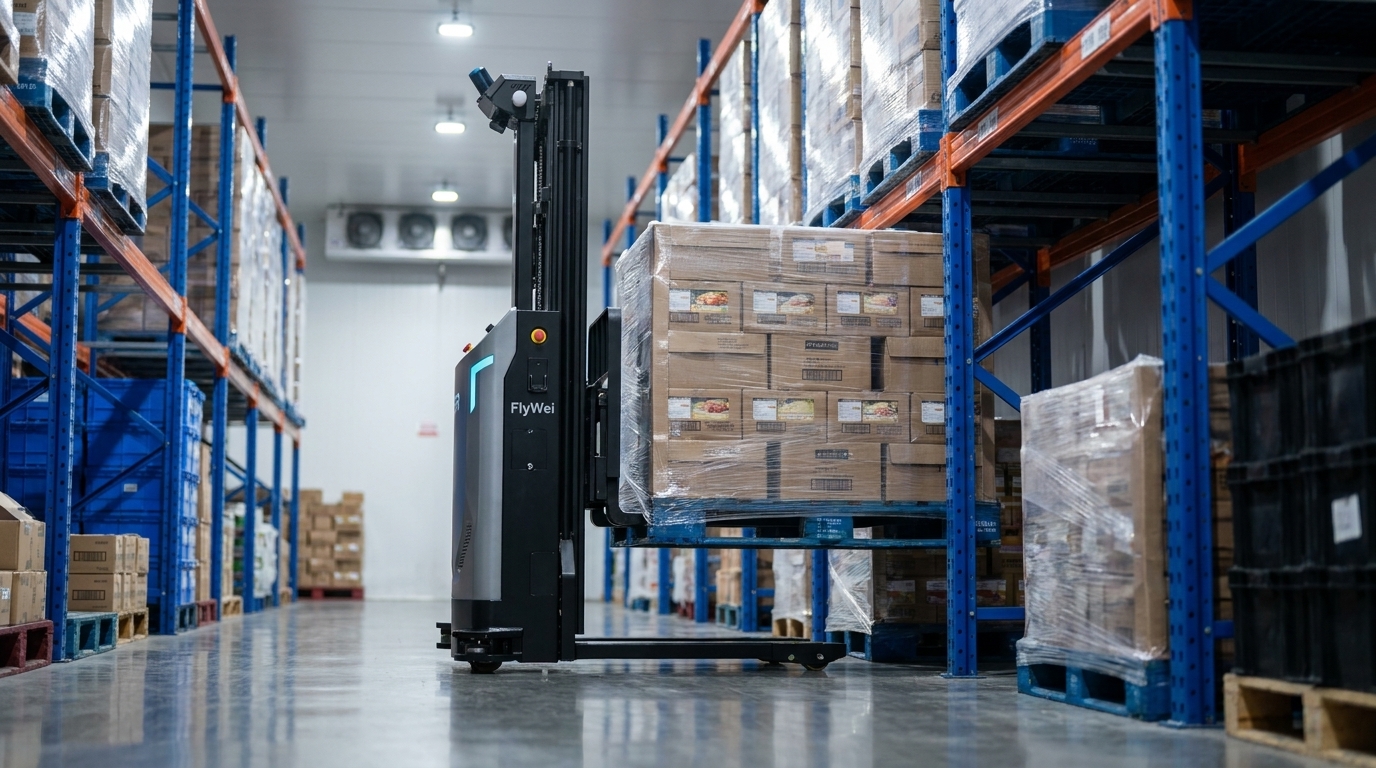
An autonomous pallet stacker is a driverless mast truck that lifts, stacks and moves pallets under fleet-controller supervision — no operator seat, no steering wheel, no cold-store cab. In a UK chilled food plant operating at -25°C, that difference is the gap between an end-of-line palletiser that stops for shift breaks and one that runs 24/7 with no human dwell time in the freezer aisle. According to HSE workplace transport guidance, transport-related incidents still account for roughly a quarter of workplace fatalities in Great Britain, with cold-store operators disproportionately exposed to cab cold-shock, slip-and-fall injury and mast-related pinch points. Plant directors at chilled ready-meal producers around Daventry, Burton-on-Trent and the wider Midlands corridor face the same equation this quarter: a night shift that no longer wants freezer work, an end-of-line palletiser that costs roughly £2,400 per lost hour, and PUWER inspectors asking harder questions about lift-truck operator competence.
Why chilled-food end-of-line is breaking
UK chilled food plants sit at the intersection of three converging pressures. First, the labour shortage: Logistics UK has repeatedly flagged that cold-store and MHE-qualified operator recruitment is the tightest segment of an already strained supply-chain workforce, with night-shift roles the hardest to fill. Second, cold-exposure health limits: the Provisions and Use of Work Equipment Regulations 1998 (PUWER) requires that lift-truck operators are competent, protected and not exposed to conditions likely to cause harm — HSE guidance and the LOLER 1998 Approved Code of Practice both bear directly on how long a human can spend on a stacker cab inside a -25°C aisle without controlled breaks.
Third, end-of-line economics have hardened. A typical chilled ready-meal plant running 90 pallets per hour on a single palletiser loses roughly £2,400 in downstream wrap, label, dispatch and lost-order-window cost for every hour the palletiser stalls waiting on a stacker cycle. Multiply that across a five-line site running two shifts and the year-one saving from a stacker fleet that never leaves the aisle rewrites the capex case on its own. The old assumption — "we need a driver in the mast" — was written before mid-mast LiDAR, VDA 5050 fleet management and the current generation of narrow-aisle sensor stacks made a driverless equivalent both safer and more available than the human alternative.
The four levers that fix a chilled end-of-line
Lever 1 — Operational: pair the stacker to the palletiser, not to the driver
The single biggest change is decoupling the pallet-flow rhythm from the human roster. In a manned end-of-line, the palletiser paces the driver: pallet built, waits, driver appears, lift-and-drop, driver disappears for the next task. In a driverless flow, the palletiser calls a stacker directly. The stacker moves the built pallet into a chilled buffer, calls a counterbalanced autonomous forklift for the trailer load, and reports the whole cycle to the plant's manufacturing execution system. The plant director's dashboard reads OEE not "who is on the mast tonight." Expect a 12–18% end-of-line OEE lift in year one where discharge was previously the constraint. This is the operational lever regulators, HSE inspectors and finance directors can all read.
Lever 2 — Technical: VDA 5050, mid-mast LiDAR and orchestrated multi-vehicle traffic
An autonomous pallet stacker is only as safe and productive as its fleet-management layer. Modern narrow-aisle stackers navigate on 3D LiDAR + reflector fusion and communicate with a fleet manager over VDA 5050 — the German-industry-authored open protocol that lets stackers, tuggers and counterbalanced trucks from a mixed fleet share the same aisle without a proprietary lock-in. FlyWei's M4 fleet manager and RDS robot dispatch handle the mixed-vehicle orchestration, cold-condensation-tolerant charge scheduling and the WMS handshake needed to keep the palletiser fed. In a chilled aisle where sub-zero condensation and frost buildup on optics are the enemy of any driverless truck, the technical detail that actually matters is: heated LiDAR windows, sealed IP-rated electronics, and a fleet manager that knows to swap a stacker out for a warm-cycle before a mission window closes.
Lever 3 — Regulatory: PUWER, LOLER and BS ISO 3691-4
Every UK chilled food plant deploying an autonomous pallet stacker is deploying a piece of work equipment governed by PUWER 1998, an item of lifting equipment governed by LOLER 1998, and an "automated industrial truck" regulated by BS ISO 3691-4. In practical terms the plant director owns a documented risk assessment, UKCA marking on every truck, a thorough-examination cycle (six-monthly for lifting equipment carrying loads), and a competent-person register even where the "operator" is a supervisor. HSE's inspector will ask to see all four. The regulatory lever is not a hurdle — it is the paperwork trail that lets the plant defend the automation decision under audit and lets the insurer price the risk properly.
Lever 4 — Commercial: lease it, don't buy it
End-of-line capex committees rarely approve a £120–180k single-truck purchase in one board meeting, especially when the plant is mid-year on its Capex envelope. The 3, 5 and 7-year FlyWei leasing programme re-classes the same fleet as an operating expense, keeps warranty and service inside the monthly line and lets Procurement clear it under a single sign-off. For a plant director building the business case, the two most persuasive levers to the CFO are: (a) the payback comparison in the table below, and (b) the fact that the leasing route bundles M4, RDS and preventive maintenance so the plant does not need to hire a robotics engineer to keep it running.
| Dimension | Manned reach/stacker | Autonomous pallet stacker (leased) |
|---|---|---|
| Year-1 cost | ~£28k operator (loaded) + £22k truck lease + £6k PPE/training | ~£38k lease incl. M4/RDS + preventive maintenance |
| Cold-exposure risk | Operator in -25°C cab, HSE-monitored | Zero human in freezer aisle |
| End-of-line availability | ~78% (breaks, sickness, night attrition) | ~94% (charge cycles only) |
| Line-stop cost exposure | ~£2,400/hr downstream | Buffered by RDS mission queue |
| Payback horizon | N/A — running cost model | 18–26 months against baseline attrition + line-stop cost |
| Regulatory position | PUWER + LOLER + operator competence register | PUWER + LOLER + BS ISO 3691-4 + supervisor register |
An autonomous pallet stacker in a UK chilled food plant handles a full 24/7 end-of-line palletising duty cycle at -25°C without a human operator in the mast cab, removing the cold-exposure risk HSE lists under workplace transport for manually-driven trucks and unlocking roughly 12–18% OEE at the discharge point.
What FlyWei does here
FlyWei designs, supplies and integrates autonomous pallet stackers and counterbalanced autonomous forklifts for UK chilled food plants running 24/7 end-of-line operations. In a typical Daventry or Burton-on-Trent chilled plant, FlyWei sizes a mixed fleet — narrow-aisle 1.5–2 tonne stackers on the palletiser discharge, counterbalanced 2–3 tonne trucks on the trailer bay — and integrates them into the plant''s existing manufacturing execution and warehouse management systems through the M4 fleet manager. RDS handles the moment-to-moment mission dispatch and battery-swap orchestration so the plant director never watches a truck stop mid-aisle waiting for someone to notice. Because the autonomous forklift fleet is regulated as automated industrial trucks under BS ISO 3691-4, FlyWei UK engineers deliver the PUWER and LOLER paperwork alongside the trucks — including risk assessment, competent-person register template and the thorough-examination cycle — so the plant director signs off a machine that is defensible under audit on day one. Commercial routes include outright purchase, 3-year, 5-year and 7-year leasing programmes, and full-service robotics-as-a-service arrangements bundled through the FlyWei leasing programme.
Frequently asked questions
What is an autonomous pallet stacker?
An autonomous pallet stacker is a driverless mast truck that lifts, stacks and moves pallets under supervisory fleet-controller software. It differs from a driverless pallet truck (which is low-profile and cannot lift to high beam levels) and from an autonomous counterbalance forklift (which is a heavier, wider-footprint truck). The stacker''s niche is narrow-aisle mid-height racking and end-of-line palletiser discharge.
Can autonomous pallet stackers operate at -25°C in a UK chilled food plant?
Yes. Cold-chain-rated autonomous stackers use sealed IP-rated electronics, heated LiDAR windows, low-temperature batteries and condensation-tolerant sensor stacks. The fleet manager schedules warm-cycle breaks so a truck never accumulates enough optical frost to fail an obstacle-avoidance check. HSE workplace-transport guidance still applies to any supervisor working in the aisle.
How does an autonomous pallet stacker comply with PUWER and LOLER?
The truck is UKCA-marked, holds a documented risk assessment, sits on a six-monthly LOLER thorough-examination cycle, and is managed under BS ISO 3691-4 as an automated industrial truck. A named competent person supervises the system rather than driving it. The compliance stack is materially the same as for a manned truck but the operator competence register is replaced with a supervisor competence register.
What is the payback period for an autonomous pallet stacker in UK chilled food?
On a typical single-line palletiser discharge with baseline manned-shift attrition and one to two line-stop hours per week, expect an 18 to 26-month payback under a 5-year lease. Payback shortens sharply where night-shift recruitment has already forced the plant to run under-shifted or where end-of-line downtime is triggering downstream trunking-window misses.
Should we buy or lease an autonomous pallet stacker?
Procurement typically prefers the FlyWei leasing route because it converts capex to opex, bundles preventive maintenance and M4/RDS licensing into a single monthly line, and clears procurement thresholds in one sign-off. The 5-year term is the most common. Outright purchase suits capex-rich plant directors who want the asset on the balance sheet.
Can an autonomous pallet stacker integrate with an existing WMS and MES?
Yes. The FlyWei M4 fleet manager exposes a stable orchestration API to the operator''s existing WMS and MES and speaks VDA 5050 downstream to the trucks. That means a mixed-vendor fleet — stackers, counterbalanced forklifts, tuggers — can share the same aisle, dispatch queue and safety envelope without a proprietary lock-in.
How many autonomous pallet stackers does a chilled food plant need?
The sizing rule of thumb is one autonomous stacker per palletiser discharge running at 90 pallets/hour, plus one shared spare per site to cover charge and thorough-examination cycles. Larger plants with three or more palletisers usually add a counterbalanced autonomous forklift on the trailer bay to close the flow.
If a chilled end-of-line palletiser sitting idle for lack of a night-shift stacker driver is on your Q3 risk register, the fastest way to test the business case is a fixed-scope feasibility read on your actual pallet flow.
Book a free 30-minute site survey with a FlyWei UK engineer, or size the fleet directly against the autonomous forklifts range.
UK-based engineers. No obligation. Reply within one business day.