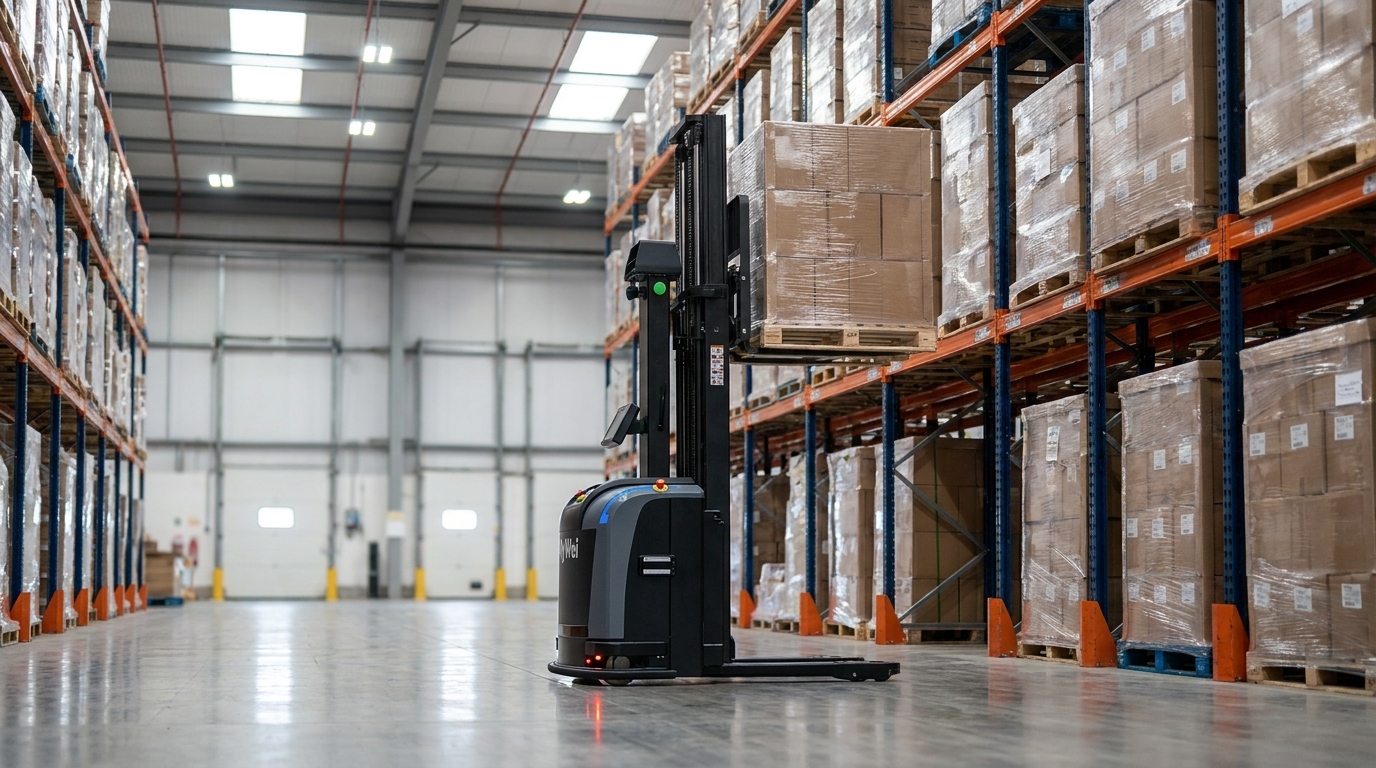
A driverless forklift is an autonomous industrial truck that lifts, moves and stacks pallets without an on-board operator, guided by on-board sensors, mapping software and a central fleet manager. For a UK paper and packaging distribution centre, it means heavy shrink-wrapped reels and palletised board can keep flowing through the night, aisle by aisle, alongside the people already on shift.
What is a driverless forklift, and why now for UK paper and packaging?
A driverless forklift — sometimes called an autonomous or self-driving forklift — navigates a live site using laser and vision sensors rather than a driver at the wheel. It collects a pallet, plots a route, slows for obstacles and sets the load down at a mapped location, then reports back to the fleet manager that coordinates every truck on the floor.
Paper, print and packaging distribution is an unusually good fit for this technology. Loads are heavy and repetitive, reels and shrink-wrapped pallets travel on predictable routes, and high-bay racking rewards consistent, millimetre-accurate placement. Sites across the East Midlands “golden triangle” — Magna Park at Lutterworth, SEGRO East Midlands Gateway and DIRFT at Daventry — increasingly run around the clock, and that is exactly where autonomy earns its keep.
The labour squeeze behind the move to autonomy
The blunt driver of change is people. Counterbalance and reach-truck operators are hard to recruit and harder to retain, and the shortage bites most at nights and weekends — precisely when a 24/7 packaging DC needs cover. Seasonal peaks make it worse, because demand for board and packaging swings sharply around retail promotions and the long pre-Christmas run.
Recruitment and retention pressure across UK transport and storage has been a persistent theme in Office for National Statistics labour-market data, and warehouse operators feel it directly. A driverless forklift does not remove people from the DC; it takes the most repetitive long-haul moves off their hands so the team can concentrate on exceptions, quality checks and safe loading.
Cost pressure is real, but it is best handled without a spreadsheet of promises. Full-service leasing lets a distributor spread the investment and fold servicing into a single agreement, while a free site survey establishes what is genuinely feasible before anyone commits to a single truck.
How does a driverless forklift fit a live packaging DC?
Modern autonomous trucks are designed to share the aisle with staffed equipment rather than needing a fenced, lights-out cell. FlyWei fleets run on the open VDA 5050 standard under one fleet manager, so autonomous counterbalance trucks, driverless reach trucks and pallet movers can be coordinated together and rerouted around congestion in real time.
Where each class earns its place
An autonomous counterbalance forklift (the SFL-CBD class) suits inbound and yard-facing moves; a driverless reach truck (the SSR-1400 class) serves the high-bay; an autonomous pallet stacker or mover (the SCB class) shuttles wrapped pallets between zones. For cages, cassettes and roll-cage work, a latent-jacking lifting AMR (the AMB class) drives beneath a cart and jacks it up rather than forking a pallet at all. The autonomous forklift range and the lifting robots show how the classes differ and where each fits.
Safety and compliance: PUWER and BS EN ISO 3691-4
Driverless does not mean unregulated. Every truck in a UK DC is still work equipment under the Provision and Use of Work Equipment Regulations (PUWER), which demands suitable selection, maintenance and inspection regardless of whether a person sits on board. Autonomy changes how you demonstrate compliance, not whether you must.
FlyWei fleets are CE-marked and built to BS EN ISO 3691-4, the standard for driverless industrial trucks and their systems. That standard governs the safety-related sensing, speed control and protective stops that let an autonomous truck work near people on foot, and it underpins the site safety case an operations manager will need to sign off.
What the safety case has to cover
A live packaging DC carries mixed traffic: staff on foot, staffed trucks, tuggers and now autonomous forklifts. The site risk assessment should map shared aisles, pedestrian crossings, kerb lines and blind corners, then set how the fleet manager slows or halts trucks around each one. Clear signage, marked walkways and a simple stop routine keep the mixed operation predictable for everyone.
Phasing driverless forklifts in, aisle by aisle
The lowest-risk way to adopt is incremental. Start with one predictable, high-volume flow — moving wrapped pallets from the wrapping line to a marshalling lane, for example — prove it over a few weeks, then extend to the next aisle once the team trusts the trucks and the data looks clean.
A sensible sequence
- Map and survey the site, confirming floor and rack readiness before anything is ordered.
- Automate one repetitive route end to end, running it alongside staffed trucks.
- Review the exceptions each week — near-misses, mis-reads, congestion — and tune the routing.
- Extend aisle by aisle, keeping people on the tasks that need judgement.
This phased approach means the DC never stops. The distributor keeps shipping board and packaging while autonomy is layered in, and the workforce grows into supervisory and exception-handling roles rather than being displaced overnight. Each stage also builds an evidence trail — mapped routes, near-miss logs and uptime records — that strengthens the safety case and makes the next aisle an easier decision for the operations team.
Staffed forklift vs driverless forklift: what changes?
The two are not rivals so much as partners, but they behave differently across the dimensions a site manager cares about. The table below sets out the practical contrasts — with no cost figures, because that is a conversation for a site survey, not a headline.
| Dimension | Staffed forklift | Driverless forklift |
|---|---|---|
| Night and weekend running | Depends on shift cover being recruited and retained | Runs consistently through unsocial hours under the fleet manager |
| PUWER inspection | Work equipment; routine inspection and maintenance required | Work equipment; same duties plus autonomous-system checks |
| Labour dependency | High — every truck needs a trained operator | Lower — people move to supervision and exceptions |
| Peak flexibility | Ramping means finding and training extra drivers fast | Add mapped routes and hours without new licences |
| Route consistency | Varies with operator, fatigue and shift | Repeatable, millimetre-accurate placement every cycle |
| Floor and rack readiness | Tolerant of worn floors and mixed rack states | Needs flat floors, sound joints and mapped, well-kept racking |
What to check first
Before a single truck arrives, a handful of fundamentals decide whether a rollout is smooth. Floor flatness and joint condition matter because autonomous trucks place loads to fine tolerances at height. Aisle widths, rack alignment and lighting all feed the sensing that keeps a driverless forklift safe and accurate.
Data readiness is the quieter checkpoint. The fleet manager needs to know where loads start and finish, so pallet locations, wrapping-line outputs and marshalling lanes should be mapped and stable. Trade bodies such as BITA, the British Industrial Truck Association, are a useful reference point for standards and duty-holder responsibilities as you plan. A free site survey turns all of this into a concrete, staged proposal rather than a leap of faith.
Frequently asked questions
Is a driverless forklift safe to run alongside people?
Yes, when specified and installed correctly. FlyWei fleets are CE-marked and built to BS EN ISO 3691-4, using safety-related sensing, speed control and protective stops to work near people on foot. The trucks remain work equipment under PUWER, so a site risk assessment, marked walkways and a clear stop routine keep the mixed operation predictable.
Do we need to change our racking or floor for driverless forklifts?
Often some preparation helps. Autonomous trucks place loads to fine tolerances at height, so flat floors, sound joints and well-aligned, mapped racking all improve reliability. A free site survey checks floor flatness, aisle widths, lighting and rack condition first, then sets out any groundwork needed before trucks are introduced, aisle by aisle.
Can driverless forklifts handle seasonal peaks?
That is one of their strongest advantages for packaging distribution. Rather than recruiting and training temporary drivers before a peak, you extend mapped routes and running hours within the existing fleet. Autonomous trucks hold a steady pace through nights and weekends, so a paper and packaging DC can flex output without the usual scramble for licensed operators.
How long does it take to add driverless forklifts to a live DC?
It varies with site readiness, but the phased method keeps disruption low. A survey and mapping stage comes first, then one repetitive route is automated and proven alongside staffed trucks. Once the data is clean and the team is confident, the fleet extends aisle by aisle, so the distribution centre never has to stop shipping.
Talk to FlyWei about a phased rollout
If you run a UK paper, print or packaging DC and the labour squeeze is biting hardest at night, a driverless forklift fleet may be the practical next step — and you can start with a single aisle. FlyWei Robotics is a vendor-neutral UK integrator offering a free site survey and full-service leasing that spreads the cost into one manageable agreement. Email sales@flywei.co.uk or call +44 20 3576 6910, and explore the autonomous forklift range to see where autonomy could fit your site.