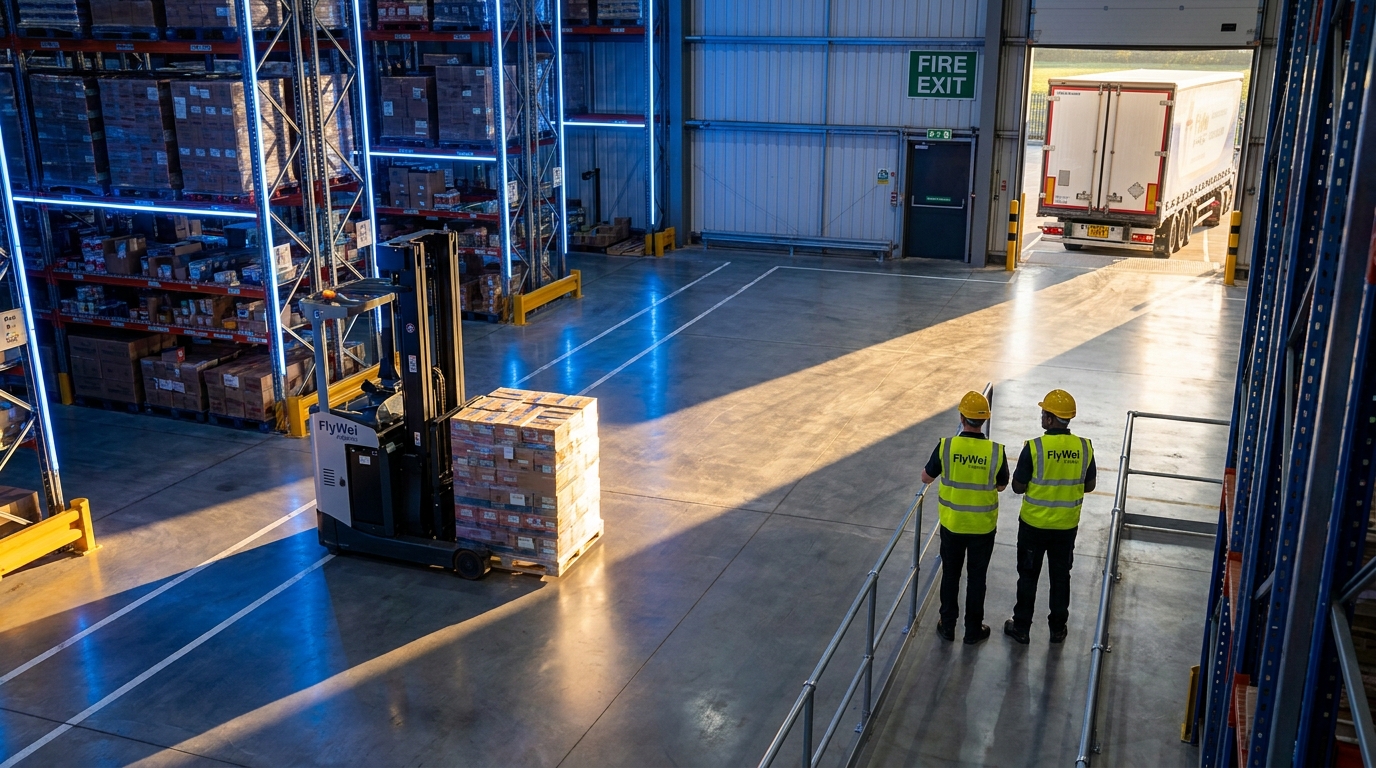
Warehouse robot ERP integration is the line item where UK SMEs lock themselves in for a decade. The current trend, buying robots from your ERP vendor as a single bundle, looks like procurement simplicity. It is actually a 7-year refresh-cycle handcuff, and the operators across Magna Park, DIRFT and SEGRO East Midlands Gateway who are signing these deals in 2026 are walking into it without seeing it.
Why warehouse robot ERP integration became a bundling pitch in 2026
Through 2024 and 2025, the UK warehouse robotics market consolidated. Several regional ERP vendors acquired or partnered with mobile-robot suppliers, then started selling the combined product as a single procurement decision. The pitch is consistent: one supplier, one contract, one go-live, one bundle discount.
For a UK SME warehouse operator with a 5 to 10 year ERP roadmap, that pitch is structurally appealing. It dodges the fleet-orchestration architecture conversation. It dodges the WMS-versus-fleet-manager middleware question. It compresses a 12-week procurement evaluation into a 4-week sign-off.
It also commits the operator to refreshing two independent depreciation cycles on the same calendar. ERPs run 7 to 10 years; warehouse robots are typically depreciated over 5 to 7. Buying both from one supplier couples two refresh cycles that genuinely have no business being coupled. Five years in, the robot fleet is end-of-life. The ERP has three years left. Replacing one means re-platforming both.
What warehouse robot ERP integration actually is
Warehouse robot ERP integration is the data and process bridge between distinct layers:
- The robot fleet. The autonomous forklifts, AMRs and lifting robots that move pallets and totes on the warehouse floor.
- The fleet manager. The orchestration layer that decides which robot does what task, in what order, with what handover. FlyWei deploys M4 for this; on the open standard side it speaks VDA 5050 to any compliant third-party robot.
- The WMS. The warehouse management system that holds the inventory state, locations, picking lists and putaway rules.
- The ERP. The enterprise system that holds the customer orders, the financials, the procurement records and the master data.
The bundling pitch collapses these four layers into one purchase order. That is the source of the lock-in. A clean integration architecture lets each layer evolve independently.
The four traps in bundled warehouse robot ERP integration
Trap one: coupled refresh cycles. The most expensive trap. Once your robot fleet and your ERP are on the same supplier's roadmap, you replace both together when either one ages out. A UK 3PL that bundled in 2025 will be in a forced re-platform conversation in 2030, not 2027.
Trap two: orchestration captured by the bundle. The bundle pitch usually presumes the customer adopts the ERP vendor's chosen fleet-manager middleware. That commits the WMS integration, the operator UX and the year-three exception-handling library to the bundle, not to the customer. The decision is rarely flagged as a decision; it travels in the proposal as a default.
Trap three: single-vendor robot fleet. Bundles typically commit the customer to the ERP vendor's chosen robot brand. If a better lifting robot lands in 2027, you cannot add it without breaking the bundle commercials. Open VDA 5050 orchestration removes this trap entirely: a UK warehouse running M4 can mix FlyWei autonomous forklifts with any VDA-5050-compliant third-party AMR in the same building.
Trap four: bundled discount that vanishes by year three. The headline 6 to 8% bundle discount is real in year one. By year three it is typically erased by the cost of being on the bundle's preferred maintenance contract, the bundle's mandatory upgrade cadence, and the bundle's WMS-integration consultancy day-rate.
"Buy the orchestration layer once. Buy robots every five years. Buy the ERP every ten. Stop coupling cycles that have no business being coupled."
The UK regulatory load you cannot transfer to the bundle
Three regulatory anchors define UK warehouse robot deployments. None of them transfer to the bundle supplier, regardless of the commercial structure.
PUWER 1998. The duty holder under HSE's Provision and Use of Work Equipment Regulations is the operating employer. Logistics UK's 2026 guidance is explicit: bundled procurement does not move the duty holder. The operator owns the inspection regime, the competency case and ACOP L22 evidence.
ISO 3691-4:2023. The functional safety standard for driverless industrial trucks attaches to the equipment in service, not to the contract under which it was procured. The dossier (risk assessment, safety functions, performance level evidence) must be auditable on-site, in English, by the operator's safety lead. ISO 3691-4:2023 is the working edition.
TR34:2024 and BS EN 15620. Floor flatness and racking tolerances govern whether a robot fleet can be installed at all. The Concrete Society's TR34 fourth edition is the working standard for new builds; older Magna Park, DIRFT and Daventry units typically need a remediation plan rather than a wholesale relay.
What clean warehouse robot ERP integration looks like
FlyWei's reference architecture deliberately keeps the four layers separate.
Robot fleet. FlyWei autonomous forklifts, lifting robots and AMRs deployed and operated as a fleet under FlyWei service.
Fleet manager. M4 orchestrates the fleet over open APIs and VDA 5050. Third-party VDA-5050-compliant robots can be added without re-platforming.
Dispatch layer. Fleet dispatch software sits between M4 and the WMS, handling task generation, prioritisation, and exception management at high throughput.
WMS / ERP. Whatever the customer entered with (enterprise WMS, regional UK ERP, in-house system) stays in place. M4 + fleet dispatch software expose the integration surface; the customer's WMS roadmap is decoupled from the robot roadmap.
The result: a UK 3PL can refresh robots in 2030 without touching the ERP roadmap, or refresh the ERP in 2032 without touching the fleet. Two independent depreciation cycles, two independent vendor relationships, two independent risk profiles.
Comparing bundled, semi-bundled and open warehouse robot ERP integration
| Approach | Best for | Trade-off | Indicative UK pricing (5-robot fleet) |
|---|---|---|---|
| Single-vendor ERP-plus-robot bundle | SMEs with no in-house WMS or fleet-manager skills who want one throat to choke | Coupled refresh cycles, captured orchestration, single-vendor robot fleet, bundle premium by year three | £420k to £640k bundled (5-yr commitment) |
| Semi-bundled (own ERP, vendor's robots + middleware) | Operators with strong ERP but limited robotics experience | Robot brand and orchestration still captured; WMS roadmap protected | £280k to £480k |
| Open architecture (own ERP + own WMS + FlyWei M4 + chosen robots) | Operators planning to scale beyond five robots and across multiple sites | Requires fleet-manager fluency in-house or via FlyWei service contract | £190k to £360k + £18k to £36k/yr M4 service |
Pricing is indicative: real numbers depend on robot mix, WMS complexity and existing rack reuse. The point of the table is the right-hand column: at five robots, the open architecture is typically 30 to 50% cheaper across a 5-year window, before counting the year-five flexibility benefit.
What FlyWei does in a UK warehouse
FlyWei's typical UK deployment is direct, not bundled. We deliver the robot fleet (FlyWei autonomous forklifts, lifting robots, AMRs as needed), deploy and configure M4, integrate over open APIs to the customer's existing WMS and ERP, and provide ongoing service. The customer's ERP environment stays untouched. The customer's WMS stays untouched. Where the purchase order, goods in and invoice steps around the robots are still keyed by hand, our ERP integration services join them up inside the same ERP. If they want to add a new robot brand in year three, M4 orchestrates it via VDA 5050. If they want to swap the WMS in year four, M4 reintegrates against the new WMS without disturbing the robot fleet.
That is the deployment pattern UK 3PLs and FMCG operators across the East Midlands corridor have used to move from a 6-month sales cycle to a 6-week deployment, without committing the next decade of their WMS roadmap to a robot vendor's calendar. Speak to the FlyWei team via flywei.co.uk/contact for a UK-grade integration assessment.
FAQ
Should warehouse robots be bought from your ERP vendor?
In most cases no. ERPs run 7 to 10 years; warehouse robots are typically depreciated over 5 to 7. Buying both from one supplier couples two refresh cycles that genuinely have no business being coupled. Open VDA 5050 orchestration via a fleet manager like M4 removes the lock-in entirely.
What is VDA 5050 and why does it matter for warehouse robot ERP integration?
VDA 5050 is the open European standard for AMR-to-master-control communication. A fleet manager that speaks VDA 5050, like FlyWei's M4, can orchestrate any compliant third-party robot in the same building, so the customer is not committed to a single robot brand for the life of the WMS or ERP.
How much does open warehouse robot ERP integration cost in the UK?
Indicative UK pricing for an open-architecture 5-robot deployment runs £190k to £360k initial plus £18k to £36k per year for M4 service. Bundled equivalents typically price at £420k to £640k for the same fleet size and offer worse year-five flexibility.
Does a bundled procurement transfer the PUWER duty?
No. Under HSE PUWER 1998 the duty holder is the operating employer. Logistics UK's 2026 warehouse automation guidance is explicit on this. A bundled commercial structure changes asset ownership but does not transfer the safety case in front of an HSE inspector.
Can FlyWei orchestrate non-FlyWei robots in a UK warehouse?
Yes. The M4 fleet manager speaks VDA 5050. Third-party AMRs and AGVs that comply with VDA 5050 can be orchestrated alongside FlyWei autonomous forklifts inside the same building, without a re-platform.
How does FlyWei integrate with our existing WMS and ERP?
M4 + fleet dispatch software expose the integration surface to whichever WMS and ERP the customer entered with. The customer's WMS and ERP stay unchanged. Integration runs over standard REST APIs and is part of the FlyWei deployment service.