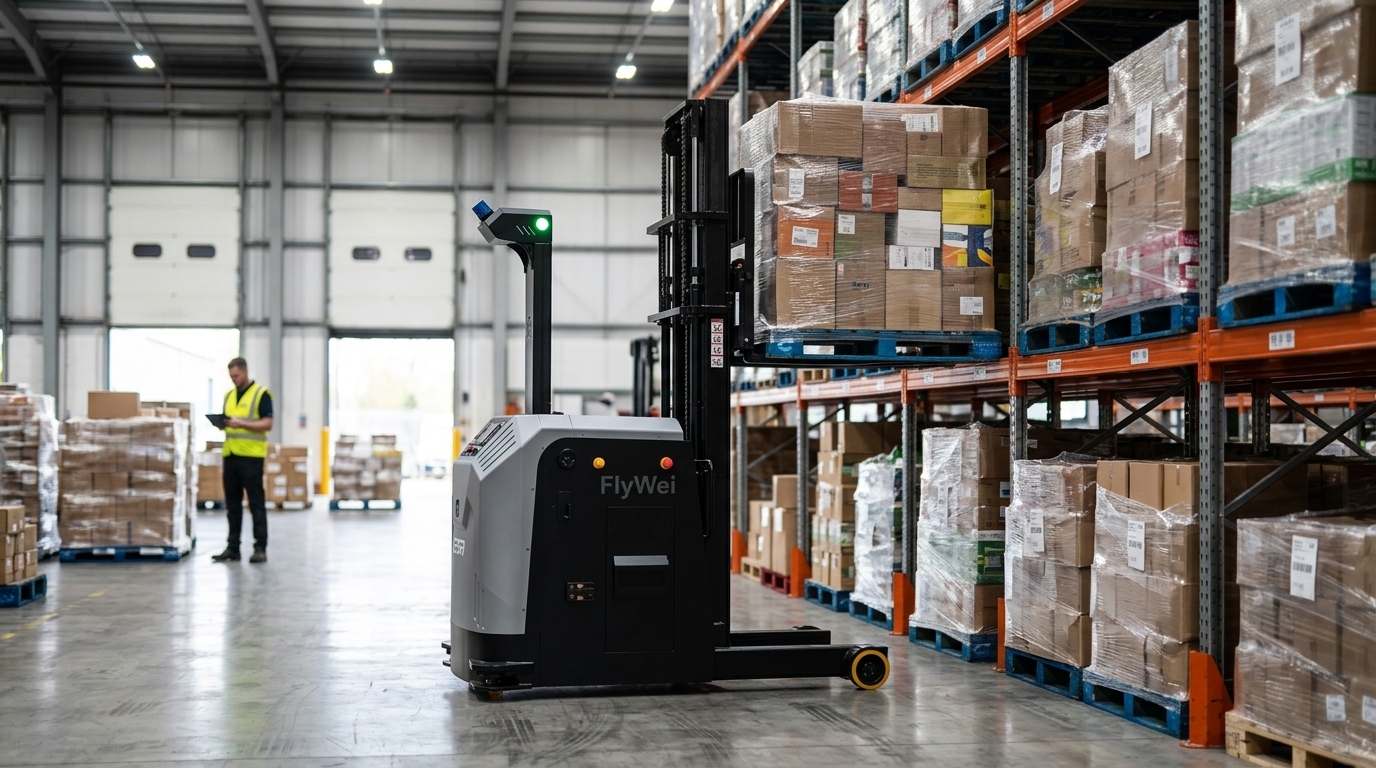
A forklift AGV is an autonomous forklift that navigates a working drinks warehouse without a driver, using onboard sensors and a central fleet manager to move pallets, kegs and cased beverages between goods-in, storage and dispatch. According to the UK Health and Safety Executive, around 5,000 workplace-transport injuries are reported every year, and roughly a quarter involve someone struck by a moving vehicle: most on the tight-turn floors that drinks warehouses run flat out at peak. For the warehouse manager of a 100,000-square-foot beer, spirits or soft-drinks DC in Burton-on-Trent, DIRFT or Magna Park, the quarterly problem is familiar: throughput doubles for the BBQ peak and again at Christmas, agency drivers turn over every twelve weeks, damage rates on 4-high cased pallets climb at every shift change, and one bank-holiday MHE stoppage can miss two dispatch waves. A forklift AGV re-plans that same floor as continuous work, not human effort.
Why the drinks warehouse hits its ceiling
Drinks logistics is one of the least forgiving categories of palletised warehousing in the UK, and warehouse managers running a mixed beer, spirits and soft-drinks operation know why. The product is heavy, glass-fragile, seasonally volatile, and travels in packaging that was designed for supermarket display, not for eight hours of manual forklift handling. When a case of 24 × 500ml cans lands on a pallet 3.6 metres up on a narrow-aisle rack, the tolerance between "good pallet" and "leaker on aisle 12" is a few centimetres of forklift-tine yaw.
The Logistics UK 2026 Skills Report continues to log an HGV and materials-handling shortage that spikes each summer, exactly when the drinks category surges: hot weather adds 30 to 45% throughput on soft drinks and beer for six to ten weeks, and the same DC then has to accept a Christmas wave for spirits and premium cases. Agency counterbalance drivers cost £22 to £28 an hour fully-loaded during those weeks, and their turnover on twelve-week contracts erodes the operator training that keeps damage rates below 1%.
On top of that, the physical constraints are unforgiving. UK drinks DCs typically operate 8 to 10 m VNA racking on a TR34-rated slab, with dock levellers on a 24/7 slot pattern feeding curtain-siders and reefers. PUWER 1998 and PUWER approved codes of practice (ACOP) require that every truck is thoroughly examined, that operators are competent, and that the workplace is organised so trucks and pedestrians are separated; precisely the discipline that decays at 02:00 on a peak Friday. A forklift AGV does not get tired at 02:00.
The four levers that fix it
Lever 1: Segment the flow, then automate the boring 70% (operational)
Do not attempt a big-bang conversion. In a 100k sqft drinks DC, roughly 70% of forklift moves are repeatable, deterministic and low-decision: goods-in bay to bulk block-stack, block-stack to VNA racking, racking to marshalling, marshalling to loading dock. These are the moves a forklift agv handles best. The remaining 30% (trailer stripping in tight windows, damaged-pallet triage, mixed-SKU kit-build for a promotional wave, keg-return handling) stay with skilled human operators on counterbalance and reach trucks. Segmenting means mapping every SKU family against move-type and shift, then drawing three lanes: fully autonomous, fully human, and shared. The shared lanes need clear pedestrian gates and VDA 5050-compatible traffic rules so a mixed fleet can co-exist safely. Warehouse managers who segment first typically hit 92%+ autonomous-move share on the target 70% within 90 days of go-live, and see damage-per-pallet fall by a third inside the first quarter.
Lever 2: Orchestrate the fleet, not the trucks (technical)
The single biggest technical mistake in drinks-DC automation is treating each autonomous forklift as a standalone asset. The gain is in the fleet-level orchestration: the layer that plans work across trucks, dock doors, bays and shifts. That layer needs three inputs it usually does not have on day one: the DC's WMS wave plan, the yard-management inbound schedule, and a real-time floor map that includes today's block-stack layout. A modern orchestration layer runs the ISO 3691-4-compliant driving stack on the truck, VDA 5050 for the traffic-management API, and a decision loop that reshuffles work every few seconds when a dock door opens late or a pallet is refused at the gate. Warehouse managers should insist that the orchestration platform exposes a live dashboard for shift-leads, not just a data pipe for engineers: the value is in the moment a shift-lead sees the queue building at Bay 8 and re-routes three trucks in one click.
Lever 3: Anchor the safety case in PUWER + ISO 3691-4 (regulatory)
The regulatory perimeter around a forklift AGV in a UK drinks DC is not new: it is the same PUWER and workplace-transport regime that already applies to manned MHE, plus the autonomous-truck standard on top. Specifically: PUWER 1998 (thorough examination, operator competence, guards), LOLER 1998 for lifting-integrity, ACOP L117 for lift-truck operations, ISO 3691-4:2020 for the autonomous industrial truck itself, and BS EN 15635 for racking inspection. UKCA marking is the entry ticket. The audit-able artefacts a warehouse manager should have on file from day one are: a workplace-transport risk assessment updated for autonomous moves, a competent-person examination schedule, an emergency-stop and safe-recovery procedure, evidence of pedestrian separation, and a change-control log for any layout tweak the AGV needs to re-scan. Do this once and the HSE conversation moves from defensive to routine.
Lever 4: Buy outcomes, not assets (commercial)
Sticker price is the wrong lens for a drinks warehouse manager, and it is the one the finance team will default to unless you re-frame the conversation. What matters is cost-per-pallet-move over five years against a manned baseline that includes agency premium, damage write-off, insurance, downtime and the mezzanine-driver churn cost. A leased fleet on a 3, 5 or 7-year term smooths that number to a monthly OpEx line, ties service into the same contract, and lets you scale up or down when a new drinks brand wins or loses a listing at a major grocer. This is exactly where a full-service leasing arrangement outperforms outright purchase for most 100k sqft drinks DCs: the operator does not own the residual-value risk on a 2028 spec truck that a 2029 orchestration update might depreciate faster.
Comparison: three procurement routes for a UK drinks DC
| Route | Upfront cost | Monthly OpEx | Service & software included? | Typical payback | Best for |
|---|---|---|---|---|---|
| Outright purchase | High: full fleet capex on the balance sheet | Low base, high variable (service, insurance, upgrades) | No, usually a separate service contract | 36 to 48 months | Operators with steady long-term volume and mature in-house engineering |
| Full-service lease (3 / 5 / 7 yr) | Zero capex | Fixed: one line item | Yes: trucks, orchestration, service, updates | 24 to 30 months (OpEx-adjusted) | Drinks DCs with peak volatility, growing brands, or CFO capex constraint |
| Robotics-as-a-Service (pay-per-move) | Zero capex | Variable: per pallet-move | Yes: bundled | Immediate positive contribution in peak weeks | Seasonal 3PL contracts, pilot lines, promotional waves |
A forklift AGV is an autonomous forklift that navigates a working drinks warehouse without a driver, using onboard sensors and a central fleet manager to move pallets, kegs and cased beverages between goods-in, storage and dispatch.
What FlyWei does in a UK drinks DC
FlyWei designs and delivers the autonomous side of a drinks warehouse from the loading bay in. In a typical 100,000 sqft two-shift DC, that means a mixed fleet of FlyWei autonomous forklifts: counterbalanced trucks for the 2-tonne case-pallet and keg moves at goods-in and dispatch, autonomous reach trucks for the 8 to 10 m VNA racking, and pallet-truck AGVs for the horizontal dock-to-stock lanes. The trucks run the ISO 3691-4-compliant driving stack; the fleet is orchestrated by FlyWei M4, which owns the decision layer over the WMS wave plan, and coordinated in the traffic layer by FlyWei fleet dispatch software using a VDA 5050 interface. FlyWei's UK-based engineers run the site survey, the safety case, the go-live and the 24/7 support out of a British depot, and the whole package is available on a 3, 5 or 7-year full-service lease that lands as one predictable monthly line, service and software included. The result on the floor is a warehouse that accepts a 40% June-to-August throughput surge without hiring a single extra agency driver, and that hits the December wave with the same damage rate as April.
Frequently asked questions
What is a forklift AGV in the context of a UK drinks warehouse?
A forklift AGV is an autonomous forklift that operates in a shared warehouse without an on-board driver, using LiDAR, cameras and a fleet manager to move pallets, kegs and cased drinks between goods-in, racking and dispatch. It complies with PUWER 1998 as work equipment and with ISO 3691-4:2020 as an autonomous industrial truck.
Will a forklift AGV cope with peak drinks-season throughput?
Yes: that is the deliberate design point. Because a forklift AGV runs 22+ hours a day without shift breaks, throughput scales linearly with fleet size rather than with agency-driver availability, which is the constraint that caps most UK drinks DCs during the BBQ and Christmas peaks.
Which UK regulations govern autonomous forklifts in drinks logistics?
PUWER 1998 (equipment safety and thorough examination), LOLER 1998 (lifting), ACOP L117 (lift-truck operations), ISO 3691-4:2020 (autonomous industrial trucks), BS EN 15635 (racking inspection), and UKCA marking for market access. The HSE workplace-transport regime applies unchanged.
What payback should a warehouse manager expect on a forklift AGV in a 100k sqft drinks DC?
Illustratively, 24 to 30 months on a full-service lease when the model counts agency-driver premium, damage-per-pallet reduction, insurance saving and downtime avoidance, not just the truck sticker price. Outright purchase typically lands at 36 to 48 months once residual-value and self-service costs are honest.
Can a forklift AGV work in an 8 m VNA aisle with 4-high cased pallets?
Yes. The reach-truck class of autonomous forklift is designed for 8 to 10 m VNA racking, with sub-centimetre lateral tolerance at height. In a UK drinks DC the constraint is usually TR34 slab flatness and rack condition under BS EN 15635: both are surveyable before go-live.
How does a forklift AGV integrate with the drinks WMS and yard management?
Through the fleet-orchestration layer. FlyWei M4 consumes the WMS wave plan and the yard inbound schedule, then dispatches truck-level tasks over VDA 5050. The warehouse manager sees a single dashboard that shows queues by bay, damage flags and shift-vs-plan attainment in real time.
What happens if a keg falls off a pallet mid-move?
The onboard safety scanners drop the truck to a controlled stop inside the safety-rated zone, the fleet manager marks the aisle as blocked, adjacent trucks re-route, and the exception is queued for a human operator with a clear photo and location. There is no runaway condition; the safety stack is ISO 3691-4 compliant.
If peak-season damage rates and agency-driver churn are on your Q3 risk register, the fastest way to see whether a forklift AGV pays back inside 30 months in your specific DC is to walk a FlyWei UK engineer around the floor.
Book a free 30-minute site survey with a FlyWei UK engineer, or read the full FlyWei autonomous forklift range for drinks logistics.
UK-based engineers · no obligation · reply within one business day.