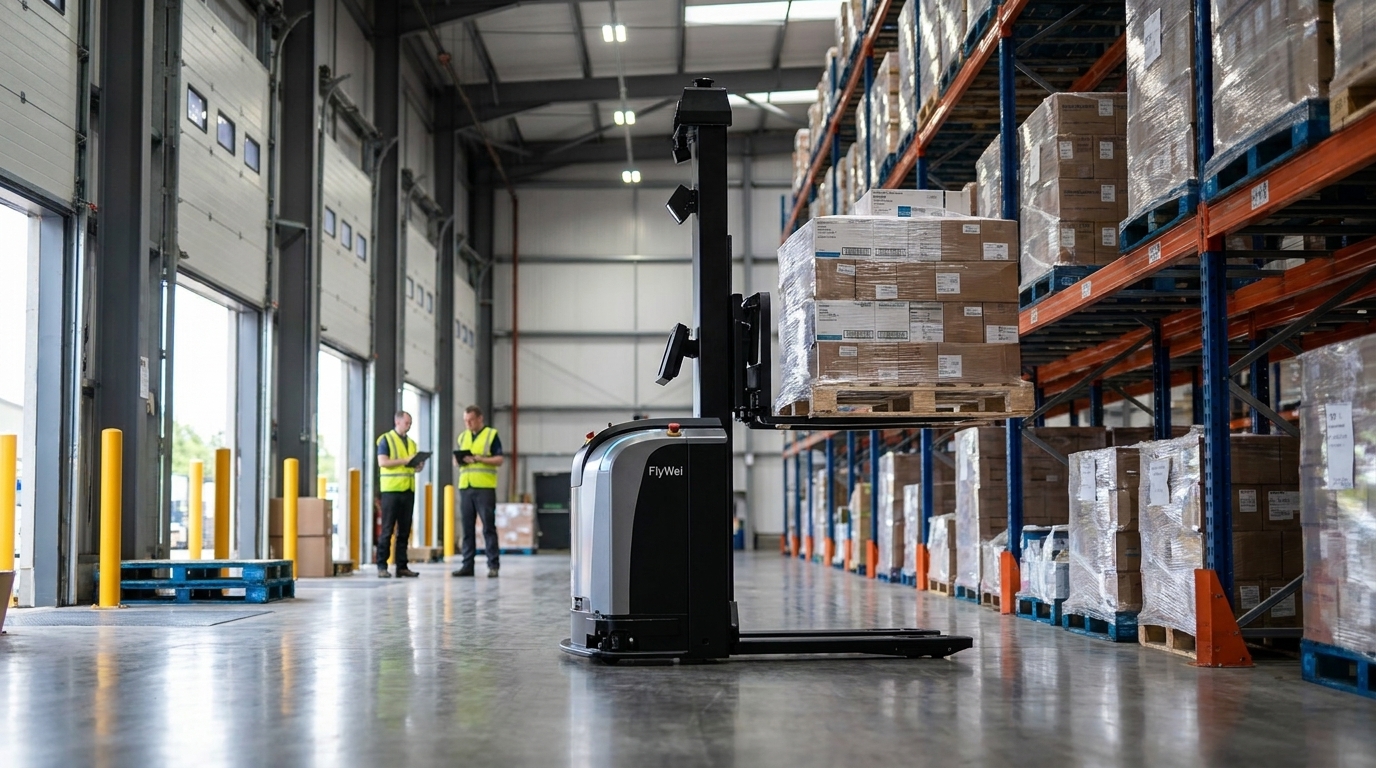
A forklift lease 3 year contract is a fixed-term operating lease that lets a UK distribution centre run an autonomous forklift fleet for 36 months on a single monthly invoice, with maintenance, software updates and end-of-life refresh wrapped in. For pharmaceutical procurement teams, the 3-year window matches the MHRA inspection cycle and the warehouse management system upgrade cadence inside most UK pharma DCs. With HSE data showing forklift trucks account for around a quarter of all UK workplace transport fatalities each year, an autonomous fleet refresh that synchronises with MHRA reinspection is a safety case as well as a capital case. The capital that would have funded outright ownership is being claimed in three places at once for a pharma procurement director: GDP cold-room refurbishment, WMS upgrade, and rising third-party logistics rates. A 36-month forklift subscription resolves that triple-claim on cash.
Why it happens: the structural mismatch between pharma capex and MHRA timing
UK pharmaceutical distribution sits inside a regulatory perimeter that no other sector has to honour at the same intensity. The MHRA reinspection runs on a 24- to 36-month cycle for licensed wholesale dealer''s authorisations, and EU GDP Annex 15 expects qualification records to follow every piece of equipment that touches saleable inventory. Each reinspection visit forces a paper review of the navigation, lifting and temperature-handling kit in scope, which means autonomous forklifts get audited on the MHRA clock whether procurement wants them to or not. Pharma procurement teams therefore think about equipment lifecycle in two-digit months, not five-digit hours.
Then comes the capital math. A typical UK pharma DC at Magna Park, Daventry or Burton-on-Trent runs 6 to 12 autonomous pallet trucks across cold-chain and ambient zones. At £85,000 to £120,000 per unit, outright ownership ties up between £510,000 and £1.44 million in equipment that has to be re-qualified after every MHRA cycle. The same capital, parked in a 36-month operating lease, frees the GDP cold-room refurbishment programme that every pharma operator around SEGRO East Midlands Gateway has on the 2026 capex queue.
The third factor is software depreciation. Navigation stacks, SIL-2 safety controllers and fleet managers compliant with ISO 3691-4 for autonomous industrial trucks are evolving on an 18- to 24-month curve. A 3-year operating lease lets the procurement team hand the platform back at month 36 and pick up the next-generation stack without writing off mid-life capex. Bought fleets get stranded between software generations; leased fleets refresh in step with the standard.
Lever 1 (operational): match the lease term to the MHRA cycle, not the depreciation schedule
Procurement teams that win the leasing argument internally stop pitching 36 months as a finance optimisation and start pitching it as a compliance-cycle play. The pharma board understands MHRA reinspection intervals viscerally — anything that synchronises equipment refresh with the audit clock is risk reduction, not cost engineering. The lever is to tie the lease contract end-date to the month after the next MHRA reinspection so the GDP qualification packet for incoming units is fresh on day one of the next cycle.
That single move converts the finance director (lease is opex; balance-sheet impact predictable under IFRS 16 right-of-use treatment) and the QA director (refresh aligns to audit; documentation burden reduced) in the same meeting. It also resolves a perennial pharma DC argument: who owns equipment re-qualification cost — capex pool or QA opex? Under a 3-year full-service lease the answer becomes "the lessor, inside the monthly fee", and the internal cost dispute disappears.
The mechanics matter. Specify in the contract that the next-generation autonomous pallet truck must be delivered, commissioned and qualified inside the 30 days before lease handover, with the MHRA-relevant documentation — factory acceptance test, site acceptance test, software change control, ISO 3691-4 conformity declaration — issued by the lessor in the format your QA team uses. FlyWei''s 3, 5 and 7-year leasing terms are built so a pharma procurement team can pick the 3-year option when the next MHRA reinspection sits roughly 30 months out, with documentation cadence baked in from day one.
Lever 2 (technical): lease the fleet as one orchestrated unit, not as separate trucks
A common pharma procurement mistake is to lease pallet trucks separately from counterbalance autonomous forklifts and reach trucks, each one to a different supplier and contract end-date. Doing so locks each form factor into a different lifecycle, prevents single-fleet optimisation and creates three parallel PUWER inspection schedules to manage. The technical lever is a single 3-year contract covering 1.5-tonne autonomous pallet trucks and 2-tonne autonomous pallet trucks under one orchestration layer.
The M4 fleet manager and RDS robot dispatch then balance dock-to-stock, ambient putaway and chilled-zone replenishment flows across the leased units in real time, using VDA 5050 messaging so the mixed fleet behaves as one cohort regardless of model class. The procurement win is contractual: one renewal date, one PUWER inspection schedule, one LOLER thorough examination register, one software baseline, one engineering escalation route.
The operational win is throughput density. A single-orchestration fleet can hand a partially built pallet from a pallet truck to a counterbalance unit at the dock edge without operator intervention; two-supplier fleets cannot. That matters most during peak pharma season — flu vaccination outbound in October, controlled-drug audit windows, and any post-MHRA-inspection batch-release surge — when the marginal pallet move costs the procurement team budget overrun. Lease the fleet as one orchestrated unit and the marginal pallet move stays inside the monthly fee.
Lever 3 (regulatory): wrap PUWER, LOLER and ISO 3691-4 inside the lease scope
Under the Provision and Use of Work Equipment Regulations 1998 (PUWER) the operator — not the lessor — holds legal responsibility for the safe use of work equipment, including autonomous forklifts. That responsibility does not transfer with a lease. What does transfer, in a correctly written full-service contract, is the inspection and maintenance burden that sits beneath the legal duty.
A 3-year forklift lease worth writing makes the lessor responsible for six-monthly PUWER inspection, annual Lifting Operations and Lifting Equipment Regulations (LOLER) thorough examination on lifting components, ISO 3691-4 conformity declarations on every navigation or safety-controller software update, an engineer-on-site response time inside 4 hours during peak picking windows, and end-of-life decommissioning that meets WEEE rules. Each of those items has a direct line in the MHRA inspector''s checklist.
The procurement scorecard line is simple. Leased equipment under a full-service lease puts the supplier on the hook for documented compliance evidence at every audit; bought equipment puts your own QA team on the hook for assembling the same evidence from internal records and third-party engineer reports. Procurement directors who survive their first MHRA reinspection after switching to leased autonomous forklifts tend to be loud advocates internally afterwards — not because the leasing maths is dramatically better, but because the audit week is materially calmer when the lessor is contractually obliged to walk the inspector through PUWER and LOLER records on their own paper.
| Decision factor | Capex outright purchase | 3-year full-service lease |
|---|---|---|
| Upfront cash (8-unit fleet) | £680k–£960k | £0–£25k mobilisation |
| Monthly cost per unit | Depreciation only | £1,500–£3,200 |
| PUWER inspection + LOLER thorough examination | Internal QA + engineer cost | Included in monthly fee |
| Software refresh at month 24 | Capex write-off risk | Included; new platform at month 37 |
| Balance-sheet treatment | Fixed asset depreciation | IFRS 16 right-of-use; opex line |
| MHRA cycle alignment | Stranded between cycles | Refresh on cycle |
For UK pharma procurement teams, a 3-year forklift lease aligns autonomous pallet truck refresh with the MHRA reinspection cycle, freeing the capital they need for GDP cold-room and WMS spend.
What FlyWei does here
FlyWei designs, supplies and integrates autonomous pallet truck fleets across UK pharmaceutical distribution sites, with leasing as a first-class commercial option rather than an afterthought. The 3-year contract is the default landing point for pharma procurement teams who want their autonomous fleet refresh to sit on the same cadence as MHRA inspection. FlyWei autonomous pallet trucks — including the 1.5-tonne, 2-tonne and 3-tonne classes — deliver 5 to 7 cm pallet placement accuracy in narrow-aisle MHRA-temperature-controlled racking, with onboard SIL-2 safety controllers and ISO 3691-4 conformity declarations issued by FlyWei as the placer-on-market for UK customers.
The M4 fleet manager and RDS robot dispatch orchestrate the leased fleet across dock, ambient and chilled zones, and FlyWei''s UK-based service engineers handle PUWER inspection, LOLER thorough examination and software updates inside the monthly fee. End-of-life refresh is contractually committed at month 36, so the procurement team never has to find capex for an unplanned generation transition. The result for a UK pharma procurement team is a single line item on the operating budget that delivers an audit-ready, software-current autonomous forklift fleet for 36 months — with a planned, no-surprise next-generation transition at month 37 that lines up with the MHRA reinspection that follows. The procurement spreadsheet that used to host an eight-figure capex argument now hosts a predictable monthly opex figure.
FAQs about 3-year forklift leasing in the UK
How does a 3-year forklift lease work in the UK?
A 3-year forklift lease in the UK is a 36-month full-service operating lease covering the use of one or more autonomous forklifts, with preventive maintenance, PUWER inspection, LOLER thorough examination, software updates and end-of-life decommissioning bundled into a single monthly invoice. The lessor retains legal ownership; the operator carries PUWER responsibility for safe use on site.
What does a 36-month autonomous forklift subscription cost in the UK?
For UK pharma distribution centres, a 36-month autonomous pallet truck lease typically lands between £1,500 and £3,200 per unit per month, depending on payload class (1.5-tonne to 3-tonne), zone count (ambient versus cold-chain) and orchestration scope. An 8-unit fleet over 36 months sits between £432,000 and £921,600 total contract value, against £680,000 to £960,000 in equivalent outright capex.
Is a 3-year forklift lease tax-deductible for UK pharma businesses?
Under IFRS 16 the right-of-use asset is recognised on the balance sheet and the lease payment is recognised as an operating expense, deductible against UK corporation tax in the year incurred. Consult your tax adviser — this is general guidance, not tax advice.
Can I lease autonomous pallet trucks and counterbalance forklifts in one 3-year contract?
Yes. Mixing form factors under one master lease is the recommended structure because it consolidates renewal dates, PUWER inspection schedules and software baselines, and lets one fleet manager orchestrate the cohort under VDA 5050 messaging.
What happens to MHRA qualification records when a leased forklift is refreshed?
The lessor delivers a fresh ISO 3691-4 conformity declaration, factory acceptance test (FAT) and site acceptance test (SAT) package for each new unit before lease handover, in a format your QA team can drop into the next MHRA inspection without rework.
What happens at the end of a 3-year forklift lease?
The lessor decommissions the existing units to WEEE rules, delivers the next-generation autonomous pallet trucks under the renewed lease, and re-issues the conformity, FAT and SAT documentation. The operator''s MHRA reinspection on day one of the next cycle sees a fully audit-ready fleet.
If MHRA reinspection in 2027 is on your Q3 risk register and your autonomous fleet refresh is fighting GDP cold-room spend for the same capex line, a 3-year lease lets you do both. Request a fleet-sizing and ROI estimate for your DC, or read more about FlyWei''s 3, 5 and 7-year autonomous forklift leasing terms.
UK-based engineers · no obligation · reply within one business day.