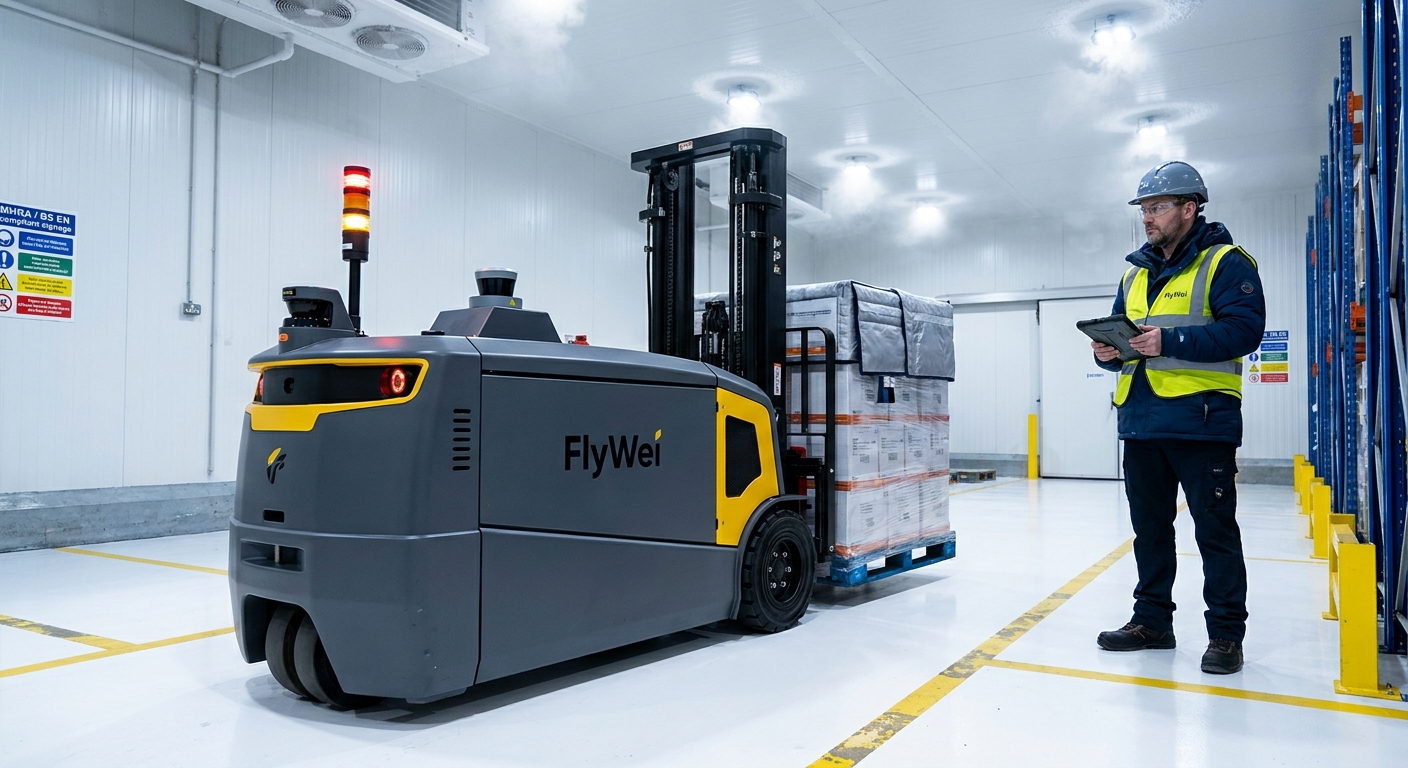
MHRA-compliant autonomous forklifts are driverless industrial trucks operating under PUWER 1998 and ISO 3691-4 with audit-grade telematics that satisfy a Medicines and Healthcare products Regulatory Agency Good Distribution Practice inspection. A 2026 Logistics UK skills survey points to a structural 34% shortfall in licensed UK forklift operators, and that gap lands hardest in MHRA-licensed pharma warehouses where every pallet move must be timestamped, traceable and chain-of-custody clean. Warehouse managers in Hatfield, Crewe, Burton-on-Trent and Coventry are now being asked to absorb double-digit volume growth, hold operator headcount flat, and walk a GDP auditor through every cold-chain temperature excursion: all in the same quarter.
Why this happens in UK pharma warehouses right now
UK Good Distribution Practice inspections in 2025 cited "deficient temperature-excursion records" and "incomplete chain-of-custody documentation" more often than any other operational finding, per the MHRA Inspectorate annual review. The two failures share one root cause: the warehouse depends on a human operator to read, transcribe and sign for events the system already captured electronically, and at 34% under-staffing, those operators are running short on time. Add a peak flu-vaccination push, a controlled-drugs audit and a January NHS resilience-stock build, and the warehouse manager faces three pressures at once.
The operating reality on the floor: licensed counterbalance and reach-truck operators are commanding 12% to 18% pay uplifts vs 2024; agencies cannot reliably fill weekend shifts; and the existing fleet's vehicle telematics rarely cross the bridge into the WMS, so each move still requires a human acknowledgement. The result is the classic UK pharma squeeze: under-staffed but over-audited.
Lever 1: Move human operators off pallet shuttles and onto exception work
The first lever is operational, not technical. Autonomous forklifts close the shuttle loop between goods-in, the QP-release staging zone, the 2°C to 8°C chamber and outbound consolidation. A warehouse manager who deploys three autonomous trucks across these moves typically frees six to nine operator-hours per shift: hours that go straight back into picking, cycle counts, GDP exception handling and short-dated stock rotation. Reframe the business case in those terms when you table it: not "fewer drivers" (which the works council will reject) but "more time on the work the auditor and customer actually pay for." The HSE workplace-transport guidance at hse.gov.uk/workplacetransport backs the same logic: the lowest-injury warehouses are the ones where pedestrians and trucks share the least floor time.
Lever 2: Integrate the trucks with M4 fleet orchestration and the existing WMS
The technical lever is orchestration. A standalone autonomous forklift moves pallets; a fleet under FlyWei M4 coordinates trucks across goods-in, QP staging, cold zone, and outbound, and exposes every move as a structured event the warehouse manager and GDP auditor can both query. M4 speaks VDA 5050 upstream and the operator's existing enterprise WMS downstream, so the truck inherits the WMS pick-list, the WMS receives the move-confirmation, and the temperature controller writes its chamber-state into the same event timeline. The warehouse manager stops being the human bridge between three disconnected systems, exactly the bridge GDP inspectors target.
Lever 3: Run PUWER + ISO 3691-4 conformity as audit evidence, not paperwork
The regulatory lever is making compliance visible. A FlyWei autonomous forklift is certified to ISO 3691-4 autonomous industrial trucks, operated under PUWER 1998, and supports the daily pre-use inspection routine the HSE expects. The audit-grade event log (every lift, every shift, every safety-stop, every battery swap, timestamped to UTC) becomes the GDP inspector's primary evidence pack on Day 1. That is the inversion warehouse managers describe most after deployment: compliance moves from a quarterly scramble into a query you run from the M4 dashboard.
Lever 4: Stage the rollout as a three-truck cold-zone pilot, then scale
The financial lever is sequencing. Start with three autonomous trucks in the 2°C to 8°C zone, paired with one human exception lead, and run a 12-week shadow against your current move log. Track three numbers: licensed-operator hours released per shift, GDP exception count, and pick accuracy in the adjacent picking aisle. A typical UK pharma warehouse pilot lands at 18 to 26 months payback on hardware alone, with the audit-evidence dividend (faster GDP inspections, fewer corrective actions) showing up inside month one. Scale next into goods-in and outbound consolidation. Reach-truck variants follow when high-bay racking comes into scope.
What FlyWei does here
FlyWei supplies UK pharma warehouse managers with autonomous counterbalance and reach-truck variants certified under PUWER and ISO 3691-4, orchestrated by M4, and integrated with the warehouse's existing enterprise WMS via VDA 5050 and standard REST. FlyWei fleet dispatch software handles cross-zone movement priorities so cold-chain pulls always pre-empt ambient consolidation. Our deployment team is UK-based: we walk every pharma site personally, capture the move log, build the shadow plan with the warehouse manager and QP, and stay on site through the first GDP audit cycle. We work with managers across UK pharma warehouses in Hatfield, Crewe, Burton-on-Trent, Coventry and the M1 corridor, and our autonomous forklift range covers counterbalance, reach, stacker and latent-jacking AMR variants from a single fleet manager. The conversation starts with your move log and your last GDP audit findings: the deployment plan follows from those two documents. Talk to FlyWei when your warehouse manager is ready to scope a three-truck cold-zone pilot.
Frequently asked questions
Do MHRA-compliant autonomous forklifts replace licensed UK forklift operators?
No. They redistribute operator hours away from pallet-shuttle duty toward exception handling, picking and GDP cycle counts: work the auditor and customer reward. Headcount stays; the work changes.
Will the trucks satisfy a GDP audit on Day 1?
The hardware ships PUWER + ISO 3691-4 certified. The audit-readiness comes from the M4 event log: every pallet move, battery swap, safety-stop and shift change timestamped and exportable. Most warehouse managers see GDP audit prep time drop by half within the first quarter.
What is the typical payback on a UK pharma cold-zone pilot?
Eighteen to 26 months on a three-truck pilot in a 2°C to 8°C zone, including integration and training. The audit-evidence dividend usually arrives inside month one.
Can the autonomous forklifts work inside a 2°C to 8°C chamber?
Yes. The FlyWei autonomous forklift range is rated for sustained operation in chilled pharmaceutical chambers, with battery chemistry and lubricants specified for the temperature profile.
How do they integrate with our existing enterprise WMS?
M4 talks the operator's existing enterprise WMS over REST or VDA 5050. The trucks inherit the WMS pick list and write back move-confirmations; the warehouse manager stops being the human bridge between systems.
Do they comply with the daily PUWER pre-use inspection rule?
Yes. The M4 dashboard surfaces the daily checks the HSE workplace-transport guidance expects, signed digitally and timestamped. The shift supervisor signs in the morning; the audit trail builds itself across the week.
What about controlled drugs and CD cabinets?
The trucks handle the upstream and downstream pallet moves; CD cabinet handling stays with licensed pharma operators. The audit-grade event log clarifies where each pallet sat at each moment, which is the inspector's usual line of questioning.