Cross-site pilots, keg lifts, palletiser handovers: three UK operations losing 25-35% of fleet hours at the handover point, and how to recover them.
You are 14 weeks out from Q4 peak. Your estate holds three UK sites, each running a different vendor's fleet under a different orchestration layer. The Midlands DC has a mainstream goods-to-person bot pool that speaks only to its own manager. The Yorkshire plant has driverless reach trucks from a tier-one MHE channel partner. The new southern cross-dock has six lifting AMRs from an early-stage startup. Each site's own director will tell you the fleet is running well. What none of them can tell you, because the data lives inside three separate closed stacks, is how many fleet hours you lose at the handover between shifts, between processes, and between sites. Across the estate this quarter, that number is probably one in four. Your Finance Director will notice before your Ops Director does.
The value in warehouse automation is not at the pick or the drop: it is at the handover, and that is where 25 to 35 per cent of your fleet hours are quietly spent idle.
1. The cross-site handover
When each UK site buys a vendor's fleet in isolation, the fleet-management layer becomes the same shape as the vendor's product catalogue. A goods-to-person bot from one supplier cannot take a task from a driverless forklift from another, even if the two machines are twelve metres apart on the same slab. That is not a technical limitation of either machine: it is a commercial choice by the fleet-manager vendor, and it is a choice you agreed to when you signed the closed bundled stack.
The published operational number to hold in your head is this: a networked fleet running one open orchestration layer over mixed hardware recovers 25 to 35 per cent of fleet hours that a siloed programme wastes on idle handoffs. Those hours are the single largest capex-free lever a Supply Chain Director controls in 2026. You do not need to buy more machines. You need the machines you already own to be able to hand a task to each other.
The mechanism is the open VDA 5050 protocol: a published messaging standard, backed by BSI-recognised industry bodies, that lets any compliant fleet-management layer instruct any compliant machine. If your next fleet-manager RFP does not require VDA 5050 conformance from the vendor and from every machine on the site, you have written a contract that pre-commits you to a closed stack for the length of the support agreement. That is usually five years. Five years is two peaks longer than most CFOs would knowingly authorise.
The question to ask in your next vendor meeting: "Show me a live production site in the UK or the EU where your fleet manager is orchestrating hardware from at least two other manufacturers, and let me speak to that customer without you in the room."
2. The line-to-truck handover
At a typical UK FMCG plant, the palletiser finishes a shrink-wrapped Euro pallet roughly every 90 seconds during a run. That pallet then needs to move six to twelve metres to the dispatch marshalling lane, where the yard tractor will collect it. In most plants that move is done by a manned counterbalance truck whose driver is also being pulled toward twelve other tasks: inbound raw materials, empty-pallet returns, line-side minor moves, the emergency the shift supervisor called in over the radio two minutes ago.
The operational cost of that competing demand is a documented average of 6.4 minutes of packaging-line stoppage per finished pallet handover. Multiply that by a plant running 80 finished pallets an hour across a 22-hour production day, and the arithmetic becomes uncomfortable fast: you are giving back the equivalent of a full production shift a day to a queue that never appears on the OEE dashboard because the palletiser is running fine; the pallet is just sitting there waiting for a truck.
A dedicated autonomous counterbalance running the same 90-second move at plus-or-minus 5 mm placement, on a fixed yellow-chevron corridor separated from free-navigation zones, does not compete with any other task. It runs the handover and only the handover. The kit itself is straightforward; an EN ISO 3691-4:2023-certified autonomous forklift, PUWER 1998 pre-use checklisted like any other truck, LOLER-inspected on the same annual cycle. The engineering is not the hard part. The hard part is deciding your palletiser output is a fixed-cadence process that deserves its own dedicated machine, and stopping trying to solve it with a shared manned fleet that will always lose the priority argument to the emergency-in-goods-in.
The question to ask on your next plant walk: "Where is our palletiser-to-dispatch move on the OEE report, and what would the number look like if we stopped hiding it inside 'handover'?"
3. The body-to-machine handover
RIDDOR-reportable manual-handling MSDs remain the largest single category of reportable injury in UK food-and-drink manufacturing. The HSE guidance is unambiguous: the risk sits at the lift, the turn, and the deposit; the moments when a human body takes the weight of a keg, a case, or a wrapped pallet under 1000 kg. Every one of those events is also an event on your Logistics UK insurance-premium curve for the following renewal.
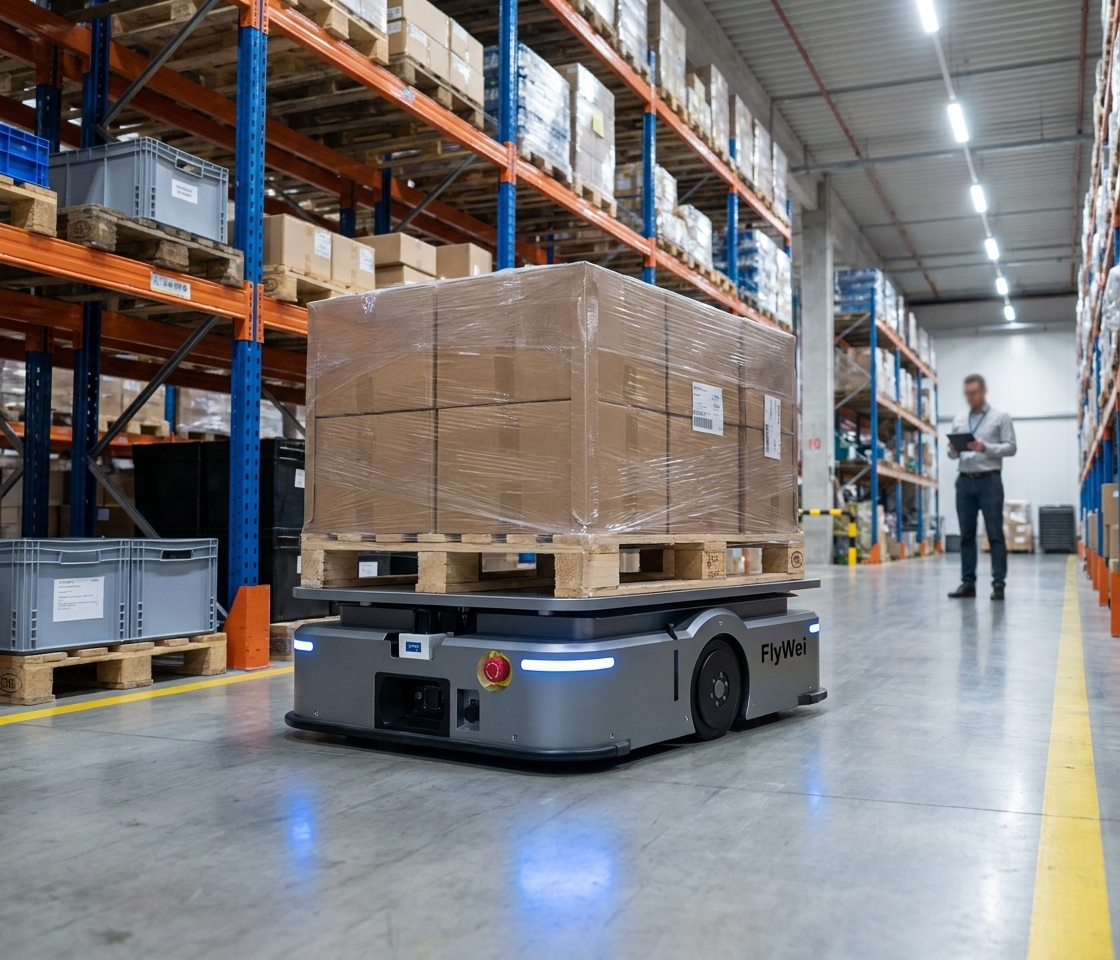
An autonomous lifting robot, a driverless AMR that jacks under a wheeled cage or pallet and moves it without a person under the load, replaces the pump-truck-and-shrink-wrapper handoff that dominates the incident log. The HSE line for the pattern is straightforward: eliminate the human under the load, then LOLER-inspect the machine like any other lifting appliance. The finance case is usually made on a five-year lease against a single year's RIDDOR-driven insurance premium hike plus one avoided lost-time incident, and the number closes without needing the labour saving to carry it.
The second-order case is quieter but larger. The UK manual-handling labour pool has been shrinking for four years running. The plant directors who are not planning for a smaller pool by 2027 are the ones who will be paying agency rates of £4,400 a week per unfilled shift to keep the palletiser fed. A lifting AMR is not a substitute for that person, the fleet still needs a supervisor on the slab, but it does mean the shift can run with fewer bodies at the highest-risk point on the line, and the bodies you do have are not being spent on the lift that will put them on the RIDDOR log.
The question to ask before the vendor slide deck opens: "How many of our RIDDOR-reportable events last year happened at the keg-to-pallet or pallet-to-cage handover, and would a lifting AMR have removed the body from that lift?" If the answer is more than three, the lifting AMR is not a productivity buy: it is a compliance-and-people buy that also happens to move faster than the manual method.
4. The fleet-ordering question
Notice what the three handovers have in common. Cross-site: a task cannot be passed between two machines because the fleet-management layer is closed. Line-to-truck: a task competes with unrelated work because the fleet is shared and unfocused. Body-to-machine: a task is done by a person because no autonomous option was specified to the handover point.
All three are ordering-and-contracting problems before they are machine problems. The Supply Chain Director who wins Q4 2026 will have three things in the contract that the director who loses it will not: open VDA 5050 orchestration written in as a hard requirement, dedicated autonomous units earmarked against fixed-cadence handovers rather than pooled with the shared fleet, and lifting AMRs specified at the handover points that currently produce the site's RIDDOR events.
A closed bundled stack (one vendor's fleet manager, that vendor's machines only, a five-year support agreement that ties you to that vendor's roadmap) will always look cheaper on the RFP scoresheet on day one. It costs you the option to fix any of the three handovers above without another purchase from the same vendor. The open path costs slightly more on the day-one scoresheet and gives you back the option value on years two through five. Option value is worth paying for. Q4 peak is where you cash the option.
The 2026 pattern to design around is not the machine: it is the handover. Machines have never been the bottleneck.
The arithmetic
- 25 to 35 per cent: fleet hours lost to idle handoffs in siloed cross-site robot programmes running closed bundled stacks
- 6.4 minutes: documented average packaging-line stoppage per palletiser-to-dispatch handover on a shared manned counterbalance fleet
- Plus-or-minus 5 mm, placement tolerance of an EN ISO 3691-4:2023 autonomous counterbalance running the handover as a dedicated task, 22 hours a day
- 1000 kg: load capacity of a lifting AMR that removes the body from the highest-frequency RIDDOR-reportable lift on a UK FMCG line
- £4,400 per week: indicative agency cost of one unfilled shift on a UK ambient distribution centre, and a useful anchor number for any fleet business case
What to do on Monday morning
- Pull the handover map, not the machine map. Ask your ops team to list every point on the site where a task passes from one machine or person to another. That list, not the machine list, is where your fleet hours are being spent this quarter.
- Count last year's RIDDOR events by handover location, not by department. If three or more events sit at the same lift-and-turn point, you have a lifting-AMR case that closes on compliance and insurance alone: before you have to argue the labour saving.
- Read the fleet-manager clause in your next RFP. If it does not require VDA 5050 conformance from both the fleet-management layer and every machine on the site, rewrite it before the RFP goes out. Five-year support agreements are two peaks longer than most CFOs would knowingly authorise for a closed stack.
If you would like a quiet, no-slides read of how an open VDA 5050 fleet would sit across your specific handovers (cross-site, line-to-truck, and body-to-machine) reply to this newsletter or leave a comment below. We will come to you, walk the slab, and put the arithmetic on your own numbers.