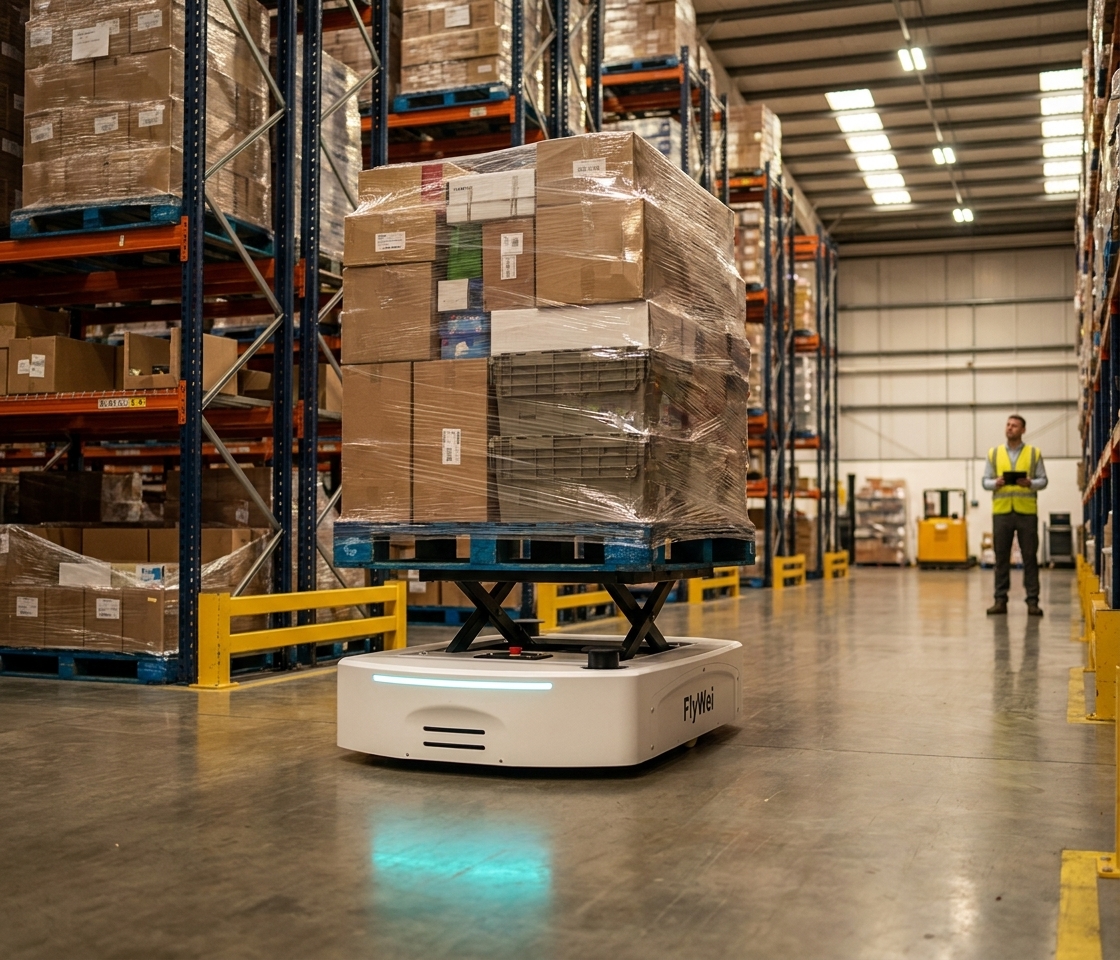
Retail DC, engineering, automotive JIS, pharma GDP, FMCG cross-site; five UK operations, one lesson: the throughput leak moved to the seams.
It's Wednesday morning and you're on a call with the site manager of the DC you re-fitted last spring. The autonomous fleet is running. The trucks are all in green on the dashboard he screenshotted at 06:00. No safety incidents this quarter, no HSE flags, no dropped pallets. And yet the goods-in throughput report he just sent through says the site is running 8% under last year's manual baseline. Not the same aisles, not the same day-rate to compare against: 8% under. Peak lands in fourteen weeks and the CFO already told you in April that this year's capex ask has landed. Somewhere between the vendor demo, the phased install, the handover to the shift teams and the second-week onboarding of the two new operations supervisors, the number moved. That is the conversation this newsletter is about.
Across five very different UK operations we've walked through in the last week (retail DCs across a five-to-nine site estate, an engineering warehouse, a Tier-1 automotive plant, a pharma fulfilment centre and a cross-site FMCG group) the throughput leak has moved to exactly the same place: the seams. Between trucks. Between sites. Between what a machine did and what the compliance record says it did.
1. Standardise the fleet before you standardise the truck
At a UK retail group running between five and nine brownfield DCs, the supply-chain director's problem this quarter isn't which truck to buy. It's how to run a mixed AGV forklift fleet (some sites on second-generation kit already, some sites on nothing yet, one site with a pilot that quietly ran over its trial window) across brownfields, before peak 2026 volume lands, without downing any site for the retrofit and without asking the CFO for a whole-estate capex bulge she has already declined once this year.
The lever isn't the truck. It's the fleet standard (the message set, the safety envelope, the traffic protocol every truck must speak) decided first, then written into every subsequent lease. A truck spec'd against a common fleet standard is a truck you can move between sites at peak, re-lease when a site's volume shape changes, retire on its own economic clock and triple-shift for the eight weeks in November when you actually need it. A truck spec'd against a single-site bundled stack is a truck stranded at that site the day the contract renews, and worth roughly nothing to the site 40 miles up the M6 that suddenly needs three more units for pre-Christmas overlay.
Two questions to take into the next vendor meeting. Does the truck speak the open VDA 5050 fleet-manager protocol out of the box, or does it require a proprietary bridge that the vendor happens to sell? And does the truck's PUWER 1998 pre-use checklist survive being handed to a different site's shift supervisor without a bespoke training week? If either answer is a no, you don't have a fleet truck. You have a single-site truck dressed up as a fleet truck, and you will find out at peak.
2. Take the repeatable loop off the agency day-rate ledger
At a UK engineering warehouse (heavy pallets, repeatable loops between goods-in and the machining cell, four bays that back onto the yard and two dispatch lanes) the warehouse manager's throughput has been stalled by two things at once. Agency counterbalance day-rates are up again this year on last, and the PUWER pre-use and LOLER thorough-examination backlog on the manual fleet is quietly eating supervisor hours no one has priced against a P&L line.
The AGV forklift argument here is not "replace all your drivers." It is narrower and it is stronger. Take the repeatable loop (the same 46-metre run from goods-in to the machining cell, twelve times an hour, every shift, every day) off the agency ledger and put it on a fleet-managed truck that runs the same loop every hour, PUWER-compliant, evidence captured to the fleet manager rather than to a paper log the supervisor has to countersign at 03:00. Free your remaining drivers for the non-repeatable work they were actually hired for: yard shunts, decanting, exception handling, the awkward pallet the AGV won't touch.
Ask in the next meeting what a single uncovered day-shift on that loop costs, all-in: agency spend plus supervisor time redirected plus LOLER backlog plus lost throughput at the machining cell that had to slow down for the missing pallets. A UK warehouse director we walked through this last week landed on £4,400 per uncovered shift once the LOLER backlog was priced in properly. The AGV lease was less than that per week.
3. Hold JIS when one driver in eight isn't there
At a UK Tier-1 automotive plant, JIS and line-side flow are starving because counterbalance driver vacancies routinely sit above one in eight on the roster, and the LOLER-flagged hand-lifting of the heavier sub-assemblies has finally caught up with the plant director's inbox in the form of two internal HSE flags in six weeks. This is not a "test some robots on the aisle" problem. It is a "the whole line stops if the goods-in-to-line-side loop misses a JIS beat" problem, and it is the problem the plant director is now personally answerable for.
A driverless counterbalance running that specific loop (Tier-1 goods-in to line-side, JIS-sequenced from the plant's own schedule, LiDAR SLAM navigation, taking task assignment from the central fleet manager rather than a supervisor's radio call) closes the vacancy at exactly the point it hurts most. The point is not that the plant needs fewer people. It is that the one loop that stops the line if it misses a beat can no longer be the one loop that depends on filling an agency shift on a Sunday night for a Monday 06:00 start.
Two questions for the vendor. What is the truck's behaviour when the line-side buffer is full and the next sub-assembly is ready: does it hold pattern, does it re-route, does it stop safely? And when a sub-assembly gets moved off-sequence for any reason, is there a fleet-manager record of when, where and by which asset, or does the sequence break silently?
4. Make the audit trail a by-product, not a task
At an MHRA-regulated pharma fulfilment centre, the supply-chain director isn't losing hours to picking. She is losing GDP chain-of-custody evidence every time a manual pallet-truck move happens without a scanner event. And it isn't that the move itself is wrong. The pallet gets where it needs to be, on time, undamaged. The evidence is what's missing, and in an MHRA audit "we moved it" and "we can prove we moved it, timestamped, tamper-evident, exportable" are not the same sentence at all. One is an operational fact. The other is the difference between a green audit and a finding on a batch that then has to be quarantined pending re-verification.
A lifting automated robot (jacking, carrying, setting down palletised or cart-based loads under fleet-manager instruction) writes a tamper-evident, timestamped chain-of-custody event for every jack, every carry, every set-down and every idle-park it performs. The audit trail stops being a task the picker has to remember at the end of a nine-hour shift and becomes a by-product of the move itself. That is not a productivity story. It is a compliance-cost story, and in GDP-regulated fulfilment the compliance-cost line (audit remediation, batch quarantine, re-verification, delayed release) is often larger than the labour line the CFO is being asked to reduce.
Question for the vendor: is every event (jack, carry, set-down, idle-park, mode change, exception handover) written to the record, and is the record exportable in the format the MHRA inspector will actually ask for on the day?
5. Stitch the sites back together with one open layer
At a UK FMCG group running cross-site robot pilots (one pilot per site, one vendor per pilot, three different fleet managers, four different maintenance contracts) the supply-chain director is watching 25 to 35 per cent of her fleet hours disappear into idle handoffs between siloed vendor stacks. Each site's fleet is fine on its own. The site KPIs are all green. The peak-season network flex is gone, because the fleets can't talk to each other, and the trucks she over-ordered at Site B in July cannot be temporarily re-hosted at Site D in October when the seasonal shape shifts.
The lever here is one open orchestration layer (VDA 5050 native, fleet-manager-agnostic) sitting over every site, so that a truck sent up to a peaking site in October is a truck that already speaks the receiving site's fleet manager on arrival. This is the difference between a closed bundled stack and an open fleet. At peak, you can move capacity where the volume goes. At contract renewal, you can move vendors without stranding the trucks you already lease. Twenty-five to thirty-five per cent of fleet hours is the single largest capex-free lever a UK Supply Chain Director controls this year, and it lives entirely at the seams: the seams between sites, between vendors, and between the pilots that were bought site-by-site because that's how the pilot budget was signed off.
The arithmetic
Pulling the five together, the numbers you can take to a board paper this week:
- One uncovered day-shift on a repeatable engineering loop, priced with agency + supervisor + LOLER backlog + lost throughput: ~£4,400.
- Counterbalance driver vacancy rate on UK Tier-1 automotive lines: above 1 in 8, routinely, and worse on Sunday-night-into-Monday-morning shifts.
- Fleet hours lost to idle handoffs between siloed cross-site vendor fleets: 25-35%; the single largest capex-free lever in the estate.
- A pallet moved in an MHRA-regulated fulfilment centre without a scanner event: 1 GDP audit finding waiting to happen; priced in remediation, not labour.
- A truck spec'd against an open fleet standard versus a single-vendor stack: portable at peak, portable at renewal, financeable on its own economic clock.
What to do on Monday morning
Three things you can do this week without a business case, without a vendor call and without a capex ask:
- Pull last year's shift roster and mark, in red, the one repeatable loop that missed an agency cover more than three times. Price that loop with agency, supervisor time, LOLER backlog and downstream lost throughput. That is your first AGV business case, and it is almost never the loop the vendor wants to talk about: vendors quote the glamour loop; the money is in the boring one.
- Open the standing order or lease for whichever autonomous truck is already on your slab and check whether it speaks VDA 5050 to a fleet manager you own, not one hosted at the vendor. If it doesn't, you don't have a fleet: you have a truck, and you'll find out when the contract renews.
- If you run more than one site, ask each site manager for the format of their compliance record: PUWER pre-use, LOLER thorough examination, GDP scan events, HSE near-miss log. If the formats don't match across sites, you are one HSE or MHRA visit away from finding out at the worst possible time.
If any of the above matches something on your slab this week, and you'd like a quiet read of an open-fleet design tailored to your operation (one that speaks VDA 5050 to whatever you already run, holds PUWER and GDP compliance as by-products of the moves themselves, and lets you move capacity across sites at peak) reply to this or drop me a comment below. No demo, no deck, just the arithmetic and a drawing.