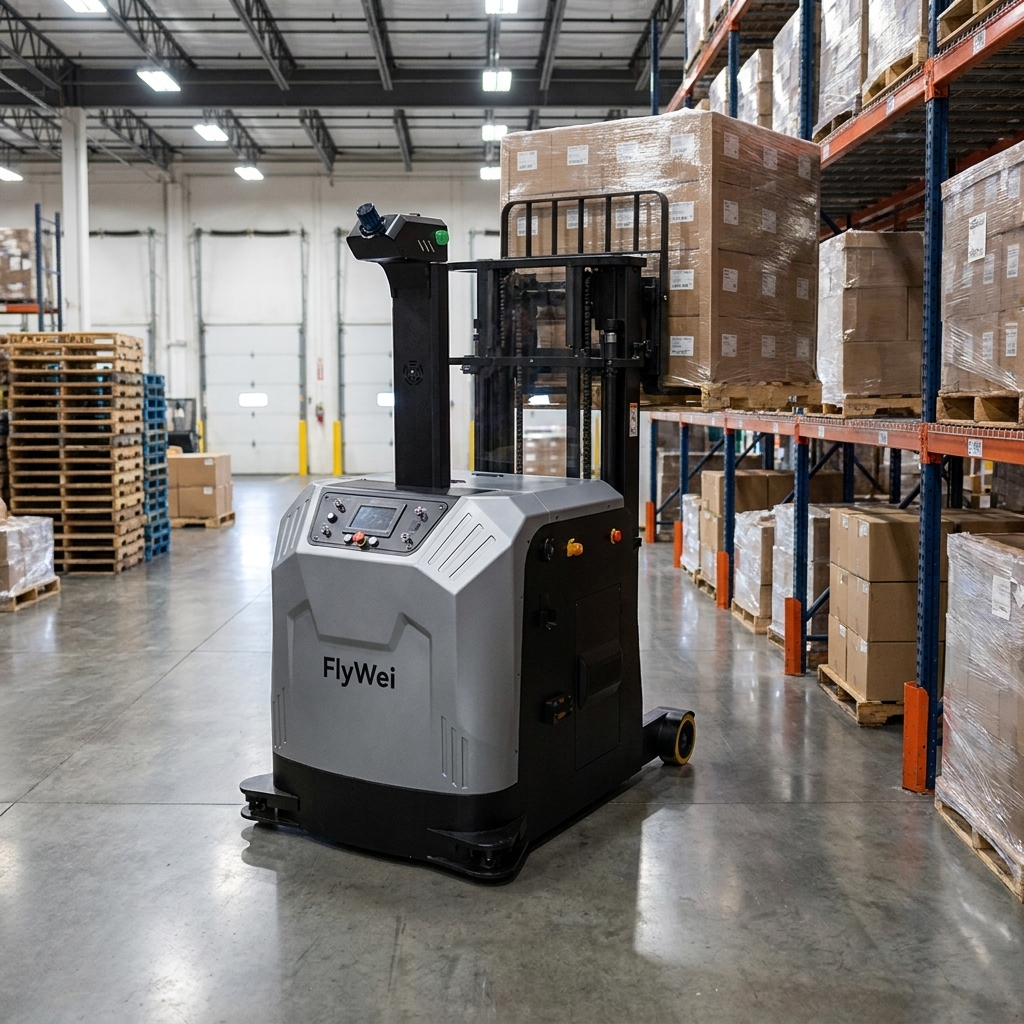
Cold-chamber cycle times, operator-hour ceilings and lump-sum quotes you can't compare — three patterns from this week, one unit that resolves all three.
It is late August. Your Q4 volume plan landed a fortnight ago and it is not a rounding error above last year. You have the racking. You have the dock doors. You have the trailers booked. What you do not have is a settled answer to a much smaller question: who is going to be sat on the trucks in week 47, and what will each pallet they move actually cost you? Somewhere between the labour plan, the cold-store rota and the capex paper still sitting with finance, that one question has been split into three problems owned by three different people. It is not three problems. It is one.
The through-line across everything we published this week: your operation does not buy forklifts, it buys pallet moves — and nearly every warehouse automation decision that stalls in the UK stalls because nobody has priced the move.
1. The conditions the move actually happens in
Start with the hardest place on your estate, because that is where the difference between a truck and a move is easiest to see.
In a chilled or frozen plant, the constraint on the blast-freeze-to-despatch leg is almost never the machine. It is the rota. Cold-chamber work is rotation work: time in, time out, warm-up, cover for the person warming up, and a supervisor holding the whole thing together while the despatch booking slot creeps closer. When one person on that rota does not turn up, the leg does not slow down gracefully — it stops, and the plant risks the slot.
Here is the fact that reframes it. A driverless forklift holds the same cycle time at minus 25°C as it does at ambient. There is no rotation, no warm-up, no cover requirement, because there is nobody in the seat to rotate. That is precisely why UK cold-chain plants that automate at all tend to automate the blast-freeze-to-despatch leg first, rather than picking. It is not that the picking is harder. It is that the despatch leg is where the human constraint and the commercial consequence sit on top of each other.
The wider lesson generalises off the cold store. Every leg on your site has an environmental tax: temperature, dust, noise, height, awkward floor, long unproductive travel. That tax is paid by the person, not by the pallet. When you compare a manned move and a driverless move, you are not comparing two ways of doing the same work — you are comparing work that degrades under conditions with work that does not.
Ask in your next vendor meeting: what is your quoted cycle time at my worst operating condition, not at your demo-hall condition — and will you put that number in the contract?
2. The ceiling you cannot recruit past
Now walk out to the ambient side, and specifically to a shared-user 3PL site running multiple clients under one roof.
Ask a site manager there what caps their peak and you will usually get an answer about space. It is rarely space. On most shared-user sites the ceiling is licensed forklift operator hours. You can have racking to spare, dock doors to spare and a yard that flows, and still be unable to move another pallet after 14:00 because there is nobody left qualified to move it. Racking does not have a licence. Dock doors do not have a shift pattern. Operators have both.
This is why the peak-cover conversation goes round in circles every autumn. Agency cover is the standard answer, and it is a genuinely reasonable one — until you notice you are paying a premium for the least familiar person on site to do the most time-critical work in the most congested weeks of the year. The premium is visible. The induction time, the supervision load, the near-miss rate and the damaged-stock rate are not, at least not on the invoice.
The useful reframe here is boring and it works: stop counting trucks and start counting seat-hours by leg. Which legs on your site genuinely need judgement, negotiation with a driver, or a decision about damaged stock? Which are repeatable A-to-B pallet moves that happen to require a licence because a human is sitting on the machine? An automated forklift, in the plain sense — a standard counterbalance, reach or pallet truck fitted with navigation and safety sensors so it moves pallets without a driver — is aimed squarely at the second category and is largely useless against the first. Knowing your split is the whole exercise.
Ask in your next vendor meeting: which specific legs on my site does your machine take off the licensed rota, and which does it leave exactly where they are?
3. The denominator on the quote
Then there is the reason so many of these projects die quietly in a finance inbox rather than on the warehouse floor.
A capex committee is not hostile to automation. It is hostile to numbers it cannot compare. When an autonomous forklift proposal arrives as a lump sum — machines, integration, commissioning, software, support, all in one figure with a payback period bolted on the end — the committee has no way to test it against the thing it is actually competing with, which is agency labour at peak, priced per hour. Two numbers in two different units do not make a decision. They make another meeting.
The fix is a denominator. Convert the lump sum into a cost per pallet move, over a defined leg, at a defined volume, across the defined life of the asset. Include the unglamorous lines, because they are real either way: energy and charging, the maintenance regime, spares availability, floor-marking and infrastructure changes, and statutory inspection. That last one catches people out, so state it plainly in the paper: autonomous forklifts are driverless industrial trucks moving palletised loads under software control, and in the UK they remain subject to the same statutory duties as manned trucks — including thorough examination of lifting equipment at least every 12 months under LOLER 1998. Removing the driver does not remove the duty holder, and any proposal implying otherwise should worry you more than a high price would.
Once the quote is expressed per move, the argument changes character entirely. You are no longer asking a committee to believe in robotics. You are asking them to compare two costs per pallet move at your real volume, with your real peak profile, and pick the lower one. That is a conversation finance is extremely well equipped to have — and it is the conversation most vendors quietly avoid, because a per-move number is testable after go-live and a lump sum is not.
Ask in your next vendor meeting: give me your quote as a cost per pallet move on this named leg at this named volume — and tell me what happens to that figure if my volume lands 20% under plan.
4. The right machine per leg, not one badge across the estate
The three patterns above converge on one uncomfortable procurement point.
If your unit is the pallet move, and your legs differ — a sub-zero despatch leg, a long ambient shuttle run, a mixed-client marshalling area, a night replenishment aisle — then it is close to arithmetic that no single manufacturer builds the best machine for every one of them. Machines have genuine specialisms: cold tolerance, mast geometry, footprint in a narrow brownfield aisle, battery chemistry and charge behaviour under a two-shift pattern, how the safety envelope behaves around pedestrians in a congested marshalling zone.
The usual route into automation is a closed bundled stack: one badge, one software layer, one commercial relationship covering the whole estate. It is administratively simple, and that simplicity is worth something. But it prices every leg at the same machine, and it makes the second and third phases of your rollout a negotiation with a single counterparty who knows you cannot easily leave. The tier-one MHE channel is structurally built to sell you more of what it already sells you.
FlyWei exists on the other side of that trade. We are an independent, vendor-neutral UK systems integrator of autonomous forklifts and AMRs — we integrate the best robots across multiple manufacturers. We are not an OEM, not a reseller, not a distributor. What that means practically is that when we look at a site, the machine selection question is genuinely open per leg: the cold despatch leg can take one manufacturer's truck, the ambient shuttle another, and the fleet still runs as one supervised operation rather than four disconnected pilots.
The honest counterpoint: an open fleet demands more of the integration layer, and you should interrogate that layer hard rather than take it on faith.
Ask in your next vendor meeting: if a better machine for this specific leg exists from another manufacturer in two years, what exactly in my contract and my software stops me putting it in?
The arithmetic
- A driverless forklift holds the same cycle time at minus 25°C as it does at ambient — which is why UK cold-chain plants deploy them on the blast-freeze-to-despatch leg first rather than on picking. The machine does not pay the environmental tax; the rota does.
- An automated forklift is a standard counterbalance, reach or pallet truck fitted with navigation and safety sensors so it moves pallets without a driver. You are not buying an exotic asset class. You are buying a familiar truck with the seat constraint removed.
- Autonomous forklifts remain subject to the same statutory duties as manned trucks in the UK, including thorough examination of lifting equipment at least every 12 months under LOLER 1998. Budget the inspection regime into the per-move figure from day one.
- Illustrative worked example, not a benchmark: say a 40,000 sqm shared-user site runs two shifts and identifies one repeatable inbound-to-reserve leg. Divide the fully loaded five-year cost of automating that single leg — machines, integration, energy, maintenance, statutory inspection — by the number of pallet moves that leg will carry over the same five years. Set the result next to your loaded agency cost for the same move at peak. Whichever way it lands, you now have one comparable number instead of two incomparable ones.
- Illustrative worked example, not a benchmark: take your peak week and count how many licensed operator hours you needed versus how many you actually had. The gap, expressed as pallet moves not made, is the size of the problem you are procuring against — and most sites have never written that number down.
What to do on Monday morning
- Write down your worst leg and its conditions. One leg, named, with its real operating environment — temperature, aisle width, floor condition, travel distance, congestion at peak. Not the whole site. One leg. Every useful conversation you have after this starts from that page.
- Split your seat-hours into judgement and repetition. Go through last week's rota by leg and mark each one: does it need a person's judgement, or does it need a licence purely because a person is sitting on the machine? Total the second column. That total is your addressable automation scope, and it is usually a different number from the one people guess.
- Send every open quote back with one instruction. Ask for it restated as a cost per pallet move, on a named leg, at your named volume, over the asset life, inclusive of energy, maintenance and statutory inspection. What comes back — and how quickly — tells you a great deal about who you are dealing with, at zero cost to you.
If you would like a quiet read of what an open-fleet design would look like on your worst leg — vendor-neutral, per-move numbers, no badge loyalty — reply to this edition or leave a comment. No deck, no pitch, just the arithmetic on your site.