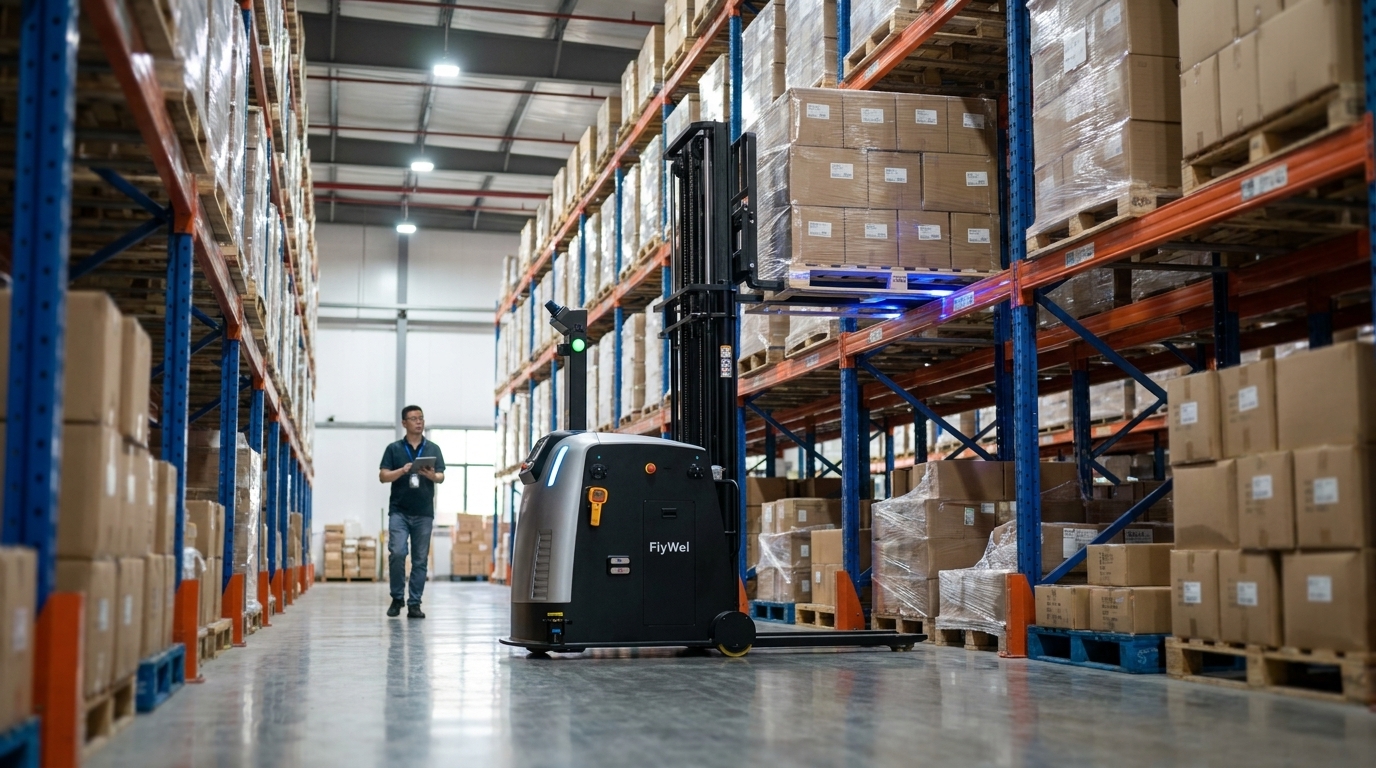
Leasing terms, safety validation and the control layer: three patterns from this week, and why they decide what your fleet is worth in year five.
The pallets moved. The plan didn't.
Somewhere in the UK this quarter, a warehouse director is going to stand in front of a fleet of driverless trucks that work perfectly and are, operationally speaking, stuck. The machines are fine. The batteries hold. The navigation is clean. What has changed is the work: a client contract has moved to a different site, the shift pattern has gone from two to three, and the aisle they were commissioned around is now storing something else entirely. The question on the table is simple and nobody can answer it quickly — what does it take to point these at the new job? Somewhere between the answer and the silence sits the whole economics of the thing.
The through-line across everything we published this week is that the truck is the cheap part of the decision, and the layers nobody quotes you on — the control layer, the safety evidence and the funding shape — are what determine whether your fleet still earns its keep in year five.
1. Re-tasking: how fast can this fleet be told to do something else?
Every automation business case is written against a picture of the work as it looks today. Every 3PL operator knows that picture has a half-life measured in contract terms, not equipment terms. The gap between those two clocks is where fleets go to die — not scrapped, just quietly under-used, running the one flow they were commissioned for while the rest of the operation moves around them.
The mechanism is worth being precise about, because it is usually described in marketing language and it is actually an engineering fact. As we set out this week, AMR controllers are the onboard computers that make a mobile robot controllable: they run navigation and motion control, enforce the safety interlocks, and carry the messaging link up to a fleet manager. That last clause is the commercial one. The messaging link decides who is allowed to give this vehicle work. If it only accepts orders from the manufacturer's own control layer, then your fleet's re-taskability is not a property of your operation — it is a property of somebody else's roadmap.
This is why the ops directors who get burned are rarely the ones who bought the wrong robot. They are the ones who bought a perfectly good robot with a closed order interface, and then discovered that a change any driver could have absorbed in a toolbox talk — new client, new drop sequence, new site layout — requires a vendor engagement, a scoping call, and a change-request price. The robot could do the work. The control layer would not accept the instruction.
The specification fix is unglamorous and it happens before purchase, not after. You write the control interface into the requirement, not the vehicle spec: what protocol accepts a job, who is licensed to send one, what happens to that licence if the supplier is acquired, and whether a second manufacturer's vehicle can be given work through the same layer. Fleets specified this way survive contract churn because the work instruction outlives the vehicle that happens to be executing it.
Ask in your next vendor meeting: if we win a contract at a different site next year and want these vehicles working there under our own fleet software, what exactly do we have to buy, and from whom?
2. Buffer recovery: the leg that stops the line
Ask a plant director what automation is for and you will often get an answer about labour. Ask them what actually cost them last quarter and you will get an answer about the palletiser.
Line-end pallet flow is one of the few places in a warehouse where a transport delay converts directly and immediately into lost production. The discharge buffer starves, the palletiser stops, and the shift target goes with it — and unlike a picking backlog, you cannot recover it later in the day by working harder. The output is simply gone. That asymmetry is what makes the line-end leg a genuinely different automation problem from the ones it gets grouped with: it is not a productivity play, it is an availability play.
What we published this week on forklift AGVs makes the definition plain: a forklift AGV is a driverless counterbalance, stacker or reach truck that moves palletised loads along mapped routes under central fleet control, and UK work equipment law applies to it exactly as it applies to a truck with a driver on board. Both halves of that matter here. The first half tells you it can hold a repeatable cycle time against a buffer — which is the whole point, because a buffer does not care about average performance, it cares about worst-case gaps. The second half tells you that swapping the driver out does not swap the duty out, which we will come back to.
Sizing the leg is where most business cases go soft. Take an explicitly illustrative example so the shape is visible: say a line discharges a pallet every four minutes, the run to the reserve lay-down and back takes six, and the buffer holds three pallets. On paper one vehicle is short and two is comfortable — but the honest number is set by the worst ten minutes of the shift, not the average, and by how long the buffer can absorb a vehicle going to charge. Those figures are hypothetical and yours will differ; the discipline is what transfers. Size against the buffer's tolerance for a gap, not against a daily throughput total, and you will avoid the two classic failures: the fleet that is technically adequate and practically always one vehicle short at changeover, and the fleet that is twice the size it needed to be because nobody measured the recovery window.
Ask in your next vendor meeting: what happens to the buffer during a charge cycle and a fault recovery, and can you show me that on our cycle times rather than a reference site's?
3. Validation: evidence on your floor, not assurance on paper
There is a category of automation project that stalls not at the technical gate but at the qualification gate, and it is almost always the same failure: the safety case was assumed to travel with the machine.
It does not. As this week's piece on safety controllers set out, safety controllers for mobile robots are the certified hardware that executes a robot's safety functions independently of its navigation software — and under PUWER 1998 they must be validated as part of your work equipment, not accepted on a supplier's assurance. Read that twice if you have ever signed off a fleet on the strength of a certificate pack. The certificate tells you the component is rated. It does not tell you the function performs correctly in your aisle, at your floor gradient, with your pallet overhangs, next to your pedestrian crossing point.
The word doing the work is independently. Navigation and safety are separate layers, rated separately, and the whole logic of a rated safety function is that it holds when the clever layer above it is wrong. That is what you are evidencing: not that the robot navigates well, but that when navigation is mistaken the protective function still stops the machine within a distance you have measured on site.
Practically, that means an on-floor validation regime built around your worst locations rather than your typical ones — the blind corner by the dock, the point where an aisle crosses a walkway, the ramp. It means recorded stopping distances at the speeds you actually run, not the speeds in the datasheet. It means a named person who owns re-validation when the layout changes, because a layout change is a change to the work equipment. And it means keeping the safety evidence in a form that does not depend on continued goodwill from one supplier, because auditors ask for it years after the commissioning team has moved on.
There is an independence argument buried in here that is worth making explicit. If the same organisation supplies the vehicle, the control layer and the safety evidence, then your assurance chain has a single point of failure that is commercial rather than technical. Separating who supplies the machine from who evidences it working safely on your floor is not bureaucracy — it is what makes the evidence worth anything.
Ask in your next vendor meeting: which safety functions are executed by rated hardware independent of navigation, and what does your on-site validation protocol measure at our speeds and our layout?
4. Cost shape: fixing what the finance committee actually rejects
Most autonomous forklift business cases that fail do not fail on merit. They fail on timing — a sound operational case arrives in a year with no capital headroom, gets deferred, and the site carries another twelve months of agency cover and unmanned night shifts while everyone agrees in principle.
The instrument that unsticks this is boring, which is why it is under-used. Warehouse robot leasing converts an autonomous forklift fleet from a single capital purchase into a fixed monthly operating cost over a three, five or seven-year term, with maintenance, fleet software and support bundled into the same payment. The operational effect is that the decision stops competing against every other capital request in the building and starts being assessed against the cost it displaces, month by month, which is the comparison that was always the honest one.
But the term length is a specification decision, not a finance detail, and this is where the week's threads tie together. A seven-year term is a seven-year bet that the work stays roughly the same shape — so it belongs to a fleet whose control layer will accept new instructions and whose safety evidence you own. Sign a long term around a closed stack and you have not spread the cost of a fleet; you have financed a commitment to one supplier's roadmap and paid for the privilege monthly. Shorter terms cost more per month and buy you the option to change. That trade is the actual decision, and it should be made by the operation, not inherited from whatever the funder proposes.
Ask in your next vendor meeting: what is bundled into the monthly payment, what happens at end of term, and what does it cost us to re-task or relocate this fleet mid-term?
The arithmetic
- Leasing converts a lump into a line. An autonomous forklift fleet moves from a single capital purchase to a fixed monthly operating cost over a three, five or seven-year term, with maintenance, fleet software and support bundled into the same payment — which is what lets the case be judged against displaced cost rather than against the capital queue.
- The control layer is the asset. AMR controllers run navigation and motion control, enforce the safety interlocks, and carry the messaging link up to a fleet manager. Whoever the messaging link answers to is who can put your fleet to work.
- The duty does not leave with the driver. UK work equipment law applies to a driverless counterbalance, stacker or reach truck exactly as it applies to a truck with a driver on board.
- Safety is a separate rated layer. Safety controllers execute their functions independently of navigation software, and under PUWER 1998 they must be validated as part of your work equipment — not accepted on a supplier's assurance.
- Sizing follows the worst case, not the average. Illustrative only: say a line discharges every four minutes, a round trip takes six, and the buffer holds three pallets — the vehicle count is decided by the worst ten minutes of the shift and the charge window, not by the daily total.
What to do on Monday morning
- Write down the three legs that stop production if they stall, with the buffer tolerance for each — how many minutes of gap before something downstream stops. That list, not a vehicle count, is the real automation brief, and it takes an afternoon on the floor to produce.
- Pull the safety evidence you currently hold on any automated or semi-automated equipment on site and check whether it is component certification or on-floor validation at your speeds and layout. If it is the former, book the validation before you buy anything else.
- Ask your finance lead what term length they would actually approve — three, five or seven years — before you scope the fleet. The answer changes what you should specify about re-tasking, because the longer the term, the more the open control layer is worth.
If any of this is live for you at the moment, reply to this edition or drop a comment. We are happy to talk through what an open, multi-manufacturer fleet would look like on your floor — a quiet read of the design, no pitch, no obligation.