Peak put-away, line-end stalls and leased co-packing halls all fail at the same layer, and Q4 capacity has to be committed while there is still time to install.
Somewhere in your operation this week, a pallet landed on the floor at goods-in and sat there. Not because anyone made a bad decision, and not because the pick face was short of people. It sat because the person who moves pallets from where they land to where they belong was doing something else: covering a trailer, chasing a check weigher, or simply not booked in for that shift. By the time the pallet moved, the put-away wave had slipped, the replenishment run behind it had slipped, and the shift report recorded the delay against picking. Picking was never the problem. The move was the problem, and the move has no owner.
The through-line across everything we published this week: the layer that breaks your shift is the repetitive pallet-move leg between the fixed points of your operation, and it is the one layer you can automate without rebuilding the building.
Four articles, four sectors (e-commerce, drinks manufacturing, third-party co-packing, retail distribution) and the same shape underneath each of them. Something lands. Something else needs it. The connection between the two is staffed by whoever is available. Below are the levers that actually move that layer, and the questions to put to anyone selling you a fix.
1. Put-away cycle time at goods-in
The dock-to-bulk leg is the least glamorous movement in a distribution centre and the one that governs everything downstream. Pallets arrive in bursts dictated by the transport plan, which you do not control. They have to clear into reserve racking at a steady rate, which you do: right up until the person doing it is pulled onto something more urgent. When put-away cannot clear the goods-in floor, the floor becomes the buffer, the buffer becomes congestion, and congestion becomes a wave of store replenishment landing late.
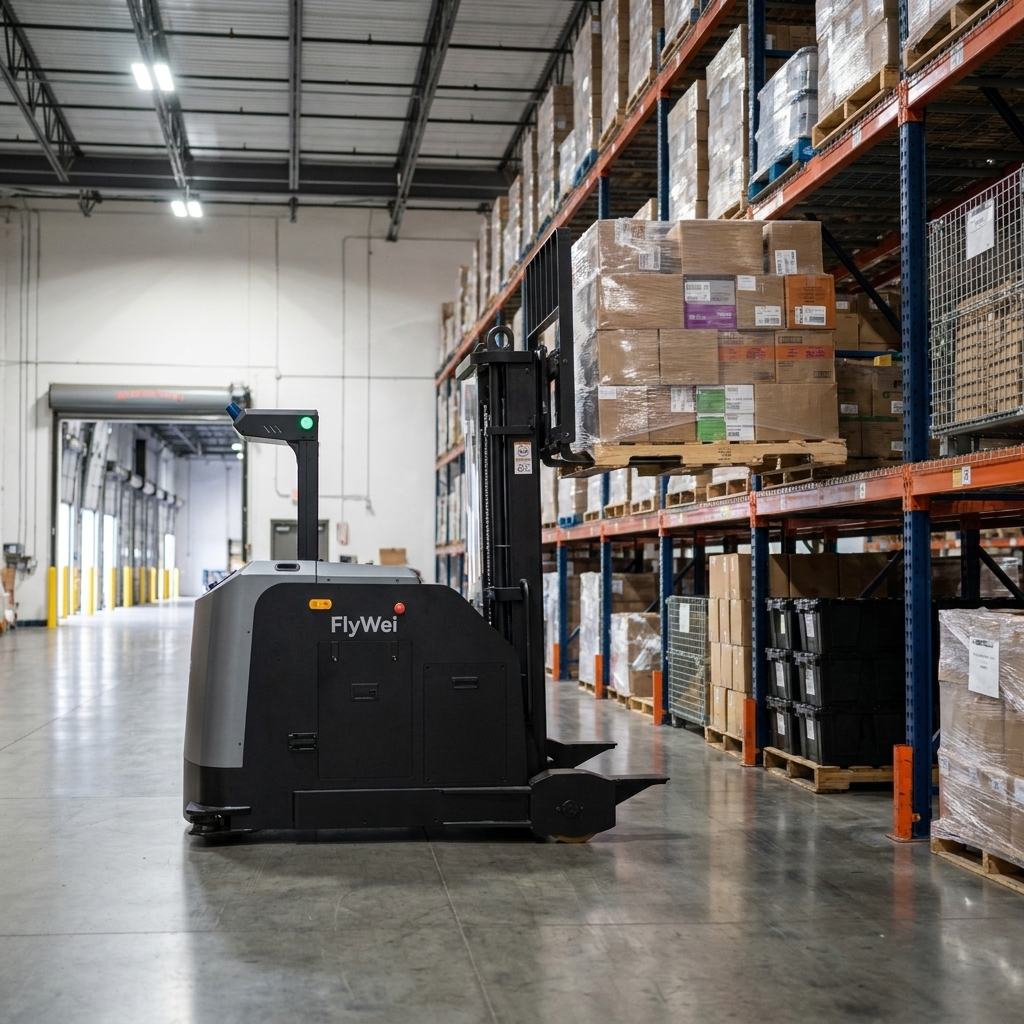
What makes this leg the right first target is not that it is difficult. It is that it is monotonous, defined, and repeated hundreds of times a shift along a route that barely changes. A driverless industrial truck moving palletised loads along a defined route under software control, with no operator on board, is a precise description of what this leg needs, and a poor description of what your licensed operators should be spending their shift on. The skill you are short of is not pallet-shuffling. It is the judgement work: damage calls, exception handling, awkward loads, trailer decisions.
The trap is scope creep. Sites that try to automate goods-in and the pick face and marshalling in one programme spend eighteen months designing and nothing runs. Sites that take the single worst repetitive leg, instrument it, and prove the cycle time, tend to have a second leg running before the first business case is even reviewed.
Ask in your next vendor meeting: which single leg does this design cover on day one, and what is the measured cycle time on that leg before we add anything else?
2. Line-end evacuation and the buffer that fills at changeover
In a drinks plant the arithmetic is brutally simple and everybody on site already knows it. The line runs at a rate. The line-end accumulates pallets at that rate. If the buffer fills, the line stops. Every minute of that stop is production you do not get back, because the line was already the constraint.
The reason line-end evacuation is so often the failure point is that it depends on counterbalance cover that varies by shift. Days are usually fine. Nights are thinner. Changeover, when the buffer fills fastest because the line is running down one SKU and building another, is exactly when the cover is stretched thinnest across the plant. And promotional peaks stack all three problems into the same fortnight.
A driverless truck that lifts, carries and stacks palletised loads under software control does not vary by shift. That is the entire point. It runs the same evacuation loop at 02:00 that it runs at 14:00, at the same rate, without a handover briefing. What it will not do is absorb a badly designed buffer: if the line-end lay-down area is too small for the run rate, automation exposes that faster than people do, because a machine will not improvise a second stack in a walkway the way a person under pressure will. Treat the buffer geometry as part of the design, not as something the robot works around.
Ask in your next vendor meeting: at our line rate and changeover pattern, how many pallets of buffer does this design need, and what happens to the line when the loop is down for planned maintenance?
3. Automating assets you do not own
This is the lever most sites assume is closed to them, and it is the one that has moved furthest. In a leased co-packing hall, the trucks are on contract hire, the racking belongs to the landlord or the client, and the warehouse system is the client's. Conventional automation (rip out, replace, re-fit) cannot be funded against a three-year contract on a building you may not hold in year four. So the repetitive internal transport keeps absorbing licensed operators, and everyone accepts it as the cost of the model.
The unlock is the controller layer. A safety-rated compute and motion layer turns a standard industrial truck into a guided vehicle, which is precisely why a brownfield site can automate internal transport without replacing racking, trucks or the warehouse system it already runs on. The asset stays the asset. The lease stays the lease. What changes is who is driving, and on which loops.
This matters commercially as well as technically. It shortens the payback window to something that fits inside a contract term rather than straddling it, and it makes the investment portable in a way a fixed installation never is. It also keeps you honest about the real question, which was never "should we automate" but "which loops in this hall are repetitive enough to be worth guiding".
Ask in your next vendor meeting: if we exit this building in twenty-four months, what part of this system comes with us, and what is stranded?
4. Lead time: the Q3 commitment for Q4 volume
Peak is a scheduling problem long before it is a capacity problem. The volume commitment is made in Q3. The labour to serve it is contracted in Q3. And any automation intended to carry part of that load has to be scoped, designed, installed, commissioned and, critically, run alongside people for long enough that the shift trusts it, all before the first genuine peak week.
That last stage is the one that gets compressed, and it is the one that should not be. A system that is technically live but operationally unfamiliar on the Monday of peak week is not capacity. It is a distraction during the worst fortnight of your year. The honest sequencing question is not "can it be installed by November", most things can, but "when does the shift stop thinking about it".
Which is why the decision you are actually making in September is smaller and more tractable than a capital approval. It is: which single leg do we want proven and boring by the time volume arrives? Pick that leg, scope it narrowly, and let the second and third loops follow in the quiet period after peak, when there is time to design them properly.
Ask in your next vendor meeting: what is the date by which our shift teams will have run this alongside the existing operation for four full weeks, and what happens to that date if commissioning slips a fortnight?
5. Compliance as a design input, not a hurdle at the end
In Great Britain, an automated forklift is regulated as work equipment under the Provision and Use of Work Equipment Regulations 1998, and designed to ISO 3691-4, the international safety standard for driverless industrial trucks. Those two references should appear at the start of a design conversation, not in an annex at the end of it.
The practical difference is real. Safety treated as design input shapes lane widths, pedestrian segregation, give-way points, speed profiles by zone and the inspection regime: all decided while they are cheap to change on a drawing. Safety treated as a sign-off exercise means discovering in commissioning week that a walkway crosses the loop at the worst possible point and the fix is paint, barriers and a re-survey. HSE guidance on workplace transport, and your existing PUWER inspection regime, are the frame you already work inside; a well-designed autonomous loop should slot into it rather than sit beside it as a special case.
Ask for the safety case in the same pack as the layout. If a supplier can show you the risk assessment, the segregation plan and the inspection schedule alongside the cycle-time model, they have designed the system. If those arrive later, they have quoted a machine.
Ask in your next vendor meeting: can we see the ISO 3691-4 conformity evidence and the site risk assessment in the same document as the throughput model?
The arithmetic
- An AGV forklift is a driverless industrial truck that moves palletised loads along a defined route under software control, without an operator on board. The labour it releases is not headcount you lose: it is judgement-work hours you get back on the same shift.
- A forklift AGV lifts, carries and stacks palletised loads under software control rather than a seated operator, and in Great Britain it must meet ISO 3691-4 and PUWER 1998. The compliance cost is a design-stage cost. Priced late, it is always higher.
- An AGV controller is the safety-rated compute and motion layer that turns a standard industrial truck into a guided vehicle, which is why a brownfield site can automate internal transport without replacing racking, trucks or the warehouse system it already runs on.
- Illustrative worked example, not a benchmark: say a 40,000 sqm site running two shifts, with one dock-to-bulk loop of roughly 120 metres each way, executed a few hundred times a day. Take your own average round-trip time, multiply by your own daily loop count, and divide by shift hours. Whatever number falls out is the number to test any proposal against, and it is a number you can produce this week from data you already hold.
- Illustrative worked example, not a benchmark: take the hourly agency premium you actually pay for counterbalance cover on nights, multiply by the hours you genuinely cannot crew reliably across a quarter, and set that against a proposal's annual cost. The comparison that matters is not automation versus your best week. It is automation versus your worst-crewed week, repeated.
What to do on Monday morning
- Time one leg, properly. Pick the single most repetitive pallet move in your operation (dock to bulk, line-end to marshalling, whatever it is) and get a real cycle time and a real daily count. Not an estimate from the shift manager. A measurement. Everything else in this decision rests on that one number, and almost nobody has it.
- Mark up the hours you cannot crew. Go back over the last quarter's rotas and highlight every shift where the pallet-move layer ran short. That map (nights, changeovers, promotional weeks) is your actual business case, and it is more persuasive to a finance director than any vendor's payback model.
- Put the safety case on the agenda first. Before any supplier walks the site, get your existing PUWER inspection regime and your current pedestrian segregation plan into one document. Any conversation about autonomous trucks that starts from your existing safety frame will be shorter, cheaper and considerably more honest than one that starts from a product brochure.
If you would find it useful to see what an open-fleet design looks like against your own numbers (the leg you would automate first, what it would cost, and what it would not solve) reply to this edition or leave a comment. FlyWei is an independent, vendor-neutral UK systems integrator of autonomous forklifts and AMRs: we integrate the best robots across multiple manufacturers, and we are not an OEM, reseller or distributor. That means the honest answer is sometimes "not yet, and here is why", which is a quieter conversation than a sales call, and usually a more useful one.