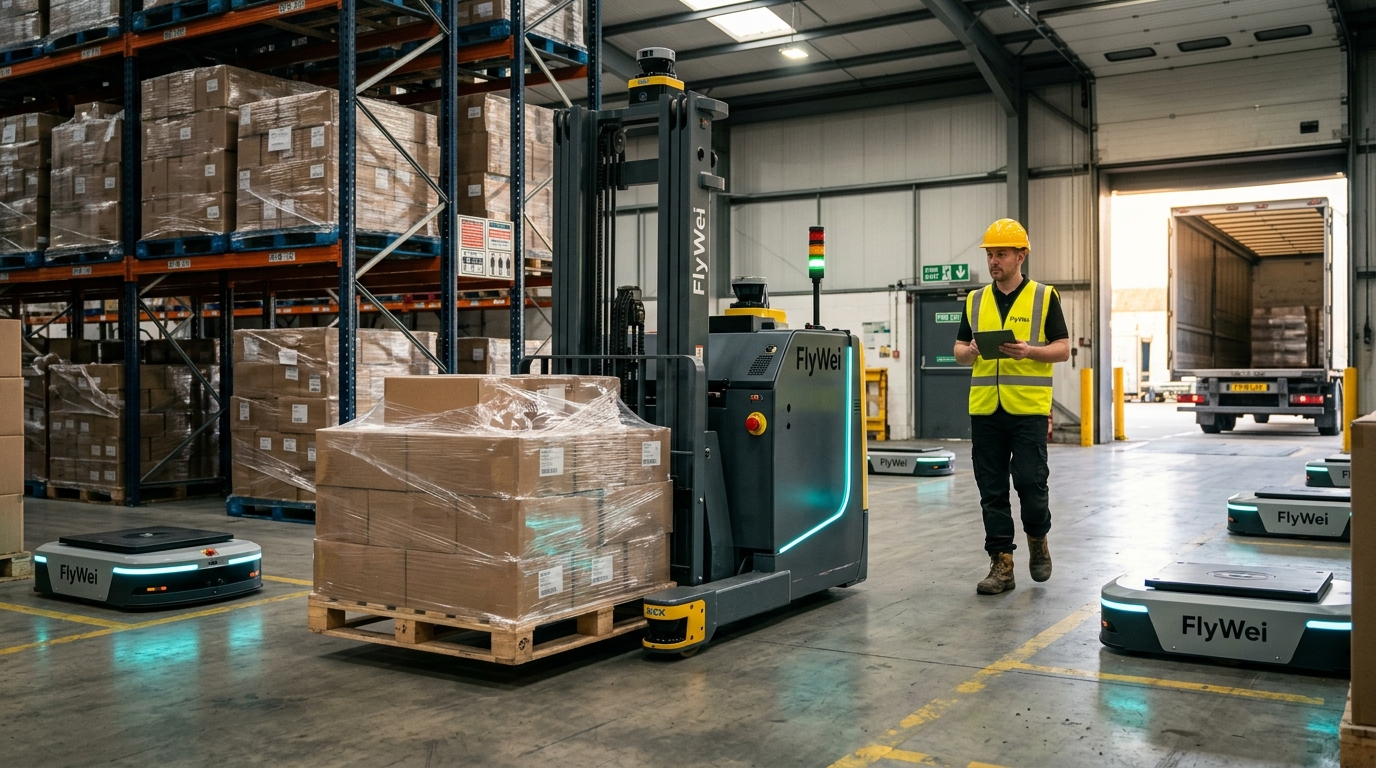
UK 3PL warehouse automation is no longer an experimental capex line: it is the operating model that decides whether a third-party logistics contract clears its margin in 2026 or quietly bleeds it. Operations directors running multi-client UK distribution centres at Magna Park, DIRFT and SEGRO East Midlands Gateway tell us the same story this quarter: peak volatility is no longer seasonal; it is weekly; agency MHE operators turn over faster than the floor can certify them; and energy contracts re-priced in 2024 to 25 have not come back down. The single largest decision an ops director will make in the next 12 months is the WMS-to-fleet-manager interface: get it right and a multi-truck autonomous forklift fleet can reach productive operation inside 10 weeks; get it wrong and pallets queue at goods-in.
Why UK 3PL warehouses are automating now
Three forces stack in 2026. First, labour: the UK MHE operator pool has tightened every quarter since the post-pandemic correction, with Logistics UK consistently flagging warehouse-floor recruitment as a top-three operational risk in its annual Logistics Report. For 3PLs running large contract sites across Burton-on-Trent, Daventry and the East Midlands Gateway corridor, agency cover for counterbalance and reach truck shifts now costs more per hour than the operator wage commanded two years ago, and the agencies cannot always fill the slot.
Second, peak. The retailer-driven peak that used to start in September now bleeds across the calendar: April Easter, May bank holidays, summer barbecue spikes for drinks and FMCG, then Black Friday, Christmas and a January returns spike that has overtaken Christmas in some apparel contracts. A static labour model cannot flex inside a contract that pays per pallet handled.
Third, energy. UK industrial electricity contracts re-priced in 2024 to 25 have not reverted; even with battery-electric MHE replacing diesel, the floor draw of an unautomated 3PL site is a material cost line. Autonomous trucks recharge opportunistically and idle predictably: the energy curve flattens.
Layered on top: regulatory clarity. The Health and Safety Executive publishes detailed guidance on the Provision and Use of Work Equipment Regulations 1998 (PUWER) covering powered industrial trucks, while BSI distributes BS EN ISO 3691-4 for driverless industrial trucks. UK 3PLs that codify these into their tender response default win RFPs faster than rivals offering cheaper but undocumented stacks.
Where automation pays back fastest in a UK 3PL DC
The fastest-payback target in a contract logistics site is rarely the picking face. It is the vertical slice that runs from goods-in through putaway to replenishment: the slice where pallets queue, where labour is least flexible, and where mis-locations propagate downstream into every onward client KPI.
Goods-in. A typical UK 3PL contract site receives a heavy stream of trailers per shift on peak; the inbound bay turns into a shunting problem the moment one stop-fit is delayed. Autonomous counterbalance trucks operating under a fleet manager will pull pallets from the bay to staging, decant, and re-stage onto a putaway lane while the goods-in clerk is still booking the next trailer. The operational lever is: never let a labour shortage on goods-in become a labour shortage on the picking face.
Putaway. This is the technical lever. UK 3PL sites stack high in narrow-aisle racking surveyed to TR34 floor flatness: the kind of environment where a poorly-tuned navigation stack will reject a pallet location repeatedly during a shift, leaving the WMS confused and the floor manager firefighting. FlyWei autonomous forklifts use natural-feature SLAM navigation and resolve location reliably without floor magnets, reflectors or QR markers. Putaway accuracy translates directly into picking productivity two shifts later.
Replenishment and goods-out. Replenishment is the unsung lever: it is where a contract loses its quality KPI overnight if a client's SKUs go short on the pick face. Autonomous replenishment running off WMS triggers, with the dispatch layer prioritising client-specific service-level windows, removes the single most common reason a 3PL site ends a shift behind plan.
The regulatory lever sits across all three: ISO 3691-4 driverless-truck safety, PUWER inspection regimes, and HSE-aligned ACOP L117 rider-truck guidance applied to autonomous fleets give the 3PL ops director a single defensible frame to take into client steering meetings. International AMR vendors frequently fall short here; UK-born integrators do not.
Choosing a UK-based automation supplier: what good looks like
UK ops directors evaluating UK 3PL warehouse automation in 2026 should ask three structural questions before any product demo. One: is the integration team in the UK, or is it a flight away? A 6 to 10 week deployment cannot survive a vendor whose engineering bench is on a different time zone. Two: who owns the WMS connector; the supplier, the WMS vendor, or a third integrator who appears in the contract for the first time at week 4? Three: what does the fleet manager look like when one truck fails at 02:00 on a peak Sunday; does the dispatch layer reroute the work, or does the floor stop?
FlyWei is built around UK answers to all three. FlyWei UK engineering, based out of Wimbledon and on-site at deployment, owns the WMS connector end-to-end. The M4 fleet management software orchestrates the truck-level mission queue, while fleet dispatch software warehouse intelligence handles the higher-order dispatch logic that decides which client's pallet moves first when SLAs collide.
Software is the moat
Hardware is increasingly commoditised; the autonomous-forklift chassis is no longer the differentiator a 3PL ops director should optimise for. The moat is the fleet manager and dispatch layer, the software that turns N trucks into one elastic capacity unit and survives the inevitable mid-deployment scope change ("the client just added two SKUs, can the system flex?").
M4 is the FlyWei fleet manager: it speaks VDA 5050 to mixed-vendor fleets, exposes a documented REST and message-bus interface to enterprise WMS, and is deployed and supported by FlyWei UK engineers as part of the standard 6 to 10-week programme. Fleet dispatch software is the dispatch and warehouse-intelligence layer above M4: it resolves client SLA priority, integrates with the operator's existing ERP and WMS, and surfaces the operations dashboards a 3PL ops director needs to defend the contract margin to the client review board.
The autonomous-mobility platform, which FlyWei runs on, is field-proven across thousands of global installs, but the UK ops director should care less about platform provenance and more about who sits in the room during week 4 of integration. That is FlyWei UK engineering, every time.
A 90-day UK 3PL deployment roadmap
The deployment cadence FlyWei runs in UK 3PL sites is calibrated to the contract review cycle, not the demo schedule.
- Week 1. Site survey at the operator's UK DC: pallet types (UK standard, Euro, CHEP), aisle widths, racking profile, floor flatness against TR34, charging-bay layout. Digital map produced inside 24 hours.
- Weeks 2 to 3. WMS / WCS integration. FlyWei UK engineering owns the connector. Test scenarios scripted against the operator's own SKU master.
- Weeks 4 to 6. Parallel testing alongside the existing manual fleet on the operator's live floor. Goods-in and putaway routes commissioned first; replenishment and goods-out follow.
- Weeks 7 to 10. Phased handover. Operator training delivered on-site by FlyWei UK engineers. Contract-level KPIs (pallets-in per shift, putaway accuracy, replenishment lead time) measured against the pre-deployment baseline.
The 90-day window is what separates a UK 3PL deployment from an international vendor pilot. Operators do not have a year to wait for the next steering review.
What FlyWei does for UK 3PLs
FlyWei supplies and integrates FlyWei warehouse automation solutions end-to-end for UK 3PL operators. The product stack is autonomous counterbalance, reach and stacker forklifts (1,000 to 2,000 kg payload, lift heights to 6 m), the M4 fleet manager, and the fleet dispatch and intelligence layer above it. Engineering, deployment, integration, support and operator training are all owned by FlyWei UK from the Wimbledon office: no offshore handover, no third-party integrator surprise in week 4.
For ops directors running multi-client UK contract logistics across Magna Park, DIRFT, SEGRO East Midlands Gateway, Daventry and the wider Midlands corridor, the practical effect is this: a documented 6 to 10-week path from a signed contract to autonomous goods-in / putaway / replenishment running in production, on a defensible PUWER and ISO 3691-4 frame, with a UK engineering team accountable for the contract-level KPIs.
"UK 3PL operations directors evaluating warehouse automation in 2026 should treat the WMS-and-fleet-manager integration interface as the single highest cost lever: get it right and a typical multi-truck autonomous forklift fleet can reach productive operation inside 10 weeks; get it wrong and even the best AMR hardware will deliver less than half its rated throughput because pallets queue at the goods-in interface." : FlyWei UK Engineering
Five questions to ask before signing
Where is the integration engineering team based?
If it is not in the UK, your 6 to 10-week deployment is at risk. FlyWei UK engineering owns the integration end-to-end, on-site at your DC.
Who owns the WMS connector?
The supplier, the WMS vendor, or a third party? FlyWei owns it. We do not pass the connector to a third integrator who appears at week 4.
Will the fleet integrate with our existing WMS and ERP?
Yes. M4 exposes documented REST and message-bus interfaces to enterprise WMS and integrates with the operator's existing ERP. Custom interfaces, where needed, are built and owned by FlyWei UK engineers.
What is the safety and regulatory frame?
BS EN ISO 3691-4 driverless-truck safety, PUWER 1998 inspection regimes, and HSE-aligned ACOP L117 rider-truck guidance applied to autonomous fleets. Documented and defensible at client steering meetings.
How long does deployment take in a UK 3PL contract site?
6 to 10 weeks from signed contract to autonomous operation: week 1 survey, weeks 2 to 3 integration, weeks 4 to 6 parallel ops, weeks 7 to 10 phased handover and training.
What happens at 02:00 on peak Sunday when one truck fails?
Fleet dispatch software reroutes the mission to other trucks in the fleet, M4 isolates the failed unit for service, and the FlyWei UK support line is on a defined response SLA. The floor does not stop.
Ready to scope a UK 3PL deployment? Speak to a FlyWei UK engineer for a contract-aware site survey and a 6 to 10-week deployment plan.