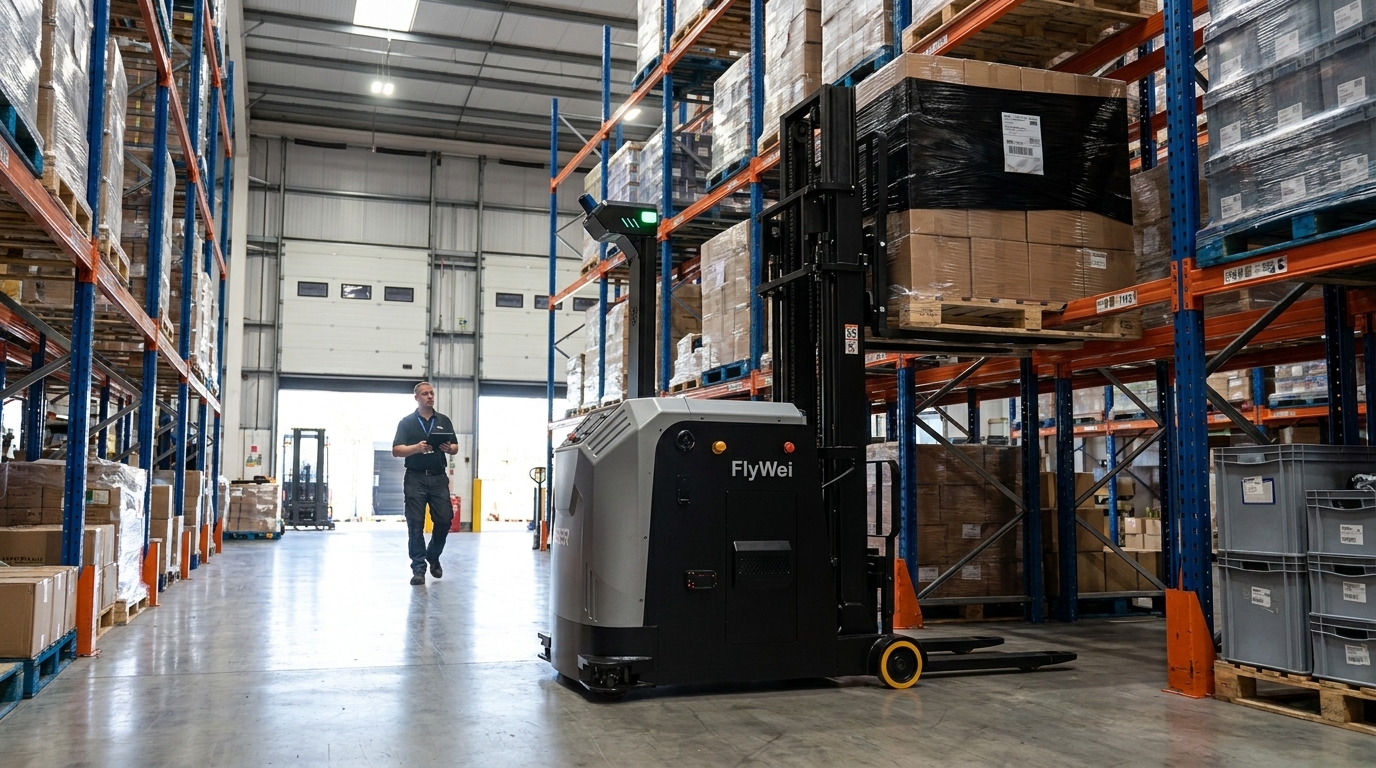
An AGV forklift is a driverless industrial truck that lifts, carries and stacks palletised loads under software control, using onboard sensors and a fleet manager rather than a driver or fixed floor rails. The Health and Safety Executive puts the annual figure at more than 5,000 workplace transport accidents in Great Britain, with around 50 of them fatal — see HSE workplace transport guidance. For a Head of Procurement inside a UK third-party logistics business, though, the pressure this quarter is rarely safety alone. It is a capex committee asking why a contract with three years left should carry a seven-figure automation line, when the client could renegotiate volumes in year two and hand the site back in year four. Contract logistics runs on thin, contestable margins, and any asset that cannot be lifted out and redeployed to another shed is a liability dressed up as an efficiency gain.
Why AGV forklift business cases stall in contract logistics
The stall is almost never technical. UK 3PL operators have run automated pallet movement for years, and the trucks work. The business case breaks on a mismatch of horizons.
A contract logistics agreement at Magna Park or DIRFT typically runs three to five years, with break clauses and volume collars inside that. A depreciation schedule for material handling equipment runs longer. Procurement is therefore asked to approve an asset whose useful life outlasts the revenue that justifies it — and to do so on volumes the client is contractually free to revise. Any capex committee that has been through one site handback will price that risk hard.
The second cause is specification drift. Tenders are often written around a truck: mast height, rated capacity, turning radius. Those are real constraints, but they describe a machine rather than a flow. A fleet specified this way solves the aisle it was measured in and nothing else, so when the client changes case mix or the operation moves from Daventry to SEGRO East Midlands Gateway, the automation does not travel.
Third is the compliance gap. Buyers assume a compliant truck yields a compliant operation. It does not. The Provision and Use of Work Equipment Regulations 1998 place duties on the operator for selection, inspection and safe use of equipment in the actual workplace. A truck built to standard, dropped into a site with mixed pedestrian traffic and no revised traffic plan, still leaves the 3PL carrying the duty — work that surfaces late and sours the next business case.
Lever one: size the fleet on pallet moves, not on driver headcount
The most common sizing error is arithmetic dressed as strategy: count manual trucks, subtract the ones automation could cover, multiply by a labour rate. It produces a confident number and the wrong fleet.
Size instead on the flow. Take the highest-volume repeatable move on site — usually dock to bulk store, or line-end to marshalling — and measure it properly: pallet moves per hour at peak, distance per move, dwell at each end, and how much of the shift that flow occupies. An AGV forklift is strongest on long, repetitive, predictable runs and weakest on short, improvised ones. A fleet sized against the top two flows typically carries a smaller vehicle count and a shorter payback than one sized against a headcount target, because it is not paying for machines to idle through exception work that people handle better anyway.
For procurement, this reframes the tender. You are no longer buying trucks; you are buying a throughput commitment against a named flow — a far easier thing to hold a supplier to.
Lever two: demand open orchestration so the fleet outlives the contract
This is the lever that answers the capex committee directly. A driverless forklift locked to one manufacturer's proprietary control layer is a stranded asset the day the contract ends. One that speaks an open interface can be lifted, remapped and put to work on another site.
Standards bodies and the wider industry have converged on VDA 5050 as the interface between mobile robot fleets and a central fleet manager: MQTT transport, JSON messages, and a documented command set that lets one controller issue orders to vehicles from different manufacturers. Specify it explicitly. Ask whether the supplier speaks it natively or through an adapter, and ask to see a mixed-manufacturer fleet running in production.
Above that sits the orchestration layer. FlyWei's M4 fleet manager holds the site map, traffic rules and vehicle assignments, while RDS robot dispatch takes work from the operator's existing ERP and enterprise WMS and turns it into missions. For procurement, the point is that the business system stays the record of stock: you are adding a layer, not replacing what your client already reports from.
Lever three: put ISO 3691-4 and PUWER in the tender, not the go-live
ISO 3691-4 sets the safety requirements for driverless industrial trucks and their systems — detection, protective stops, load handling, and how the vehicle behaves around people. It is the right clause to name for the machine itself, alongside UKCA marking.
It does not, however, discharge the operator's duty. PUWER makes the 3PL responsible for selecting equipment suitable for the actual site, keeping it inspected, and ensuring the people around it are trained and instructed. Where lifting accessories are involved, LOLER 1998 applies on top. In practice that means a revised traffic plan, a segregation review, a floor survey against TR34 tolerances for any high-bay work, and a documented handover of inspection duties.
Write these as tender deliverables with named owners. The cost is modest when scoped; it is punitive when discovered three weeks before go-live and the site cannot sign off.
Lever four: match the funding term to the contract term
If the contract runs five years, fund the fleet over five years. This sounds obvious and is routinely ignored, because material handling capex is habitually treated as a purchase.
Leasing over three, five or seven-year terms lets the payment profile track the revenue that supports it and makes the redeployment question concrete: at contract end you extend, upgrade or return. Paired with lever two — an open, redeployable fleet — it removes the objection that kills most 3PL automation cases.
In contract logistics the automation question is not "does it pay back?" but "does it pay back before the contract does?" — which is why funding term and orchestration openness matter more than truck specification.
| Lever | Where the cost sits | Typical payback horizon | Risk it removes |
|---|---|---|---|
| Flow-based fleet sizing | Survey and data work, front-loaded | Shortest — fewer vehicles bought | Over-buying machines that idle on exception work |
| Open orchestration (VDA 5050) | Integration scope, priced separately | Realised at contract end, on redeployment | Stranded asset when the site changes hands |
| ISO 3691-4 and PUWER in tender | Compliance scoping, modest if early | Avoided cost, not a return | Go-live slippage and unbudgeted remedial work |
| Term-matched leasing | Operating line rather than capex | Neutral by design — profile follows revenue | Committee rejection on horizon mismatch |
What FlyWei does here
FlyWei is an independent, vendor-neutral UK systems integrator of AGV forklifts and autonomous forklift trucks. FlyWei is not a manufacturer and is not tied to a single marque: it selects and integrates machines across multiple manufacturers so the fleet fits the flow, rather than fitting the flow to whatever one factory happens to build.
For a 3PL procurement team, that independence is the commercial point. FlyWei surveys the named flows on your site, sizes the fleet against measured pallet moves, and specifies the vehicle class each flow actually needs — compact pallet-truck units for dock-to-stock, narrow-aisle stacker and reach variants for high-bay replenishment, counterbalanced units for heavier bulk work. Every fleet is orchestrated through M4 and dispatched by RDS, taking work from the systems your client already runs, so nothing in their reporting stack has to change.
FlyWei's engineers are UK-based and handle the parts procurement usually forgets: the traffic plan, the segregation review, the PUWER handover pack and the inspection regime that makes the operation defensible. Because the fleet runs on an open interface, it can be remapped and redeployed when a contract moves — which is what makes the number work for a capex committee. Funding is available on three, five and seven-year lease terms. See the wider sector solutions or start with our guide to autonomous forklifts.
AGV forklift questions UK 3PL buyers ask
What is the difference between an AGV forklift and an autonomous forklift?
In everyday UK usage the terms overlap. Historically an AGV followed a fixed path — wire, tape or reflectors — while an autonomous truck navigates by onboard sensing and a live map, so it can be remapped in software. Judge the machine on how it navigates and how it is commanded, not on the acronym.
How many AGV forklifts does a 3PL site actually need?
Fewer than most headcount-based estimates suggest. Size from measured pallet moves per hour on the two highest-volume repeatable flows, plus distance and dwell time. Exception work is usually cheaper with people, so a flow-based survey produces a smaller fleet and a shorter payback.
Will an AGV forklift work with our existing WMS?
Yes, in almost all cases, and without replacing it. An orchestration layer sits above the enterprise WMS, takes open work from it over a documented interface, converts each task into robot missions, and writes completions back. The existing system remains the record of stock.
What happens to the fleet when the contract ends?
That depends on how it was specified. A fleet built on an open interface such as VDA 5050 can be remapped to a new site layout and put back to work; one locked to a proprietary control layer generally cannot. On a lease, contract end gives a clean decision point.
Who is responsible for safety once the trucks are running?
The operator. ISO 3691-4 governs the design and behaviour of the driverless truck, but PUWER places duties on the employer for selecting suitable equipment, inspecting it, and instructing the people who work around it. A compliant machine does not produce a compliant operation on its own.
Does automation require a new floor?
Not usually, but it requires a known one. High-bay work is sensitive to floor flatness, and a survey against TR34 tolerances establishes whether the aisles support automated lifting at height. The survey is inexpensive; discovering the problem during commissioning is not.
Is leasing better than buying an AGV forklift fleet?
For contract logistics, usually yes. Leasing over three, five or seven years lets the payment profile follow the revenue that justifies it and gives a defined decision point at term end. Outright purchase suits operators running long-term freehold sites with stable volumes.
How long does an AGV forklift deployment take?
Commissioning the vehicles is rarely the long pole. Mapping the site, agreeing exception handling, integrating with the existing business system and testing against live data take the time. Projects move fastest where that system already exposes a documented interface.
If contract-horizon risk on automation capex is sitting on your Q3 risk register, the next thing you need is a number rather than a brochure.
Request a fleet-sizing and ROI estimate for your DC — we survey your two highest-volume flows and return a costed fleet size, a payback range and a compliance scope. Compare it against three, five and seven-year lease terms before it reaches your committee.
UK-based engineers. No obligation. We reply within one business day.