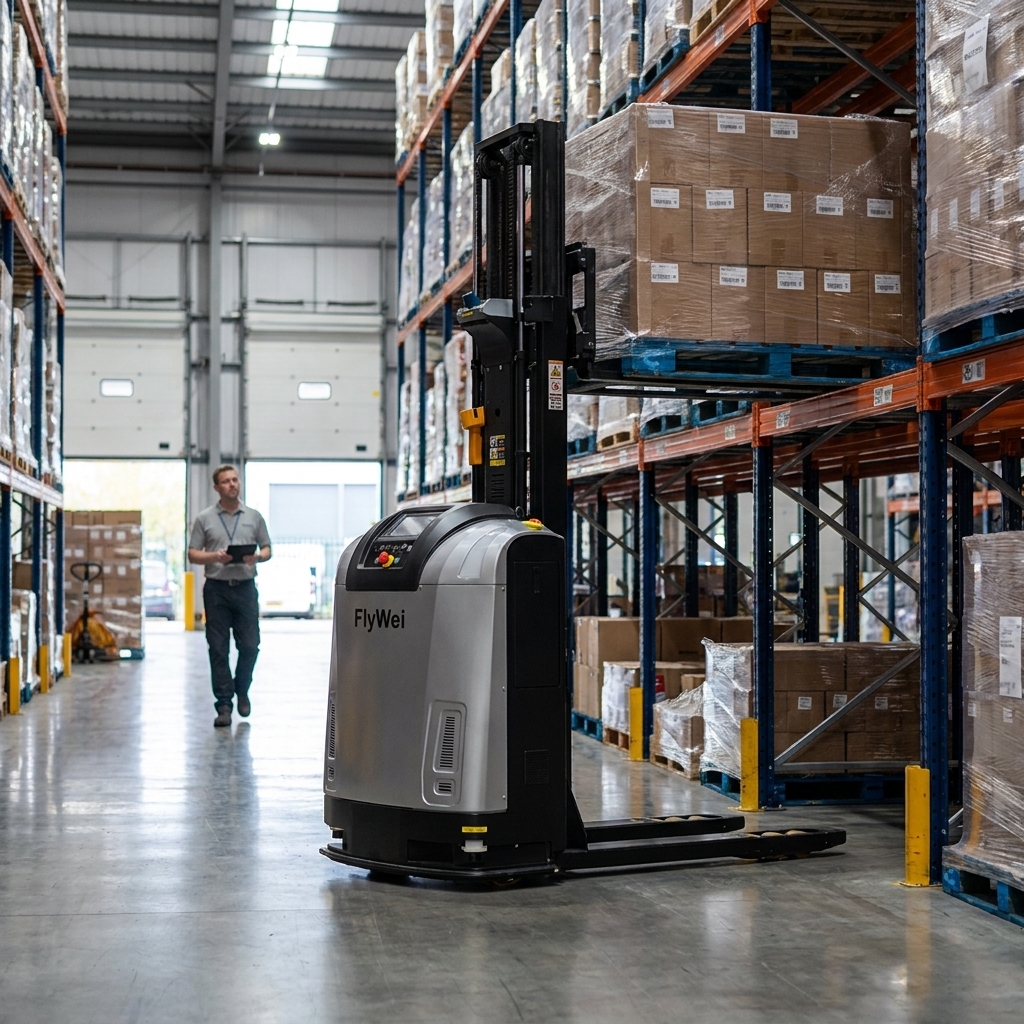
AGV forklift trucks are driverless, sensor-guided pallet vehicles that plan their own routes across a warehouse under a central fleet manager, replacing conventional counterbalance and reach trucks in the highest-volume aisles of a modern FMCG plant. HSE's workplace transport data keeps forklift movement at the top of the UK workplace-injury table year after year — the single largest equipment category by reported incident. For the FMCG warehouse manager, that risk profile collides every autumn with a peak-season throughput spike of 30-50% and an agency-driver market that has priced itself out of viability, according to Logistics UK's peak-season briefings. Temporary bodies can no longer be stacked into an aisle to soak up the spike; the aisle itself has to do more work. AGV forklift trucks are how leading UK plants are rebuilding pallet flow so that the peak is planned, not survived.
Why the peak-season pallet bottleneck has stopped responding to old fixes
The autumn and Christmas peak in UK FMCG has always been about pallet flow. What has changed since 2022 is the labour side. Agency counterbalance-truck drivers booked at £14-£17 an hour now clear £22-£26 where they can be found at all, and the pool has shrunk as fewer new operators enter the trade and the over-50 cohort retires. Plants that plan for peak on the assumption a phone call will conjure ten more temp drivers on Monday morning are building a plan that will not survive contact with reality.
At the same time, the fixed-asset floor is under compression. Landlords in Magna Park, Daventry and DIRFT have moved from six-year rolling leases to five-year absolute commitments, which changes the shape of any capex conversation about heavy plant. The underlying reason to buy more trucks — that the aisle needs more moves per hour — has always been the wrong reason. The bottleneck is not the number of trucks; it is the coordination between the trucks, the shunting bay, the finished-goods buffer and the trailer-loading dock.
Regulation has quietly caught up. PUWER 1998 and the ACOP L117 code still bind every conventional counterbalance operation. But ISO 3691-4 — the safety standard for driverless industrial trucks — has since 2020 given a clear conformance path for AGV forklift trucks that removes the operator from the exposure envelope entirely. The plants that absorbed that standard early can now deploy an autonomous fleet without a bespoke risk-assessment exercise per install.
AGV forklift trucks let a UK FMCG plant absorb a 30-50% autumn peak-season throughput spike without stacking extra agency drivers into the aisles, while removing the human exposure that puts forklift movement at the top of HSE's workplace-injury table.
The three-and-a-half levers that fix it
Lever 1 (operational) — treat the aisle as the constraint, not the driver
The instinct at peak is to add heads to lanes. Evidence from UK FMCG plants that have modelled it says the opposite: the constraint is rarely truck-hours. It is queue length at the trailer-loading bay and buffer starvation in front of the shrink-wrap line. Autonomous forklift orchestration flips the conversation from "how many operators do we book?" to "how do we sequence the moves?"
A well-run peak plan maps every high-frequency pallet lane — the ones carrying more than forty moves a shift — and identifies which can be run under closed-supervision orchestration. Typically three or four lanes qualify. Handing those lanes to an AGV forklift fleet frees the human operators for exception moves, line-side replen and receiving. Throughput on the orchestrated lanes climbs 40-60% at peak because the driverless forklift does not stop for tea, changeover briefings or fatigue-driven slowdowns.
Lever 2 (technical) — VDA 5050 fleet management wins the orchestration fight
The critical mistake is procuring AGV forklift trucks without first choosing the orchestrator that will manage them alongside the trucks that come next, and the AMR pucks that come after that. Once a plant is running two vendors' fleets under two proprietary controllers, coordination collapses back to a whiteboard and the whole point is lost.
VDA 5050, the interface standard now adopted by every serious European fleet OEM, is the practical baseline for interoperable fleet management. A VDA 5050-conformant fleet manager can dispatch mixed autonomous forklifts, AMRs and legacy AGVs across a common map, exchange safety state cleanly with a plant's SCADA, and expose a queryable API to the enterprise ERP or WMS above it. FlyWei's M4 fleet manager is built to that standard; the underlying RDS robot dispatch service handles the second-by-second traffic control. That two-layer separation is what keeps the peak-season pallet plan reconciled with the WMS pick lists without the enterprise WMS itself having to speak fluent robot.
Lever 3 (physical) — match the truck to the move, not to the aisle
The label "AGV forklift trucks" lumps together several distinct machine classes. Getting the mix right is the difference between a fleet that pays back in thirty months and one that pays back in ninety.
- Counterbalance autonomous forklift (SCB-2000EU class): 2-tonne outbound pallet moves from the finished-goods buffer to the trailer-loading bay. The workhorse of any UK FMCG operation.
- Reach-truck autonomous forklift (SSR-1400EU class): 1.4-tonne put-away into the high-bay racking up to 8-10 m. Where a plant is battling stochastic put-away caused by uneven receiving, this class recovers the shift.
- Stacker autonomous forklift (SSS-1500EU class): mid-height 1.5-tonne moves for replen from block-stack to case-pick aisle.
- Autonomous pallet stacker or automated forklift (SFL-CBD15 class): the low-profile driverless forklift for short dock-to-stock lanes and the sub-forty-move lanes that never justified a dedicated operator.
Skew the fleet toward counterbalance and reach for a UK FMCG plant; blend in stackers where mid-height replen dominates. FlyWei's autonomous forklifts range covers all four classes on a common M4 controller so the mix can shift as the ranging plan changes.
Lever 4 (regulatory) — build the compliance stack once, defend it every audit
The prize is not just the AGV forklift trucks themselves; it is a compliance stack that lets the safety manager show HSE a defensible position on day one. That stack has four blocks:
- PUWER 1998 — the general work-equipment duty applies to autonomous and manual forklifts alike. The AGV forklift trucks meet it by design; the plant closes the loop on maintenance, inspection and competence for the supervisory staff who now interact with the fleet.
- ISO 3691-4 — the standard for driverless industrial trucks. Every FlyWei AGV forklift truck ships with an ISO 3691-4 conformance file that the safety manager can hand to a HSE inspector directly.
- ACOP L117 — the code of practice for rider-operated lift trucks. It still binds the residual manual fleet and defines what "competent supervision" of an autonomous fleet looks like in practice.
- Concrete Society TR34 — the industrial concrete floor standard. AGV forklift trucks are more sensitive than manual counterbalance trucks to floor tolerance under 8 m of rack; a TR34 FM2 flatness read is the answer to "why is my fleet slowing at replen?"
| Machine class | Best move | Peak throughput (moves/shift) | Indicative capex | Payback (single-shift) |
|---|---|---|---|---|
| Counterbalance autonomous forklift | Trailer load-out | 220-280 | £130-160k | 28-36 months |
| Reach-truck autonomous forklift | High-bay put-away 8-10 m | 140-190 | £140-180k | 34-44 months |
| Stacker autonomous forklift | Mid-height replen | 170-220 | £95-125k | 26-32 months |
| Autonomous pallet stacker | Dock-to-stock < 40 m | 240-320 | £65-90k | 18-26 months |
Indicative UK ranges based on FlyWei applications engineering data; site-specific pricing on request. A three- or five-year leasing arrangement reprofiles these capex bands into a single opex line.
What FlyWei does here
FlyWei designs, supplies and integrates AGV forklift trucks for UK FMCG plants under a single accountable delivery model. The starting conversation is not "which truck?" but "which lane?" — a two-week engagement with the warehouse manager, engineering lead and safety manager to map the top three pallet lanes and size the fleet against the peak-season shift plan.
From there, FlyWei provides the vehicles across the class range — counterbalance, reach, stacker, pallet — the M4 fleet manager to orchestrate them, the RDS dispatch layer for real-time traffic control, and the ISO 3691-4 conformance files the safety manager needs on day one. Integration into the existing enterprise WMS and ERP is a defined boundary; the customer keeps the enterprise stack and M4 sits inside it as the fleet-of-record.
Commercial terms include outright purchase and a leasing programme on three-, five- and seven-year terms that treats the fleet as an opex line rather than a capex hit — designed for the plant that wants to prove the peak-season case before scaling site-wide. UK-based engineering and service resources support each install from Southampton, the Midlands and the North. For plants where pallet handling runs alongside line-side kit or case shuttling, FlyWei's lifting robots range plugs into the same M4 orchestrator.
FAQ
What are AGV forklift trucks?
AGV forklift trucks are driverless, sensor-guided pallet vehicles — counterbalance, reach, stacker or pallet-truck class — that navigate a warehouse under a central fleet manager. They differ from AMRs in that they carry standard fork attachments and handle full pallet weights up to three tonnes.
How do AGV forklift trucks handle a UK FMCG peak?
They convert peak-season throughput from a labour problem to an orchestration problem. Three or four high-frequency palletised lanes are handed to the AGV fleet under closed-supervision orchestration. Human operators keep the exception moves. Throughput on the orchestrated lanes climbs 40-60% at peak without extra agency headcount.
Are AGV forklift trucks compliant with UK HSE rules?
Yes. AGV forklift trucks fall inside the same PUWER 1998 duty as any other work equipment, and the driverless-truck standard is ISO 3691-4:2020. FlyWei's AGV forklift trucks ship with an ISO 3691-4 conformance file the safety manager can hand to an HSE inspector directly.
What's the cheapest way to trial AGV forklift trucks?
A single-lane, single-shift pilot on a three-year FlyWei leasing arrangement typically clears the feasibility question inside one peak cycle without a large upfront capital ask.
Do AGV forklift trucks integrate with our existing WMS?
Yes. FlyWei's M4 fleet manager exposes a VDA 5050 interface upward to the enterprise WMS or ERP and downward to the RDS dispatch service. The enterprise WMS keeps its pick logic; M4 owns the pallet-move plan.
How long is payback on AGV forklift trucks in FMCG?
Single-shift payback for a counterbalance-class AGV forklift truck typically lands between twenty-eight and thirty-six months in UK FMCG. Autonomous pallet stackers on shorter dock-to-stock lanes clear payback inside twenty-six months.
What floor condition do AGV forklift trucks need?
A Concrete Society TR34 FM2 flatness read is the pragmatic target for the aisles the fleet will run. Where the floor sits below FM2, either grind the worst zones locally or reserve AGV routes for the lanes that already meet tolerance.
Where does FlyWei fit against enterprise WMS platforms?
FlyWei owns the physical fleet and the fleet-manager layer (M4 and RDS). The enterprise WMS and ERP remain the operator's — an FMCG plant can add AGV forklift trucks without disturbing its enterprise stack.
If the autumn peak-season pallet bottleneck is on your Q3 risk register, a two-week feasibility read from FlyWei's UK team costs nothing and closes off the "will it work here?" question before the capex conversation begins.
Book a free 30-minute site survey for your highest-volume palletised lane, or see the full autonomous forklift range mapped to FMCG pallet moves.
UK-based engineers · no obligation · reply within one business day.