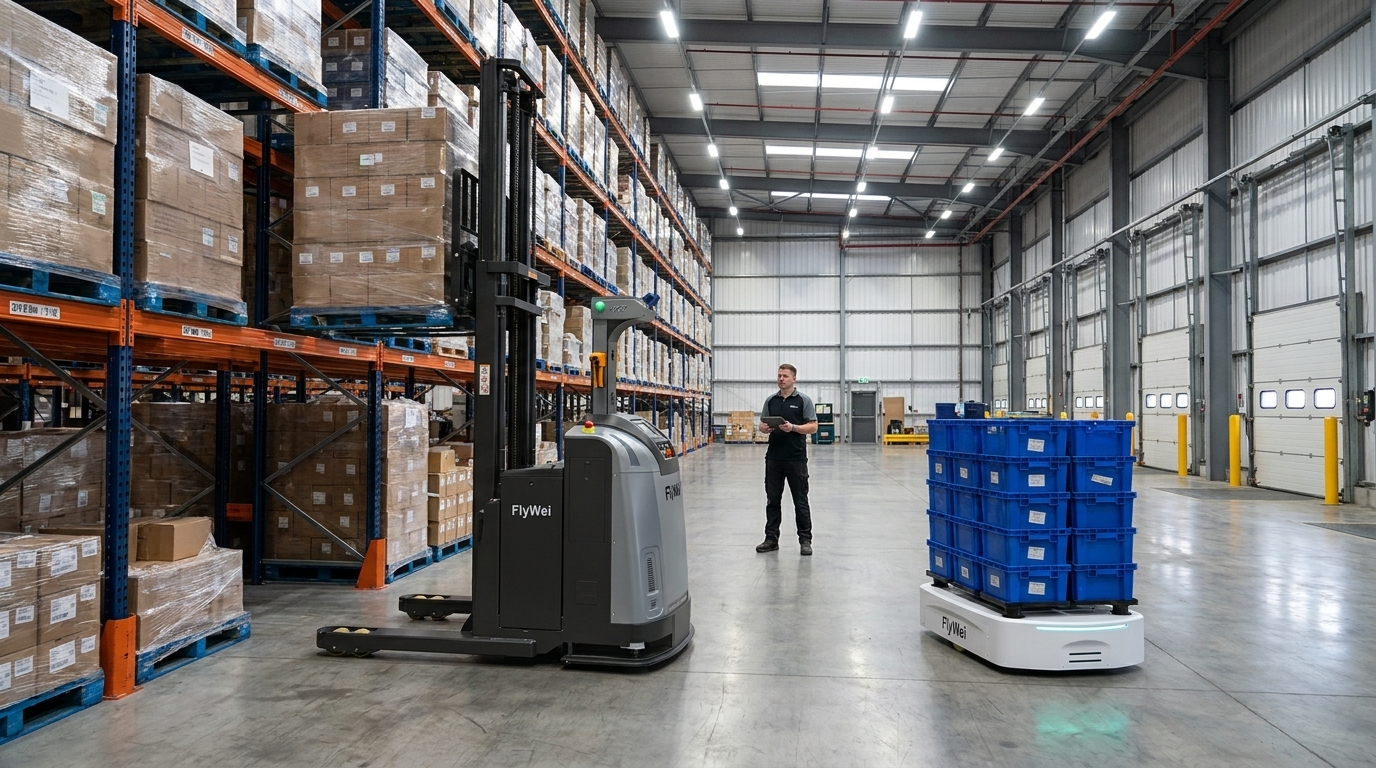
AGV vs AMR is the single most consequential warehouse automation question a UK third-party logistics warehouse manager will answer in 2026, because the wrong call freezes a 100,000 sq ft distribution centre into a navigation model that will not scale past the first peak. Sector capacity has tightened sharply: an estimated 5,000 indirect-handling hours per peak season have evaporated from a typical Midlands DC alongside the HGV driver gap reported by the UK industry body for freight and logistics. Warehouse managers running >100,000 sq ft contract sites in Magna Park, DIRFT, Daventry and Burton-on-Trent now face the same board question: lock in an automated guided vehicle on fixed magnetic strips, or commit to an autonomous mobile robot that free-navigates around stray pallets and last-minute layout changes? The answer determines five-year fleet flexibility, ISO 3691-4 commissioning cost, and whether the operation can absorb a January contract win without a redesign.
Why the AGV vs AMR question is harder in 2026
The automated guided vehicle concept dates to 1950s automotive assembly lines: a tow tractor following a wire embedded in the slab. Fifty years of incremental improvement gave UK distribution centres magnetic-strip AGVs that did one thing very well: high-volume, repetitive, lane-bound pallet flow. The autonomous mobile robot is a different lineage: a post-2015 generation built on natural-feature SLAM (simultaneous localisation and mapping), where the robot builds and updates its own map of the building from on-board LiDAR and vision data, and re-plans paths in milliseconds when the floor changes.
Two pressures collided in 2024 to 2025 to force the AGV vs AMR question into every UK 3PL capex committee. First, contract churn: the typical Magna Park or DIRFT contract logistics operator now wins or loses a major retail client every 18 to 24 months, and each handover triggers a layout change that pure-AGV infrastructure cannot follow without floor downtime. Second, the labour gap: Logistics UK has flagged a structural shortfall in HGV drivers and warehouse operatives that compounds the cost of every manual pallet move, particularly in cold-chain and FMCG sites running peak through Burton-on-Trent and the East Midlands corridor.
Regulation has tightened in parallel. ISO 3691-4:2023, the international standard for driverless industrial trucks, applies equally to AGVs and AMRs, and the Health and Safety Executive's PUWER 1998 overlay means any UK deployment must demonstrate functional safety, operator competence and risk-assessed coexistence with pedestrians, regardless of navigation class. LOLER 1998 adds a periodic thorough-examination obligation on the lifting elements that does not care whether the truck is wire-guided or SLAM-guided.
AGV vs AMR is no longer a binary choice in a 2026 UK distribution centre: the operationally correct answer is a fleet that can flip between fixed-lane and free-navigation modes, governed by a single orchestration layer.
How AGV and AMR actually compare: the decision-grade table
| Dimension | AGV (Automated Guided Vehicle) | AMR (Autonomous Mobile Robot) |
|---|---|---|
| Primary navigation | Magnetic strips, optical lines, embedded wires, reflectors | Natural-feature SLAM, on-board LiDAR map, no fixed infrastructure |
| Floor preparation | Tape, paint, slot-cut wire: days to weeks of downtime per change | One software survey: hours, no civils |
| Obstacle response | Stops at obstacle; waits for manual clear | Re-routes dynamically around the obstacle |
| Typical payload band | 1 to 2 tonne pallets, narrow-aisle racking up to 8 m | 0.3 to 1 tonne carts, sub-assemblies, totes |
| Best-fit work | High-volume repetitive lane work, stable layouts | Mixed, variable, high-mix flows; brownfield sites |
| Commissioning timeline | 8 to 16 weeks incl. floor preparation | 3 to 6 weeks software-only |
| Indicative UK 3PL payback | 24 to 36 months | 18 to 30 months |
| ISO 3691-4:2023 obligation | Identical functional-safety bar | Identical functional-safety bar |
The four levers that fix the AGV vs AMR decision
1. Operational: pick the navigation model by flow stability, not vendor pitch
The honest test is layout stability over 36 months, not over the next quarter. If your site runs the same SKUs through the same lanes from the same goods-in doors year-on-year (a single-client dedicated DC, for instance) then driverless forklift navigation on fixed paths is a defensible choice, and an AGV will deliver lower per-cycle energy and cheaper safety scanners. If your floor reconfigures more than twice a year because of contract wins, peak overlays or trial racking, you should default to AMR-class free navigation. The expensive failure is buying AGVs because the unit price looked lower, then writing off the floor infrastructure when a new retail client demands cross-dock lanes where the magnetic strips used to be. Test stability the same way you test rack utilisation: by counting events, not by asking opinions.
2. Technical: insist on a single orchestrator for the mixed fleet
Most >100,000 sq ft UK 3PLs end up with a mixed fleet: counterbalanced pallet movers in one zone, latent-jacking sub-assembly shuttles in another, and reach-truck-class autonomous forklifts in narrow-aisle racking. The trap is buying each from a separate vendor with a separate dispatch layer. The right architecture is a single orchestrator speaking VDA 5050 to every robot regardless of navigation class, talking northbound to the operator's existing WMS and southbound to the LiDAR fleet. Lifting robots and AMR pucks must show up on the same control screen as the autonomous forklifts: otherwise traffic congestion at goods-in becomes a manual coordination problem that erases the productivity gain you paid for.
3. Regulatory; build to ISO 3691-4:2023 from day one
The ISO 3691-4:2023 standard for driverless industrial trucks applies equally to AGVs and AMRs, and the British Standards Institution (BSI) has aligned UK implementation guidance accordingly. The HSE workplace transport framework adds PUWER, LOLER and ACOP L117 obligations on top. The practical implication: do not let a vendor scope-out the safety-rated scanners, emergency-stop architecture or operator-training pack on the basis that "it's only an AGV". An automated guided vehicle on a fixed path that still shares an aisle with a forklift driver carries the same Cat 3 PL d functional-safety requirement as an autonomous mobile robot. Build the safety case once, at commissioning, against the 2023 revision: retrofitting later is the most expensive lever there is.
4. Commercial: lease against uptime, not buy against catalogue
The commercial answer in 2026 is robotics-as-a-service. Capex committees at FMCG DCs in the East Midlands and Burton-on-Trent are increasingly approving 3, 5 and 7-year lease structures over outright purchase: partly because contract logistics has no five-year revenue visibility, and partly because the navigation question itself is in flux. A 5-year leasing agreement with an uptime SLA puts the navigation-class risk on the supplier: if AMR free-navigation out-performs the AGV mode in your real flows, the fleet flips without a new capex line. If your business case relies on capex purchase, you are paying twice for the option value of changing your mind: once for the unit, and again for the rip-and-replace when the navigation model needs to change.
What FlyWei does in this AGV vs AMR comparison
FlyWei integrates autonomous forklifts and lifting AMRs that operate in either mode, fixed-lane (AGV behaviour) or natural-feature SLAM (AMR behaviour), under a single orchestration layer. The FlyWei autonomous forklift range covers counterbalanced 2-tonne pallet movers, reach-truck class machines for narrow-aisle racking up to 8 m, stacker-class for mid-bay, and low-profile pallet-truck units for dock-to-stock moves. Underneath, the M4 fleet manager handles task dispatch, traffic, charging schedules and live safety overrides across the mixed fleet, and FlyWei fleet dispatch software translates WMS work orders into robot-class-aware tasks. The M4 platform speaks VDA 5050, so adding a latent-jacking AMR puck or a heavy-lift scissor robot later does not require ripping out the controller stack. UK warehouse managers running contract logistics sites in Magna Park or DIRFT typically start with a 6-robot mixed pilot scoped to one shift, measured against ISO 3691-4:2023 safety functional requirements and a 12-month uptime SLA, then scale on a per-shift basis. Commercial structure: 3, 5 or 7-year leasing terms with UK-based engineering support and a single point of accountability for the navigation class.
Frequently asked questions
What is the core difference between AGV and AMR?
An AGV (automated guided vehicle) follows a fixed path defined by infrastructure in the slab: magnetic strips, embedded wires, optical lines or reflectors. An AMR (autonomous mobile robot) navigates by building and updating its own map of the building using natural-feature SLAM from on-board LiDAR and vision, so it can re-route around obstacles and tolerate layout changes without infrastructure work.
Are AGVs cheaper than AMRs in 2026?
Unit price is usually lower for AGVs, but total cost of ownership is generally lower for AMRs in UK 3PL distribution centres because the floor preparation, downtime during layout changes, and stranded infrastructure cost on contract churn typically wipe out the unit-price advantage by month 24.
Can FlyWei autonomous forklifts run as both AGV and AMR?
Yes. The FlyWei autonomous forklift range supports fixed-lane behaviour for high-volume repetitive flows and natural-feature SLAM for free navigation in mixed-flow brownfield sites, switchable per task in the M4 fleet manager.
How does ISO 3691-4:2023 apply to AGVs versus AMRs?
Identically. The standard is technology-neutral on navigation method: the functional-safety requirements for emergency stop, pedestrian detection, speed governance and zone management apply regardless of whether the robot follows a wire, a tape, or an internal SLAM map.
Which is better for UK 3PLs with seasonal contract churn?
AMR-class free navigation, or a hybrid fleet that supports both modes. Pure-AGV deployments lock in floor infrastructure that does not survive a major contract change in a Magna Park, DIRFT or Daventry DC.
What payload range is realistic for AMR pallet handling?
Lifting AMRs typically span 0.3 to 1 tonne for carts and sub-assemblies. Full-pallet 1 to 2 tonne work is handled by autonomous forklift platforms (counterbalanced, reach, stacker, pallet-truck classes) that can run in either AGV or AMR mode.
How long does AGV vs AMR commissioning take?
Pure-AGV deployments are typically 8 to 16 weeks including floor preparation; AMR-class deployments are 3 to 6 weeks software-only. FlyWei hybrid pilots in UK 3PL sites typically commission a 6-robot mixed fleet in 4 to 6 weeks.
If the AGV vs AMR navigation lock-in is on your Q3 risk register, the fastest way to size the right hybrid fleet for your contract mix is to walk the floor with our engineers.
Book a free 30-minute site survey with the FlyWei UK team, or read the leasing options page for 3, 5 and 7-year terms that protect against the navigation-class decision changing mid-contract.
UK-based engineers · no obligation · we reply within one business day.