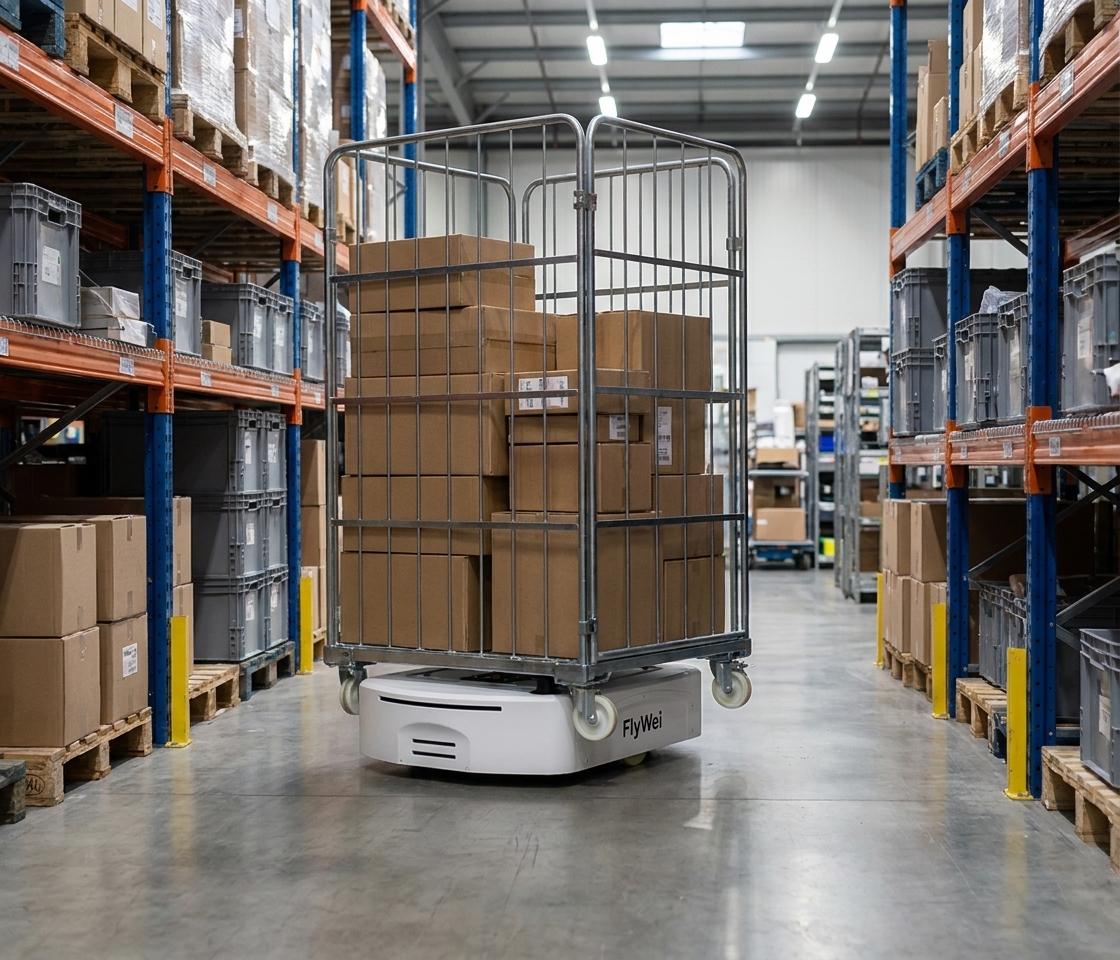
AMR ROI in warehouses is the payback period and lifetime cash benefit of an autonomous mobile robot or autonomous forklift fleet, measured net of capital, finance, energy, maintenance and decommissioning over a 5-to-10-year horizon. For UK cold-chain operators the maths is sharper than for ambient: an estimated 1 in 4 workplace-transport reportable injuries each year involve a forklift, according to HSE workplace-transport guidance, and chilled aisles concentrate that risk because visibility, friction and operator dexterity all degrade below 5°C. AMR ROI in UK cold-chain warehouses typically lands inside 30 months when a mixed forklift-AMR fleet runs at least 18 hours a day across chilled and ambient zones, because the labour-scarcity premium at −25°C compounds wage inflation that conventional forklift TCO models routinely understate. Supply chain directors running multi-site chilled networks need a payback model the FD will sign, the ops team will trust, and the HR director can map to a falling agency-shift bill.
Why cold-chain AMR ROI is different
Logistics UK has tracked logistics wage growth running ahead of the wider economy for four years running, and chilled and frozen sites carry the heaviest premium because finding reliable forklift drivers who tolerate −25°C blast-freezer shifts is genuinely difficult. Add the 7–9% productivity loss most chilled operators record after the first two hours of a sub-zero shift, and the labour line dominates total cost of ownership far more than it does in an ambient distribution centre.
Equipment costs also bend in cold-chain. Lead-acid batteries lose significant useful capacity below 0°C, so most cold-chain manual fleets carry roughly 1.4× the battery pool of an equivalent ambient fleet, plus a dedicated battery-charging room kept above 10°C. Tyre wear, drive-unit seals and onboard electronics all degrade faster. None of this shows up in the headline list-price comparison vendors put in front of capex committees, and it is exactly what trips up a payback model six months into deployment.
The compounding effect is what makes the cold-chain payback equation so distinct. Lose two drivers to a competitor offering a higher shift bonus, and an agency premium that was 18% last year becomes 32% this year. A capex case modelled on last year's labour rate is already wrong on the day it is signed. UK supply chain directors covering multi-site chilled networks — typical footprints around Magna Park, DIRFT and Burton-on-Trent — need a model that prices labour scarcity as a moving line, not a fixed one. That is where autonomous reach trucks and pallet AMRs change the conversation: their unit-cost-per-pallet-move is flat regardless of what the local labour market does next quarter.
The four levers that fix the cold-chain payback
Lever 1 (operational): reach 18+ hours of daily fleet utilisation across chilled and ambient
The single biggest variable in cold-chain AMR ROI is daily operating hours. A fleet that runs 12 hours a day pays back in 38–48 months. The same fleet running 18 hours a day pays back in 24–30 months because the only marginal cost between shifts is electricity. Practically, the way most UK cold-chain operators reach 18h is to architect the fleet so robots flow between chilled bulk-store, chilled pick face and ambient outbound staging on the same shift. Use the chilled night-shift for goods-in put-away, the ambient morning shift for retrieval and the chilled afternoon for replenishment. The robots never stop; only the dock activity changes. Our lifting AMRs and autonomous forklifts are rated for transit between zones without operator intervention.
Lever 2 (technical): orchestrate a heterogeneous fleet on one VDA 5050 control plane
If your reach-truck AMRs and your pallet AMRs are managed by different vendor consoles, you will never reach Lever 1's utilisation target — operators will end up favouring whichever fleet has the easier UI and the other will idle. The fix is a single orchestration layer that speaks VDA 5050, the open robot-to-fleet interface published through the VDMA, and that schedules every move across every robot in the building regardless of make or class. FlyWei M4 does exactly this for mixed chilled and ambient fleets, and FlyWei RDS handles the millisecond-level dispatch decisions when two AMRs converge on a cross-aisle. The orchestration layer is also where you bank the second-largest ROI lever after labour: the elimination of empty travel. A well-orchestrated mixed fleet typically reduces empty-leg distance by 22–28% in chilled DCs.
Lever 3 (regulatory): price ISO 3691-4, PUWER and LOLER into the model from day one
UK boards have learned the hard way that a payback model that ignores standards compliance is a payback model that gets challenged in the audit committee. Every autonomous truck specified for a UK cold-chain DC must comply with ISO 3691-4 (the international standard for driverless industrial trucks), with PUWER 1998 for the equipment itself and with LOLER 1998 for any lifting operation. BSI sells the harmonised standards if you need them on the shelf. Quantify the legal cost of non-compliance, including thorough-examination and inspection cycles, in the payback model. Done properly, this lever adds 2–4 months to the headline payback and saves the board challenge that would otherwise add 6 months of decision delay.
Lever 4 (commercial): use a 3, 5 or 7-year operating lease to flip capex to opex
The fastest way to move a cold-chain robotics business case through a constrained capex envelope is to take it out of the capex envelope. A full-service operating leasing arrangement over 3, 5 or 7 years rolls hardware, maintenance, software and end-of-life into a single monthly figure that lands in opex. The FD compares it directly against the present-day agency-shift bill rather than against a future capex slot. For multi-site SC directors this is often the difference between getting one site automated now versus all four sites automated in three years' time, and it has become the dominant procurement route for UK cold-chain robotics in 2026.
A comparison the board can screenshot
| Approach | Day-one capex | Payback (months) | Standards risk |
|---|---|---|---|
| Mixed AMR + reach-truck fleet, 18h/day, purchased | High | 24–30 | Low (ISO 3691-4 from spec) |
| Single-class chilled AMR, 12h/day, purchased | Medium | 40–60 | Medium |
| Manual reach-truck refresh, status quo | Medium | n/a (rising opex) | High (labour-driven incident risk) |
| Mixed AMR + reach-truck fleet, 5-year operating lease | Zero | Opex-positive from month one | Low |
AMR ROI in UK cold-chain warehouses typically lands inside 30 months when a mixed forklift-AMR fleet runs at least 18 hours a day across chilled and ambient zones.
What FlyWei does here
FlyWei designs, supplies and integrates autonomous reach trucks, counterbalance forklifts, latent-jacking AMRs and heavy-lift AMRs rated for sustained operation across chilled and frozen UK distribution centres. Every machine we deploy carries the same orchestration brain: FlyWei M4 for fleet management and FlyWei RDS for sub-second robot dispatch, built on a proven autonomy platform but tuned to UK cold-chain duty cycles by FlyWei engineers in the field. Our integration teams have specified mixed chilled and ambient fleets for multi-site UK operators around Magna Park, DIRFT, Burton-on-Trent and Daventry, and the typical model we deliver hits 18h+ utilisation in week six of operation. We supply the autonomous forklifts and AMRs themselves, the M4 control plane that orchestrates them, and the leasing structure that flips the conversation from capex to opex so your FD can sign the deal this quarter rather than next year. Pre-sales site surveys are run by HSE-aware UK engineers who write the ISO 3691-4 and PUWER 1998 compliance evidence into the deployment plan before a single robot ships.
Frequently asked questions
What is AMR ROI in a warehouse?
AMR ROI is the net financial return on an autonomous mobile robot or autonomous forklift fleet, measured as the payback period plus lifetime cash benefit net of capex, finance, energy, maintenance and decommissioning, typically over 5–10 years. For UK cold-chain operators it is dominated by labour displacement and agency-shift cover.
How long does AMR payback take in UK cold-chain warehouses?
Typically 24–30 months for a mixed reach-truck and pallet AMR fleet running 18+ hours a day across chilled and ambient zones. Below 12h/day utilisation, payback usually drifts past 40 months and the business case has to be restructured around leasing.
Can autonomous forklifts work in −25°C blast freezers?
Yes. FlyWei autonomous reach trucks and counterbalance forklifts are specified for sustained sub-zero operation, including transit between chilled bulk-store and ambient outbound staging without operator intervention.
Is leasing or purchase better for cold-chain AMRs?
Operating leasing (3, 5 or 7-year) is usually faster to approval because it lands in opex rather than capex and avoids depreciation arguments. Purchase typically wins on lifetime cash benefit if the FD has appetite for the upfront capex slot.
What standards apply to AMRs and autonomous forklifts in UK cold-chain DCs?
ISO 3691-4 for driverless industrial trucks, PUWER 1998 for the equipment itself, LOLER 1998 for any lifting operation, with HSE workplace-transport guidance as the practical compliance anchor. BSI publishes the harmonised standards.
How does M4 fit into a multi-site chilled fleet?
FlyWei M4 is the VDA 5050-compliant orchestration layer that schedules every move across every robot regardless of class, including transit between chilled and ambient zones. It is also where empty-leg distance reduction is banked, typically 22–28% in chilled DCs.
What is the minimum daily utilisation for AMR ROI to work?
The breakpoint sits at roughly 18 operating hours a day across mixed chilled and ambient zones. Above that, payback is typically inside 30 months. Below 12h, payback drifts past 36 months and the business case usually needs leasing to land board approval.
If chilled-aisle labour scarcity and rising agency-shift cover are on your Q3 risk register, you need a fleet-sizing and ROI estimate that survives an audit committee.
Request a fleet-sizing and ROI estimate for your chilled DC from our UK engineering team, or review our 3, 5 and 7-year leasing options if your capex envelope is already booked for the year.
UK-based engineers · no obligation · we reply within one business day.