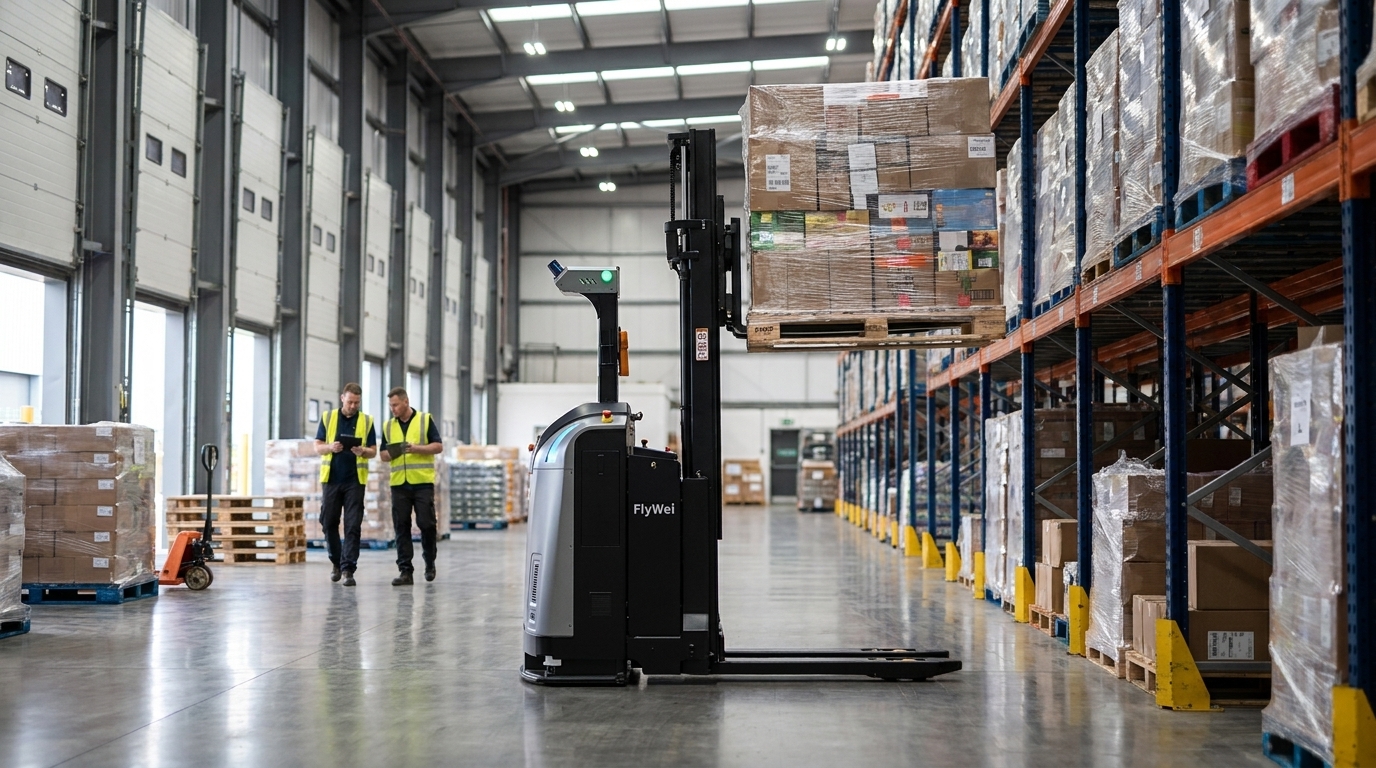
An automated forklift AGV is a driverless industrial truck that moves pallets through a warehouse on its own — guided by laser, vision and LiDAR, sequenced by a fleet manager and certified to ISO 3691-4, the international standard for driverless industrial trucks. For a UK 3PL supply chain director the definition matters less than the operating reality: the Health and Safety Executive attributes around a quarter of workplace transport injuries to forklift incidents, and every one of them lands on the same risk register that already carries driver shortages and rising agency rates. By 2026 the question is no longer whether to automate pallet flow at Magna Park, DIRFT or SEGRO East Midlands Gateway — it is how to orchestrate an automated forklift AGV fleet across four or five shipper SKU pools, hold a single-pane-of-glass customer view, and still hit the 18% IRR your capex committee signed off on last quarter.
Why mixed-shipper 3PL sites are running out of road on manual forklifts
Three forces converged on the UK 3PL sector through 2024–2026 and they have not abated. First, the labour pool. Logistics UK continues to flag a structural shortfall in counterbalanced and reach-truck operators, with agency rates in the East Midlands corridor sitting well above pre-pandemic levels. A 24/7 contract DC of the size FlyWei deploys into now needs materially more trained forklift FTE than it did pre-pandemic to maintain the same uptime, once turnover and absence are baked in — and the FTE you do find is increasingly an agency hire on a Friday-only contract.
Second, the risk register. PUWER 1998 is unchanged but enforcement is sharper, and the post-incident discovery process now routinely surfaces the gap between the written safe system of work and the Friday-night reality on aisle 22. A single forklift-pedestrian incident at a multi-shipper DC is an enterprise-grade event: it pulls a customer audit, it pulls a HSE visit, and it pulls a clause in your next contract renewal that you cannot price.
Third, the customer KPI mix. The shipper sitting in bay 4 measures dock-to-stock minutes; the one in bay 6 measures pallet-perfect rate; the one in bay 8 measures real-time inventory accuracy through their own enterprise WMS feed. Manual forklift fleets, dispatched by a shift supervisor with a radio, cannot give a supply chain director the audit-grade evidence that all three KPIs were met on the same shift. Driverless forklifts can — provided the orchestration layer is right.
The four levers that fix it
1. Operational lever — wave-based dispatch instead of supervisor radio
The fastest payback in any UK 3PL automation programme is not the robot — it is the dispatch logic that sits above it. Most multi-shipper sites still run a "next task to the next free truck" model, dispatched by a shift supervisor on a radio. Across FlyWei''s deployed UK 3PL benchmark, that model burns roughly a fifth of truck-hours on empty travel because the supervisor cannot see the whole picture in real time. Wave-based dispatch breaks the shift into 20–40-minute waves, each wave grouping inbound, putaway and replenishment tasks by aisle cluster and by shipper SKU pool. An automated forklift AGV fleet executes the wave; the supervisor manages exceptions. In a representative 12-bay UK contract DC, redesigning the wave logic alone lifts pallets-per-truck-hour by a clear double-digit margin before a single new robot is commissioned, and gives the supply chain director something to point at when a shipper challenges the contract uplift. If you are still weighing autonomous forklifts against an AMR-only programme, the AGV vs AMR comparison covers the trade-off.
2. Technical lever — a VDA 5050-aligned fleet manager
VDA 5050 is the German automotive industry''s interface specification for driverless transport vehicles and it has become the de-facto European standard for mixed-vendor fleet orchestration. A VDA 5050-aligned fleet manager talks to every driverless forklift, every AMR and every conveyor handshake in the same vocabulary, which means a 3PL site can grow the fleet over three to five years without forklifting (forgive the verb) the whole orchestration stack each time. Today the FlyWei M4 fleet manager dispatches one shipper''s putaway flow; in 2027 it dispatches the same plus another shipper''s pick-face replenishment; in 2028 it dispatches a third shipper''s cross-dock. One supply chain director, one single-pane-of-glass view, one source of truth for the customer report pack. The orchestration layer is also where the operator''s existing ERP and enterprise WMS plug in — so the shipper still sees their own system, while the site runs on the FlyWei dispatch.
3. Regulatory lever — ISO 3691-4, PUWER and ACOP L117 in one safety case
A driverless forklift is still an industrial truck under UK law. PUWER 1998 still applies, the BSI-published ISO 3691-4 standard covers the autonomy-specific safety case, and the HSE-approved Code of Practice L117 covers operator and pedestrian interaction at the truck. A 2026-grade automated forklift AGV deployment writes one safety case that satisfies all three, with the LiDAR field maps, emergency-stop logic and supervisor-handover protocol all documented to the same audit standard. The win for a supply chain director is not philosophical: it is that the customer audit pack and the HSE visit pack are now the same pack, prepared once, version-controlled, and refreshed automatically when the fleet manager logs an aisle change.
4. Commercial lever — lease the capex, not the IRR
The IRR-killer on every UK 3PL automation business case is the front-loaded capex. A fleet of eight driverless forklifts plus the orchestration layer is a seven-figure ticket; on a five-year contract it depreciates against revenue your finance director has not yet booked. Leasing on three, five or seven-year terms moves the spend off the capex line and onto opex, which in FlyWei''s deployed UK 3PL benchmark means the labour saving covers the lease payment from month nine. It also means the fleet refresh in year five does not need a new capex paper.
| KPI | Manual fleet (today) | Automated forklift AGV fleet (orchestrated) | Payback driver |
|---|---|---|---|
| Pallets per truck-hour | 14–16 | 20–24 | Wave dispatch removes empty travel |
| Operator FTE per shift | 6 | 1 supervisor + 1 exception handler | Agency rate exposure removed |
| Forklift-pedestrian incidents (annualised) | 2–4 | 0–1 | LiDAR field + ISO 3691-4 stop logic |
| Audit-grade shipper KPI evidence | Manual reconciliation | Single-pane-of-glass, time-stamped | Fleet manager log |
| Capex impact in Year 1 | £0 (but rising agency cost) | £0 on 5- or 7-year lease | Opex treatment, IRR preserved |
| Time to first pallet moved | n/a | 10–14 weeks from PO | Brownfield, no civils |
An automated forklift AGV fleet in a UK 3PL warehouse is not a labour-replacement project — it is an orchestration project that lets one supply chain director sequence mixed-shipper pallet flows under ISO 3691-4 with audit-grade evidence, while leasing keeps the capex IRR intact.
What FlyWei does here
FlyWei supplies, integrates and supports an end-to-end automated forklift AGV stack for UK 3PL sites running mixed-shipper contracts. The hardware spine is the FlyWei autonomous forklift family — counterbalanced models for 2-tonne pallet handling, reach trucks for narrow-aisle high-bay racking, stacker variants for mid-height work and pallet-truck variants for dock-to-stock — all certified to ISO 3691-4 and CE/UKCA-marked. The orchestration layer is the FlyWei M4 fleet manager, which speaks VDA 5050 to every truck in the fleet and exposes a single-pane-of-glass dashboard the supply chain director can hand a shipper unedited. The RDS robot dispatch service sits underneath, sequencing pallet moves in waves rather than first-come-first-served. The full stack for a brownfield 3PL deployment at a location like Magna Park, DIRFT or SEGRO East Midlands Gateway commissions in 10–14 weeks from purchase order, without civils, and can be leased on three, five or seven-year terms via FlyWei leasing so the IRR your capex committee approved survives contact with the project. UK-based FlyWei engineers handle commissioning, the PUWER safety case and the post-go-live audit pack.
FAQ
What is an automated forklift AGV?
An automated forklift AGV is a driverless industrial truck that moves pallets on its own under a fleet manager, certified to ISO 3691-4. It is sometimes called a driverless forklift, an automated guided forklift or, in narrow-aisle variants, an autonomous pallet stacker.
Is an automated forklift AGV legal to operate in a UK 3PL warehouse?
Yes. It must satisfy PUWER 1998, the ISO 3691-4 standard for autonomous industrial trucks and the HSE-approved Code of Practice L117 on operator and pedestrian interaction. FlyWei writes the safety case for each deployment and hands it to the supply chain director as a single document.
How quickly can a UK 3PL site be commissioned?
A brownfield 12-bay contract DC at a location like Magna Park, DIRFT or SEGRO East Midlands Gateway typically commissions in 10–14 weeks from purchase order. No civils are needed because the trucks navigate the existing aisle and racking layout.
How does the orchestration handle multiple shippers in one site?
The FlyWei M4 fleet manager segments task pools by shipper while sharing the truck fleet. Each shipper sees their own dock-to-stock, pallet-perfect and inventory-accuracy KPIs in a dashboard the supply chain director can publish unedited. The site''s existing enterprise WMS and ERP plug in via VDA 5050-aligned interfaces.
Does an automated forklift AGV reduce forklift-pedestrian incidents?
Yes. The combination of LiDAR field, ISO 3691-4-certified stop logic and supervised handover protocols removes the operator-error tail the HSE attributes to most workplace transport incidents. Most UK 3PL deployments report zero or one annual forklift-pedestrian event after the first full year.
How is the project funded so the capex IRR survives?
Three, five or seven-year leases move the spend off the capex line and onto opex. In most UK 3PL geometries the labour saving covers the lease payment from month nine. The Year-5 refresh does not need a new capex paper.
What if the shipper insists on their own WMS?
The orchestration layer is built to plug under the operator''s existing ERP and enterprise WMS via VDA 5050-aligned interfaces. The shipper keeps their system; the site runs on the FlyWei fleet manager and dispatch.
If sequencing mixed-shipper pallet flows under one orchestrated automated forklift AGV fleet is on your Q3 risk register, FlyWei will scope it for you. Book a free 30-minute site survey with a UK-based FlyWei engineer, or explore how the FlyWei autonomous forklift range covers counterbalanced, reach, stacker and pallet-truck variants under a single fleet manager. Three, five and seven-year leasing terms are available so the capex IRR stays intact. UK-based engineers, no obligation, reply within one business day.