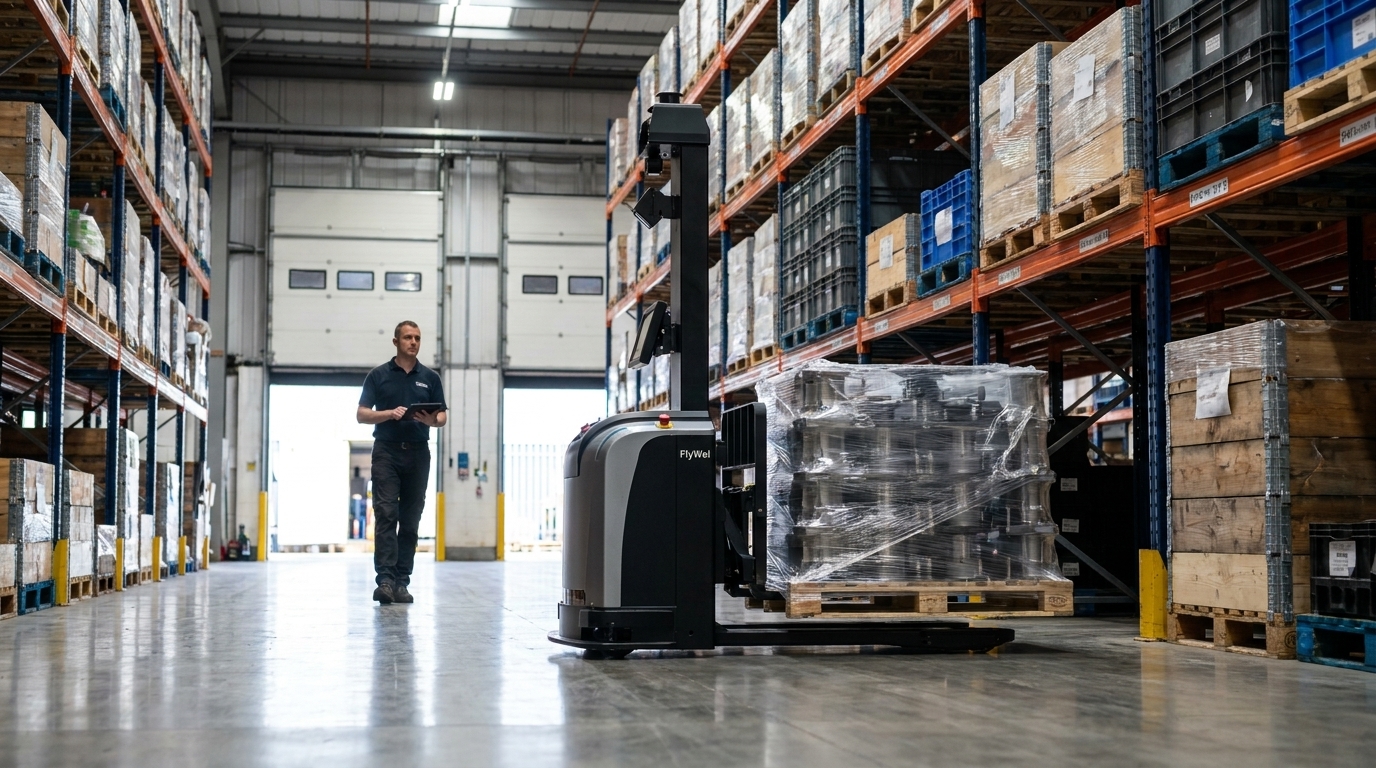
Automated parts washing machine loading and unloading is the autonomous forklift and AGV choreography that pulls wet steel-mesh baskets and tooling fixtures vertically out of an industrial parts-washer, degreaser or drying oven, and feeds the next load in — no driver, no manual lift, no door queue. Around 25 UK workplace fatalities a year are attributed to vehicle and lifting incidents, per the Health and Safety Executive, and its workplace-transport guidance is explicit that any lift exposing an operator to a hot, wet or off-balance load must be designed out wherever reasonably practicable. For a UK Plant Director, the live pain is the same on every shift: an expensive long-cycle washer or vapour-degreaser sits idle while a labourer wrestles a 1–2-tonne basket out of the chamber, the safety zone empties, and downstream machining starves until somebody is free to slot the next fixture.
Why parts-washer load-unload is the hidden bottleneck on UK production lines
Parts-washing covers more equipment than the term suggests. On a typical UK engineering or precision-machining floor, you will find some combination of aqueous immersion washers, ultrasonic tanks, vapour degreasers, spray-cabinet and turntable washers, and conveyor wash-and-dry lines. The parts they clean are presented as open welded steel-mesh baskets — sometimes 1.25 m square and 3 m tall — bespoke tooling fixtures or jigs, or as palletised batches.
The reason the manual loop persists is physical, not cultural. A wet basket leaves the chamber with a high centre of gravity, fluids streaming off, and a vertical withdrawal that fork tines alone cannot stabilise. The labourer is often working into a hot or vapour-rich envelope. The machine cycle is long — often 20–90 minutes — so a single operator covers four or five other duties between loads, and the expensive asset sits idle while they finish each round trip.
The downstream cost is what shows up on the Plant Director's KPI sheet. A washer-and-dryer pair feeds a CNC cell or a paint line, and any starvation cascades: machining slows, the paint booth misses its take, and finished-goods despatch slips a shift. Logistics UK tracks this kind of bottleneck as a leading cause of UK manufacturing OEE loss, and the symptom is always the same — one cheap manual step gating one expensive automated step.
Automated parts washing machine loading and unloading is an autonomous forklift and AGV choreography that pulls wet steel-mesh baskets and tooling fixtures vertically out of an industrial parts-washer or degreaser and feeds the next load in, with no driver and no manual lift.
Lever 1 — Build the cycle around a pick-up/drop station and an unload-then-load choreography
The architectural unit is not the truck — it is the P&D station. A P&D station is a precisely located floor frame, typically aluminium-extruded, sitting in front of the machine door. It carries machine-readable fiducials, fork pockets at a fixed height, and a PLC handshake line into the washer's control panel. The autonomous forklift navigates to the station, the PLC confirms the door is open and the chamber is at safe temperature, the truck withdraws the finished basket vertically, places it on a clean side of the station, then turns and presents the next fixture into the chamber. The door closes; the machine restarts. A single P&D station eliminates door-queue conflict because the truck never waits in the door envelope.
Lever 2 — Run a multi-vendor brownfield fleet under one VDA 5050 plane
Most UK engineering plants do not have one truck — they have a brownfield mix. A 2008 counterbalanced manual truck still does palletised inbound, a 2021 reach truck still does racking, and a new autonomous forklift is being added for the washer loop. The VDA 5050 open interface, originally written for German automotive AGV interoperability and now adopted across European warehouses, lets the new autonomous truck speak to FlyWei's M4 fleet manager and RDS dispatch alongside any other VDA 5050-compliant assets the plant adds later. The result for the Plant Director: one orchestration plane, no proprietary lock-in, and the washer loop sequenced into shift plans without ripping out anything that already works.
VDA 5050 also matters for the resale or expansion conversation in three years' time. If a second washer is added on the line, or an older truck in the brownfield mix is replaced, the orchestration plane does not change — only the truck endpoints do. A plant locked into a proprietary fleet protocol pays for that lock-in every time the line changes shape; a VDA 5050 floor lets the cell grow without rip-and-replace.
Lever 3 — Match the truck to the load, and treat the end-effector as engineering, not a SKU
This is where honest specification matters. A ~2-tonne wet steel-mesh basket needs a counterbalanced autonomous forklift rated to that load — the SCB-2000EU class, 2,000 kg, with attachment interfaces engineered for specialised loads. A ~1-tonne tooling fixture or jig sits comfortably on the SSR-1400EU reach truck (1,400 kg) or the SSS-1500EU autonomous stacker (1,500 kg). Never imply a 1,400 kg reach truck lifts a 2,000 kg basket: that is a LOLER and PUWER breach, not a specification choice.
The hydraulic-latch or clamp end-effector that sits above the forks and grips the basket frame is not an off-the-shelf SKU. It is integrator-scoped engineering, designed against the specific basket geometry, weight distribution and chamber geometry of the machine — drawn up in CAD, fabricated, then placed under a 6-monthly LOLER thorough examination as a lifting accessory. FlyWei's free site survey is where this decision is made. Engineers measure the basket, weigh a representative load, walk the door envelope, photograph the chamber, and only then propose the truck class and the end-effector design.
Lever 4 — Hold the whole loop under ISO 3691-4, PUWER and LOLER from day one
ISO 3691-4 is the UK-recognised standard for driverless industrial trucks; PUWER 1998 covers all work equipment and is referenced in the HSE PUWER ACOP L22; LOLER 1998, set out at legislation.gov.uk, governs lifting operations. The exam cadence is non-negotiable: the truck itself is thoroughly examined every 12 months, while the fork tines, side-shifts and the bespoke hydraulic-latch end-effector are lifting accessories examined every 6 months.
A Plant Director who builds these into the integrator's scope from day one inherits a single statutory calendar, not a stack of vendor PDFs to chase. The plant's existing competent person, named in the LOLER schedule, can hold the routine — or FlyWei can coordinate it under the M4 calendar, where every truck and accessory exam is held against a date, an inspector and a written report.
| Lever | What changes | UK regulatory anchor | FlyWei role |
|---|---|---|---|
| P&D station + cycle choreography | Door queues vanish; long-cycle washer never starves | PUWER 1998 reg 11; BS EN ISO 12100 | Designs station, fiducials and PLC interlock spec |
| VDA 5050 multi-vendor fleet plane | Brownfield trucks merge into one orchestration plane | ISO 3691-4 | M4 fleet manager + RDS dispatch |
| Truck-to-load matching + hydraulic latch | The right truck lifts the right load — never overrated | LOLER 1998 reg 9; UKCA marking | Specifies truck class; CADs the end-effector |
| Single statutory exam calendar | 12-monthly truck + 6-monthly accessory exam routine | LOLER 1998; PUWER 1998 | Builds the calendar; coordinates competent person |
What FlyWei does in this space
FlyWei is an independent UK systems integrator — not a reseller, not a manufacturer. When a UK engineering plant in Coventry, Sheffield or Burton-on-Trent asks how to automate a parts-washer loop, FlyWei sends an engineer to walk the line and measure the chamber, the basket, the floor, the door envelope and the surrounding machine layout. That walk is a free site survey, and it ends in a written feasibility read — not a proposal.
From there, FlyWei designs the cell. The autonomous truck class is matched to the load (an SCB-2000EU counterbalanced unit for 2-tonne baskets, an SSR-1400EU reach truck or SSS-1500EU stacker for ~1-tonne fixtures). The hydraulic-latch end-effector is CAD-engineered against the specific basket frame and machine geometry. The P&D stations are drawn into the plant layout. The PLC handshake and door interlocks are specified jointly with the washer OEM. The fleet sits inside FlyWei's M4 platform under ISO 3691-4, with the LOLER calendar held under one routine.
FlyWei does not pretend any of this is a product on a shelf. It is engineering work — but the engineering is delivered as one accountable scope, end-to-end, by a UK team that lives within walking distance of the BSI standards your plant already runs against.
Frequently asked questions
Can a single autonomous forklift both unload and load the same washer?
It can, but on a long-cycle wash-and-dry pair it is almost always wrong. Two AGVs working an unload-then-load choreography across the wash-and-dry pair keep both machines fed across every shift and remove door-queue conflict. A single truck creates a serial bottleneck the moment the second machine is added.
What does the hydraulic latch actually grip?
It grips the box-section frame at the top of the steel-mesh basket — never the mesh itself. The latch is hydraulically actuated, fail-safe closed, and instrumented so the M4 fleet manager confirms positive engagement before the truck initiates the vertical withdrawal.
How is the AGV physically interlocked with the wash-chamber door?
Through a PLC handshake at the P&D station. The truck's controller requests entry; the washer's PLC replies only once the door is open, the chamber is at safe temperature and the vapour extract has cleared. The truck cannot enter without the handshake, and the washer cannot restart its cycle without the truck's all-clear.
What is the LOLER exam schedule for the truck and the latch?
The autonomous truck itself is thoroughly examined every 12 months under LOLER 1998. The forks, the side-shift and the bespoke hydraulic-latch end-effector are classed as lifting accessories and are examined every 6 months by a competent person.
Why specify two AGVs across a wash-and-dry pair instead of one?
To remove the door queue and keep the long-cycle machine fed across shifts. One truck unloads the finished part from the dryer; a second immediately loads the next dirty fixture into the washer. The machines restart in parallel and the labour ratio of the cell drops to a supervisor on a tablet.
Why isn't this an off-the-shelf product I can simply buy?
Every wash chamber, basket and tooling fixture is slightly different. The truck is catalogue, the fleet platform is catalogue, but the hydraulic-latch end-effector, the P&D station, the PLC handshake and the LOLER calendar are bespoke integrator-scoped engineering — delivered after a free site survey.
If a labourer wrestling a 1–2-tonne wet basket out of an industrial degreaser is on your Q3 risk register, you are not alone — and there is a more accountable way to specify it.
Get a 48-hour feasibility read on your highest-volume flow, or go straight to FlyWei's range of lifting robots and autonomous forklifts to see which truck class your basket and fixtures actually need.
UK-based engineers · no obligation · reply within one business day.