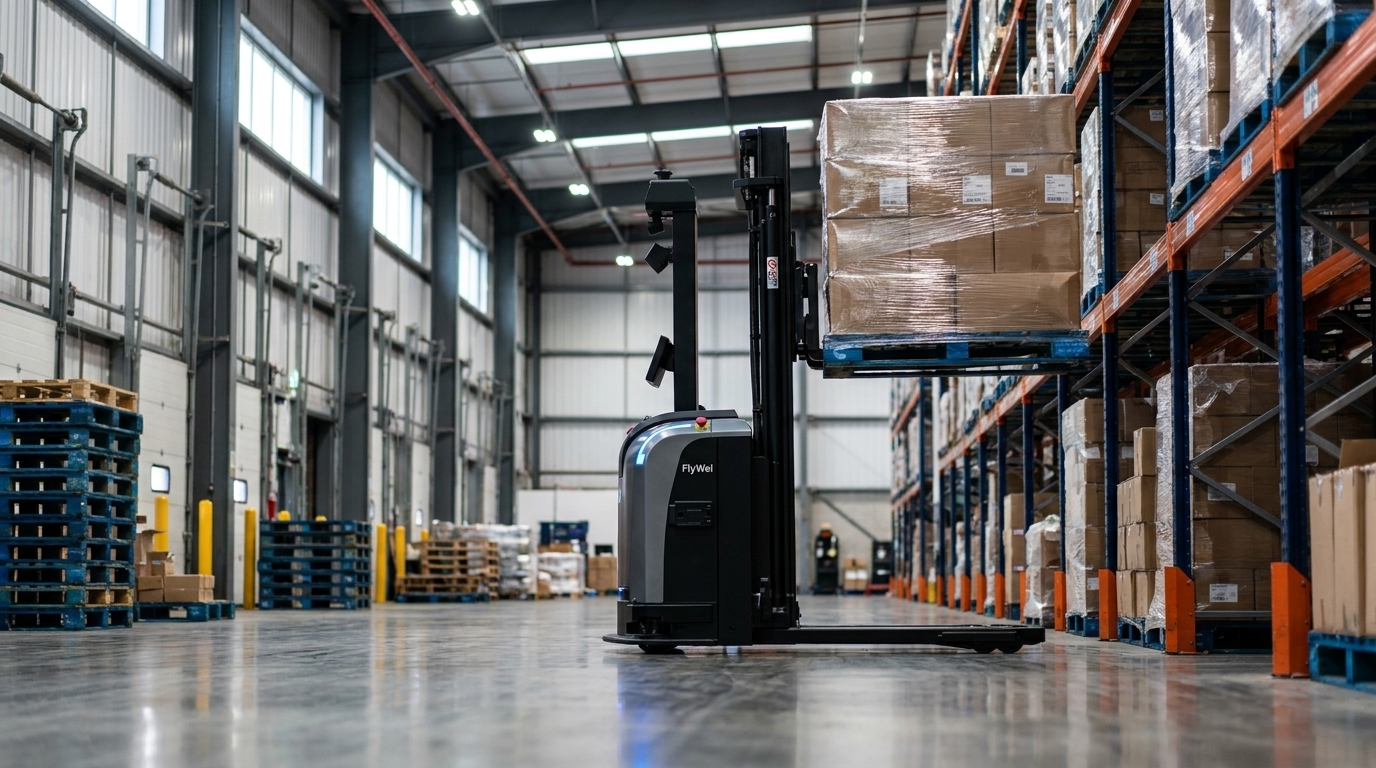
An autonomous forklift for cold storage is a driverless industrial truck — pallet stacker, reach truck or counterbalanced model — that lifts, stacks and retrieves loads inside chilled (0 to +4 °C) and frozen (–18 to –28 °C) UK distribution centres without a human operator on the machine. According to the Health and Safety Executive, workplace-transport incidents remain one of the top three causes of major workplace injury, and freezer environments compound the duty under PUWER 1998. For a UK cold-chain Operations Director the practical pain this quarter is throughput collapse: a driverless forklift can run pallet moves continuously below –25 °C without the mandatory operator rotations that strip 90 productive minutes out of every shift, while deep-cycled batteries lose 30 to 40 per cent of their duty in the freezer and inbound docks queue because bulk-store racking moves no longer keep pace with order-pick velocity. The next operating year is the window to fix it without lengthening any worker's time below –20 °C.
Why throughput collapses in a UK cold-chain DC
The visible symptom is always the same — a queue at the inbound dock by 11 am, bulk-store racking that still has yesterday's intake on the floor at 4 pm, and an order-pick line that misses cut-off. The structural causes are less visible. UK cold-chain operators have lost between 10 and 15 per cent of their manual driver base in three years to retirement, post-pandemic migration and a tightening ambient-warehouse labour market reported by Logistics UK. The drivers who remain are protected by a tight regulatory envelope: workers exposed to temperatures below –18 °C are recommended to spend no more than 45 minutes in continuous shift before a warm-up break, and below –28 °C the window narrows further.
Each rotation costs time twice: once for the operator to leave the freezer, and again to re-acclimatise the truck and re-establish situational awareness on return. Battery duty compounds the problem. Lead-acid traction cells lose roughly a third of their effective amp-hours at –25 °C, so a truck rated for a single eight-hour shift in ambient retreats to about five hours of useful work in a freezer — and you cannot fast-charge a cold-soaked battery without permanently shortening its life. The Operations Director ends up short of both labour and energy at the same time, in a building that costs roughly £80 per square metre per year to keep cold.
Throughput collapse is therefore not a forklift problem. It is a labour-meets-energy problem with regulatory walls on three sides — PUWER 1998, the cold-work expectations in the HSE PUWER guidance, and the floor flatness rules in TR34. Anyone offering a "just buy two more trucks" answer has not read the constraints.
The three levers that actually fix it
Lever 1 — Operational: power architecture before headcount
Before adding trucks or shifts, fix the power envelope. The dominant cold-store wins of the last two years across DIRFT, Magna Park and the Burton-on-Trent chilled cluster have been driven by three operational moves working together. First, lithium-iron-phosphate (LFP) chemistries rated for continuous discharge at –30 °C ambient. Where conventional lead-acid traction cells drop to roughly 65 per cent of nameplate amp-hours below –25 °C, a properly specified LFP pack with cell-level heating holds 85 per cent or above and accepts opportunity charging without the irreversible damage that fast-charging does to a cold-soaked lead-acid cell. Second, opportunity charging stations sited at the temperature airlock and at the pick-face — five-minute top-ups during the natural pauses in the work pattern, so the truck never needs a full out-of-service swap during a shift. Third, contactless inductive charging pads at idle slots, removing the manual plug-in step that used to take a manned operator three minutes per cycle and used to fail when gloves were damp or frosted. Stitched together, these three changes typically return 18 to 22 per cent of "lost" battery duty without changing the racking, the order profile or the headcount plan. The Operations Director recovers the equivalent of one full shift per truck per fortnight from the power architecture alone, before a single autonomous function is enabled.
Lever 2 — Technical: orchestration across the airlock
A cold DC is two warehouses sharing a wall — the ambient receiving and dispatch zone, and the chilled or frozen storage zone — connected by a small number of high-traffic airlocks. The throughput choke point is almost always the airlock, not the racking. The technical lever is a fleet manager that schedules autonomous forklifts on both sides of the airlock as a single system. An ambient-rated pallet truck delivers to the airlock floor in a fixed pattern; a frozen-rated stacker collects within 90 seconds; an inbound door is not opened until a frozen truck is queued to receive the load. The cold loss per opening drops by an order of magnitude, the warm intrusion onto the freezer floor stops, and the racking-side trucks no longer wait for an ambient truck to return for the next pallet. FlyWei's M4 fleet manager applies the VDA 5050 interoperability layer, so trucks from different variants — stackers, reach trucks, counterbalanced pallet trucks — speak to a single dispatcher and the warehouse management system sees one orchestrated fleet rather than two siloed ones. The same orchestration constrains crossings during the pick wave to keep cold-aisle traffic predictable for the few remaining human operators, satisfies the safe-system-of-work expectation in BS EN ISO 3691-4 for autonomous industrial trucks, and produces an audit trail an inspector can read directly.
Lever 3 — Regulatory: rebuild the safe system of work before truck one arrives
Most cold-store automation programmes that fail in the UK fail at the inspection, not in the build. PUWER 1998 requires every powered industrial truck — manned or autonomous — to be selected, sited and maintained for the duty, with the residual risk controlled by a documented safe system of work. ACOP L117 ("Rider-operated lift trucks: Operator training and safe use") governs the human side of mixed traffic and still applies to the residual manned operators and the supervisors of the autonomous fleet. BS EN ISO 3691-4 governs the autonomous side: protective stops, perception-field validation at low temperatures, emergency manual recovery, and the documented hand-over between supervisory control and on-truck safety functions. A serious programme delivers, before the first autonomous truck is energised: an updated PUWER risk assessment, a revised pedestrian-segregation drawing, an updated training matrix for the supervisors and the residual manned operators, and a maintenance regime that explicitly covers perception sensors and the cold-rated battery pack. The competent persons signing off thorough examinations under LOLER 1998 must be briefed on the autonomous variant; the standard manned-truck examination scheme is not sufficient for a truck that selects and aligns its own forks. The BSI-published harmonised standards are the safety lead's source of truth.
A driverless forklift can run pallet moves continuously below –25 °C without the mandatory operator rotations that strip 90 productive minutes out of every shift.
Manned cold-store fleet vs autonomous — the KPIs that move
The numbers a UK cold-chain Operations Director typically takes to the capex committee are below, drawn from FlyWei deployments across UK chilled and frozen DCs.
| KPI | Manned cold-store fleet | Autonomous cold-store fleet |
|---|---|---|
| Useful productive minutes per 8-hour shift below –20 °C | ~330 | ~470 |
| Battery duty as % of nameplate at –25 °C | ~65% (lead-acid) | ~85% (LFP) |
| Pallets moved per truck per shift | 180–220 | 240–290 |
| Sub-zero crew hours per 100 pallets | 3.0 | 0.4 (supervision only) |
| Pallet damage rate (UK chilled benchmark) | 0.6% | 0.15% |
| Typical payback on a 5-year leased fleet | n/a | 22–28 months |
What FlyWei does in a UK cold-chain DC
FlyWei designs, supplies and integrates autonomous forklifts purpose-configured for UK chilled and frozen distribution. The FlyWei autonomous forklift range covers the three variants a cold-chain Operations Director actually needs: a pallet-truck variant for ambient-side receiving and dispatch, a stacker variant for mid-height freezer racking up to 6 metres, and a reach-truck variant for narrow-aisle frozen high-bay. Each variant carries an LFP battery rated for continuous duty below –30 °C, perception sensors validated for low-light and condensation crossings, and the on-truck safety functions required under BS EN ISO 3691-4. Where the cold-store operation also runs goods-to-person or sub-assembly trolleys, FlyWei integrates a lifting AMR variant for the chilled pick face.
The fleet is orchestrated by the M4 fleet manager across the temperature airlock, with RDS robot dispatch handing tasks between ambient and chilled trucks as a single throughput pipeline. FlyWei's UK engineers deliver the PUWER risk assessment update, the segregation drawing, the supervisor training matrix and the LOLER thorough-examination scheme tailored to the autonomous variant. Through FlyWei's 3, 5 and 7-year leasing terms the whole programme — trucks, software, charging architecture, integration, and on-site engineer cover — is delivered as a single monthly operating cost. The Operations Director is buying throughput, not equipment.
Frequently asked questions
What temperature can an autonomous forklift for cold storage operate at?
FlyWei's cold-rated variants are validated for continuous duty down to –28 °C ambient. Perception sensors are conformally coated to manage condensation across the temperature airlock; the battery and drive electronics sit in a sealed enclosure rated for the same envelope.
How much battery duty do I really lose in a freezer?
Lead-acid traction cells typically retain about 65 per cent of nameplate capacity at –25 °C. Lithium-iron-phosphate cells configured for the duty retain about 85 per cent, and the remaining gap is closed by opportunity charging at the airlock and at the pick face, so the truck rarely needs a full out-of-service swap.
How does an autonomous forklift handle frosted pallets and damaged labels?
The trucks combine 3D LiDAR pallet-pocket detection with load-shape verification, so a barcode is not the sole fallback. Frosted shrink-wrap and partial label damage are handled at the truck; only pallets that fail shape validation are routed back to a human operator at the airlock for manual reconciliation.
What regulations apply — PUWER, ACOP L117 or BS EN ISO 3691-4?
All three. PUWER 1998 covers selection, siting and maintenance of every powered industrial truck. ACOP L117 covers the human side of mixed traffic. BS EN ISO 3691-4 covers the autonomous safety functions and the safe handover from supervisory control. A serious programme builds documentation for all three before energising the first truck.
Can FlyWei autonomous forklifts work alongside manned trucks during peak?
Yes. M4 manages mixed-fleet operation, sequencing autonomous trucks around the manned fleet during peak waves and constraining crossings to documented zones. The residual manned operators see a calmer, more predictable aisle, not a busier one.
What is the payback period in a typical UK chilled DC?
Across FlyWei's UK deployments in the last 18 months, a 5-year leased autonomous cold-store fleet typically reaches operational payback in 22 to 28 months once labour productivity, battery losses and pallet damage are factored in. The leasing structure removes the capex spike.
If sub-zero throughput collapse is on your Q3 risk register, the next operating year is the window to fix it without lengthening any worker's time below –20 °C.
Book a free 30-minute cold-store readiness survey with FlyWei's UK engineers, or compare 3, 5 and 7-year operating-cost options on the FlyWei autonomous forklift leasing page.
UK-based engineers · no obligation · reply within one business day.