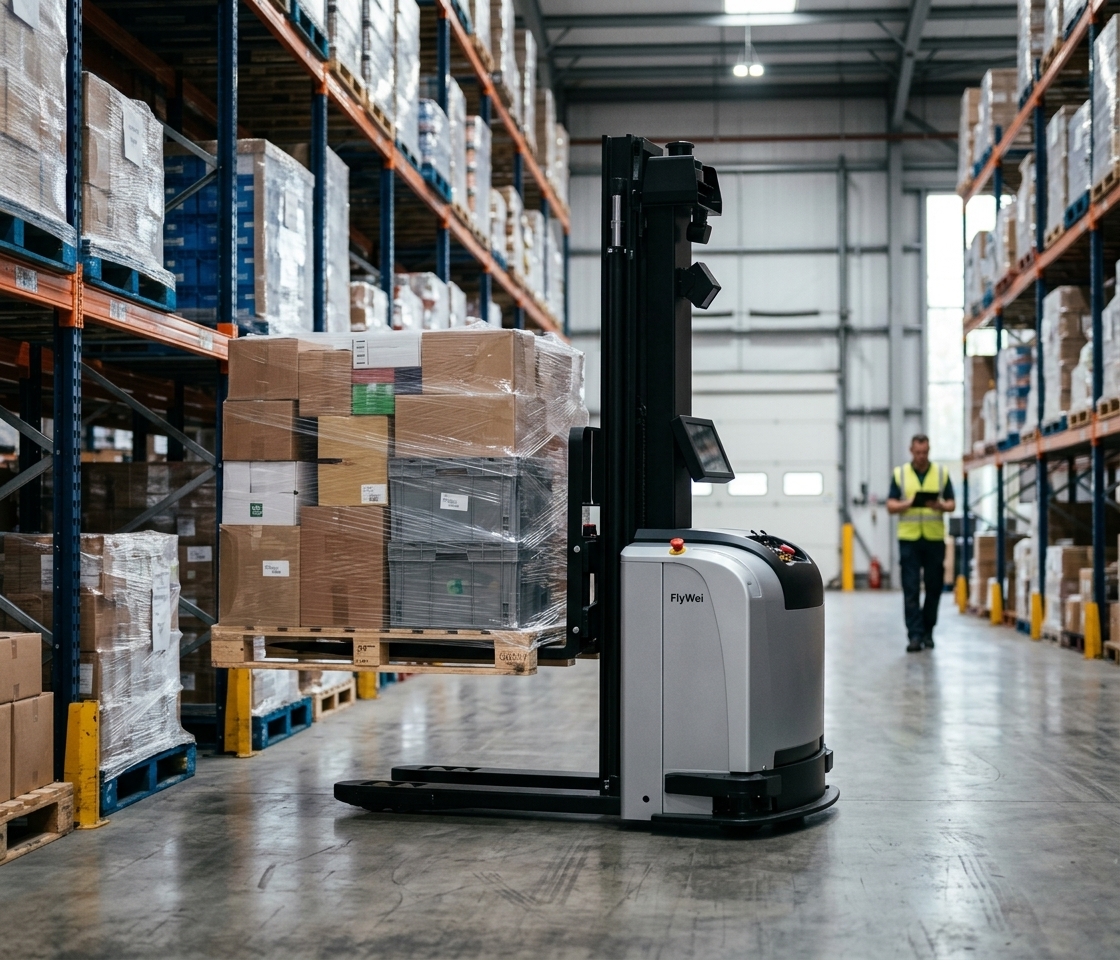
Autonomous forklift leasing is a financing structure that converts the six-figure capital outlay of a driverless forklift fleet into a fixed, full-service monthly operating cost over a 3, 5 or 7-year term, with the hardware, fleet-management software, maintenance, parts and software updates bundled into a single line. In the UK, every powered industrial truck must undergo a thorough examination at least every 12 months under PUWER 1998 (SI 1998/2306), and every 6 months under LOLER 1998 (SI 1998/2307) where it has people-lifting attachments — recurring inspection lines that legacy capex spreadsheets routinely under-cost across years two through five. For UK retail DC procurement and capex committees, this is the live pain in 2026: you are being asked to underwrite five-to-seven-year residual-value risk on lithium-battery autonomous fleets your finance team has never depreciated before, against a brief that demands payback inside 36 months.
Why this is the procurement question of 2026
UK retail distribution centres are walking three pressures into the same capex committee at the same time. First, the driver-shortage premium that pushed contract MHE rates sharply higher between 2022 and 2025 has not unwound; Logistics UK industry surveys continue to flag warehouse labour as the largest single operating-cost line item for sites above 100,000 sq ft. Second, lithium-ion autonomous forklifts only arrived in volume on UK shop floors from 2023 onward, which means the typical retail-DC asset register has no five-year depreciation precedent for the battery: residual values are being modelled on diesel and lead-acid data that materially overstates write-down risk.
Third, the EU mid-market materials-handling supply base has consolidated sharply through 2025-2026. Capex committees that two years ago could play three integrators against each other now face fewer, larger counterparties — and a sharper question about whether the right exposure is to the integrator's balance sheet or the operator's own. Operating leases push that exposure onto the supplier; outright purchase keeps it on the DC.
The procurement pain underneath this is operational, not financial. You are being asked to commit to a fixed fleet size when the underlying demand profile shifts meaningfully every grocery promotional cycle, every new e-commerce SKU range, every seasonal peak. A leased, full-service fleet that can flex its size, mix and uplift profile inside the contract solves a problem that a purchased fleet, depreciated linearly, cannot.
Autonomous forklift leasing converts the six-figure capex of a driverless forklift fleet into a fixed monthly operating cost across 3, 5 or 7 years, with hardware, fleet software, maintenance, parts and updates bundled into a single line.
The four levers that turn the leasing question into a decision
Lever 1 — Size the lease against utilisation, not vehicle count
The single biggest cause of overspend on UK autonomous forklift programmes is sizing the order to peak demand and then carrying 35-45% idle vehicle hours through eight months of the year. A utilisation-based lease structure flips this: the procurement committee buys a guaranteed throughput — for example, 1,200 pallet moves per shift inside a stated cycle-time envelope — and the supplier sizes, flexes and re-rates the fleet to deliver it. For a typical retail DC at Magna Park or DIRFT, that means agreeing two seasonal uplift windows inside the 5-year term where the supplier ships an additional 4-6 vehicles for 8-12 weeks at a known marginal rate, rather than the operator buying for those windows and idling the equipment afterwards. The operational consequence: fleet-manager M4 telemetry, not the truck count, becomes the contracted unit — the right unit for a retail DC whose throughput swings by 60% inside a calendar year.
Lever 2 — Make telemetry the residual-value mechanism
A diesel forklift's residual value at year five is whatever the auction market says it is, plus or minus body damage. An autonomous forklift's residual value is — to a far greater degree — a function of cumulative battery cycle count, software-version currency and accident-free run hours, all of which the fleet manager records continuously. The capex committee's job is to insist the lease contract makes that telemetry the residual-value reset mechanism: a vehicle that has run inside its battery cycle envelope and remained on the current firmware track at year five carries a contractually higher residual, refunded as a credit against renewal. The technical underpinning is the FlyWei M4 fleet manager and RDS dispatch layer, both exposing cycle, fault and update telemetry against a VDA 5050 interface that the operator's existing ERP and WMS can audit independently. This is the lever procurement and the supplier should be co-engineering, because it prices residual-value risk fairly.
Lever 3 — Anchor the lease to PUWER, LOLER and ISO 3691-4
Statutory duty travels with the operator, not the lessor — but a well-drafted full-service lease can absorb most of the recurring cost. The Provision and Use of Work Equipment Regulations 1998 (PUWER) requires thorough examination and routine maintenance of every powered industrial truck; the Lifting Operations and Lifting Equipment Regulations 1998 (LOLER) adds six-monthly thorough examinations where the truck lifts loads with people implications, such as mast-attachment work platforms. ISO 3691-4 specifies the functional-safety requirements for driverless industrial trucks themselves. A capex committee should require the lease to: include all PUWER and LOLER inspections inside the fixed monthly rate; bundle software updates as ISO 3691-4 conformance is revised; and name a UK-based competent engineer as the contractual signatory on inspection records held against the operator's site at Burton-on-Trent, SEGRO East Midlands Gateway or wherever the fleet is deployed. Outsource the bills, never the duty.
Lever 4 — Choose 3, 5 or 7 years against the right business problem
The headline monthly rate is a poor primary input. The right question is which contract length matches the operational problem.
| Lease term | Best fit | Residual risk profile | Indicative total cost vs outright purchase (5-year horizon) |
|---|---|---|---|
| 3 years | Seasonal peak augmentation; pilot DCs; sites awaiting ERP/WMS upgrade | Lowest — supplier owns one battery cycle | ~108-115% of outright purchase |
| 5 years | Typical retail-DC contract length; matches BSI-aligned thorough examination cadence | Balanced — battery within warranted cycle envelope | ~95-102% of outright purchase |
| 7 years | Mother-DC programmes; committed multi-site retail rollouts | Highest — battery refresh inside term | ~85-92% of outright purchase |
The pattern across UK retail DCs we have priced inside this matrix: where the underlying contract logistics agreement is five years, a five-year lease cleanly transfers MHE risk into the same horizon as the customer P&L. Where the operator owns the building — more common for grocery mother-DCs at Daventry or Burton-on-Trent — seven-year terms unlock the lowest monthly rate, provided the residual-value telemetry from Lever 2 is contractually live.
What FlyWei does in this conversation
FlyWei designs, supplies and integrates autonomous forklift fleets for UK retail distribution centres on 3, 5 and 7-year full-service leases, priced against utilisation rather than per-vehicle. The fleet runs on FlyWei autonomous forklifts — pallet trucks, narrow-aisle stackers, counterbalance trucks and reach trucks — orchestrated by the FlyWei M4 fleet manager and RDS robot dispatch layer, with VDA 5050 conformance so the operator's existing ERP and WMS can read fleet state directly. For procurement committees, the FlyWei leasing programme bundles PUWER and LOLER thorough examinations, ISO 3691-4 software currency, battery health monitoring, on-site parts inventory and named UK-based engineering support into a single monthly invoice. FlyWei lifting AMRs can be added inside the same fleet manager licence if goods-to-person picking joins the brief. The default contract carries two seasonal uplift windows, transparent battery-cycle residual reporting and an explicit refund mechanism at end-of-term for vehicles that remain inside their cycle envelope. Lease terms, pricing bands and a fleet-sizing worksheet sit on the FlyWei autonomous forklift leasing page.
Frequently asked questions
What is autonomous forklift leasing?
Autonomous forklift leasing is a 3, 5 or 7-year full-service finance structure under which the operator pays a fixed monthly rate that bundles the autonomous forklift hardware, fleet-management software, all scheduled and unscheduled maintenance, parts, software updates and statutory thorough examinations into a single OpEx line — replacing the six-figure capex outlay of an outright purchase.
How does autonomous forklift leasing compare to buying outright?
Across a 5-year horizon, full-service leasing typically lands at 95-102% of the all-in cost of outright purchase once PUWER inspections, LOLER thorough examinations, software-update cycles, battery replacement and the operator's own engineering overhead are loaded onto the purchase side. Where the operator's underlying customer contract is 3-5 years, leasing also transfers MHE risk into the same horizon as the P&L.
What is included in a full-service autonomous forklift lease?
The autonomous forklift hardware, M4 fleet manager and RDS dispatch licences, VDA 5050 software updates, ISO 3691-4 currency, PUWER and LOLER inspections, scheduled maintenance, unscheduled call-outs, parts, on-site spares and named UK engineering support. Battery health monitoring and end-of-term battery handling sit inside the rate.
What lease term — 3, 5 or 7 years — is best for a UK retail DC?
Three years suits seasonal peak augmentation, pilot DCs and sites awaiting an ERP or WMS upgrade. Five years is the procurement default — it matches typical UK retail-DC contract length and the BSI-aligned thorough examination cadence. Seven years gives the lowest monthly rate for committed mother-DC and multi-site retail programmes where the operator also owns the building.
Who carries the residual-value risk on the lithium-ion battery?
Under a full-service lease, the supplier carries the residual-value risk on the battery. The lease contract uses fleet-manager telemetry — cumulative cycle count, average state-of-charge envelope, fault history — as the mechanism for adjusting the end-of-term residual. Operators who remain inside their battery cycle envelope earn a contractual residual credit.
Is autonomous forklift leasing the same as RaaS (robotics-as-a-service)?
They overlap but are not identical. RaaS is typically priced per outcome (per pallet moved, per pick) with a shorter notice period. Leasing fixes the monthly rate and contract length and aligns cleanly with retail-DC capex committee approval frameworks. FlyWei offers both; for UK retail DC procurement, leasing usually wins on approval velocity.
Does autonomous forklift leasing satisfy PUWER and LOLER inspection requirements?
Statutory duty under PUWER and LOLER stays with the operator regardless of finance structure. A well-drafted full-service lease bundles the inspections inside the rate and names a UK-based competent engineer as the contractual signatory on the inspection records held against the operator's site, but the duty itself cannot be outsourced.
Can I scale the fleet up or down within a lease?
Yes — the FlyWei default contract carries two seasonal uplift windows where extra vehicles are deployed for 8-12 weeks at a known marginal rate. Permanent scale-up adds vehicles inside the same fleet manager licence. Scale-down at year three is available on 5 and 7-year terms.
If five-to-seven-year residual-value risk on an autonomous forklift fleet is sitting on your Q3 capex agenda, the answer is rarely a different purchase decision — it is a different financing structure.
Request a fleet-sizing and ROI estimate for your DC, and our UK-based procurement engineers will return a sized programme, an indicative monthly rate across 3, 5 and 7-year terms and a residual-value model against your live throughput within one business day. The full lease structure, included scope and term comparison sit on our autonomous forklift leasing page.
UK-based engineers. No obligation. Reply within one business day.