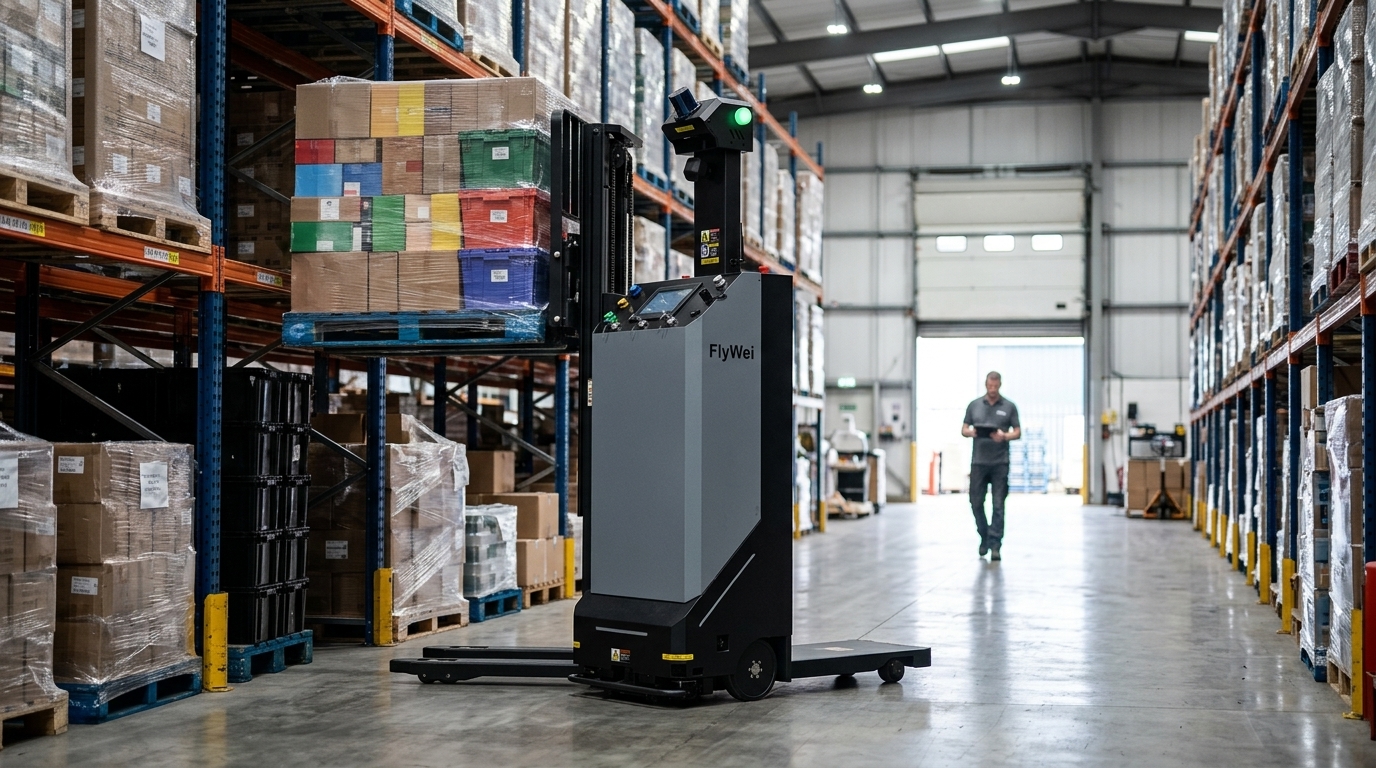
Autonomous forklifts in Italy are driverless industrial trucks — counterbalanced, reach, stacker and pallet variants — that navigate Lombardy, Veneto and Emilia plants under SLAM-based perception, lift loads up to 2,000 kg, and dock to the plant warehouse management system over the VDA 5050 interoperability standard. Workplace-transport collisions remain among the top three causes of fatal industrial injury across European manufacturing operations, and Italian carrellisti certifications have been lapsing faster than Tier-1 supplier hiring since 2024, with the over-55 share of the certified pool now climbing fast across the industrial belt. For the supply chain director running a Modena engine plant, a Brescia white-goods DC, or a Parma food-valley fulfilment site, the combination of compliance pressure under D.Lgs 81/08 enforcement and a structural shortage of certified forklift operators is what makes 2026 the year the autonomous-forklift conversation in Italy moves from the innovation budget to the operations P&L.
Why Italy is feeling the squeeze first
Three forces are colliding inside Italian distribution and manufacturing this quarter. The first is regulatory. D.Lgs 81/08 — the Testo Unico sulla salute e sicurezza sul lavoro — has tightened around industrial trucks since 2023, and the EN ISO 3691-4:2023 update sets explicit safety-of-the-intended-functionality requirements for driverless trucks. Tier-1 supplier audits in Modena and Bologna have flagged manual-forklift near-misses as a top-three finding. EN ISO 3691-4 is the standard buyers ask about first.
The second force is labour. The patente carrellista — Italy''s certified-forklift-operator licence — sits behind a mandatory training cycle and biennial revalidation. Italian operations across the industrial belt report the share of carrellisti aged 55-plus climbing fast, and Tier-1 supplier intakes from Brescia to Bologna are hiring against shrinking pools. Multi-site DCs in Veneto''s logistics corridor through Padova and Rovigo describe recruitment cycles for night-shift drivers stretching well into double-digit weeks.
The third force is energy. Italian industrial electricity tariffs remain elevated through 2026; lithium-ion-powered autonomous trucks now deliver an energy-per-pallet-move significantly below diesel reach-trucks operating in unconditioned warehouses. Logistics UK industry benchmarks point the same direction across European peers: capex-light, energy-efficient fleets are the consensus 2026 buy.
Put the three together and you get the situation a Modena Tier-1 supply chain director described in May: the next time we lose two carrellisti at once, the line stops. That is no longer an acceptable risk-register entry.
Autonomous forklifts in Italy are driverless industrial trucks that lift up to 2,000 kg and dock to plant WMS via VDA 5050, letting Lombardy, Veneto and Emilia DCs absorb the EU-wide carrellisti shortage without losing throughput.
Four levers that fix the squeeze before the line stops
Lever 1 — Brownfield retrofit, not greenfield replatform (operational)
The fastest Italian deployments in 2025-26 share one pattern: they kept the existing racking, dock layout and putaway logic, and slotted autonomous trucks into the lanes the carrellisti were already running. A Lombardy white-goods DC switched four diesel reach-trucks for four autonomous reach-trucks across a single weekend without replacing a rack upright. SLAM-based perception removes the need for floor tape, magnets or reflectors, so the deployment crew leaves the plant looking the same on Monday morning. The KPI a supply chain director should ask about is minutes of plant downtime to commission — anything above eight hours per truck means the integrator wants to sell racking, not robots.
Lever 2 — One fleet manager talking to your existing WMS (technical)
The 2024-25 generation of European autonomous-forklift projects failed where the truck fleet and the WMS spoke different dialects. The 2026 generation has converged on VDA 5050 — the German automotive industry''s interoperability standard — as the lingua franca between mixed-vendor robots and warehouse management. Adopting a single fleet manager that maps WMS putaway orders into VDA 5050 mission language means the supply chain director keeps the existing ERP and WMS investment, and still runs a mixed fleet of counterbalanced, reach and pallet autonomous trucks underneath. FlyWei''s M4 fleet manager is built on this contract, and dispatches autonomous forklifts and lifting AMRs from the same mission queue.
Lever 3 — 3- and 5-year operating lease instead of capex (procurement)
Italian procurement committees that walked an autonomous-forklift business case through finance in 2024 ran into the same wall: a five-truck capex order plus a year-one integration tail is hard to land in a single budget cycle. A 3- or 5-year operating lease — hardware, deployment, maintenance and fleet software bundled monthly in EUR or GBP — converts that capex into an opex line that lives next to operator payroll. Procurement committees in Modena and Padova have closed projects under this model in under nine weeks; FlyWei''s 3, 5 and 7-year operating leases are the route most Northern Italy DCs now use, with a single monthly figure covering the trucks, the M4 software, and the on-site service contract.
Lever 4 — EN ISO 3691-4:2023 conformity as the contract baseline (regulatory)
Every Italian buyer in 2026 should write EN ISO 3691-4:2023 conformity into the supply contract, not the deployment phase. The standard sets explicit requirements for the safety controller, the perception field, the emergency-stop architecture, and the way the truck behaves when a pedestrian crosses its planned path. Insisting on this conformity at PO signature — alongside CE marking and a documented Safety Integrity Level rating on the safety controller — saves the plant safety officer from a three-month corrective-action cycle later. UK PUWER guidance covers the same ground for cross-border plants supplying UK customers, and the BSI route to EN ISO 3691-4 conformity is well documented for procurement teams that need an English-language paper trail.
| Option | Indicative monthly cost (EUR, per truck) | Time to first productive shift | Carrellista licence still required? | EN ISO 3691-4:2023 baseline | Payback profile |
|---|---|---|---|---|---|
| Buy diesel reach-trucks outright | — | 2 weeks | Yes — one per shift per truck | Not applicable | Sensitive to driver pay; 4-5 years typical |
| Buy autonomous reach-trucks outright | — | 6-10 weeks | No (supervisor only) | Mandatory | 3-4 years |
| Operating lease, 3 years (FlyWei) | mid four-figure range | 4-8 weeks | No | Mandatory | Cash-neutral month one |
| Operating lease, 5 years (FlyWei) | lower four-figure range | 4-8 weeks | No | Mandatory | Cash-positive month one |
What FlyWei brings to a Northern Italy DC
FlyWei designs and integrates autonomous-forklift fleets for the exact shape of the Italian Tier-1, FMCG and pharma DC. The product range covers the four truck families a Lombardy, Veneto or Emilia operation actually needs: a counterbalanced autonomous forklift for 2-tonne pallet handling on engine, transmission and white-goods lines; an autonomous reach-truck for high-bay racking up to 8 metres in the Modena and Bologna logistics corridors; an autonomous pallet stacker for mid-height ambient DCs; and a low-profile autonomous pallet truck for dock-to-stock moves on the Parma food-valley fulfilment lanes. Underneath the fleet sits the M4 fleet manager, which translates plant WMS putaway orders into VDA 5050 missions, plus RDS for ad-hoc dispatch when the line plan shifts mid-shift. FlyWei delivers the hardware, the deployment crew, the SLAM mapping, the safety case under EN ISO 3691-4:2023, and the after-sales support from UK-based engineers with EU on-site dispatch. The vertical-specific deployment playbooks — automotive, FMCG, pharma, drinks, 3PL — sit on FlyWei''s solutions hub. The procurement route most Northern Italy supply chain directors now take is the operating lease, which bundles trucks, M4 software, and the on-site service contract into a single EUR monthly line and keeps autonomous-forklift adoption on the operations P&L rather than the capital budget.
FAQ
What is an autonomous forklift in the Italian regulatory context?
An autonomous forklift is a driverless industrial truck conforming to EN ISO 3691-4:2023, CE-marked, and operated under D.Lgs 81/08 risk-assessment procedures with a documented safety case. It does not require a patente carrellista to operate, only a trained supervisor monitoring the fleet via the M4 console.
Do autonomous forklifts in Italy still need a patente carrellista?
No. The licence applies to the human driver; when the truck is driverless, the requirement transfers to a trained supervisor monitoring the fleet via the M4 console, not to per-truck operator licences.
How long does deployment take in a brownfield DC in Lombardy or Emilia?
Four to eight weeks from contract signature to first productive shift is typical for a four-truck mixed fleet, including SLAM mapping, the WMS handshake and the EN ISO 3691-4:2023 safety case. No racking changes are needed in most brownfield installations.
Can autonomous forklifts integrate with our existing WMS and ERP?
Yes. FlyWei''s M4 fleet manager speaks the VDA 5050 interoperability standard plus REST and OPC-UA, so it slots underneath any modern WMS without replacing the operator''s existing ERP investment.
What payload range do FlyWei autonomous forklifts cover for Italian plants?
From 1.5-tonne pallet stackers and 2-tonne counterbalanced trucks, up through narrow-aisle reach configurations to 8 metres. See the full autonomous-forklift range.
Is leasing available for an Italian Tier-1 DC?
Yes — FlyWei offers 3, 5 and 7-year operating leases priced in EUR or GBP, bundling hardware, deployment, fleet software and on-site service. See the leasing options.
How does the M4 fleet manager handle a mixed fleet of autonomous forklifts and lifting AMRs?
M4 dispatches autonomous forklifts and lifting AMRs from a single mission queue, using VDA 5050 to coordinate hand-offs between pallet, tote and shelf transport across the same DC.
If a sudden carrellista shortfall on your Modena, Brescia or Padova lines is on your Q3 risk register, FlyWei can put a number on the fix this week.
Get a 48-hour feasibility read on your highest-volume flow, or compare the procurement maths against your existing capex plan on the FlyWei 3, 5 and 7-year operating lease.
UK-based engineers · EU on-site dispatch · no obligation · reply within one business day.