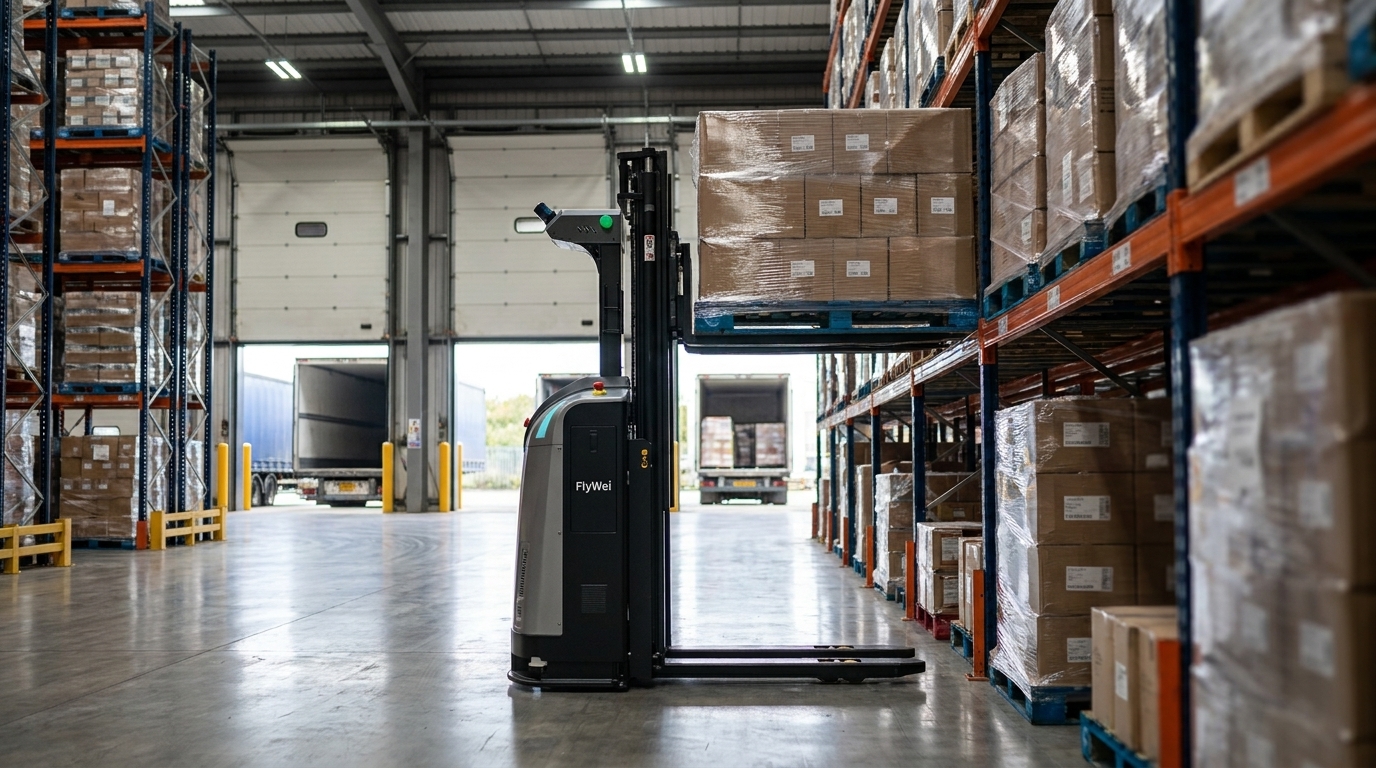
Autonomous forklifts in Sweden are counterbalanced, reach and stacker trucks that navigate independently under BS EN ISO 3691-4:2023, replacing manned trucks on repetitive dock-to-stock, cross-dock and cold-storage cycles across Stockholm, Gothenburg and the Öresund corridor. The standard was published in 2023 by ISO and adopted across the harmonised European framework the Health and Safety Executive references for workplace transport, a formal signal autonomous industrial trucks now sit inside a defined safety envelope Nordic regulators can audit. For the warehouse manager running a Nordic cold-chain DC — Arla ambient, Findus frozen, or an IKEA regional flat-pack building serving Skåne — 2026 arrives with a driver shortfall that peaked over winter, an Arbetsmiljöverket focus on repetitive lifting, and freight volumes through the Port of Gothenburg that keep pushing dock-to-stock cycle times past what a two-shift human fleet can absorb without overtime.
Why the Nordic warehouse manager runs out of forklift hours
Three trends collide in a Swedish cold-chain distribution centre in 2026 and they compound the way overtime does. First, the licensed forklift-driver pool across the Nordics has not recovered from the 2022-2024 tightening; agencies serving Jönköping, Örebro and the Göteborg DC belt confirm sustained gaps against three-shift rotas, and the Logistics UK annual skills tracking shows the same pattern in Britain, where warehouse operatives and forklift drivers have been named among the hardest-to-fill roles for four consecutive years. The Nordic labour market is tighter still because winter absence and cold-chain PPE fatigue add ten to fifteen per cent to sickness rates in ambient and chilled buildings between November and March.
Second, freight flow through the Port of Gothenburg — the largest port in Scandinavia and the primary rail hinterland gateway to Stockholm and Oslo — keeps growing on the same DC footprint. When container throughput rises but the building does not, dock-to-stock cycle time is the first metric that snaps.
Third, the regulatory picture has hardened. BS EN ISO 3691-4:2023 (a European harmonised standard for driverless industrial trucks) is now the operative safety envelope for autonomous forklifts across the EU and UK; Arbetsmiljöverket's AFS 2020:1 obliges Swedish employers to plan out repetitive workplace-transport risk; and the Öresund cross-border corridor means the same fleet must satisfy Danish Arbejdstilsynet expectations when a trailer feeds Malmö from Copenhagen. Manual overtime is no longer a lawful long-term shock absorber for this workload.
The four levers that fix Nordic cold-chain dock-to-stock throughput
Lever 1 — Consolidate the movement lanes (operational)
Before any autonomous truck is specified, the warehouse manager consolidates. A Swedish cold-chain DC typically has four movement lanes worth automating first: inbound trailer-to-goods-receive, receive-to-put-away for palletised ambient and chilled, cross-dock for retail store replenishment, and dispatch marshalling. Consolidation means measuring cycle time and pallet-density per lane, then choosing one or two lanes for a phased pilot rather than trying to automate the whole building at once. The HSE workplace-transport methodology — segregate, mark, plan — gives the manager a template that maps cleanly onto a Malmö or Gothenburg DC. Pilots that start on inbound dock-to-stock, where the pallet mix and route are most repeatable, hit measurable payback fastest and give the operations team a clean before-and-after benchmark ahead of a wider roll-out.
Lever 2 — Adopt VDA 5050 fleet orchestration (technical)
Autonomous forklifts on their own solve a lane; a mixed fleet orchestrated over the VDA 5050 open interface solves a building. VDA 5050 is the standard messaging protocol between a fleet manager and a heterogeneous mix of autonomous trucks, latent-jacking AMRs and stackers. For the Nordic warehouse manager it means the DC can start with a two-truck reach pilot in a chilled ambient area, add counterbalanced units at inbound in year two, then merge lifting robots into cross-dock — all under one supervisor screen. FlyWei's M4 fleet manager speaks VDA 5050 and hands off traffic priority, charging windows, and shift-change swaps between machine classes. That orchestration layer is what turns four discrete pilots into one fleet with a single KPI: pallets moved per operator-shift.
Lever 3 — Evidence EN ISO 3691-4 compliance from day one (regulatory)
Regulators do not sample paperwork; they arrive after an incident. Any autonomous forklift specified into a Swedish DC in 2026 must present a documented safety file mapping to ISO 3691-4:2023 — the same standard adopted by BSI as BS EN ISO 3691-4 and referenced by PUWER 1998 for UK operators handling cross-border fleets. The file evidences safety-related control system performance level, protective zones, emergency stop coverage, warning signals, and the operator training that lets a supervisor override a truck safely. In parallel, Arbetsmiljöverket's AFS 2020:1 (organisational and social work environment) obliges the manager to document how repetitive workplace-transport risk has been removed. FlyWei's site-survey deliverable is the exact document set both bodies request in an audit.
Lever 4 — Lease in SEK-denominated 3, 5 or 7-year terms (commercial)
The last lever is a procurement lever and it usually decides whether the pilot survives Q4. Buying a fleet outright is a capex decision that competes for the same board slot as racking, chillers and PV; leasing in SEK-denominated terms turns the same fleet into operating cost and lines it up against the wage bill it is displacing. FlyWei's 3, 5 and 7-year leasing structure — live since June 2026 — is priced to be neutral against the equivalent labour-plus-hire-truck run rate for a two-shift Nordic cold-chain DC, and includes UK-based engineering support with response inside one business day. That is the move that closes the business case for a Swedish warehouse manager who has to defend fleet automation against the racking upgrade in the same quarter.
Comparison — buying versus leasing an autonomous forklift fleet in Sweden
| Consideration | Buy (capex) | FlyWei 3-7 year lease (opex) |
|---|---|---|
| Capital call | Full purchase price up front | Deposit + fixed monthly payment in SEK |
| Board approval path | Competes with racking, chillers, PV | Sits in operating cost, offsets wage bill |
| Technology refresh | Locked to today's controller and LiDAR generation | Term-end upgrade path to newer-generation trucks |
| Service and parts | Separate contract, often per-visit | Included, UK-based engineers, one-business-day response |
| Break-clause flexibility | None — asset is on your balance sheet | Structured break points at end of years 3, 5 or 7 |
| Compliance evidence | You maintain the ISO 3691-4 file | FlyWei maintains and refreshes with the fleet |
Autonomous forklifts in Sweden are counterbalanced, reach and stacker trucks that navigate independently under BS EN ISO 3691-4:2023, replacing manned trucks on repetitive dock-to-stock, cross-dock and cold-storage cycles across Stockholm, Gothenburg and the Öresund corridor.
What FlyWei does for a Swedish cold-chain DC
FlyWei designs, supplies and integrates autonomous forklifts and lifting robots into working Nordic distribution centres from Malmö and Gothenburg to Stockholm Arlanda cargo. The counterbalanced units cover 2 to 3-tonne pallet handling at inbound; reach trucks handle narrow-aisle high-bay racking up to 10 metres for retail replenishment; stackers cover mid-height ambient and chilled put-away. The M4 fleet manager orchestrates the mix over VDA 5050 and merges with the operator's existing warehouse management system. Site survey, ISO 3691-4 evidence pack, pilot deployment, ongoing service and the SEK-denominated 3, 5 and 7-year lease are delivered as one integrated engagement. Cross-industry pattern references from ambient FMCG through to cold-chain seafood and IKEA-scale flat-pack are on the FlyWei solutions page. For the manager coming to the topic fresh, the plain-English primer on what an autonomous forklift is covers the driverless-forklift definition, sensor stack and cold-chain readiness in one page.
Frequently asked questions
Are autonomous forklifts allowed to work at –20°C in a Swedish cold store?
Yes. FlyWei autonomous forklifts are specified with cold-store battery packs (LiFePO4 with low-temperature performance envelopes) and sealed drive electronics for chilled and frozen operation. The compliance envelope is BS EN ISO 3691-4:2023, and cold-store deployment adds a documented low-temperature commissioning pass covering sensor performance, wheel compound and dwell-time in the chiller lock.
Which Swedish safety standard covers autonomous industrial trucks in 2026?
Two apply in parallel. BS EN ISO 3691-4:2023 covers driverless industrial truck design and safety-related control performance. Arbetsmiljöverket's AFS 2020:1 obliges the employer to plan out repetitive workplace-transport risk and evidence the organisational controls. FlyWei's site-survey pack maps to both.
How does an autonomous forklift fleet handle Öresund cross-border operations to Denmark?
Cross-border operation is a data and compliance question, not a hardware one. The trucks stay inside the Swedish DC; the trailer feeding Copenhagen is loaded by an autonomous truck the same way it would be by a manned truck. Where a shared fleet supports both a Malmö and Copenhagen building, the fleet manager applies both AFS 2020:1 and Danish Arbejdstilsynet expectations to the safety file.
How long does a pilot take from site survey to first move?
A typical Nordic cold-chain pilot runs 10 to 14 weeks from signed lease to first live dock-to-stock move: two weeks of survey and safety file preparation, four to six weeks for truck build and factory acceptance, two weeks for on-site commissioning under BS EN ISO 3691-4, and two weeks of supervised operation before hand-over.
Do we have to replace our warehouse management system?
No. FlyWei's M4 fleet manager integrates with the operator's existing WMS and ERP over a standard message interface. VDA 5050 handles the machine layer; M4 handles orchestration; the WMS keeps stock accuracy and dispatch. The site survey confirms the integration points before the first truck arrives.
Can we lease the fleet in Swedish krona rather than pay capex?
Yes. FlyWei offers 3, 5 and 7-year leases in SEK, with break points at term end and a technology-refresh path onto next-generation trucks. UK-based engineers cover service and parts under the lease.
How does an autonomous forklift compare with a lifting robot in a cold-chain DC?
Autonomous forklifts move palletised loads on and off floor and rack; lifting robots (latent-jacking AMRs and rotary-lift units) move totes, carts and sub-assemblies at floor level. A well-designed Nordic DC uses both — forklifts on the pallet lanes and lifting robots on cross-dock and picking — orchestrated as one fleet through M4.
If Nordic driver-shortage overtime and Q4 cold-chain volume are on your risk register, the first step is a survey of your busiest lane.
Book a free 30-minute site survey — or read the FlyWei autonomous forklifts range to see which counterbalanced, reach or stacker class fits your Malmö, Gothenburg or Stockholm DC.
UK-based engineers, no obligation, one business day response.