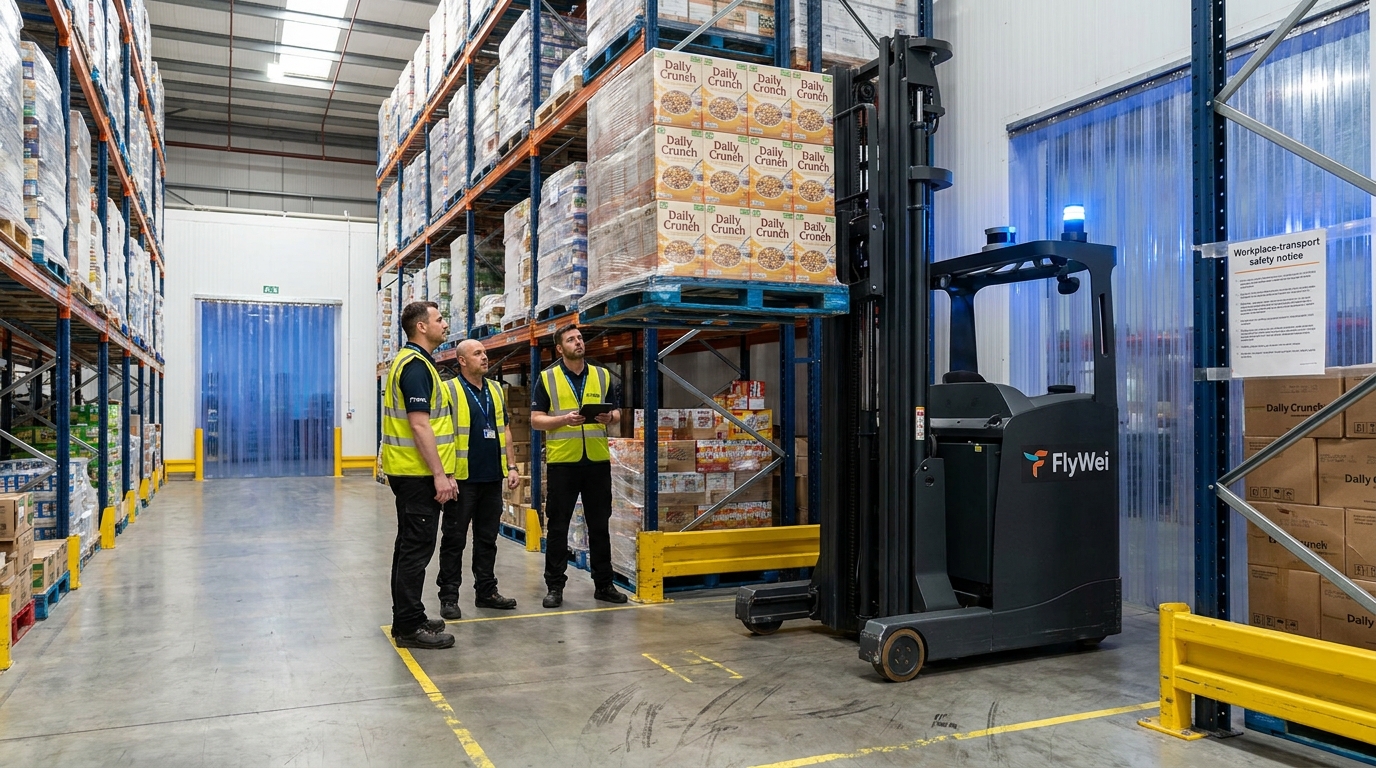
Autonomous forklifts in UK food and beverage distribution have moved from pilot conversations to procurement decisions across grocery DCs in Daventry, ambient sheds at DIRFT and chilled hubs around Burton-on-Trent. UK supply chain directors face the same compound problem: a 34% structural shortfall in certified FLT operators (RTITB, Q1 2026), agency premiums of £14 to £19 per hour, seasonal peaks that lift throughput 35 to 45% above baseline, and a TUPE-sensitive workforce that union representatives are watching closely. Pallet movement is the bottleneck, but the only lever that resolves all four pressures at once is fleet autonomy.
Why UK food and beverage DCs are running out of road on pallet labour
The shortage is structural, not cyclical. RTITB's 2026 Operator Skills Census records a 34% gap between certified FLT operators on the UK register and the headcount UK warehousing requires this year, and food and beverage is one of the worst-affected verticals because temperature-controlled work attracts a wage premium that ambient-only operators rarely match. Labour costs are compounding: standard hourly rates for trained FLT operators in food DCs ranged from £14 to £19 in Q1 2026, with peak-season agency premiums of 15 to 25% on top. The Food and Drink Federation has documented sector-wide vacancy rates at multi-year highs, while Logistics UK reports persistent shortfalls in HGV, FLT and DC support staff across multi-site grocery operations.
Seasonality compounds the cost. UK food and beverage DCs handle 35 to 45% above baseline throughput from late-November to mid-January, and again during the late-summer barbecue and bank holiday peaks. Operators cover this with agency labour at premium rates, but agency operators churn faster, raising RIDDOR-reportable incident risk and lifting PUWER 1998 training overhead. Meanwhile, unionised sites carry a TUPE-consultation obligation when contract-logistics handovers change site staff, and a misjudged automation rollout that signals redundancy without a workforce-transition plan can stall a procurement decision by two quarters.
The structural lever, reducing the headcount needed for routine pallet moves while protecting the existing workforce through retraining, is now the most defensible procurement position a supply chain director can take to their executive committee.
RTITB's 2026 census records a structural 34% shortfall of certified FLT operators in the UK food and beverage sector, where peak-season throughput typically jumps 35 to 45% above baseline.
Lever 1, Operational: deploy reach-truck autonomy first, not goods-to-person
In UK food and beverage DCs, the highest-volume movement is single-deep and double-deep pallet retrieval from 6 to 10 metre racking and replenishment from goods-in. Reach-truck autonomous forklifts handle this profile without rack modification, reflective tape or a floor change. The deployment sequence that consistently delivers fastest payback in UK DCs is straightforward: replace 60 to 80% of routine pallet movements between dock and racking with autonomous reach trucks; keep manned trucks for non-routine and exception work; then introduce a stacker autonomous forklift on the dock-to-stock loop for fast-moving SKUs. The throughput gain is not just hours saved: it is the elimination of the shift-changeover gap. Autonomous units do not pause for breaks, handover briefings or end-of-shift battery swaps, which alone delivers a 7 to 10% throughput lift in 18-hour ambient operations.
Lever 2, Technical: M4 fleet manager, fleet dispatch software and VDA 5050 orchestration
A single autonomous truck is a curiosity. A coordinated fleet is the productivity unlock. FlyWei's M4 fleet manager and Robot Dispatch System handle traffic management, charging schedules, exception routing and integration with the operator's existing WMS over standard REST and VDA 5050 interfaces, so mixed fleets with manned trucks remain orchestrated rather than antagonistic. That matters for food and beverage operations because batch and expiry constraints mean any autonomy layer must accept WMS-driven task priorities: first-expired-first-out is non-negotiable on chilled SKUs. VDA 5050 also future-proofs the fleet: it lets a second-vendor truck join the same orchestration layer later without rip-and-replace, which insulates a five-year capex commitment from single-vendor lock-in. The technical lever, in short, is to buy autonomy as a fleet capability, not as a unit-by-unit purchase.
Lever 3, Regulatory: PUWER, ACOP L117, BS EN ISO 3691-4 and TUPE
Four regulatory anchors govern an autonomous-forklift deployment in the UK. PUWER 1998 requires that work equipment be suitable, maintained and safely used: for autonomous trucks that means a documented duty-of-care risk assessment covering pedestrian interaction, exclusion zones and emergency stop. ACOP L117 (rider-operated lift trucks) and BS EN ISO 3691-4:2023 (driverless industrial trucks) are the operative standards, and the HSE expects evidence of safety integrity for the navigation and emergency-stop systems consistent with these standards. On the workforce side, TUPE, the Transfer of Undertakings (Protection of Employment) Regulations, does not directly govern an automation rollout, but in unionised contract-logistics environments the consultation precedent applies in spirit, and any plan that signals operator redundancy without an alternative role typically triggers a formal collective consultation. The compliance posture FlyWei recommends is: PUWER risk assessment before installation, BS EN ISO 3691-4 conformity statement at acceptance, UKCA mark verified on every unit, and a documented workforce-transition plan signed by the site's union representative before kit goes live. See gov.uk guidance on TUPE for the consultation framework.
Lever 4, Financial: 16-month payback on ambient, 19-month on chilled
The capex case for UK food and beverage DCs converges on a tight band. In an ambient DC running five days × 18 hours with eight FlyWei reach-truck autonomous units replacing 10 manned reach trucks, the typical 12-month numbers are: £320,000 in direct labour savings, £28,000 in maintenance savings (autonomous units accrue downtime on a predictable schedule rather than an incident-driven one), and a 9% throughput gain from eliminated shift-changeover gaps. Payback comes in at 16 months. The same model in a seven-day × 20-hour chilled DC with six units delivers £240,000 in labour savings, a 12% uptime gain from reduced cold-chamber dwell time, and payback at 19 months. The sensitivity that supply chain directors should stress-test in their own model is energy price: LiFePO₄ batteries are 25 to 30% cheaper to charge per kWh-equivalent than diesel or LPG, and commercial energy rates have remained the dominant swing factor over the past 18 months. Procurement committees that model only labour savings consistently understate the payback by four to six months.
| DC profile | Units | Annual labour saving | Throughput lift | Payback |
|---|---|---|---|---|
| Ambient, 5 days × 18 hrs | 8 reach-trucks (replacing 10 manned) | £320,000 | +9% | 16 months |
| Chilled (2°C to 8°C), 7 days × 20 hrs | 6 reach-trucks | £240,000 | +12% uptime | 19 months |
| Mixed ambient + chilled, 6 days × 16 hrs | 10 (8 reach + 2 stacker) | £380,000 | +8% | 17 months |
What FlyWei delivers in UK food and beverage DCs
FlyWei supplies and integrates autonomous-forklift fleets for UK food and beverage distribution from a Wimbledon HQ with deployment teams across the Midlands and South East. The standard offer is a FlyWei autonomous forklift fleet (reach-truck variant for high-bay, stacker variant for mid-bay, and counterbalanced variant for dock-to-stock) coordinated by the M4 fleet manager and integrated to the operator's existing WMS over REST and VDA 5050. Trucks are rated for continuous operation from −10°C to +40°C with LiFePO₄ batteries that hold capacity in chilled environments, IP54 sealing for fresh-produce washdown areas, and LiDAR navigation that does not require reflective tape or floor modification. Typical site-assessment to go-live is 8 to 14 weeks. FlyWei's solutions team runs the PUWER risk assessment, BS EN ISO 3691-4 conformity check and the workforce-transition plan (including 3 to 5 days of operator retraining as system supervisors, maintenance technicians and exception handlers) before a single truck moves on site. The model dovetails with the peak-season playbook covered in FlyWei's UK drinks-logistics peak-season guide for directors running mixed F&B operations.
Frequently asked questions
Can autonomous forklifts handle the temperature swing between ambient and chilled zones in a UK food DC?
Yes. FlyWei autonomous forklifts are rated −10°C to +40°C for continuous operation. LiFePO₄ batteries hold capacity in chilled environments; LiDAR navigation is rated to −20°C without reflective tape or floor modification. For blast-freeze ante-chambers, entry cycles down to −18°C are supported with no degradation.
Is TUPE consultation legally required when deploying autonomous forklifts?
TUPE applies to staff transfers during business transfers and service-provision changes. An automation rollout that does not involve a service-provider change is not strictly a TUPE event, but in unionised UK food DCs, the consultation precedent is the practical baseline, and a documented workforce-transition plan is the path that consistently clears collective consultation in good standing.
What standards govern autonomous-forklift safety in UK warehouses?
BS EN ISO 3691-4:2023 (driverless industrial trucks safety requirements), PUWER 1998 (suitability and safe use of work equipment) and ACOP L117 (rider-operated lift trucks). UKCA marking is required for new units sold in Great Britain. The HSE expects documented safety-integrity evidence for the navigation and emergency-stop systems.
How long does deployment take from contract signature to first productive cycle?
Site-assessment-to-go-live is typically 8 to 14 weeks, gated by WMS integration complexity, the PUWER risk-assessment timeline and on-site infrastructure readiness. Brownfield sites with mature WMS and clean racking complete at the lower end of that range; greenfield sites and sites with bespoke WMS take longer.
What is the realistic payback for a UK ambient food and beverage DC?
16 months for an 8-unit FlyWei reach-truck fleet replacing 10 manned reach trucks in an ambient 5-day × 18-hour DC, on a labour saving of £320,000 per year, maintenance saving of £28,000 and a 9% throughput lift. Chilled DCs typically pay back in 19 months because higher uptime offsets the lower duty-cycle hours.
Can the FlyWei fleet operate alongside our existing manned reach trucks?
Yes. The M4 fleet manager and Robot Dispatch System coordinate mixed fleets: autonomous units take routine pallet cycles between dock and racking, while manned trucks handle non-routine and exception work. VDA 5050 support means second-vendor trucks can join the same orchestration layer later without rip-and-replace.
Talk to FlyWei
If you run a UK food and beverage DC and want a no-obligation site assessment with labour and capex modelling specific to your throughput profile, contact FlyWei. We will run the PUWER, BS EN ISO 3691-4 and workforce-transition workstreams in parallel with your procurement process so the lead-time on a Q3 2026 go-live remains realistic.