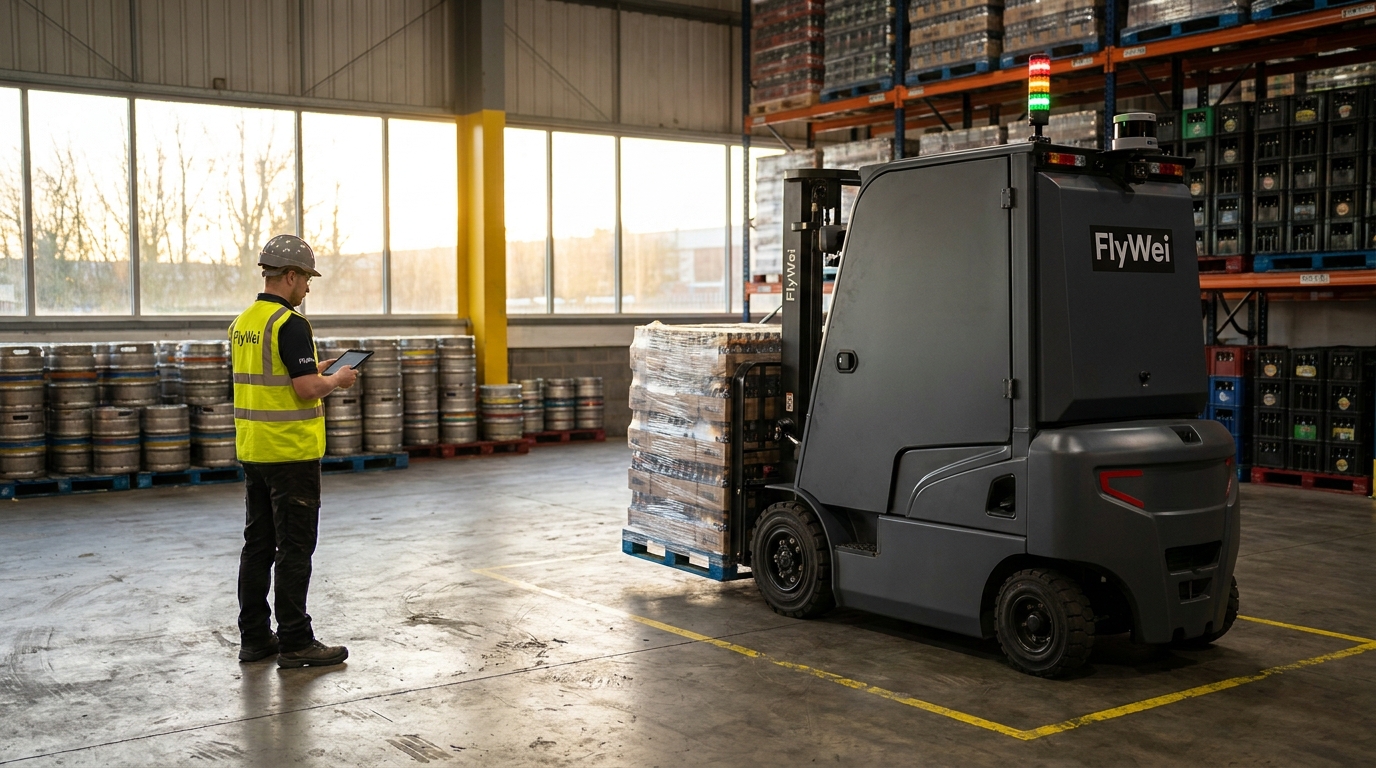
Across UK drinks logistics, this summer's peak is already exposing the same fault line that broke last year's: an autonomous forklift shortage of qualified operators, not of pallets. A regional brewer near Burton-on-Trent and a national drinks 3PL close to Daventry told us the same story this April: orders are up, kegs are returning faster than expected, but their counterbalance trucks sit idle for half a shift because the only thing in short supply is a licensed driver. For Operations Directors in UK drinks logistics, the question is no longer whether to automate handling: it is which lever to pull first without breaking bonded-warehouse compliance or ripping out perfectly good racking.
Why drinks peak breaks UK warehouses
Britain is a drinks-export superpower. The British Beer and Pub Association tracks tens of millions of bulk barrels shipped each year by the country's roughly fifty large brewers and 1,800-plus craft producers (BBPA). The Wine and Spirit Trade Association adds further billions of litres of wine, spirits, and ready-to-drink stock entering the UK supply chain (WSTA). The vast majority of that volume is palletised case stock, but a stubborn 15 to 25 per cent, depending on operator, is steel-keg, glass-bottle, or premium-cask handling that simply does not fit a pallet-only automation play.
The labour side has gone the other way. Logistics UK's annual reporting records persistent material-handling vacancy rates, and forklift-licence renewals under ACOP L117 have not kept pace with attrition (Logistics UK). At the same time, HSE workplace-transport statistics continue to name counterbalance forklifts as a leading single cause of fatal and major injury in food-and-drink warehousing. The combination (fewer licensed drivers, more peak volume, higher safety scrutiny) is structural, not cyclical.
Bonded duty-deferred storage adds a second layer. HMRC excise warehouses store drinks stock before duty is paid, which means every pallet movement is auditable, every reconciliation is timed, and a missing keg is not just an operational loss but an excise liability under HMRC Notice 197. An Operations Director cannot simply throw more agency staff at peak: every additional hand on a bonded UK drinks site is also a compliance event.
UK drinks operators ship tens of millions of bulk barrels and billions of litres of wine and spirits each year, yet HSE workplace-transport statistics still name counterbalance forklifts as a leading cause of major workplace injury in warehousing: exposing the gap that autonomous handling, not inventory scanning, is engineered to close.
The four levers that fix UK drinks-peak throughput
Lever 1 (operational): Design a mixed autonomous fleet, not a single-platform bet
Drinks DCs are deceptively varied. The first 60 per cent of moves are palletised cases coming off the bottling or canning line: clean, square, predictable, and ideal for a counterbalance autonomous forklift that can lift two tonnes from line to ambient store. The next 25 per cent is racking work, picking palletised case stock for outbound consolidation, which suits a reach-truck autonomous forklift in a narrow aisle. The remaining 15 per cent is the problem: returnable steel kegs, mixed-SKU layer pallets, and bonded premium-spirits cages. That work needs a low-profile latent-jacking AMR that can slip under a cage or trolley, and a heavy-lift AMR that can hold a one-tonne keg pallet at the right ergonomic height for a manual de-stacker.
Operations Directors who deploy a single platform either compromise on payload, slowing peak, or compromise on flexibility, leaving keg work manual. The fleet design that actually works in UK drinks logistics is a mixed fleet, orchestrated as one, that handles cases, kegs, and racking without forcing an aisle redesign. FlyWei's solutions catalogue details the variant mix used at recent UK brewery and bottler sites.
Lever 2 (technical): Orchestrate the fleet through M4 and VDA 5050
The single biggest reason warehouse automation projects miss their deployment dates is integration debt. A drinks operator already runs a warehouse management system, an excise reconciliation database, and an end-of-line MES from the brewery. Three more proprietary truck controllers will not help. What helps is a fleet manager that speaks VDA 5050, the open AMR-to-fleet-manager standard, and exposes a stable REST API into the operator's existing WMS. FlyWei's M4 fleet manager orchestrates mixed autonomous fleets through VDA 5050 and feeds movement events back to the WMS in real time, so the bonded-warehouse audit trail updates without manual keystrokes.
This is also where inventory-only scanning robots diverge from autonomous handling. A scanning drone or LiDAR-on-a-stick robot maps where stock is, that is useful, but it does not move kegs, does not lift pallets, and does not reconcile movement to the WMS. It is a complement to autonomy, not a substitute, and the drinks operators that buy scanning first usually discover the handling gap one peak season later.
Lever 3 (regulatory): Engineer for PUWER 1998, ACOP L117, and BS EN ISO 3691-4 from day one
UK drinks warehouses are PUWER-regulated workplaces under the Provision and Use of Work Equipment Regulations 1998 and the wider HSE PUWER guidance. Every powered handling device (manual, semi-automated, or autonomous) must be selected, used, inspected, and maintained against PUWER's competency, suitability, and maintenance standards. For driverless trucks specifically, the operational layer is set by BS EN ISO 3691-4, the driverless industrial truck safety standard, plus ACOP L117 for residual manual counterbalance training. Operations Directors who treat autonomy as the same forklift just without a driver usually miss the standard's safety-zone, light-curtain, audible-warning, and emergency-stop requirements and end up retrofitting at the worst possible moment, at peak.
FlyWei autonomous forklifts ship with the BS EN ISO 3691-4 stack built in (360 degree LiDAR, top puck, light tower, audible warning, and the sealed electronics enclosure where a driver cab would otherwise be) and supervisors receive a documented operator-supervisor competency pack mapped to ACOP L117. That is the path of least HSE risk for a bonded UK drinks site under PUWER 1998.
Lever 4 (commercial): Preserve bonded-warehouse audit integrity
HMRC Notice 197 requires every movement in or out of an excise warehouse to be evidenced. In a manual operation that means handwritten or barcode-scanned reconciliation at goods-in, racking, picking, and dispatch. An autonomous fleet records the same events automatically (pallet ID, location, timestamp, supervising operator) and writes them straight into the WMS. UK drinks operators we work with at sites near Burton-on-Trent, Daventry, and Magna Park use this audit trail to compress monthly HMRC reconciliations and to spot keg-loss patterns long before the duty liability becomes material. The commercial saving is rarely the headline number, but it is the one that pays for the second tranche of trucks.
| Operational dimension | Manual counterbalance fleet | Autonomous mixed fleet |
|---|---|---|
| Peak shift cover | Driver-bound; agency premium at peak | 24/7 capacity; supervisors not drivers |
| Keg / cage handling | Manual; ergonomic risk under HSE LOLER | Heavy-lift AMR plus latent-jacking AMR |
| HMRC Notice 197 audit | Hand-scanned, end-of-shift | Event-stream into WMS, real-time |
| HSE / PUWER posture | Driver-error exposure | BS EN ISO 3691-4-compliant by design |
| Aisle / racking change | Often required | Brownfield retrofit, no aisle redesign |
What FlyWei does here
FlyWei supplies and integrates autonomous forklift fleets for UK drinks operators: brewers, bottlers, distillers, and the 3PLs that move their stock. For a typical UK brewery distribution centre, FlyWei autonomous forklifts handle the line-to-store palletised case flow, FlyWei reach-truck autonomous forklifts manage the narrow-aisle case picking, and FlyWei heavy-lift AMRs and latent-jacking AMRs from the lifting-robots range cover the keg-yard, cage, and trolley work that breaks single-platform fleets. The whole fleet is orchestrated by M4, which speaks VDA 5050 to the trucks and REST into the operator's existing WMS and excise reconciliation database.
FlyWei delivers this as a brownfield retrofit: no aisle redesign, no racking change, no rip-out of the existing WMS. Typical UK drinks-DC deployments span six to ten weeks from contract to first autonomous pallet move, and the HMRC Notice 197 audit trail is part of the integration scope, not a phase-two add-on. For directors thinking about the wider business case, our UK autonomous forklift TCO guide and 3PL ops director guide set out the cost and integration arithmetic, and our cold-storage driver-crisis brief covers the same labour pattern from an adjacent sector.
Frequently asked questions
Can autonomous forklifts handle steel kegs as well as palletised cases in a UK brewery?
Yes, but not on a single platform. A counterbalance autonomous forklift handles palletised cases efficiently; steel kegs in cages or trolleys are better matched to a low-profile latent-jacking AMR for the cage move and a heavy-lift AMR for layer pallets. Most UK breweries deploy a mixed autonomous fleet orchestrated by one fleet manager.
Are autonomous forklifts compliant with PUWER 1998 and HSE rules for UK drinks warehouses?
FlyWei autonomous forklifts meet BS EN ISO 3691-4 and operate within PUWER 1998 inspection, maintenance, and competency requirements. Supervisors receive a documented competency pack mapped to ACOP L117 for the residual manual fleet.
How does autonomous handling affect HMRC bonded-warehouse compliance?
It improves it. Every pallet movement is recorded automatically (pallet ID, location, timestamp, supervising operator) and written into the WMS. UK drinks operators use this event stream to compress HMRC Notice 197 reconciliation and to detect keg-loss patterns earlier than manual scanning ever allows.
Do I have to redesign my racking or aisles to install autonomous forklifts in a UK brewery DC?
Almost never. FlyWei autonomous forklifts are designed for brownfield retrofit. SLAM navigation maps the existing aisles, and BS EN ISO 3691-4 safety zones are configured against the actual site layout. Most UK drinks-DC deployments complete in six to ten weeks without any racking change.
How do autonomous forklifts compare to inventory-only scanning robots in a drinks warehouse?
They solve different problems. Scanning robots map where stock is, a planning input. Autonomous forklifts move that stock and reconcile every movement to the WMS, a handling output. Most peak failures in UK drinks logistics are handling failures, not planning failures, which is why scanning alone never closes the gap.
What is a realistic ROI window for UK drinks operators deploying autonomous forklifts?
Most UK brewery and bottler operators we work with target an 18 to 30 month payback on the first tranche of trucks. Peak agency-driver displacement, HSE incident reduction, and HMRC audit compression are the three largest contributors; aisle-utilisation gains usually show up as a fourth-year benefit.
Where to start
If you run drinks logistics in the UK and you can already see this summer's peak breaking the same way it did last year, the right next step is not a longer agency-driver call list. Talk to FlyWei about a brownfield retrofit of a mixed autonomous fleet (counterbalance, reach, and AMR) orchestrated by M4 and built for bonded-warehouse audit from day one.