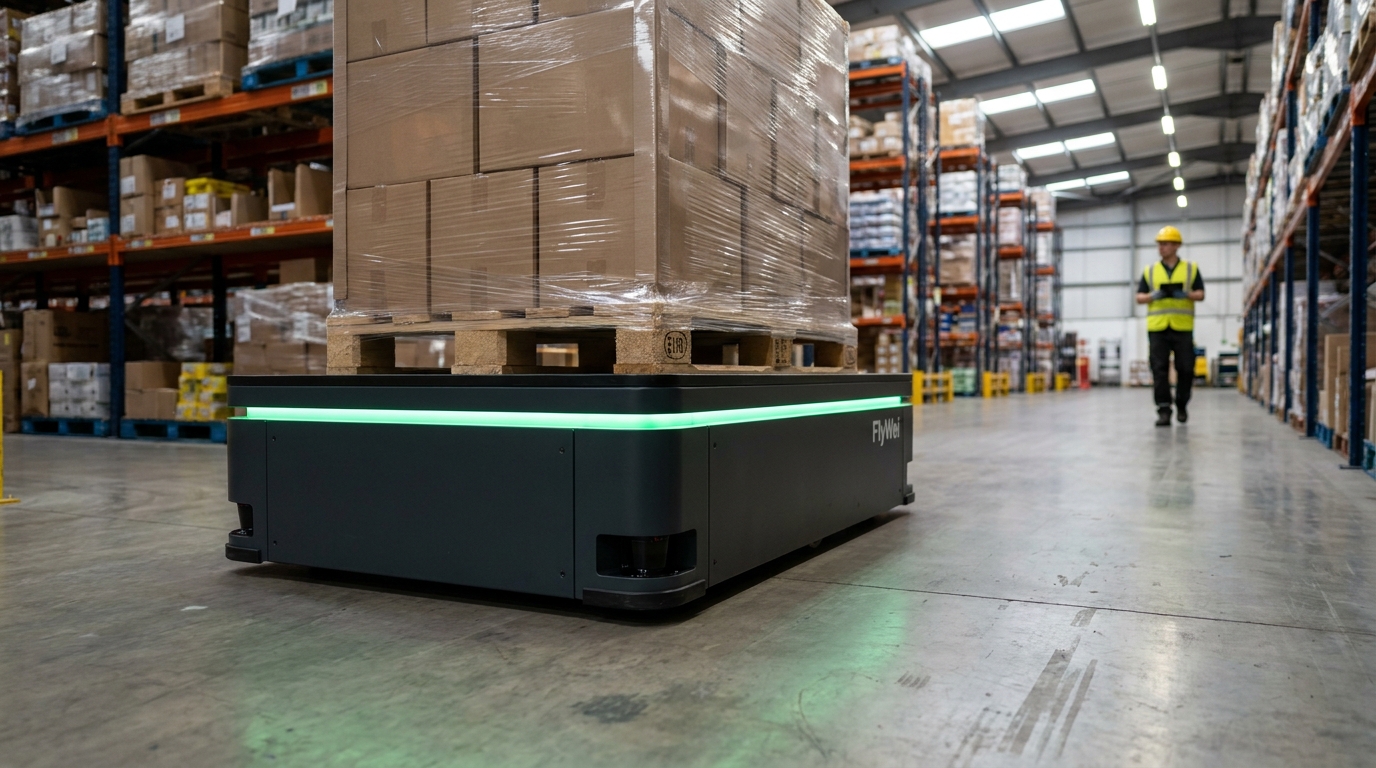
Autonomous forklifts vs shuttle systems is the £8m+ capex fork facing every UK retail DC procurement committee in 2026. Autonomous forklifts are layout-agnostic warehouse robots that move pallets along software-defined routes inside an existing building, while shuttle systems are fixed high-bay ASRS that store and retrieve pallets via captive shuttles bonded to bespoke racking. The Health and Safety Executive reports that workplace transport, including lift trucks, accounts for around a quarter of UK workplace fatalities each year (HSE workplace transport), and any new automation choice must answer to that safety profile. For a 150,000 sq ft re-fit at Magna Park, DIRFT, or SEGRO East Midlands Gateway, the question isn't which system stores pallets faster: it's which one survives a tenancy break, a sortation overhaul, or a new SKU profile without writing off the racking.
Why this decision is harder in 2026 than it was in 2020
UK retail distribution has changed shape since the last major wave of shuttle ASRS deployments. Big-box e-commerce volume has plateaued; omnichannel returns flows have surged; retailers are signing shorter, more flexible leases at parks like Magna Park, DIRFT, SEGRO East Midlands Gateway, and Daventry rather than committing to bespoke owner-occupied buildings. Logistics UK reports persistent volatility in pallet throughput across the grocery and general-merchandise sectors, and procurement committees are being asked to defend ten-year capex against a five-year demand picture they cannot reliably forecast.
The shuttle ASRS model assumes the opposite: that pallet count, SKU profile, drop velocity and seasonal peaks will look broadly similar in 2036 to how they look today. When that assumption holds (typically in deep-stock, slow-moving inventory operations) shuttle systems perform well. In UK retail DC reality, that assumption rarely holds for more than three to four years. SKU counts double. Mezzanines get added. A category management decision in head office redirects a third of throughput overnight. The bespoke racking that justified the eight-figure capex is suddenly the constraint that prevents the operation from responding.
Autonomous forklifts invert the trade-off. They follow software-defined routes; the racking is conventional adjustable-pallet, the floor is conventional TR34-compliant slab, and the robots can be redeployed against new flows without civils, structural surveys or re-certification. Procurement teams who price both options against a ten-year residual value increasingly find that the "expensive" robot fleet is the cheaper bet once optionality is priced in. The capex paper that wins board approval in 2026 is the one that prices flexibility, not the one with the lowest year-one number.
The four levers a UK retail DC procurement committee should pull
1. Operational: match the system to your real SKU velocity, not the brochure
Shuttle ASRS is engineered for ultra-dense, slow-moving stock with predictable retrieval profiles. Autonomous forklifts are engineered for the messy middle: variable pallet weights, mixed dimensions, peak-season surges, and ad-hoc cross-docking. Map your last 24 months of throughput by SKU velocity band before any vendor walkthrough. If more than 60 per cent of pallet moves are sub-30-day stock, shuttle ASRS will be over-engineered for your reality and over-priced against your actual usage. Most UK retail DCs sit in this band. The operational lever is honesty about the data, not aspiration about the building. Ask the operations team for two years of actual receipt-to-dispatch dwell times by SKU band before the procurement committee scores any vendor proposal.
2. Technical: insist on VDA 5050 and an open fleet manager
The single largest hidden cost in a shuttle ASRS deal is the proprietary control layer that locks the operation to one vendor's roadmap. FlyWei's M4 fleet manager and FlyWei fleet dispatch software implement the VDA 5050 open-interface standard, which means any future autonomous robot (counterbalanced forklift, pallet truck, reach truck, latent-jacking AMR) can be added to the same fleet without rewriting the integration. Compare that to shuttle ASRS, where the control system, the shuttles, the racking and the lifts are bonded into a single proprietary stack. If a vendor data sheet does not cite a published open-standard interface, the procurement committee should assume a long-term lock-in rather than a logistics asset. Open standards are the cheapest insurance policy on a ten-year capex.
3. Regulatory: PUWER 1998, ISO 3691-4 and TR34 do not disappear with shuttles
Procurement teams sometimes assume that high-bay ASRS removes the workplace-transport risk. It does not. Under the Provision and Use of Work Equipment Regulations 1998 (PUWER), every powered industrial truck (manual, AGV or autonomous) must be risk-assessed, maintained and operated within its certification envelope. ISO 3691-4 covers autonomous industrial trucks specifically and is the certification baseline FlyWei autonomous forklifts are designed against. Shuttle ASRS, by contrast, sits under PUWER plus the racking and structural rules including the 1998 PUWER regulations, TR34 for the floor slab and BS EN 15512 for the racking. A SKU change that demands taller shuttles or heavier loads frequently triggers fresh structural calculations and re-certification: a hidden recurring cost that rarely appears on the original quote.
4. Capex optionality: price the tenancy break, not the steady state
Sign a ten-year lease at Magna Park or DIRFT with a five-year break clause and the tenancy-break exposure on a shuttle ASRS is dramatic. The racking is bonded to the floor, the shuttles are matched to that racking, and the residual market for a bespoke high-bay system is narrow. An autonomous forklift fleet, by contrast, has a real and active secondary market: the robots, the chargers and the M4 orchestration are portable to the next building. When the procurement committee scores capex against the tenancy break, the "expensive" option is frequently the one with the strongest residual value. Build that residual into the business case at the outset; do not let the vendor frame the comparison as system A versus system B at steady state. The tenancy break is when the capex paper gets tested in earnest.
What FlyWei does here
FlyWei supplies and integrates autonomous forklift fleets sized to UK retail DC reality. Our autonomous forklift range covers counterbalanced units for two-tonne pallets, pallet-truck variants for dock-to-stock moves, reach-truck variants for narrow-aisle high-bay racking, and stacker variants for mid-height racking. Our lifting robots handle heavier sub-assembly moves where the application demands it. The whole fleet runs on FlyWei M4 fleet manager with FlyWei fleet dispatch software, implementing the VDA 5050 open standard so the deployment is never locked to a single vendor, including FlyWei.
Procurement teams typically engage us for a six-week diagnostic: throughput modelling, lane-by-lane phasing plan, PUWER and ISO 3691-4 compliance map, and a side-by-side capex-versus-opex comparison against the incumbent shuttle ASRS quote. Deployment is phased (first lane in six to twelve weeks, scaling from there as the business case proves out) so the operation does not have to take a single-block capex bet against a five-year demand picture. Explore the full FlyWei solutions portfolio or speak to the team directly.
Autonomous forklifts are layout-agnostic warehouse robots that move pallets along software-defined routes inside an existing building, while shuttle systems are fixed high-bay ASRS that store and retrieve pallets via captive shuttles bonded to bespoke racking.
Frequently asked questions
What is the typical capex range for autonomous forklifts vs shuttle systems in a 150,000 sq ft UK retail DC?
Shuttle ASRS for a building that size is typically a single-block capex covering civils, bespoke racking, lifts and proprietary controls. Autonomous forklift deployments are phased lane by lane and blend capex on the robots with an opex orchestration layer on the M4 fleet manager. Procurement committees should request a phased TCO model over seven to ten years that includes a tenancy-break scenario, not just a steady-state comparison.
Do autonomous forklifts replace shuttle systems entirely?
Not in every case. For ultra-dense slow-moving stock with stable retrieval profiles, shuttle ASRS is well-suited. For the messy middle (variable pallet weights, mixed SKUs, peak-season surges and changing category mixes) autonomous forklifts are the more flexible bet. Map the throughput data first, then decide.
How does PUWER 1998 apply to autonomous forklifts and shuttle ASRS?
PUWER 1998 applies to every powered industrial truck: manual, AGV or autonomous. Risk assessment, maintenance regime and operator competence requirements apply equally to both options. ISO 3691-4 is the specific certification baseline for autonomous industrial trucks.
Can autonomous forklifts integrate with our existing WMS?
Yes. FlyWei M4 fleet manager integrates with the operator's existing enterprise WMS and ERP via standard interfaces. The autonomous forklifts execute tasks dispatched from the WMS through M4; there is no requirement to rip and replace the warehouse-management layer.
What happens to a shuttle ASRS at a tenancy break?
Shuttle ASRS is bonded to the floor and to bespoke racking, so the residual market is narrow and removal costs are material. Autonomous forklift fleets, by contrast, are portable to the next building and have an active secondary market, which is why procurement committees should price the tenancy-break scenario explicitly before signing.
How quickly can autonomous forklifts be deployed in an existing UK retail DC?
FlyWei typically delivers a first lane in six to twelve weeks after the diagnostic, with subsequent lanes added as the business case proves out. Shuttle ASRS deployments in a 150,000 sq ft building are usually measured in twelve to twenty-four months including civils.
Does ISO 3691-4 apply to shuttle ASRS as well?
ISO 3691-4 covers driverless industrial trucks specifically and is the baseline for autonomous forklifts. Shuttle ASRS is governed by a different mix of standards, including PUWER for the work-equipment side and structural standards including TR34 (floor slab) and BS EN 15512 (racking). Both options need a rigorous compliance map at design stage.
Talk to FlyWei about a capex-versus-opex comparison for your Midlands DC re-fit →