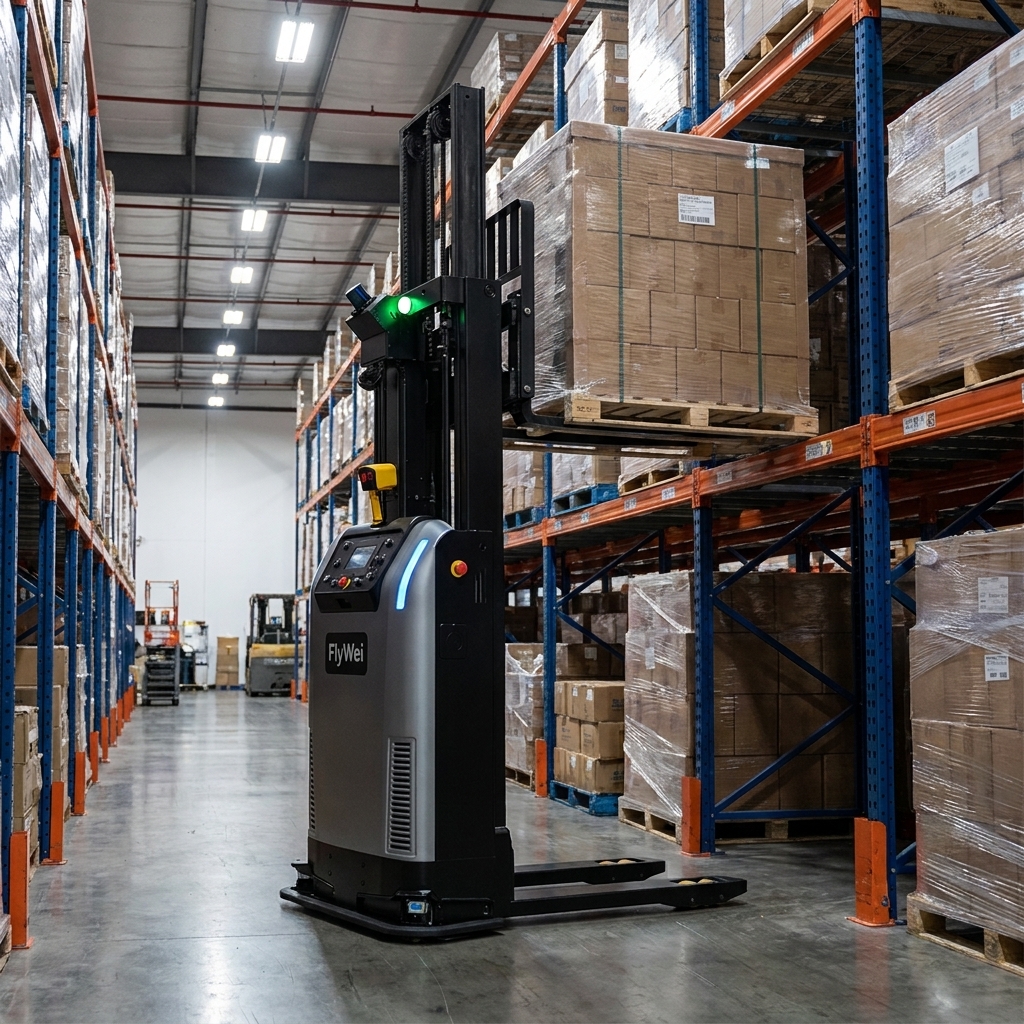
An autonomous pallet stacker is a driverless stacker forklift that lifts, transports and puts away pallets to mid-height racking without an on-board operator, using onboard LiDAR, safety-rated controllers and a fleet manager to plan every move. In the UK, the pressure on warehouse managers to deploy one has jumped: the Logistics UK Skills and Employment Report 2025 still shows the 3PL sector short of forklift operators despite a nine-point wage rise year on year, while HSE workplace-transport statistics put around 25% of all UK workplace transport injuries at the forklift interface. For a warehouse manager running a UK 3PL contract site with 5,000 pallet locations, no space to widen aisles and a client SLA at 06:00, that is the operational squeeze that decides whether the next racking bay is stacked by a human or worked overnight by an autonomous pallet stacker.
An autonomous pallet stacker is a driverless stacker forklift that puts pallets away to mid-height racking without an on-board operator, using LiDAR, safety-rated controllers and a fleet manager to plan every move.
Why the narrow-aisle pallet-stacker squeeze is now a UK 3PL warehouse manager's problem
Three forces have made this a warehouse-manager problem rather than an ops-director problem. First, the labour envelope has tightened structurally. Logistics UK reports the third consecutive year of forklift-operator shortages across contract logistics, with agency day rates in the Golden Triangle around Magna Park, DIRFT and SEGRO East Midlands Gateway now consistently above headline permanent rates on nights and weekends. That means every uncovered shift lands in the warehouse manager's WhatsApp at 05:30, not in the ops director's Monday review.
Second, the regulatory floor rose. HSE PUWER guidance and the Approved Code of Practice make it clear: a manual pallet stacker driven by an under-refreshed operator on a wet dock is a compliance risk owned by the site, not the agency. LOLER 1998 examinations, six-monthly, are increasingly used by clients' HSE consultants as an audit lever inside contract renewals.
Third, the racking envelope shrank. Consolidation has pushed 3PLs into buildings sized for 2019 SKU counts, not 2026's. Warehouse managers running Burton-on-Trent and Daventry contract sites now report that their operational choice is not "widen the aisles" but "put the pallets away with less floor space per aisle", which is exactly the specification an autonomous pallet stacker (also called a driverless forklift or automated stacker truck) is designed for.
The four levers that fix a narrow-aisle pallet backlog
Below is the decision-grade cost and payback table a warehouse manager can screenshot into a contract-review meeting. Each row is what one lever actually costs to try on a live 5,000-pallet UK 3PL site.
| Lever | Upfront cost | Ongoing cost | Payback | Compliance impact |
|---|---|---|---|---|
| Add a night shift (three human stackers) | Nil | £220 to £280k/yr agency | Immediate but recurring | Higher PUWER exposure at 03:00 |
| Widen aisles for reach trucks | £120 to £180k racking rework | Loss of 8 to 12% pallet locations | 3 to 5 years | Neutral |
| Cube-based ASRS (a leading vertical-ASRS vendor) | £1.4 to £2.2m grid and software | £85k/yr service | 7 to 9 years | Fixed grid: cannot re-plan |
| Autonomous pallet stacker fleet (2 to 4 units on leasing) | £0 (opex on 3, 5 or 7-year leasing) | £11 to £16k/unit/month | 18 to 30 months on 16h/day duty | PUWER-friendly by design |
Lever 1 (operational): shift-shape the aisle before you shift-shape the fleet
Before signing anything, a warehouse manager should measure two numbers on a Tuesday night: how many pallets per hour actually move in the target aisle, and how many of those moves are wasted travel; empty legs or retrieval-then-put trips. On most UK 3PL contract sites we survey, 30 to 40% of stacker-truck time is empty travel; putting an autonomous pallet stacker on that aisle without fixing the empty legs first captures maybe half the possible gain. Shift-shape first: batch put-aways in 60-minute windows, close the aisle to non-stacker traffic during those windows, and route the receiving pallets to the correct sub-aisle at goods-in. Only then do you introduce the driverless forklift, which now runs against a cleaner traffic pattern and books its own uptime rather than fighting for aisle share.
Lever 2 (technical): one fleet manager, many machine brands, VDA 5050
A 3PL warehouse manager's second lever is orchestration. The client's WMS talks to the site in movement instructions; the fleet manager translates each instruction into a job for a specific autonomous pallet stacker, a reach truck AMR or a latent-jacking AMR. FlyWei M4 is a multi-vendor fleet manager that speaks the open BSI-referenced VDA 5050 protocol, so the operator's existing ERP and enterprise WMS do not need to be replaced. FlyWei fleet dispatch software handles the sub-second dispatch decisions once the WMS has picked the pallet. Cross-vendor VDA 5050 means the site is never locked to a single robot supplier, which matters at contract renewal, when a client wants proof that the automation on their pallets is portable.
Lever 3 (regulatory): ISO 3691-4, PUWER and the Approved Code of Practice
The autonomous pallet stacker itself must be certified to ISO 3691-4 (Driverless industrial trucks). That is not a nice-to-have: it is the standard cited by insurers, by the client's HSE consultant, and by any post-incident investigation. Site-side, PUWER Reg. 4 and Reg. 5 still apply to the machine (suitability and maintenance). LOLER inspections still apply to the mast at six-monthly intervals. TR34 floor-flatness surveys still apply to the aisles the robot uses. The best-run UK 3PL warehouse managers put these four documents (ISO 3691-4 declaration of conformity, PUWER Reg. 4 and Reg. 5 records, LOLER report, TR34 survey) into a single "robotics compliance pack" that becomes part of the contract-renewal file, so the client's audit team can be answered in one email rather than three meetings.
Lever 4 (commercial): the leasing envelope is where the fleet decision actually lives
Very few UK 3PL contract sites buy an autonomous pallet stacker on capex. The unit economics only work when the fleet flexes with the contract length, which is why FlyWei leasing offers 3, 5 and 7-year terms aligned to typical UK 3PL contract cycles. A 5-year lease on two stackers plus M4 orchestration typically clears £11 to £16k per unit per month all-in, which is meaningfully below the fully-loaded cost of the two agency operators the fleet displaces on nights and weekends. The lease also carries the LOLER inspections, PUWER Reg. 5 servicing and software updates: one line item, one number for the P&L, and the fleet can grow with the client's SKU count rather than the building's capex cycle.
What FlyWei does for UK 3PL contract sites
FlyWei supplies and integrates the autonomous pallet stacker fleet for UK 3PL contract logistics. The typical engagement for a warehouse manager on a 5,000-pallet site looks like this: a UK-based FlyWei engineer runs a free 30-minute site survey (aisle widths, floor flatness against TR34, racking heights, WMS movement counts by hour), FlyWei returns a fleet-sizing and ROI estimate with a scenario for 3, 5 and 7-year leasing, and if the model works the first productive pallet in a live aisle typically lands 8 to 12 weeks after contract signature. FlyWei supplies the autonomous pallet stackers, the M4 fleet manager, the fleet dispatch layer and the ongoing PUWER and LOLER servicing under one contract, so the warehouse manager does not spend Friday afternoons chasing three vendors. Because M4 speaks VDA 5050, the same fleet manager can also orchestrate any brownfield AGV forklifts already on site: no rip-and-replace. Related read for the same site from the ops-director angle: our AGV forklift uptime playbook for UK 3PL ops directors.
Frequently asked questions
What exactly is an autonomous pallet stacker?
An autonomous pallet stacker is a driverless stacker forklift certified to ISO 3691-4 that lifts, transports and puts away pallets to mid-height racking (typically 3 to 8m) without an on-board operator. It uses onboard LiDAR, a safety-rated controller and a fleet manager to plan and execute every move. Synonyms in common UK use: driverless forklift, automated stacker truck, autonomous stacker truck, agv forklift.
How does an autonomous pallet stacker differ from an AGV forklift?
An AGV forklift traditionally follows fixed magnetic or optical guidance, while an autonomous pallet stacker uses SLAM and LiDAR-based navigation and can re-plan its path around obstacles in real time. In practice most modern UK 3PL deployments use the two terms interchangeably; what matters is whether the machine can handle a live 3PL aisle with mixed manual traffic.
How much does an autonomous pallet stacker cost in the UK?
UK 3PL sites typically deploy on opex through leasing, not capex. Expect £11 to £16k per unit per month all-in on a 5-year term, including the machine, PUWER Reg. 5 servicing, LOLER inspections, software updates and the M4 fleet manager licence. Payback vs the displaced agency shift lands at 18 to 30 months on 16-hour daily duty.
Does an autonomous pallet stacker need special racking or floor?
Racking usually does not need to change. Floors are the risk item: TR34 floor-flatness surveys are non-negotiable in narrow aisles at 6m+ lift heights. A FlyWei site survey checks TR34 compliance before any commercial commitment.
Which UK regulations apply?
Four: ISO 3691-4 (machine certification), PUWER 1998 (site suitability and maintenance), LOLER 1998 (six-monthly mast inspections) and the Approved Code of Practice for lift-truck operations. The autonomous pallet stacker sits inside PUWER scope; the fleet manager and dispatch software fall under the site's normal software-assurance process.
How long from decision to first live pallet?
On a typical UK 3PL contract site with 5,000 pallet locations, 8 to 12 weeks. Weeks 1 to 2: site survey, racking check, TR34 assessment. Weeks 3 to 6: fleet-sizing, leasing paperwork, WMS integration scoping. Weeks 7 to 10: install, M4 configuration, PUWER Reg. 4 sign-off. Weeks 11 to 12: shadow-run, then live productive pallets on the aisle.
If narrow-aisle pallet backlog and PUWER exposure are on your Q3 risk register, the fastest way to test whether an autonomous pallet stacker fits your 3PL contract site is to put a UK engineer on it for 30 minutes.
Book a free 30-minute site survey, or see the machine specifications, aisle-width and lift-height ranges on our autonomous forklifts page.
UK-based engineers · no obligation · reply within one business day.