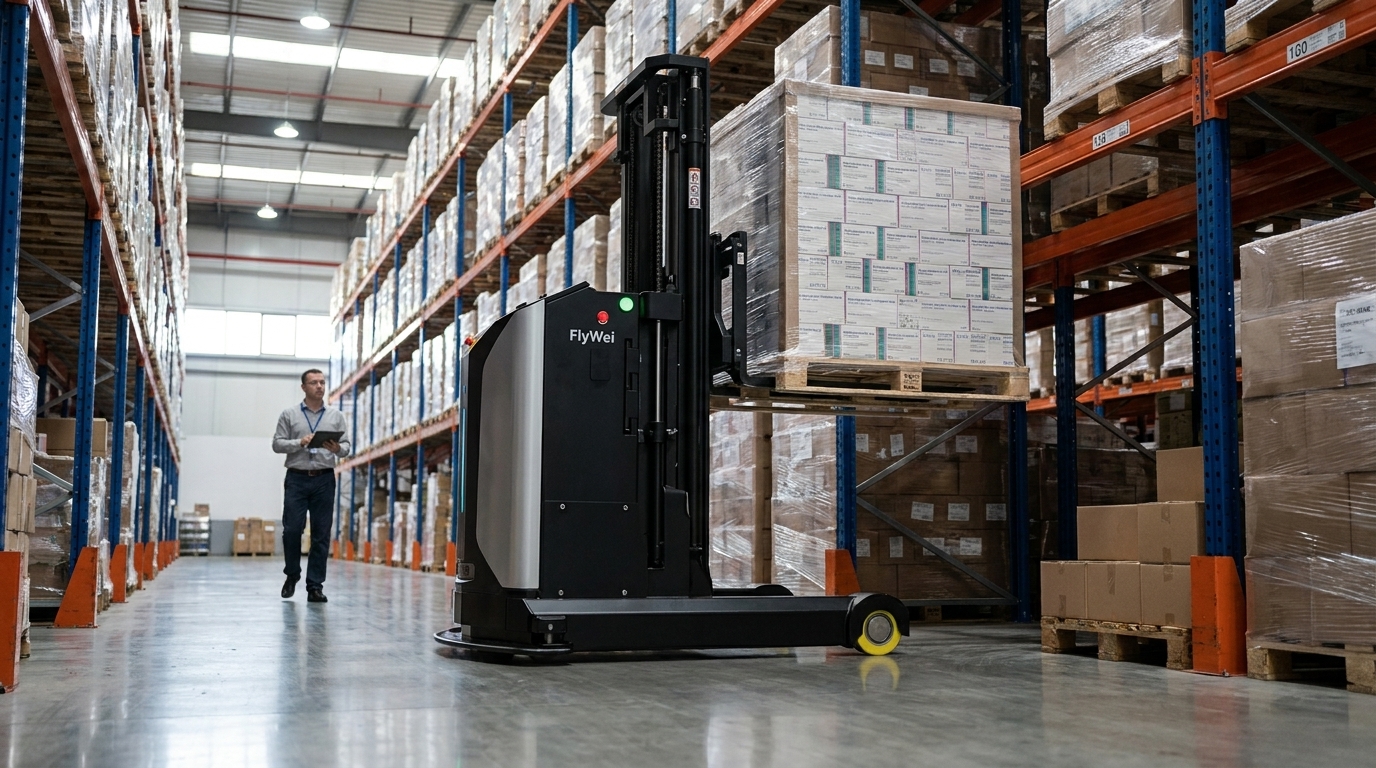
An autonomous pallet stacker is a driverless lift truck that picks, transports and places pallets at height in narrow racking aisles, navigating by on-board LiDAR and a fleet-management dispatcher rather than an on-board operator. According to Logistics UK, UK warehouses are now carrying a 35% labour-shortage premium on counterbalance and reach-truck operators, with vacancy rates outpacing every other intralogistics role across 2025-26. For UK pharma Operations Directors running multi-temperature distribution centres in Burton-on-Trent, Magna Park or DIRFT, that shortage is no longer a headline — it is a daily throughput cap and a regulatory exposure. MHRA Good Distribution Practice insists on validated chain-of-custody for every pallet movement, and PUWER 1998 holds the duty-holder personally liable when an inexperienced lift driver misroutes a controlled-drug pallet. The autonomous pallet stacker collapses both risks into a single audited movement, running 1.6 m clear aisles at ±5 mm placement accuracy and reclaiming up to 25% of slab cube under fully PUWER- and LOLER-compliant duty-holder responsibility.
Why pharma DC throughput is stalling in 2026
UK pharma distribution operates inside a tighter compliance envelope than almost any other logistics vertical. Every pallet movement must remain inside MHRA Good Distribution Practice temperature bands, every controlled-drug movement must be audit-trail traceable, and every lift over 1.8 metres falls inside the LOLER 1998 inspection cycle. The current throughput stall has three compounding causes that any Operations Director will recognise from the shift KPI dashboard.
First, labour. The HSE workplace transport guidance ties productivity to certified operator hours, but UK lift-truck operator vacancy rates have run above 9% every quarter since 2024 and trained operators bleed from regulated pharma sites into faster-paying, less-regulated 3PL sheds within weeks of induction. Pharma DCs are now paying a per-hour premium just to backfill the rota.
Second, infrastructure. Most UK pharma DCs in Daventry, Burton-on-Trent and the South Midlands sit in 1990s-2000s brownfield slabs with TR34 FM2 flatness or worse, and the rack systems were certified to BS EN 15512 for a fixed reach-truck duty cycle. Rebuilding either is a 12-24 month outage no pharma operator can absorb against a fixed MHRA inspection schedule.
Third, regulation. MHRA inspectors increasingly look for digital chain-of-custody on cold-chain pallet moves. A traditional driver carrying a paper sheet cannot produce the timestamped placement evidence inspectors now expect, and a near-miss in a narrow aisle becomes a four-week internal investigation under PUWER duty-holder rules. Add the Falsified Medicines Product traceability rules and the documentation burden for every pallet move now rivals the labour cost itself.
The combined effect: many UK pharma DCs run on 70-80% of designed throughput, with overtime burning operating margin and racks nudging their next LOLER thorough examination earlier than planned.
Lever 1 — Match the reach-height ladder to your existing rack
The first lever is matching payload and lift height to the rack you already own. FlyWei''s narrow-aisle autonomous pallet stackers are sized as a stepped ladder so an Operations Director can pick the smallest truck that clears the bay without forcing rack changes:
| Truck | Payload | Reach height | Clear aisle | Best UK pharma duty |
|---|---|---|---|---|
| SFL-CDD14 | 1.4 t | 4.0 m | 1.6 m | Ambient pick face, controlled-drug cage transfers |
| SSS-1500EU | 1.5 t | 6.0 m | 1.7 m | 2-8°C chilled bays, refrigerated APIs |
| SSS-2000EU | 2.0 t | 9.0 m | 1.8 m | VNA bulk stocks, finished medicinal product raw materials |
Picking too far up the ladder wastes capex and forces a wider aisle than the rack allows. Picking too far down caps throughput because the stacker cannot reach the top tier of a 7.5 metre bay. The Operations Director''s decision is therefore a 30-minute mapping exercise: existing rack height by SKU velocity by temperature band. A typical UK pharma site lands on a mixed fleet — two SSS-1500EU for chilled bays plus one SFL-CDD14 for the ambient pick face — under one dispatcher.
Lever 2 — Run the fleet under one orchestration layer
The second lever is the orchestration layer. A single autonomous pallet stacker delivers maybe 15% of a DC''s labour saving; a coordinated fleet under one dispatcher delivers all of it. FlyWei''s M4 fleet manager handles slot-by-slot map updates, charging cycles, traffic management and operator handover at every shift boundary. Its sibling, the RDS robot dispatch service, allocates each pallet move to the nearest free stacker using the operator''s existing WMS as the source of truth — no rip-and-replace.
Both layers speak VDA 5050, so a pharma DC running heterogeneous robots — narrow-aisle stackers in the bays plus latent-jacking lifting AMRs at the pick face — can route them off one queue. That matters in 2026 because MHRA inspectors are starting to ask for fleet-level audit trails, not single-truck logs. Without an orchestration layer, every robot is an island, every incident is a fresh root-cause investigation, and the digital audit trail the inspector wants does not exist. With M4 and RDS in place, the audit pack regenerates on demand.
Lever 3 — Close the PUWER, LOLER and BS EN ISO 3691-4 loop
The third lever closes the regulatory loop. Under PUWER 1998, the duty-holder must select work equipment that is suitable for purpose, inspected and used only by trained operators. Under LOLER 1998, every lifting operation must be planned, supervised, recorded and supported by a thorough examination at least every twelve months — or six for some lift duties.
Autonomous pallet stackers conformant to BS EN ISO 3691-4 satisfy both: the truck is certified-suitable, the dispatcher logs every lift, and the duty-holder retains accountability via configuration and audit logs rather than driver supervision. A digital LOLER thorough examination record drops out of the M4 logs and lands with the inspector as a single PDF rather than eighteen months of paper sheets. PUWER duty-holder status does not transfer to the robot — it stays with the employer — but the evidence pack becomes infinitely easier to produce. For pharma sites already inside an MHRA inspection window, that means fewer findings and shorter close-outs.
Lever 4 — Use a 36/60/84-month lease, not a capex bid
The fourth lever is how the fleet is paid for. A typical three-truck UK pharma DC stacker fleet sits at £350k-£550k before installation, software and the first LOLER thorough examination — which puts it firmly inside a capex committee approval. UK pharma capex committees in 2026 are tight after stock-build for Falsified Medicines Product rule changes, so most live deals close on a FlyWei 36-, 60- or 84-month operating lease: a fixed monthly opex line with M4, RDS, scheduled maintenance, breakdown cover and end-of-term refresh bundled in.
The 60-month term is the most-quoted because it amortises the truck across two full LOLER thorough-examination cycles and a single MHRA inspection cycle, and because the end-of-term refresh keeps the BS EN ISO 3691-4 conformance current. The residual is taken by FlyWei rather than the operator, which removes the technology-obsolescence risk from the Ops Director''s balance sheet — and from the conversation with the CFO.
Autonomous pallet stackers run 1.6 m clear aisles at ±5 mm placement accuracy and let UK pharma DCs reclaim up to 25% of slab cube without rebuilding racking — under fully PUWER- and LOLER-compliant duty-holder responsibility.
What FlyWei does here
FlyWei designs, supplies and integrates autonomous pallet stackers into live UK pharma DCs without an operational shutdown. The SFL-CDD14, SSS-1500EU and SSS-2000EU are the three sizes that cover almost every UK pharma bay, all conformant to BS EN ISO 3691-4 and delivered with the M4 fleet manager and RDS dispatch service pre-integrated to the operator''s existing WMS. UK-based field engineers from FlyWei survey the slab and rack first — TR34 flatness, BS EN 15512 rack ratings, racking integrity reports — and only then size the fleet to the throughput target.
A typical narrow-aisle pharma deployment is six to ten weeks from site survey to first audited pallet move, with go-live overlapping the existing reach-truck shift so the MHRA cold-chain validation runs in parallel rather than after switch-over. Sites in Daventry, Magna Park, Burton-on-Trent and DIRFT have followed this pattern with no shift loss to date. After go-live, FlyWei retains responsibility for the truck under the lease — software updates, parts, scheduled maintenance and breakdown cover — so the Operations Director carries one supplier, one SLA, one digital audit trail and one monthly opex line, rather than three separate vendors stitched together by spreadsheet.
Frequently asked questions
How narrow an aisle can an autonomous pallet stacker actually run?
FlyWei narrow-aisle stackers run from 1.6 m clear aisle width (SFL-CDD14) up to 1.8 m for the 9 m reach SSS-2000EU. Below 1.6 m the aisle becomes a Very Narrow Aisle (VNA) duty and a different chassis applies.
What payloads are supported across the FlyWei stacker range?
FlyWei autonomous pallet stackers cover 1.4 tonne (SFL-CDD14), 1.5 tonne (SSS-1500EU) and 2.0 tonne (SSS-2000EU). Heavier pallets route to a counterbalance autonomous forklift class on the same M4 dispatcher.
Are autonomous pallet stackers MHRA-compliant out of the box?
The trucks themselves do not hold MHRA validation — your validated cold-chain process does. What the stacker delivers is the timestamped digital placement evidence MHRA inspectors increasingly require, satisfying chain-of-custody under Good Distribution Practice.
Who is the duty-holder under PUWER 1998 if no operator is on the truck?
Duty-holder responsibility under PUWER stays with the employer. The change is that the employer now demonstrates "suitable" and "inspected" via M4 logs and the BS EN ISO 3691-4 conformance certificate, rather than via individual operator training records and paper inspection books.
Does my pallet rack need a fresh LOLER thorough examination after install?
The truck itself sits under LOLER 1998 and FlyWei delivers the first thorough examination certificate at go-live. The rack continues under its existing BS EN 15512 inspection regime; the change in lift-cycle profile is logged via M4 so the inspecting engineer can verify it on the next visit.
What does a 60-month FlyWei lease actually include?
The FlyWei 60-month operating lease bundles the truck, M4 fleet manager licence, RDS dispatch service, scheduled maintenance, breakdown cover and end-of-term refresh into a single monthly opex line. The 36- and 84-month variants follow the same structure with different residuals.
How long does a brownfield pharma DC deployment take?
A typical narrow-aisle pharma DC deployment is six to ten weeks from FlyWei site survey to first audited pallet move, overlapped with the existing reach-truck shift so the MHRA cold-chain validation runs in parallel rather than after switch-over.
If narrow-aisle throughput and MHRA chain-of-custody are both on your Q3 risk register, FlyWei can quantify the saving inside one site visit. UK-based field engineers survey the slab and rack, size the fleet from the ladder above, and return a fully costed 36/60/84-month lease quote within one business day. Book a free 30-minute pharma DC site survey with a FlyWei engineer — UK-based engineers, no obligation, reply within one business day.