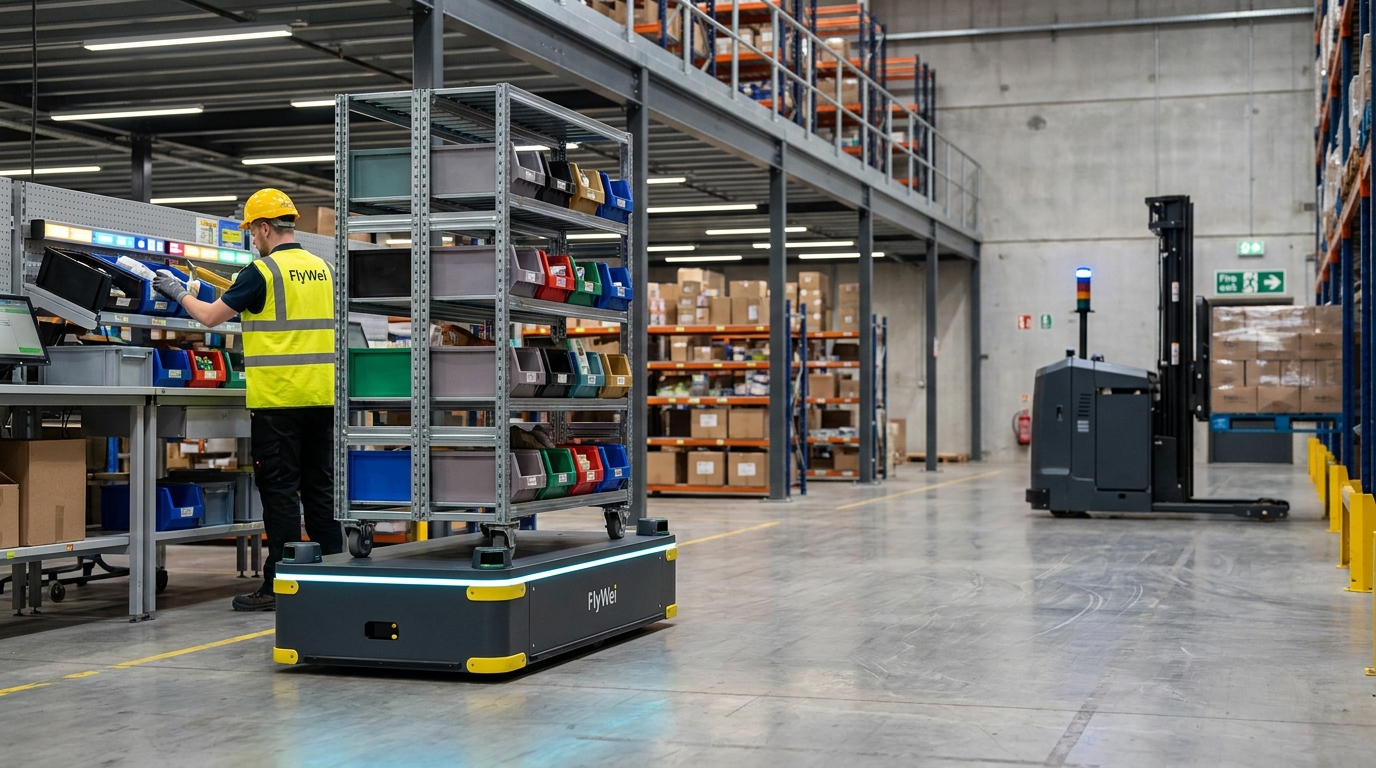
Autonomous picking robots are mobile warehouse robots that carry stock or completed orders through a fulfilment centre so order pickers stop walking the aisles, letting a UK e-commerce operation lift pick throughput without adding headcount. They matter now because the manual alternative is getting harder to staff and harder to keep safe: workplace transport still causes around 5,000 reported incidents in UK workplaces every year, around 50 of them fatal, according to the HSE workplace transport guidance. For an operations director running an e-commerce fulfilment centre, the pain is concrete this quarter. Peak demand is volatile, agency labour is expensive and slow to onboard, and a mixed-SKU order profile means pickers spend more of every shift walking than picking. When volumes spike, throughput plateaus, cut-off times slip, and next-day promises start to fail, exactly when customer tolerance is lowest.
Why e-commerce pick throughput stalls
E-commerce throughput stalls for reasons that have little to do with how fast people work. In a mixed-SKU operation, an order picker can spend most of a shift travelling between locations rather than handling stock. Add orders and you add travel, so output rises far more slowly than headcount: the diminishing return that turns every peak into a staffing arms race.
The UK labour market compounds it. Warehousing roles remain hard to fill, and pay competition across a shared distribution estate pushes agency rates up sharply at peak. Logistics UK has consistently flagged recruitment and retention as a structural constraint on the sector; see the analysis from Logistics UK. An operation near Magna Park, DIRFT or SEGRO East Midlands Gateway recruits from the same pool as a dozen neighbours.
Risk rises too. A fulfilment centre at peak is congested, and mixing people, pallet movements and powered trucks raises the chance of contact incidents. The Health and Safety Executive records workplace transport as a leading cause of serious workplace injury: exposure that grows precisely when an operation is tempted to push harder.
Finally, the demand profile itself is spiky and hard to forecast. A manual operation absorbs that volatility with overtime and agency cover, both slow, costly and capped by how many trained people you can place on the floor. None of these causes is fixed by working harder; they are fixed by changing how the work moves.
Autonomous picking robots are mobile warehouse robots that carry stock or completed orders through a fulfilment centre so pickers stop walking the aisles, letting a UK e-commerce operation lift pick throughput without adding headcount.
1. Take the walking out of the pick
The biggest lever is the simplest to state: stop asking people to walk. In a goods-to-person model, autonomous picking robots, usually latent-jacking AMRs that slide beneath a mobile rack or tote cart, bring stock directly to a picker at a fixed, ergonomic station. The picker never loses time to travel, congestion or aisle searches.
The effect is twofold. Pick rates climb because the picker is only ever picking. And the operation gains a lever it never had: it flexes capacity by reassigning robots to a zone in minutes, not by inducting another shift of agency staff. It also protects quality: a fixed station supports scan verification and put-to-light confirmation, so accuracy holds under pressure instead of collapsing with fatigue. For an operations director, that turns peak from an annual emergency into a planned, routine event.
| Factor | Manual mixed-SKU picking | Autonomous picking robots |
|---|---|---|
| Picker travel | Most of each shift spent walking | Near zero: stock comes to the station |
| Scaling for peak | Recruit, induct and train agency staff | Reassign robots in minutes by software |
| Accuracy under load | Falls as fatigue builds | Holds: fixed station with scan verification |
| Congestion risk | Rises with people and truck movements | Managed by the fleet controller |
2. Make one fleet manager the brain
Robots only deliver if they behave as a fleet, not a collection of devices. That is an orchestration problem, and it is where most disappointing deployments fail. A fleet manager, FlyWei’s M4, holds the live picture of every robot, task and congestion point, and decides what happens next. It sequences tasks against order cut-off times, balances load across zones and reroutes around blockages automatically.
The integration layer matters as much. M4 connects to the operation’s existing WMS so orders flow straight into robot tasks, and uses the VDA 5050 standard to coordinate mixed fleets, AMRs and autonomous forklifts, under one controller. FlyWei’s fleet dispatch software turns live WMS demand into prioritised movement in real time. With a single orchestration brain, adding robots adds throughput predictably; without it, every new unit adds congestion. Treat the fleet manager, not the robot, as the core purchasing decision.
3. Keep replenishment ahead of the pick face
Goods-to-person picking only works if the pick faces never run dry. That is a replenishment problem, and at peak it is usually the hidden bottleneck. If one human forklift driver is the only thing moving full pallets from reserve racking to the pick area, the whole robot fleet is throttled by that single resource.
The fix is to automate the feed as well as the pick. FlyWei autonomous forklifts, counterbalanced units for pallet handling and reach-truck variants for high-bay racking up to eight metres, move full pallets into the replenishment buffer on the same M4 schedule that drives the picking robots. Because both run under one fleet manager, replenishment is sequenced against actual pick-face depletion rather than a fixed timetable. The result is a closed loop that keeps throughput flat right through the cut-off window.
4. Build the rollout on ISO 3691-4 and PUWER
Compliance is not a box ticked at handover; it is a design input that shapes the deployment from the first layout sketch. Driverless industrial trucks operating in shared space are governed by recognised standards, and an operations director should make them part of the brief.
ISO 3691-4 sets the safety requirements for driverless industrial trucks: the personnel-detection, speed-zoning and emergency-stop behaviour that lets robots and people share an aisle. Specifying conformity up front builds the safety case into the fleet rather than retrofitting it. Domestically, the Provision and Use of Work Equipment Regulations (PUWER) require equipment to be suitable, maintained and used only by adequately trained people; BSI guidance helps translate those duties into procedure. Treating ISO 3691-4 and PUWER as design inputs also has a commercial payoff: a demonstrably compliant deployment clears internal safety review and insurer scrutiny faster, protecting the go-live date.
What FlyWei does for e-commerce fulfilment operations
FlyWei supplies and integrates autonomous picking and materials-handling systems for UK e-commerce fulfilment centres. The starting point is the operation, not the robot: FlyWei maps your order profile, pick-face layout and peak curve, then specifies the equipment mix that fits.
For the pick, FlyWei deploys goods-to-person AMRs and lifting robots that bring stock to fixed picker stations. For replenishment and reserve handling, FlyWei autonomous forklifts move full pallets from goods-in and high-bay racking into the pick area. Both run under M4, FlyWei’s fleet manager, with the fleet dispatch layer turning live WMS demand into prioritised tasks. Because M4 coordinates the whole fleet over VDA 5050, operators avoid buying robots that cannot talk to each other.
FlyWei delivers it the way an operations director needs: phased, so the first zone proves throughput before the rollout widens, and timed around your peak; the same discipline behind the FlyWei e-commerce capex playbook. The safety case is built on ISO 3691-4 and PUWER from the design stage. Explore FlyWei fulfilment solutions to scale throughput with software rather than recruitment.
Frequently asked questions
What are autonomous picking robots?
Autonomous picking robots are mobile warehouse robots that move stock or completed orders through a fulfilment centre under software control. In a goods-to-person setup they bring totes or racks to a fixed picker station, removing the travel that dominates manual picking.
How much can autonomous picking robots improve pick throughput?
The gain comes from eliminating picker travel, which absorbs most of a manual shift, and from holding pick rates steady through peak. The exact uplift depends on order profile and layout, so FlyWei models it against your own data first.
Do autonomous picking robots replace warehouse staff?
No. They remove the walking, not the people. Pickers move to fixed stations and supervisors take on fleet oversight, so the operation scales by reassigning robots rather than recruiting agency staff for every peak.
Are autonomous picking robots safe to work alongside people?
Yes, when specified correctly. Driverless industrial trucks are covered by ISO 3691-4 for personnel detection and speed zoning, and by PUWER duties on the operator. FlyWei builds that safety case in from the design stage.
How long does it take to deploy autonomous picking robots in a UK fulfilment centre?
FlyWei phases deployments so the first zone proves throughput before the rollout widens, and times go-live to avoid your peak. Timelines depend on site readiness, WMS integration and fleet size.
Do autonomous picking robots work with our existing WMS?
Yes. FlyWei’s M4 fleet manager integrates with your existing WMS and uses the VDA 5050 standard to coordinate mixed fleets, so orders flow into robot tasks without replacing your core systems.
What is the difference between autonomous picking robots and autonomous forklifts?
Autonomous picking robots support order selection, usually by bringing stock to a picker. Autonomous forklifts move full pallets, replenishing pick faces and handling reserve racking. In a well-designed centre both run under one fleet manager.
Talk to FlyWei about turning peak into a planned event. Book a fulfilment automation consultation and we will model autonomous picking robot throughput against your own order data: get in touch with the FlyWei team.