Cube-based storage is a high-density warehouse system that stacks totes inside an aluminium grid and moves them with robots running on rails across the grid's top surface. It concentrates stored small-item SKUs into roughly a third of the footprint that conventional pallet racking would consume, but demands a six-month civil works window and a permanent commitment to bin-scale inventory. Across UK distribution centres over 100,000 square feet, HSE workplace transport guidance records that around a quarter of workplace fatal injuries continue to happen on internal transport routes, most involving pedestrian–forklift interactions — a hard operational reason to shrink footprints and stripe robots into the same aisles. For a warehouse manager running a Magna Park or DIRFT fulfilment site this quarter, the question is no longer whether to add density, but which density model matches the load profile: a grid that swallows small totes at speed, or a floor-based autonomous mobile robot fleet that keeps pallets moving under the racking already in place.
Why UK e-commerce warehouses are hitting the density wall in 2026
Three pressures have converged on UK fulfilment centres above 100,000 square feet this year. SKU counts have climbed as brands add direct-to-consumer variants against a rack layout drawn for a narrower catalogue. Land at prime e-commerce nodes — Magna Park, DIRFT, SEGRO East Midlands Gateway, Daventry — is rationed by planning consents and grid connections, so building outwards is no longer routine. HGV driver availability has stabilised but not recovered to 2019 levels, per Logistics UK reporting, pushing dwell time onto the yard and staging into the building.
The result is a warehouse whose racking is chronically full off-peak and physically full for the fortnight around Black Friday. Order profiles have polarised: a long tail of single-item eaches picked to totes, and a heavier peak of full-pallet moves from goods-in to reserve and out to dock. That is the exact condition under which a cube-based storage sales pitch becomes tempting — and the exact condition under which a hasty capex commitment locks a UK site into a single mode for a decade. A warehouse manager needs a framework that separates the grid-storage question from the flow question before signing anything.
Lever 1 — Operational: match the mode to the load profile
Cube-based storage is engineered for one thing and does it well: totes. A grid ASRS is at its throughput peak when a robot on top of the grid shuttles a 30–40 kg bin from any cell to any port in a small number of moves. That maps cleanly to fashion, health and beauty, small parts, jewellery — any e-commerce catalogue whose median line fits in a shoebox. Where cube-based storage struggles is the moment loads leave the bin envelope: full pallets, oversize cartons, mixed-load reserve, palletised chilled goods heading to a chilled dock. The grid was not designed to hold them without a second storage system alongside.
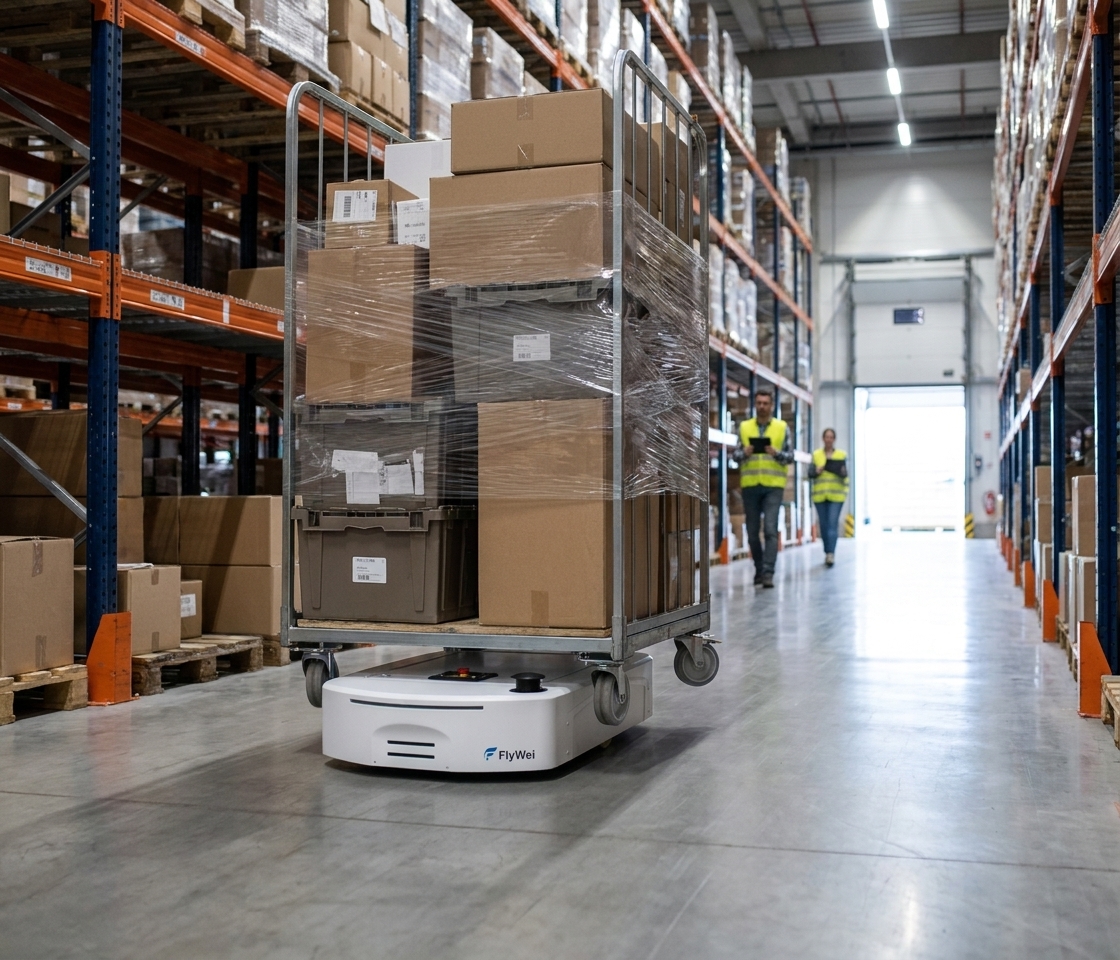
Floor-based autonomous mobile robots and autonomous forklifts occupy the pallet and mixed-load half of the same warehouse. A latent-jacking AMR slips under a cart to shuttle picked totes to a packing station; a counterbalanced driverless forklift picks a 1.5-tonne pallet out of block stock; an autonomous reach truck stows a pallet six metres up in existing racking. The operational lever is not which robot is best but which portion of my SKU catalogue is genuinely tote-scale, and which needs to stay on pallets. Split that honestly before evaluating vendors — a grid ASRS running at 40% of rated tote throughput has stranded a large capex sum.
Lever 2 — Technical: orchestration is the real capacity multiplier
The unfair advantage of a cube-based storage grid is that its robots, bins and ports are controlled by a single vendor's warehouse control system. Nothing about the grid needs to negotiate with a legacy fork truck fleet or a mezzanine picker; that homogeneity is why grid ASRS demos look effortless. A UK e-commerce DC running a mixed fleet — pedestrian pallet trucks, manned reach trucks, a growing autonomous fleet — has to produce the same effortless behaviour with an orchestration layer sitting above the machines. This is where a fleet manager like the FlyWei M4 platform earns its capex, arbitrating task allocation, aisle contention, dock timing and charging windows across mixed brands using an open ISO 3691-4-aligned safety envelope and the VDA 5050 interface for driverless industrial trucks.
The RDS robot dispatch layer closes the loop into the WMS: when a wave releases 3,000 pick lines, RDS decides which lines go to a manual picker, which to a goods-to-person station fed by a latent-jacking AMR, and which straight to a full-pallet driverless forklift. Because arbitration is open rather than tied to a single-vendor grid, the site scales by adding another lifting robot next quarter without a civil works window. Cube storage vs AMR framed as a raw robot-count contest misses this — the multiplier is the layer that decides what each robot does next.
Lever 3 — Regulatory: PUWER, LOLER, ISO 3691-4 and TR34 gate what's deployable
Neither cube-based storage nor floor AMR exempts a UK site from statutory duties. PUWER 1998 requires that all work equipment — autonomous mobile robots and grid-mounted shuttles included — is suitable for use, maintained, inspected and used by trained persons. LOLER 1998 sweeps in the vertical lift of a stacker AMR and the vertical lift on a grid ASRS port alike. ISO 3691-4:2020 covers driverless industrial trucks and their systems, published by BSI in the UK, defining the safety functions a UKCA-marked autonomous forklift must meet.
Two under-appreciated regulatory levers separate a proposal that passes a UK risk assessment from one that stalls at commissioning. The first is slab flatness: any high-density system — grid ASRS or narrow-aisle reach truck AMR — needs a slab meeting the appropriate TR34 category, and retrofitting a legacy DC's slab is rarely surfaced in headline capex. The second is workplace transport segregation: HSE inspectors expect demonstrable segregation of pedestrians and moving equipment, and a mixed autonomous-manual environment must show how Logistics UK-style best practice on pedestrian corridors, controlled crossings and audible warnings has been designed in.
A cube-based storage grid concentrates small-item SKUs into roughly a third of the footprint pallet racking would consume, but demands a six-to-eight-month civil works window; a floor-AMR retrofit over live UK racking can go from survey to first productive shift in four to six weeks — the choice is a bet on your load profile, not a bet on robotics.
The cube-based storage vs floor AMR decision matrix
Before either proposal reaches the capex committee, the manager needs a single-page picture the committee can screenshot. The matrix below is deliberately blunt — the shape of the decision, not a vendor scorecard.
| Dimension | Cube-based storage (grid ASRS) | Floor AMR + autonomous forklifts |
|---|---|---|
| Best-fit load | Totes and eaches under ~40 kg | Pallets, mixed loads, cartons, kegs |
| Footprint saved vs racking | Up to two-thirds for bin-scale SKUs | 10–25% via denser pick paths |
| Time to first shift | 6–8 months civil works | 4–6 weeks retrofit over live racking |
| Slab and civil works | Full grid foundation; sprinklers reworked | TR34 check on existing floor |
| Capex profile | Large one-off; hard to phase | Phased; leasing available |
| Change tolerance | Grid geometry fixed for site's life | Fleet re-tasks in software |
| UK compliance envelope | PUWER, LOLER, machine safety | PUWER, LOLER, ISO 3691-4, UKCA |
| Ideal UK case | Pure-play small-item e-commerce | Mixed-load DC, 3PL, drinks, cold-store |
Read the matrix as a filter. A site that is 80% tote-scale with stable ranges will find grid storage warehouse UK economics stack up. A genuine mixed-load DC — Daventry-style retail replenishment, Burton-on-Trent drinks, or a national 3PL depot — will consistently find floor AMR buys more throughput per pound of capex and closes faster.
What FlyWei does here
FlyWei designs, supplies and integrates the floor-based half of that matrix for UK e-commerce warehouses. The lifting robot range covers latent-jacking AMRs for tote and cart shuttling, heavy-lift jacking AMRs for oversize loads, and rotary-jacking robots for orientation into packing stations. The FlyWei autonomous forklift line — counterbalanced, pallet-truck, reach-truck and stacker variants — retrofits into existing UK pallet racking under PUWER, LOLER and ISO 3691-4. M4 and RDS orchestrate the mixed fleet so the WMS keeps its single view of the wave. FlyWei's 3, 5 and 7-year leasing converts the proposal into a monthly operating line a capex committee can compare cleanly with a cube storage warehouse quote. UK-based engineers commission and service on site.
Frequently asked questions
Is cube-based storage always faster than floor AMRs for e-commerce eaches?
For pure tote-scale picking at very high line rates and a stable range, cube-based storage is usually the throughput leader. For mixed loads, oversize cartons, palletised reserve and any SKU family that resists decanting into bins, floor AMRs and autonomous forklifts recover the lead once the six-month civil works window is priced into the ASRS proposal.
Do I need to rebuild my slab for a floor AMR retrofit?
Usually no, but a TR34 flatness survey is essential. Legacy UK DCs built before 2010 often meet TR34 Category 2 in most bays but fail in high-traffic goods-in aisles; localised grinding is a low-cost fix compared with the full grid foundation cube storage requires.
How does PUWER apply to autonomous robots?
PUWER 1998 applies to all work equipment, including autonomous mobile robots and grid ASRS shuttles. Duties cover suitability for use, maintenance, inspection and training. A UK site's risk assessment must specifically address autonomous operation and pedestrian interaction.
Does ISO 3691-4 apply to grid ASRS shuttles?
ISO 3691-4:2020 is the safety standard for driverless industrial trucks, adopted by BSI in the UK. It applies to autonomous forklifts and AMRs; grid ASRS shuttles are governed by parallel machine-safety and lifting-equipment regimes, so the compliance stacks are not identical.
Can I phase a floor-AMR deployment?
Yes — phasing is the norm. A UK site can begin with two or three autonomous forklifts on a single flow (dock to reserve, for example) and add lifting robots quarter by quarter. Cube-based storage is much harder to phase because the grid geometry is fixed at commissioning.
How do you compare cube-based storage vs floor AMR on TCO?
TCO depends on SKU mix and lease terms. FlyWei's 3, 5 and 7-year leasing converts floor-AMR capex into a monthly line that sits next to a cube ASRS quote on the same page; engineers run the model against your live pick, put-away and dwell data.
Is high-density warehouse storage the same as cube storage?
No — high-density warehouse storage is the umbrella; cube-based storage is one implementation. Others include very narrow aisle (VNA) racking with autonomous reach trucks, drive-in racking with pallet-truck AMRs, and mezz-fed goods-to-person cells served by lifting robots — the FlyWei solutions library maps each pattern against typical UK sector loads.
If maxed-out racking, a Black Friday capacity cliff and a cube storage warehouse proposal are on your Q3 risk register, the fastest way to test the alternative is to walk the floor with a UK engineer who has retrofitted DCs of your size.
Book a free 30-minute site survey with FlyWei — we read your slab, racking, dispatch profile and ISO 3691-4 envelope in one visit. Compare the outcome cleanly against any grid quote using our 3, 5 and 7-year leasing pricing. UK-based engineers · no obligation · reply within one business day.