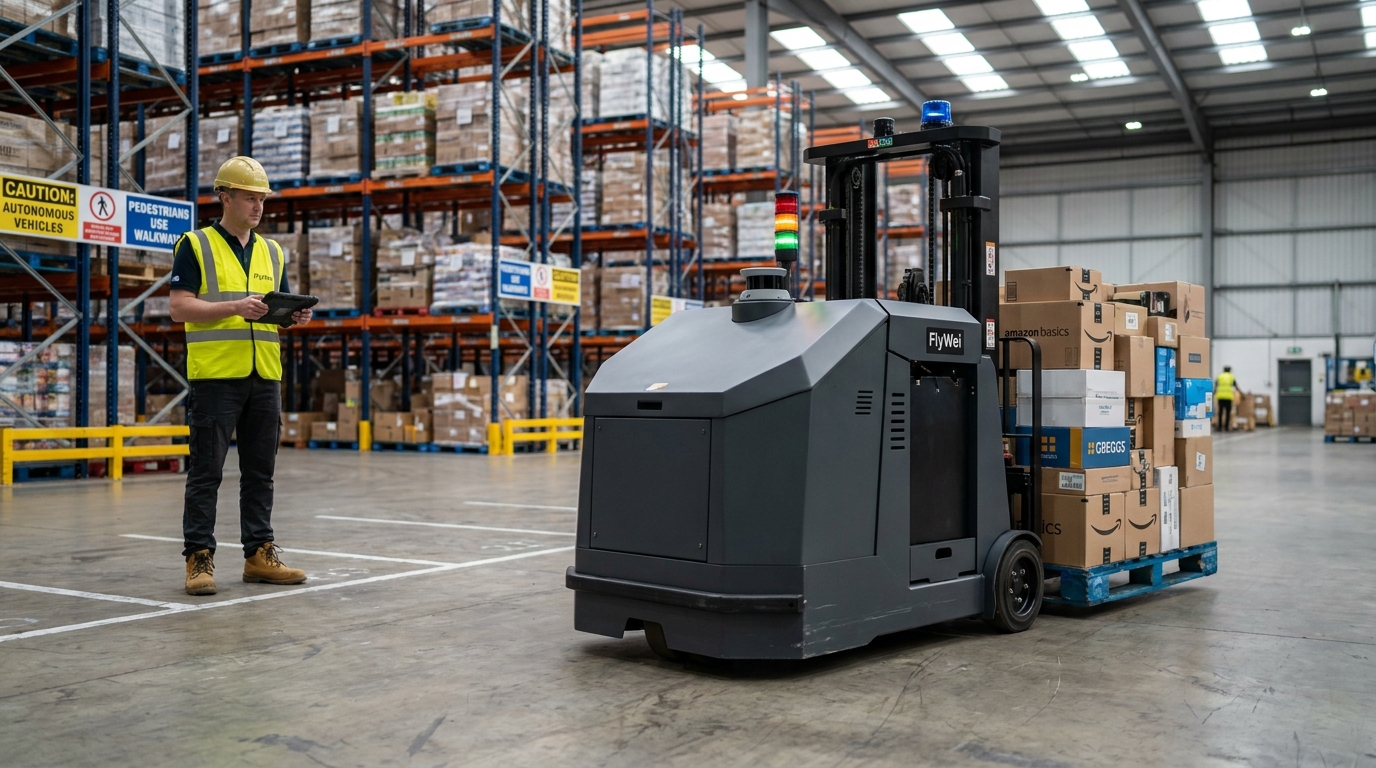
Cube-storage robotics and autonomous forklifts are two competing automation paths for UK third-party logistics warehouses, and the choice is now landing on warehouse managers' desks every quarter. Cube-storage robotics stack totes in a dense high-bay grid for goods-to-person picking; autonomous forklifts handle full pallets across existing aisles, dock-to-stock and back. According to the Health and Safety Executive, workplace transport — overwhelmingly forklift work — causes around 1,300 reportable injuries every year in Great Britain, which is why directors are pushing hard for automation. But for a UK 3PL warehouse manager running mixed-pallet contracts at Magna Park, DIRFT or Daventry, the cube-storage pitch can quietly obscure a hard truth: most 3PL contracts move pallets in and pallets out, not totes in and totes out. Picking the wrong technology in 2026 locks an operator into a decade of capex regret, missed throughput windows and broken service-level agreements.
Why the cube-versus-forklift question landed on your desk in 2026
Three forces are converging on UK 3PL warehouse managers this year. First, the operator shortage: Logistics UK has tracked persistent warehouse-and-forklift vacancy rates across the East Midlands corridor, with attrition concentrated at sites running double-shift or weekend cover. Second, rent inflation at Magna Park, DIRFT, SEGRO East Midlands Gateway and Daventry has made cube density an attractive headline number — vendor pitches lead with eight times the pallets per cubic metre before walking back the operational footprint. Third, capex committees in 2026 are demanding a single automation budget rather than incremental materials-handling-equipment swaps, which surfaces the comparison earlier in the planning cycle than warehouse managers have traditionally seen.
The result is a presentation deck on your desk comparing two unlike systems. Cube-storage robotics excel at tote-level goods-to-person work — they are designed for fashion sub-eaches, e-pharmacy split packs and small-parts kitting. Autonomous forklifts are pallet-flow technology: they collect full pallets from inbound docks, place them in racking and retrieve them for outbound. The two categories solve different problems but get pitted against each other because both are labelled warehouse automation and both compete for the same capex line.
UK 3PL contracts complicate the picture further. Most contracts mix full-pallet receipts, case-pick replenishment for retail and occasional sub-each overflow at peak. The pallet portion is structural; a cube system cannot serve it without a parallel pallet-handling layer anyway. The real question for the warehouse manager is therefore not cube or forklifts but what proportion of my movement profile is pallets, what does the residual look like in 2028, and which technology absorbs the swings between contracts I will inherit next year.
The four levers that decide cube versus autonomous forklift for a UK 3PL
Lever 1 — Measure your pallet-in / pallet-out ratio before signing any quote
The single biggest mistake a warehouse manager can make in 2026 is to walk into the capex committee meeting with a vendor's projected throughput rather than your own movement data. Pull a 90-day extract from your warehouse-management system covering every inbound and outbound move, segmented by handling unit — full pallet, layer, case, each. Plot the ratio at hour granularity across peak, trough and seasonal swings. For most UK 3PL sites this reveals a pallet-to-tote split somewhere between 75:25 and 90:10 by movement count, and even higher by weight. That is the number that should anchor every comparison. A cube system that quotes twelve thousand tote moves per hour is solving for the ten to twenty-five per cent of your operation that is not your structural cost driver.
Lever 2 — Orchestrate, don't bundle: M4 and the VDA 5050 interface
The second mistake is letting a vendor sell you an orchestration layer that only speaks to its own kit. Modern fleet management for autonomous industrial trucks uses VDA 5050, the open interface jointly defined by the German automotive and intralogistics industry, which lets a single fleet manager dispatch heterogeneous machines from different manufacturers. FlyWei's M4 fleet manager and RDS dispatch layer are built on that interface, which means a UK 3PL operator can run counterbalanced, reach-truck and pallet-truck variants on the same orchestration backbone — and bolt on heavy-lift AMRs for engine-block or paper-roll sub-jobs without rebuilding the integration. If your shortlist includes any system that locks you to one vendor's robots forever, treat it as a structural risk on the capex paper, not a footnote.
Lever 3 — PUWER 1998, LOLER 1998 and ISO 3691-4:2023
UK regulators have a clear framework for autonomous industrial trucks. The Provision and Use of Work Equipment Regulations 1998 (PUWER) and the underlying statutory instrument require employers to ensure work equipment is suitable, maintained and inspected — autonomous status does not exempt the fleet from any of this. The Lifting Operations and Lifting Equipment Regulations 1998 (LOLER) add a six-monthly thorough examination duty for any lifting attachments. International standard ISO 3691-4 codifies the safety requirements for autonomous industrial trucks specifically, and its 2023 revision is the current reference inspectors use. Ask each vendor to map their machine, fleet manager and service contract against each instrument — and to name a UK-resident competent person who signs off the inspections.
Lever 4 — Compare retrofit windows, not just capex headlines
Cube-storage robotics are an architecture decision: the racking comes out, the cube grid goes in, the fire suppression is re-engineered, the building consent is reissued, and the warehouse is non-productive for the duration. Six to nine months is a reasonable range for a meaningful UK retrofit. Autonomous forklifts are a fleet decision: the trucks are commissioned into the existing aisles, the WMS integration is configured against your live data, and the fleet runs alongside manned MHE during a phased ramp. Eight to twelve weeks to first productive shift is realistic for an operator already running a modern WMS. The retrofit window is rarely on the first slide of a vendor deck, but it decides whether your 2026 contract renewals are served by the new system or the old one.
| Dimension | Cube-storage robotics | Autonomous forklifts |
|---|---|---|
| Best-fit movement profile | Tote-pick, sub-each, narrow SKU | Full pallets, mixed-SKU 3PL contracts |
| UK retrofit window | Six to nine months, non-productive | Eight to twelve weeks, alongside manned MHE |
| Building works required | Racking demolition, fire suppression redesign, building consent | None — runs on existing aisles |
| Orchestration openness | Vendor-proprietary, single-vendor lock | VDA 5050 open interface, mixed-vendor fleet |
| UK regulatory framework | Building regs, fire engineering, PUWER for goods-out MHE | PUWER 1998, LOLER 1998, ISO 3691-4:2023 |
| Portability if you lose a customer | Architecture written for that SKU profile; hard to repurpose | Fleet redeployable to next contract in days, not months |
For UK 3PL warehouses where pallet-in pallet-out movements dominate, autonomous forklifts deliver full-pallet flexibility that cube-storage robotics cannot match — and avoid the racking demolition and operating-pattern lock-in that cube systems require.
Where FlyWei fits
FlyWei designs and delivers autonomous forklift fleets purpose-built for UK 3PL distribution centres. Our counterbalanced, reach-truck, stacker and pallet-truck variants share the M4 fleet manager and RDS dispatch layer, so a Magna Park, DIRFT or Daventry site can mix machine types without per-vendor orchestration silos. FlyWei integrates with the operator's existing WMS through the open VDA 5050 interface, so the warehouse manager does not have to swap the broader IT stack to get the productivity. UK-resident service engineers handle PUWER and LOLER inspection cycles on the same schedule the site already runs for manned MHE.
For the cube-versus-forklift question specifically, FlyWei runs a no-cost movement-profile audit using ninety days of your WMS data and returns a quantified pallet-flow versus tote-flow split — the number that should anchor your capex paper. Where cube is genuinely the right answer for a sub-each peak, we say so and scope a hybrid alongside our solutions team. Where pallet flow dominates — which is true for the majority of UK 3PL contracts we audit — autonomous forklifts retrofit faster, scale with shift hours and avoid the multi-month building-works window. The decision belongs to the warehouse manager and the capex committee; FlyWei supplies the data and the kit.
Frequently asked questions
When is cube-storage robotics the right call for a UK 3PL warehouse?
When the contract profile is structurally tote-level — fashion sub-eaches, e-pharmacy split packs, small-parts kitting — and the SKU master is stable across multi-year contracts. If the operator inherits a new pallet-heavy contract two years in, the cube architecture cannot absorb it without bolting on a parallel pallet system.
How long does an autonomous forklift retrofit take at a working UK 3PL DC?
Eight to twelve weeks from purchase order to first productive shift is realistic for an operator already running a modern warehouse-management system. The fleet runs alongside manned materials-handling equipment during a phased ramp, so the site stays productive throughout commissioning.
Does PUWER 1998 cover autonomous forklifts?
Yes. PUWER 1998 applies to all work equipment in scope of an employer's duty, regardless of whether the equipment is manned. Autonomous forklifts must be suitable for the task, maintained and inspected, and operators of the wider system must be competent. ISO 3691-4:2023 then codifies the safety requirements specific to autonomous industrial trucks.
Can autonomous forklifts and cube-storage robotics coexist in the same building?
Yes, and for the largest UK 3PL sites that is sometimes the right answer — cube for a defined sub-each cell, autonomous forklifts for the structural pallet flow. The key is to scope each technology against its actual movement share rather than the aggregate.
What ISO standard governs autonomous industrial trucks in the UK?
ISO 3691-4:2023 — Industrial trucks, Safety requirements and verification, Part 4: Driverless industrial trucks and their systems. It is the current reference HSE inspectors use when assessing an autonomous fleet, and it sits alongside PUWER 1998 and LOLER 1998 in the compliance stack.
How does open fleet management differ from single-vendor orchestration?
Open fleet management — for example FlyWei's M4 built on VDA 5050 — dispatches heterogeneous machines from different manufacturers through a single layer. Single-vendor orchestration locks the operator to one vendor's hardware roadmap and pricing for the life of the integration. For a UK 3PL operator inheriting unpredictable contracts, the open path materially reduces future capex exposure.
Ready to anchor your capex paper on real data? Talk to FlyWei and we will run a no-cost ninety-day movement-profile audit on your UK 3PL site — the number that should sit at the top of any cube-versus-forklift comparison.