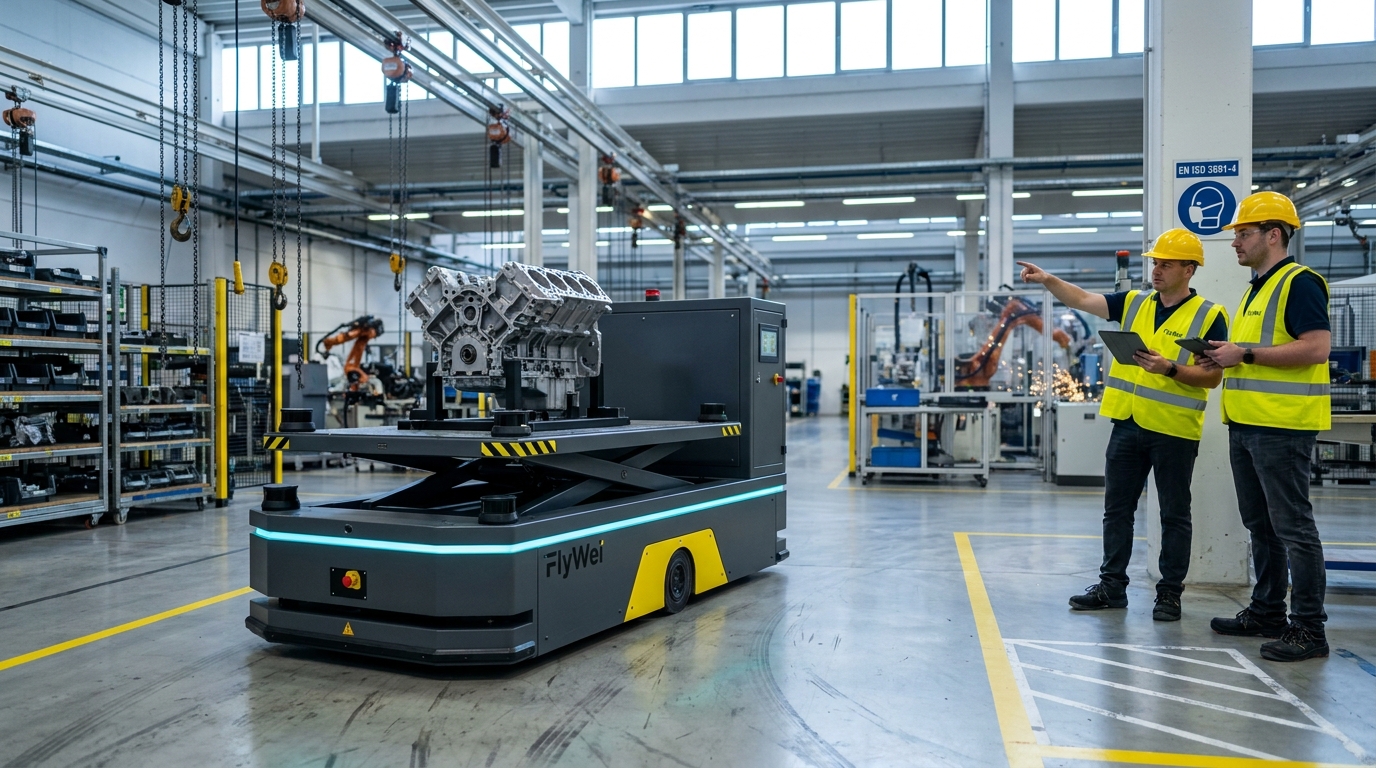
European engineering warehouse automation is the use of autonomous forklifts, mobile robots and fleet-management software to move components, sub-assemblies and finished machinery across multi-site engineering plants without relying on driver-operated lift trucks or fixed grid storage. Workplace transport collisions accounted for around 25% of all fatal workplace injuries in Great Britain in 2024 to 25, according to HSE data, and the same risk profile carries across European Tier-1 supply chains where oversized castings, transmissions and engine blocks routinely move between cells. For Supply Chain Directors running engineering operations across the UK and mainland Europe, the practical pain this quarter is twofold: capex committees are pushing back on grid-ASRS quotes that do not accept anything over 1.5 tonnes, and HR cannot replace the FLT drivers retiring from Daventry, Burton-on-Trent or the Ruhr Valley fast enough to keep night shifts staffed.
Why European engineering plants stall on automation
European engineering supply chains carry a structural mismatch that smaller-unit sectors do not. A 3PL handling ambient FMCG cartons can adopt almost any automation off the shelf because the unit load is predictable: a 1,000 mm × 1,200 mm pallet, at or under 1 tonne. Engineering plants move castings, machined housings, transmission casings, V8 blocks, paper rolls and motor cores: units that frequently exceed 1.5 tonnes and rarely arrive on a clean Euro pallet. That single fact eliminates a large slice of the automation market from serious consideration before the first technical workshop.
The pressure on Supply Chain Directors has nonetheless intensified. Logistics UK has documented the persistent driver and FLT operator shortage that now bites at engineering sites in Daventry, DIRFT, Magna Park and SEGRO East Midlands Gateway, and the equivalent picture holds across German, French and Italian engineering clusters. Capex committees see the operator gap and ask for an automation answer. Vendors arrive with grid-storage quotes that assume tote-sized goods and quietly fail the unit-load test.
The regulatory layer adds a second filter. PUWER 1998 and LOLER 1998 govern lifting equipment in Great Britain; ISO 3691-4 sets the autonomous industrial truck bar across Europe. Each requires a documented safety case that a hardware-only purchase rarely covers. Plant directors who have lived through one near-miss with a manual FLT do not want to inherit a sprawling integration project that leaves them holding the ISO 3691-4 compliance bag on day one of go-live.
The result is paralysis: real driver shortage, real capex pressure, no architecture that fits the unit load. Most quotes either price the plant out or miss the brief.
Lever 1, Operational: choreograph the heavy moves, not just the light ones
The biggest unforced error in engineering automation is putting the highest-throughput, lowest-value moves first, pallet-to-pallet shuttling across an aisle, while leaving the 2-tonne engine block to the manual reach truck. The throughput maths is wrong. A single counterbalanced autonomous forklift moving a 2 T paper roll twelve times per shift releases more aggregate driver-hours than four AMR carts shuttling totes between picking modules. The operational discipline is to baseline the move-mix by unit weight, not by move count, then sequence automation onto the heaviest reliable routes first. Sub-assembly tugger trains and rotary-lift AMRs handling transmission cases come after the headline 2 T routes are choreographed and proven on real shift data.
Lever 2, Technical: one fleet manager, one safety perimeter
A multi-site engineering operation that buys three vendors' AGVs ends up with three traffic managers, three safety controllers and three integration projects. The right architecture is a single fleet manager, FlyWei's M4, speaking ISO 3691-4-compliant protocols and the open VDA 5050 interface to every robot on the floor, autonomous forklift or heavy-lift AMR. Fleet dispatch software (FlyWei's robot dispatch service) sits above M4 and turns ERP-side move orders into routed missions. The technical benefit is not just orchestration; it is a single safety case envelope. One stop request from M4 halts the whole fleet inside its certified perimeter: the regulator and the plant safety officer see one system, not five. That is what passes audit, and what scales from one UK site to a Tier-1 European footprint without re-papering the safety case at every plant.
Lever 3, Regulatory: own the safety case end-to-end
Engineering plants live inside PUWER and LOLER, with ISO 3691-4 framing the autonomous-truck specifics. The lever is to insist on an integrator who writes the operational safety case as part of the deliverable, not as a bolt-on. That means: documented hazard analysis per route, light-curtain and floor-zone definitions for the no-go envelopes around manual cells, recorded LOLER thorough examinations for any forks that lift, and a written commissioning protocol the HSE inspector can read end-to-end. Where FlyWei deploys, the safety case is part of the install, written against the same standards on every site, so a Plant Director in Burton-on-Trent and a counterpart in Stuttgart sign off against an identical paper trail. The compliance cost per site falls as the fleet grows: the opposite of the experience most operations have with multi-vendor estates.
Lever 4, Procurement: mobility over slot-binding
The strategic procurement lever is to refuse the false choice between "do nothing" and "buy a vertical-grid system". A leading vertical-grid storage vendor will quote a high-density goods-to-person solution that, for engineering plants, fails the unit-load test before the first PO is raised. Mobility-first automation (autonomous forklifts for the heavy floor-pallet moves, heavy-lift AMRs for sub-assembly, latent-jacking pucks for the trolley flows) costs less per throughput-unit, decouples the move plan from any fixed grid, and protects the option value of changing the line layout next year without writing off the asset.
A mobility-first fleet of autonomous forklifts and heavy-lift AMRs delivers grid-ASRS-equivalent throughput at roughly half the capex, without locking a multi-site engineering plant into a single building shape.
That is the argument capex committees are now waiting for.
| Dimension | Vertical-grid ASRS | FlyWei mobility-first fleet |
|---|---|---|
| Max unit weight | ~1.5 tonnes | 2+ tonnes (heavy-lift AMR, counterbalanced forklift) |
| Building dependency | Bolted to one footprint | Portable; redeploys on layout change |
| Capex profile | High upfront, single-site | ~50% lower, scales site-by-site |
| Safety case | Per-site, multi-vendor | One envelope across UK + EU plants |
| Orchestration | Proprietary controller | Open VDA 5050 via M4 |
What FlyWei does for European engineering supply chains
FlyWei supplies and integrates the autonomous fleet that fits the engineering unit load: across the UK and mainland Europe under one safety-case envelope.
For 2 T-class floor-pallet and roll moves, FlyWei autonomous forklifts (counterbalanced and reach variants) handle the headline routes: line-side feed, finished-goods to stage, stage to dock. For sub-assembly and trolley flows, FlyWei heavy-lift AMRs and latent-jacking pucks shuttle motor cores, transmission cases and engine sub-assemblies between cells. Above the hardware, the M4 fleet manager orchestrates every machine on a single VDA-5050 layer, and fleet dispatch software takes the ERP-side move list and dispatches missions in priority order.
The architecture is deliberately mobility-first: no fixed grid, no slot-binding, no commitment to today's building shape. A UK Supply Chain Director rolling out from one Midlands plant can replicate the safety case at a German or Italian site without rewriting it from first principles. FlyWei's commissioning protocol covers the PUWER, LOLER and ISO 3691-4 obligations as part of the install, and the documentation is identical across sites: one paper trail, one orchestration layer, one inspector-ready safety dossier.
That is the operational shape a Supply Chain Director wants when capex is tight, drivers are short and the brief is to lift engineering output across Europe without locking the estate into a building that may have to change in 2028. See the solutions library for site-by-site playbooks, or talk to FlyWei for a tailored move-mix baseline.
Frequently asked questions
What is European engineering warehouse automation?
European engineering warehouse automation is the use of autonomous forklifts, heavy-lift AMRs and fleet-management software (such as FlyWei's M4) to move oversized and heavy components (engine blocks, transmissions, machined castings, paper rolls) across multi-site engineering plants in the UK and mainland Europe without relying on driver-operated FLTs or fixed grid storage.
Why does grid ASRS fail for engineering plants?
Most vertical-grid storage systems are sized for tote-class loads under 1.5 tonnes. Engineering unit loads (V8 blocks, transmission cases, motor cores) routinely exceed that, and rarely arrive on a clean Euro pallet. A mobility-first fleet of autonomous forklifts and heavy-lift AMRs is the right architectural answer.
How does FlyWei meet PUWER, LOLER and ISO 3691-4?
FlyWei writes the operational safety case as part of the install: hazard analysis per route, floor-zone definitions, LOLER thorough examinations for any forks that lift, and a written commissioning protocol against ISO 3691-4. The documentation is identical across UK and EU sites, so a Supply Chain Director sees one paper trail across the European estate.
Can FlyWei run on a single fleet manager across multiple plants?
Yes. FlyWei's M4 fleet manager orchestrates autonomous forklifts and heavy-lift AMRs across multi-site European estates on a single VDA-5050 layer, and fleet dispatch software translates ERP-side move orders into routed missions. One system, one safety perimeter, one upgrade path.
What is the typical capex profile versus grid ASRS?
For engineering unit loads, a mobility-first FlyWei fleet typically delivers grid-ASRS-equivalent throughput at roughly half the capex, with the added benefit that the asset is portable: if the line layout changes in two years, the robots redeploy. Grid systems are bolted to one building shape.
How fast can a first site go live?
A focused first site, typically a 2 T-class move-mix on three to five routes, can go live in 12 to 16 weeks from order, including the safety-case write-up. Multi-site rollouts use the same playbook so the second and third sites compress to 8-10 weeks each.
What size of engineering plant is the right starting point?
The sweet spot is a plant of 100,000 to 500,000 sqft with at least one 24-hour shift pattern and a unit-load profile that includes 1.5 T+ components. FlyWei runs a baseline move-mix exercise as part of the scoping; book one here.