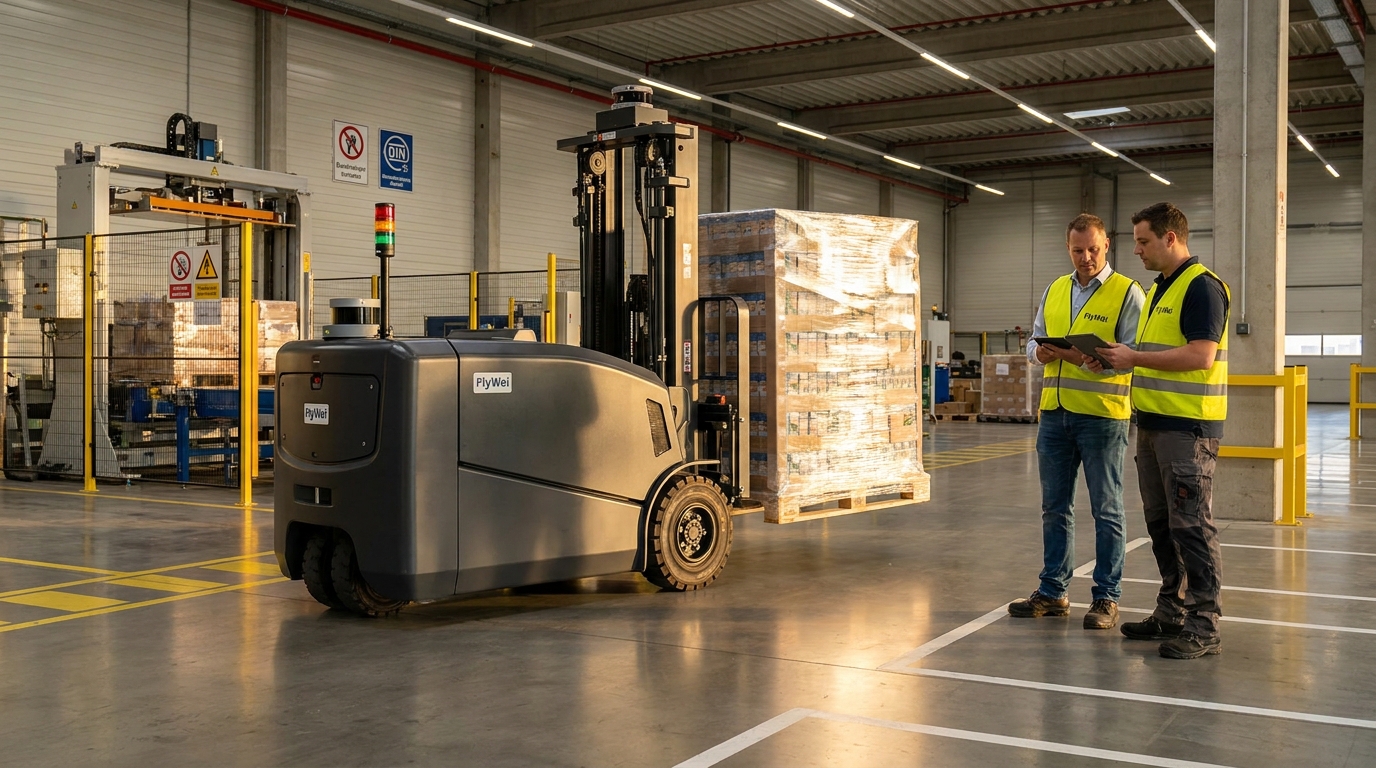
European FMCG warehouse automation is the deployment of autonomous forklifts, mobile lifting robots, and ceiling-mounted goods-to-person systems inside fast-moving consumer goods distribution centres across the EU and UK, replacing manual pallet handling and conventional materials-handling equipment under EN ISO 3691-4 and CE-marking requirements. HSE workplace transport data shows that vehicles and lift trucks remain among the most common causes of fatal injuries in warehousing, with roughly a quarter of all workplace transport fatalities tied to lift-truck operations and far more reported lost-time incidents every year. For an FMCG operations director running multi-site European DCs across UK, DACH, Benelux, and CEE, the question in 2026 is no longer whether to automate but which automation layer to commit capex to: floor-level autonomous forklifts that follow your existing aisle layouts, or ceiling-mounted cube-storage AMRs that demand a slab pour, a racking strip-out, and a fourteen-to-twenty-eight week build-out before the first SKU moves.
European FMCG warehouse automation in 2026 splits between floor-level autonomous forklifts that retrofit existing aisle layouts under EN ISO 3691-4:2023, and ceiling-mounted cube-storage AMRs that demand a slab pour and a fourteen-to-twenty-eight week build-out before the first SKU moves.
Why this decision is hard right now
European FMCG operations are caught between three pressures at once. Driver and lift-truck operator availability has not recovered to pre-2022 levels: Logistics UK continues to report a structural shortfall in goods-vehicle and warehouse operators across the UK and northern Europe, and Polish and Czech wages are now climbing eight to twelve per cent year on year as eastern-European labour markets tighten. Output per operator has flatlined while wage cost per pallet has risen.
At the same time, retailer service-level penalties have stiffened. UK and DACH grocers have moved from monetary chargebacks to delivery-window scoring that compounds across the trading year, so missed despatch slots from a single bottleneck in end-of-line palletisation now reduce the next quarter's allocation. An FMCG operations director cannot solve that with a hiring round.
And the technology landscape has split into two camps that look superficially equivalent but commit you to very different physical assets. Floor-level robotics (autonomous forklifts, latent-jacking AMRs, tugger trains) work on the floorplate you already have, follow human-grade aisles, and certify under EN ISO 3691-4:2023. Ceiling-mounted goods-to-person systems, climbing AMRs that scale a high-density cube, work on a different physical plane, demand a flat-floor specification with crack-controlled joints to TR34 free-movement tolerances, and lock you into a proprietary container and rack format for the life of the asset. The two are not interchangeable, and the wrong call in 2026 is a fifteen-year mistake.
The four levers that fix it
1. Operational lever: re-engineer the flow before you buy hardware
Before any vendor quote arrives, an FMCG operations director should run a five-day flow study that captures pallet moves per hour per zone, dwell time at each handoff, and the percentage of SKUs that genuinely benefit from goods-to-person presentation. In most European FMCG distribution centres the answer is uncomfortable: seventy to eighty-five per cent of pallet moves are inbound, end-of-line, and bulk-storage; flows that floor-level autonomous forklifts handle without any change to building shell. Only the slow-moving long tail of small case-pick SKUs, typically eight to fifteen per cent of throughput in a UK or DACH FMCG DC, actually justifies the capex of a ceiling-mounted cube. Running the flow study first stops the team from buying a cube system to solve a problem that is really a bulk-handling problem. Make the study an internal exercise, not a vendor pitch: ask procurement, the health-and-safety lead, and one warehouse manager to sign off the volume profile before any RFQ leaves the building. Five days of clean operational data beats five months of vendor demos.
2. Technical lever: pick an orchestration layer that owns every floor at once
The hidden trap in European FMCG warehouse automation is operating two robot fleets under two unrelated control systems. Floor-level autonomous forklifts arrive with one fleet manager. Ceiling-mounted cube-storage AMRs arrive with another. Each speaks its own dialect of fleet messaging, each holds its own digital twin of the building, and the warehouse management system ends up arbitrating between them by polling: slow, lossy, and exactly where the missed despatch slot is created on a Friday afternoon. A VDA 5050-aligned fleet manager such as FlyWei M4 closes the gap by orchestrating mixed-vendor mobile robots under one traffic model and pushing one event stream to the operator's existing ERP and WMS. The technical decision is not which robot to buy first; it is which orchestration layer will still be open three vendors from now. Lock that in, and the building can absorb future automation layers without an integration rewrite each time. Procurement teams in DACH and the Benelux now make orchestration the first technical question of any RFQ, ahead of the robot bill of materials.
3. Regulatory lever: design to EN ISO 3691-4 and PUWER from day one
Floor-level autonomous forklifts placed on the European market in 2026 must conform to EN ISO 3691-4:2023, the harmonised safety standard for driverless industrial trucks, and to the UK PUWER 1998 regime for in-service work equipment. Ceiling-mounted cube systems are not in scope of ISO 3691-4: they sit under the EU Machinery Regulation 2023/1230 as fixed installations, with a separate safeguarding analysis and a longer commissioning audit. If you mix the two regimes, your in-house safety team must hold competence across both, which is a hiring and training cost most procurement leads under-budget. BSI publishes the British implementation of the ISO standard, and HSE's workplace-transport guidance maps the safe systems-of-work that a competent person must sign off on each machine before in-service use. Procurement should ask each vendor for the declaration of conformity, the EN ISO 3691-4 safety case, and the residual-risk register: before, not after, signing the purchase order. An audit-ready safety case is now a deal-blocker, not a finishing-touch document.
4. Financial lever: protect the capex envelope and the exit value
Floor-level autonomous forklifts have a credible residual after five years: the robot can be redeployed across the estate, sold into the second-hand market, or reconfigured onto a different aisle plan with a software change. Ceiling-mounted cube installations have effectively no residual once commissioned: the racking, containers, software, and slab specification are vendor-specific and the cube footprint is now load-rated for that one system. An FMCG operations director should model both options on a seven-year hold with a building-exit clause baked in, then ask the board which scenario survives a SKU-mix change, a site disposal, or a buyer carving up the European estate in 2031. Ask each vendor for a written buy-back schedule and a redeployment clause, and rate the contract on what happens in year six, not year one. The answer almost always favours the floor-level fleet you can take with you.
What FlyWei does in this picture
FlyWei integrates the floor-level layer of European FMCG warehouse automation. Our autonomous forklift range covers counterbalanced 2-tonne pallet handling for end-of-line palletisers, reach trucks for narrow-aisle high-bay racking up to 8 metres, and pallet-truck variants for dock-to-stock moves; all CE-marked to EN ISO 3691-4:2023 and PUWER-ready for UK in-service inspection. Our lifting and latent-jacking AMRs shuttle goods-to-person trolleys for the slow-moving SKU tail without committing the building to a fixed cube footprint. FlyWei M4 is the VDA 5050-aligned fleet manager that orchestrates both, and FlyWei fleet dispatch software bridges to the operator's existing enterprise WMS and ERP. We supply, deploy, and support every machine in the fleet ourselves: no reseller layer, no integrator handoff, with a six-hour first deployment on a single line. Our autonomous forklift fleet is in service across UK FMCG distribution centres from Magna Park to DIRFT and Daventry, and we extend the same one-call service contract across DACH, Benelux, and CEE. For operations directors weighing a phased capex programme across multiple European DCs, that means one safety case, one event stream, one phone call for service, and a fleet you can redeploy when the SKU mix shifts.
Frequently asked questions
Is EN ISO 3691-4 mandatory for autonomous forklifts in the EU and UK in 2026?
EN ISO 3691-4:2023 is the harmonised safety standard for driverless industrial trucks across the EU and is recognised by UK regulators alongside PUWER 1998. Putting an autonomous forklift on the European market without an EN ISO 3691-4 safety case is not defensible at audit.
Can I retrofit floor-level autonomous forklifts into an older FMCG DC without changing the building?
In most cases, yes. Floor-level autonomous forklifts work with the aisle widths and slab specification of an existing DC, provided you correct any floor cracks or expansion-joint gaps that exceed the published tolerances. A FlyWei site survey takes a day.
What is the deployment time for floor-level vs ceiling-mounted automation?
A floor-level autonomous forklift can be commissioned on a single line in around six hours with M4 traffic rules loaded. A ceiling-mounted cube system typically requires a racking strip-out, slab levelling, and a build-out of fourteen to twenty-eight weeks before the first SKU moves.
Does mixing fleets from different vendors cause WMS integration problems?
It can, unless the orchestration layer is VDA 5050-aligned. FlyWei M4 was designed to mix multi-vendor mobile robots under one traffic model and push one event stream to the ERP and WMS, so the WMS does not see fleet heterogeneity.
How does the capex picture compare over a seven-year hold?
Floor-level autonomous forklifts have a credible residual after five to seven years: the asset is redeployable across the estate. Ceiling-mounted cube installations effectively have no residual once commissioned. Model both options before committing.
Can FlyWei deploy across UK, DACH, Benelux, and CEE under one contract?
Yes. FlyWei delivers and supports its autonomous forklift fleet, M4 fleet manager, and fleet dispatch across the UK, Germany, Austria, the Netherlands, Poland, and the Czech Republic under a single master agreement, with local service coverage and one safety case.
Planning a 2026 capex round across multiple European FMCG DCs? Talk to FlyWei about a one-day flow study and a phased autonomy roadmap that protects your residual value.