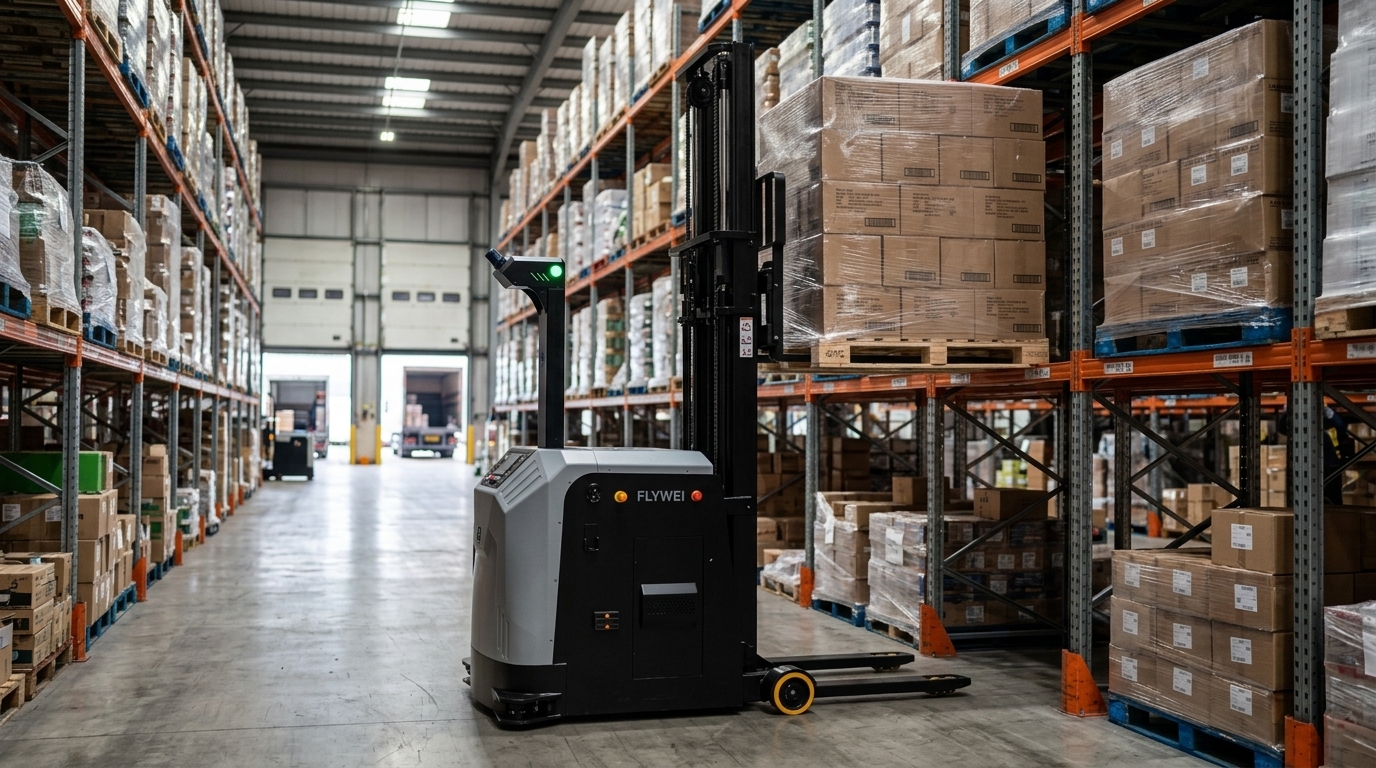
FMCG robot fleets are autonomous mobile robots — counterbalanced forklifts, reach trucks and latent-jacking AMRs — deployed inside fast-moving consumer goods plants to move pallets, totes and cartons between production lines, packaging halls and dispatch yards. According to HSE workplace transport guidance, around a quarter of all workplace fatalities involve vehicles, and FMCG palletised flow concentrates that risk where line speed and human pickers collide. Yet most UK plant directors do not have a "robots vs people" problem — they have an integration problem: a mid-life MES, an invested palletiser, a stable shift pattern, and an OEE board that cannot afford a six-month rip-and-replace experiment. The honest playbook for 2026 is narrower than the vendor brochures suggest: an FMCG robot fleet must orchestrate with existing palletisers, MES and dispatch — not replace them — to protect line cadence and OEE.
Why FMCG plant directors are stuck on robot orchestration
Three forces converge on the FMCG plant director''s desk and they pull against each other. The first is OEE pressure. UK FMCG sites typically target overall equipment effectiveness in the 75–85% band, and the difference between 78% and 82% is the difference between a calm quarter and an emergency capex submission. Any change that risks taking the line down — even briefly — has to clear a high bar, and "the new robots need the WMS reconfigured" is exactly the kind of risk that loses an OEE point.
The second is the heterogeneous-asset reality. A typical UK FMCG plant has a palletiser bought six years ago, an MES on a mid-life upgrade cycle, a SCADA layer that pre-dates both, and a warehouse management system originally specified for human-operated forklifts on dedicated lanes. Industry analysis published by Logistics UK consistently ranks "integration with existing systems" above price as the top selection criterion for warehouse automation among UK FMCG operators. A robot fleet that demands ripping out any one of these layers fails the test before procurement even sees the spec sheet.
The third is the regulatory floor. Autonomous trucks on a shared FMCG floor have to satisfy PUWER 1998, ISO 3691-4 (the standard for autonomous industrial trucks), and the relevant approved code of practice for workplace transport. None of this is optional, and a plant director who signs off a fleet that later fails a PUWER assessment is personally exposed under the regulations. The combined effect is a director who genuinely wants automation but has every rational reason to delay it.
The four levers that fix the orchestration problem
Lever 1 (operational) — pilot one end-of-line bay before scaling
The fastest way to de-risk an FMCG robot programme is to deploy a single autonomous counterbalanced truck in one end-of-line bay for six weeks. Measure four things only: pallets moved per hour against the human baseline, mean time between interventions, the number of MES touchpoints that needed editing, and unplanned downtime caused by the robot. A single-bay pilot at a UK confectionery plant near Burton-on-Trent typically clears all four metrics inside six weeks and produces a board-grade business case for the next 8–12 trucks. The crucial discipline is to resist scope creep: this pilot is a measurement exercise, not a transformation programme.
Lever 2 (technical) — orchestrate over the MES bus with VDA 5050
The integration risk that scares plant directors is solved by a fleet manager that uses VDA 5050 — the open communication standard that decouples robots from the dispatch layer — and that publishes simple events back to the existing MES rather than asking the MES to learn new APIs. FlyWei''s M4 fleet manager acts as that translation layer: it accepts dispatch from the MES (or from a Manufacturing Execution layer that already plans the line), and it returns standardised telemetry the plant''s OEE board already knows how to consume. RDS sits on top as a thin dispatch policy engine that respects line schedules — pause the fleet when the line pauses, accelerate when there is a dispatch peak — without anyone in IT having to touch the MES roadmap.
Lever 3 (regulatory) — design the fleet to PUWER, LOLER and ISO 3691-4 from day one
Most fleet failures audit-wise are not technical, they are documentation. Specify the fleet to PUWER 1998 and LOLER 1998 from the procurement brief, insist that each truck carries a current ISO 3691-4 conformity statement, and require that the supplier''s UK service engineers complete a documented thorough examination on the same cycle as the plant''s manual lift trucks. UKCA marking covers the product; what the HSE looks at on site is whether the work equipment is being used, maintained and inspected to the same standard as the rest of the plant. A vendor who cannot produce a PUWER risk assessment in week one is not a vendor for an FMCG plant.
Lever 4 (commercial) — lease the fleet, ring-fence the capex for primary plant
For an FMCG plant director, the worst outcome of automation is to spend a capex window on robots and then discover the palletiser needs replacing in 18 months. Treating the robot fleet as OPEX through a leasing structure — typically 3, 5 or 7-year terms with full-service maintenance bundled — moves the cost line from the capex committee to the operations P&L and keeps capex available for primary process plant. The maths gets easier the moment the fleet stops competing with the palletiser, the dust collector and the chiller upgrade for the same pot.
FMCG robot deployment models compared
| Approach | Typical capex per truck | Time to first pallet | MES touchpoints | Best for |
|---|---|---|---|---|
| Single end-of-line pilot (1 truck, 6 weeks) | £0 (leased) | 3–4 weeks | 1–2 | De-risking before board sign-off |
| End-of-line bay fleet (4–8 trucks, 1 quarter) | £0 (leased) | 8–10 weeks | 3–5 | Stable seasonal FMCG sites |
| Full plant-to-dispatch orchestration (12+ trucks) | £0–£800k (mixed lease + capex) | 6–9 months | 5–8 | Plants with an active MES refresh |
| Rip-and-replace integrated system | £1.5m+ capex | 12–18 months | 15+ (full reconfig) | Greenfield only |
An FMCG robot fleet must orchestrate with existing palletisers, MES and dispatch — not replace them — to protect line cadence and OEE in a UK plant.
What FlyWei does here
FlyWei designs, supplies and integrates autonomous forklifts and lifting robots for UK FMCG plants on exactly this orchestration-first basis. The counterbalanced and reach-truck range carries the palletised-carton flow from the end of the line to dispatch staging; the latent-jacking and heavy-lift AMRs handle the cart and tote moves around blow-moulding, fillers and case-packers. Both ranges run under M4 fleet manager (the VDA 5050 orchestration layer) and RDS (dispatch policy), which lets the fleet sit alongside an existing MES, palletiser controls and WMS without forcing a roadmap fight.
For plant directors who want the OPEX route, the FlyWei leasing programme offers 3, 5 and 7-year terms with UK-based engineers on-site, scheduled thorough examinations and PUWER documentation included. For directors who want the catalogue view first, FMCG and consumables solutions walks through the typical end-of-line, mezzanine and dispatch flows with a UK FMCG plant as the reference. Every deployment carries a documented PUWER and ISO 3691-4 file from week one, and every truck is supported by UK-based service engineers from depots inside short response distance of the Midlands FMCG cluster.
FAQ
What is an FMCG robot and how is it different from a generic warehouse AGV?
An FMCG robot is an autonomous truck — typically a counterbalanced forklift, a reach truck or a latent-jacking AMR — specified for the cadence and floor-share conditions of a fast-moving consumer goods plant. The differences from a generic warehouse AGV are usually tighter integration with end-of-line palletiser controls, lower MTBF tolerance because the line cannot wait, and a documented PUWER and ISO 3691-4 file appropriate for a regulated UK food or drinks site.
Can an FMCG robot fleet integrate with our existing MES without reconfiguring it?
Yes, if the fleet manager uses VDA 5050. The fleet manager translates dispatch instructions in both directions, so the MES sees the robots as another resource and the robots receive standardised tasks. The integration work is contained inside the fleet-manager layer, not the MES.
How long does a single-bay pilot take in a UK FMCG plant?
A typical pilot runs 6 weeks end-to-end: week one for site survey and PUWER documentation, weeks two and three for commissioning, weeks four to six for measured operation against a human baseline. A board-grade business case for the next 8–12 trucks usually emerges in week six.
What does PUWER require for autonomous forklifts in an FMCG plant?
PUWER 1998 requires that work equipment is suitable for its intended use, maintained in safe condition, inspected at appropriate intervals, and used only by trained people. For autonomous forklifts this means a documented risk assessment, a thorough examination cycle aligned with manual lift trucks, conformity with ISO 3691-4, and operator training for the supervisors and maintenance team — even though no one drives the truck.
Can we lease an FMCG robot fleet rather than buy it?
Yes. UK leasing terms are now standard at 3, 5 and 7 years, typically with full-service maintenance bundled. Leasing moves the fleet cost from capex to OPEX, preserves the capex pot for primary plant, and gives the plant director a single all-in monthly cost to defend at the OEE board.
What size of UK FMCG plant justifies a robot fleet?
The breakeven point is usually around 60–80 pallets a shift on a single dispatch flow. Below that volume the human baseline is competitive; above it the cumulative dwell time, double-handling and pedestrian-collision risk make an autonomous fleet the more defensible answer.
What if our palletiser is from a different vendor than our WMS?
That is the normal UK FMCG case and it is precisely why the fleet manager exists. M4 acts as the translation layer between heterogeneous palletiser, MES and WMS vendors; the robots themselves only need to know how to execute the standardised task the fleet manager hands them.
If FMCG line cadence and a heterogeneous MES are on your Q3 risk register, the right next step is to see whether your highest-volume end-of-line bay would clear an autonomous-fleet pilot inside six weeks.
Book a free 30-minute site survey with a FlyWei UK plant engineer, and read the FMCG and consumables solutions page for the typical UK plant deployment shape.
UK-based engineers · no obligation · reply within one business day.