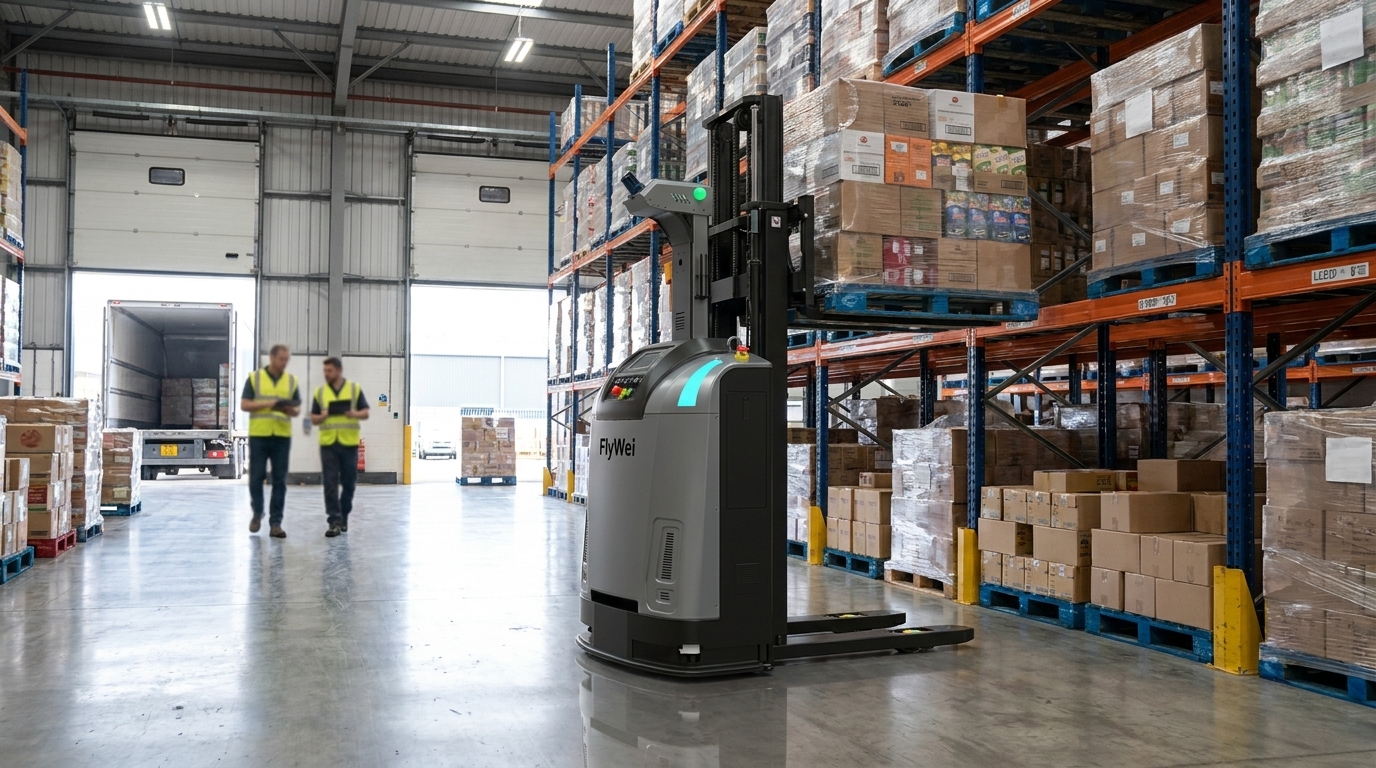
FMCG robot fleets are the mixed set of driverless forklifts, autonomous pallet trucks and latent-jacking AMRs a fast-moving consumer goods distribution centre bolts on to a live floor without knocking down a rack. The UK's material-handling backdrop for this decision is unforgiving: the Health and Safety Executive counts around 1,300 workplace-transport injuries each year, and the industry's own trade body, Logistics UK, tracks a persistent HGV-driver shortage that is now spilling into DC pick and put-away labour. For an operations director running a Midlands ambient FMCG DC through July peak, that headline meets a quieter, uglier reality: your 5am wave of pallet moves is late, agency headcount cannot ride a shift-differential through peak, and the board wants a robot answer by Q3 that does not empty the aisle for six weeks of installation.
Why UK FMCG DCs still miss peak with a full aisle of people
Most UK ambient FMCG DCs were designed for a labour pool that no longer exists at the price the operating model assumed. The building is fine — Magna Park, DIRFT, SEGRO East Midlands Gateway and Daventry-style ambient sheds are broadly TR34-compliant and structurally suited to reach-truck lanes and floor-level pallet flow. What has changed is the shift shape: peak is longer, agency backfill costs are higher, and the Health and Safety Executive's PUWER guidance keeps tightening the operator-safety bar every year, most visibly around reversing lift trucks and blind corners.
At the same time, the previous generation of automation — fixed-path AGVs on floor tape, ceiling-slung conveyor, hard-wired wire-guided very narrow aisle — is exactly what an operations director cannot buy any more. It demands a floor closure of weeks, an IT project of months, and it stops paying back the moment your SKU mix shifts. What the operations director actually wants is a robot fleet that walks into a live aisle on Monday, moves pallets on Tuesday, and can be re-tasked to a new dock two months later without a re-cabling job.
Enter the mixed autonomous fleet. A counterbalanced autonomous forklift takes the receiving-to-reserve pallet move, an autonomous pallet stacker cycles reserve-to-forward, and a latent-jacking AMR shuttles wheeled cages between the value-add cell and the outbound dock. Each machine sits on top of a shared orchestration layer — increasingly a VDA 5050-speaking fleet manager — and works alongside the crewed forklifts that keep the messy long-tail flows moving. That mixed model is the shape UK ambient DCs are now buying.
The four levers a UK operations director actually pulls
Lever 1 — Shift-shape absorption (operational)
The single highest-yield move in an ambient FMCG DC is to let robots absorb the 22:00–06:00 backfill wave. Overnight replenishment from reserve to forward is repetitive, spatially bounded and safety-critical when it slips into the day shift — which is exactly the profile driverless forklifts were built for. A properly sized fleet takes replenishment off the day shift's plate, freeing crewed forklifts for the exception work — damaged pallets, mis-sloted stock, hazmat re-checks — that a robot should not touch. In the first eight weeks of operation, expect a 15–25% lift in day-shift picks and a measurable drop in near-miss reports as the aisle empties of after-hours human traffic.
Lever 2 — Fleet orchestration and VDA 5050 (technical)
A single-vendor fleet ages quickly. The technical lever every ops director should insist on in 2026 is orchestration through an open interface — the industry-standard now is VDA 5050, the mission-and-status protocol that lets a fleet manager task any conformant robot from any vendor. FlyWei's M4 fleet manager and RDS robot dispatch service run on that basis: one control tower, one shift-plan, mixed machines. The practical effect on the floor is that when the operator adds a new dock or splits a pick face, the change is a rules update, not a fresh AGV integration project. That is what turns a robot fleet from a one-off capex event into a re-configurable line-item on the ops director's toolkit.
Lever 3 — PUWER, ISO 3691-4 and the risk-assessment hinge (regulatory)
The regulation is not the blocker most FMCG DCs assume. The Provision and Use of Work Equipment Regulations 1998 and ISO 3691-4 together accept autonomous work in mixed aisles — provided the operator's risk assessment covers the hand-over between crewed and robot flows and the safety-related control system is verifiable. In practice that means: named safety zones, chalked or optically marked hand-over corridors, a documented emergency-stop procedure that the shift-lead can trigger from an aisle-side pendant, and a maintainer trained under the ACOP L117 lift-truck operator code. Get those four artefacts on paper and your fleet is legally deployable. The vendor should present BSI-verifiable evidence of ISO 3691-4 conformance for every machine, not a marketing brochure.
Lever 4 — Leasing so peak-shape capex stops competing with fit-out capex (financial)
Every capex committee reviewing a robot fleet is also reviewing a mezzanine, a new dock, or a UPS. Full-service leasing — three-, five- and seven-year terms including maintenance — pulls the fleet out of capex and into a predictable opex line that maps to shift volumes. FlyWei's leasing programme, live since June 2026, is designed for exactly this decision: the finance director models a per-machine, per-month cost against overtime and agency spend, and the ops director gets to say yes on Q3 timelines without a fresh capex round.
What FlyWei does on an ambient FMCG DC floor
FlyWei designs, supplies and integrates the mixed fleet that makes this playbook real. On a UK ambient FMCG DC the deployment usually spans three machine families. FlyWei counterbalanced autonomous forklifts take the receiving-to-reserve two-tonne pallet moves. FlyWei autonomous pallet stackers work the reserve-to-forward lift with reach-truck-class height into narrow aisles. FlyWei latent-jacking lifting robots — knee-height AMRs that slip under wheeled dollies — shuttle the value-add cell to outbound. Every machine is orchestrated by the FlyWei M4 fleet manager over a VDA 5050 interface, dispatched by RDS. FlyWei UK-based engineers install into a live aisle in a phased go-live — receiving lane first, reserve second, forward-pick last — so no wave is dark for more than a single shift. The operator keeps their existing WMS; M4 speaks to it as an equipment layer. A phased UK ambient FMCG solutions deployment is typically live in six to ten weeks from purchase order, with a service-level agreement backed by UK-based engineers and next-business-day response on any Priority 1 fault.
Comparison — the four levers on one page
| Lever | Cost band (per DC) | Payback window | Regulatory hook | Board-level risk |
|---|---|---|---|---|
| Shift-shape absorption | £450k–£1.2m capex or opex-equivalent lease | 18–30 months | PUWER Reg 4 (suitability) | Low — reversible if fleet is idled |
| Fleet orchestration (M4 + VDA 5050) | £40k–£90k software and integration | Immediate operational leverage | ISO 3691-4 §5 (safety-related control system) | Low — decouples vendor lock-in |
| PUWER / ISO 3691-4 compliance uplift | £15k–£45k documentation and safety hardware | Insurance and HSE reporting from month one | PUWER 1998, ACOP L117, ISO 3691-4 | Medium if skipped |
| Full-service leasing | Opex — from £2,800 per machine per month | Cash-flow positive from month one | N/A — commercial | Low — no residual value exposure |
An FMCG robot fleet is a mixed set of driverless forklifts, autonomous pallet trucks and latent-jacking AMRs added to a live UK distribution centre to lift throughput without pausing peak operations.
Frequently asked questions
What exactly is an FMCG robot fleet?
It is a mixed set of driverless forklifts, autonomous pallet stackers and latent-jacking AMRs deployed inside a fast-moving consumer goods distribution centre to absorb repetitive pallet, tote and dolly moves alongside crewed staff — orchestrated by a fleet manager over VDA 5050.
Do we have to close the DC to install robots?
No. A phased go-live — receiving first, reserve second, forward-pick last — takes each wave dark for a single shift only. FlyWei UK-based engineers commission at night against a mapped floor, so day-shift operations continue.
How does an FMCG robot fleet stay legal under PUWER 1998?
PUWER 1998 and ISO 3691-4 both accept autonomous work in mixed aisles. The operator needs a risk assessment covering human-to-robot hand-over, named safety zones, an aisle-side emergency-stop, and a maintainer trained under ACOP L117. FlyWei supplies BSI-verifiable ISO 3691-4 evidence for each machine.
Can autonomous forklifts share aisles with human forklift drivers?
Yes. Under ISO 3691-4 mixed aisles are permitted with a safety-related control system, defined hand-over corridors, and trained supervisors. FlyWei M4 chalks these zones dynamically and enforces stop-and-yield behaviour when a crewed truck enters the corridor.
Is leasing available for a UK FMCG robot deployment?
Yes. FlyWei offers three-, five- and seven-year full-service leases that include maintenance, spares and software updates, from roughly £2,800 per machine per month depending on class and duty cycle.
Which KPIs should an ops director track after Day 1?
Track pallets moved per robot-hour, near-miss reports per aisle-shift, agency headcount avoided, overtime hours displaced, and Priority-1 fault mean-time-to-recover. Expect a 15–25% day-shift pick lift in eight weeks.
What is the payback on an FMCG robot fleet?
Typical UK ambient FMCG payback lands at 18–30 months on the shift-shape absorption case alone. Under leasing, the operation is cash-flow positive from month one; capex payback aligns to the amortisation profile.
If a live-floor deployment inside a working UK ambient FMCG DC is on your Q3 risk register, the fastest useful next step is a walk-around with an engineer who has done it before. Book a free 30-minute site survey and we will map your dock-to-forward flow, size a mixed fleet, and mark the shifts a robot fleet would absorb first. Or read the UK FMCG solutions page for the deployment shape by rack layout. UK-based engineers, no obligation, reply within one business day.