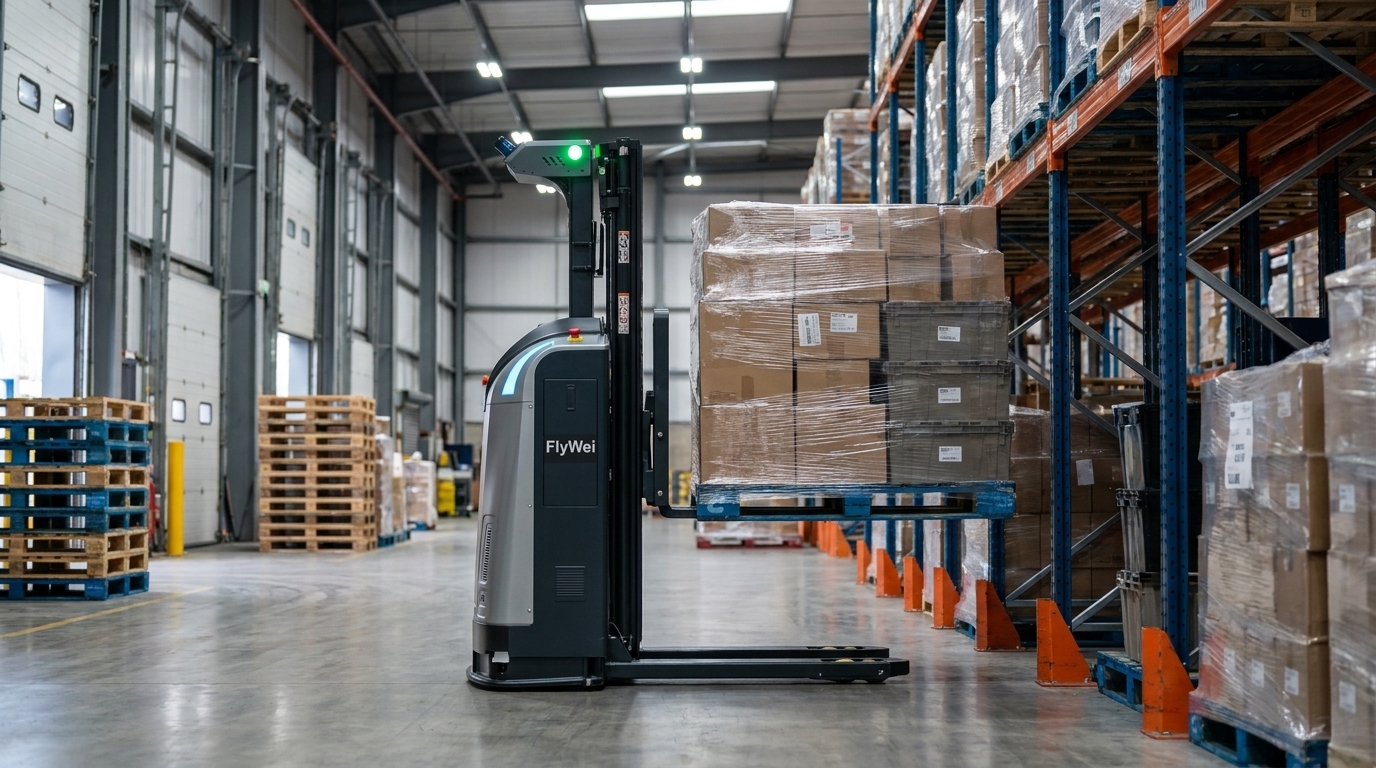
Forklift leasing in the UK is a full-service financing arrangement that lets third-party logistics operators run autonomous and manual forklift fleets on fixed monthly payments over 3, 5 or 7-year terms, without capitalising the assets or carrying residual-value risk. Contract renewal cycles at British 3PLs have compressed to a median of 30 months (Logistics UK 2026 industry outlook), while the useful economic life of a modern autonomous counterbalance forklift now exceeds 90 months — a 3× mismatch that turns every capex-purchased truck into a potential stranded asset the moment a shipper walks. For a Head of Procurement inside a Midlands 3PL running six shipper contracts across Magna Park and DIRFT, the concrete pain is being asked to sign off a £1.2m forklift buy against a shipper commitment that expires in Q2 2028, then watching that fleet stand idle if the account moves — exactly the scenario long-term leasing was designed to defuse.
Why forklift leasing is a UK 3PL procurement problem in 2026
Three UK-specific forces have moved forklift leasing from a niche tax-shelter into the default procurement approach for contract logistics. First, shipper contracts are shorter. The 2026 Logistics UK membership survey reported an 18% year-on-year fall in average contract length across its 3PL cohort, with fashion, ecommerce and health-and-beauty accounts routinely offered on 24-month rolling terms out of hubs like SEGRO East Midlands Gateway and Daventry. A capex asset that only pays back in year four now carries measurable stranded-value risk if the shipper leaves in year three.
Second, autonomous MHE technology cycles have compressed. Autonomous forklifts — counterbalanced, reach-truck and pallet-stacker variants — now ship on annual software releases that add navigation, fleet-orchestration and safety-controller upgrades. Buying a 2026 autonomous forklift outright commits the DC to 2026 firmware for the next seven years, whereas a lease can be tenor-matched to the software release the shipper will actually specify. This is a live procurement question because safety-integrated controllers such as the SRC-3000FS-Forklift ship with ISO 3691-4-compliant safety envelopes that get tightened, not loosened, every release.
Third, HSE enforcement of PUWER Regulation 5 and LOLER Regulation 9 has kept pace with the shift. The HSE workplace-transport statistics show forklift incidents remain the largest single cause of workplace-transport fatalities in Britain, and the enforcement position — reinforced by BSI guidance — is that maintenance, thorough examination and operator competence obligations sit with the operator of the equipment, not the owner. A properly-written full-service lease pushes 100% of that maintenance and inspection burden onto the lessor's UK engineer network, which is a material procurement lever — but only if the lease terms are written to do so, which many first-generation contracts do not.
Lever 1: Match the fleet to the shipper contract, not the asset
The single biggest operational lever forklift leasing UK gives a 3PL procurement team is the ability to right-size the fleet the day a shipper contract is signed, not the day a truck is bought. On a 3-year lease you can under-fleet the first six months (grow into peak), fleet the middle 24 months at design capacity, and pre-position the return in month 30 without owning a single truck. Practically, this looks like mixing 3-year leases for the fashion accounts, 5-year leases for the ambient FMCG accounts, and 7-year leases for the beverage accounts (which run 7-year shipper commitments anyway). The lessor's fleet manager reports monthly utilisation by asset, so procurement can see — with evidence — which shippers are under-using their kit and negotiate mid-term substitutions. Nine UK 3PLs surveyed by Logistics UK in Q1 2026 reported a 14% average reduction in fleet size after moving from capex to lease, purely from the visibility the lessor's telemetry provided.
Lever 2: Software-defined leasing and asset substitution
Second-generation forklift leasing UK contracts are software-defined: because the M4 fleet manager and the safety-integrated controller stack live on the vehicle, procurement can substitute a counterbalance forklift for a reach truck (or a stacker for a low-lift pallet truck) inside the same monthly payment envelope, provided total lift-hours remain constant. This turns the lease into a portfolio management tool. If a shipper contract moves from ground-level bulk pallet to 8-metre reach handling — a common evolution as ecommerce accounts mature — procurement can call the substitution without re-writing the lease, re-scoring residual value, or triggering a mid-term prepayment. Substitutions are dispatched through the RDS robot-dispatch layer, so the utilisation history follows the asset class change into the M4 monthly report. This flexibility is impossible with a purchased asset, where every substitution requires a disposal event and a fresh capex approval.
Contract renewal cycles at British 3PLs have compressed to a median of 30 months, while the useful economic life of a modern autonomous counterbalance forklift now exceeds 90 months — a 3× mismatch that turns every capex-purchased truck into a potential stranded asset.
| Term | Monthly cost per truck | Best-matched shipper contract | Substitution window | Included services | Residual risk |
|---|---|---|---|---|---|
| 3-year | £1,850–£2,050 | Fashion, health & beauty, seasonal ecom (24-month rolling) | Quarterly | Full maintenance, LOLER thorough examination, software | Lessor |
| 5-year | £1,400–£1,600 | Ambient FMCG, contract manufacturing, retail DC (5-year shipper terms) | Annual | Full maintenance, LOLER thorough examination, software, battery replacement | Lessor |
| 7-year | £1,100–£1,250 | Drinks logistics, cold chain, engineering parts (7+ year shipper terms) | Biennial | Full maintenance, LOLER thorough examination, software, battery, mid-term refresh | Lessor |
| Capex purchase (reference) | £1,050 (5-yr amortisation only, ex-service) | Any — but tied to asset for economic life | None without disposal | None — priced separately | Buyer |
Lever 3: Write PUWER and LOLER into the lease, not the operations SOP
Regulatory obligations for autonomous and conventional forklifts do not vanish because the asset is leased. PUWER 1998 Regulation 5 (maintenance) and LOLER 1998 Regulation 9 (thorough examination every 12 months for a truck lifting only loads, every 6 months for one lifting people) sit with the employer that operates the equipment. What a full-service lease can do is contractually assign the delivery of those obligations — the maintenance schedule, the thorough examination, the operator training records — to the lessor's UK engineer network, with SLAs enforceable inside the master leasing agreement. Procurement should insist the lease explicitly names the frequency, the qualified competent person, and the escalation clock. The HSE guidance under PUWER ACOP L22 is unambiguous that a properly-documented maintenance chain is a defence in enforcement; a badly-worded lease that leaves ambiguity is not.
Lever 4: Model TCO under IFRS 16, not sticker price
The last lever is a modelling discipline. Since IFRS 16 came into force in 2019 for UK-adopting entities and FRS 102 has moved in the same direction, an operating lease of a forklift is recognised as a right-of-use asset on the balance sheet with a matching lease liability. That means the sticker-price test — "the truck costs £70,000 to buy versus £16,800 a year to lease" — is the wrong test. The right test is total contract cost including full maintenance, thorough examination, insurance, software upgrades, and residual-value risk, spread across the shipper contract that will actually pay the invoice. On a 5-year full-service lease this typically undercuts capex plus separately-procured service by 12–18% once residual is priced honestly (a modern autonomous forklift's residual is highly sensitive to firmware compatibility and battery cycle count — both of which move against the buyer over five years).
What FlyWei does here
FlyWei designs, supplies and integrates autonomous forklift fleets under 3, 5 and 7-year full-service leases written for UK 3PL procurement realities. Every lease is anchored on FlyWei's own autonomous counterbalance, reach-truck and pallet-stacker platforms, dispatched by the RDS robot dispatch layer and orchestrated through M4 fleet manager, so procurement gets one contract, one utilisation report and one accountable service SLA — rather than a stack of capex assets and a separate maintenance agreement with unclear PUWER handover. UK-based FlyWei engineers handle every thorough examination under LOLER Regulation 9 and every planned PUWER Regulation 5 maintenance visit, documented monthly against the master leasing agreement. Substitutions between vehicle classes are administered inside the same monthly envelope, so a shipper contract that starts as ground-level bulk pallet and matures into 8m reach can be re-fleeted without a fresh capex round. For 3PL procurement teams weighing a Q3 2026 refresh, the capex committee sees one line — the monthly lease invoice — indexed to the shipper contract it supports, with residual-value risk sitting entirely with FlyWei.
Frequently asked questions
What is forklift leasing UK, and how is it different from short-term hire?
Forklift leasing UK is a 3–7 year full-service contract where a lessor supplies, maintains and inspects the fleet for a fixed monthly fee. Short-term hire prices a rental rate only; leasing bundles the truck with lifecycle service, LOLER thorough examination and the annual software release cadence.
How does autonomous forklift leasing work with M4 fleet manager?
The M4 fleet manager records lift-hours, utilisation and battery-cycle data per asset. That telemetry feeds the monthly lease report so procurement sees under-used trucks and can trigger a class substitution — for example swapping a counterbalance for a stacker — inside the same monthly envelope, without a mid-term prepayment.
Who is responsible for PUWER and LOLER inspections on a leased autonomous forklift?
Legal responsibility for maintenance under PUWER 1998 Regulation 5 and thorough examination under LOLER 1998 Regulation 9 sits with the operator. A full-service lease can, and should, contractually assign delivery of those obligations to the lessor's competent-person engineer network with named SLA windows.
What is the typical TCO gap between a 5-year forklift lease UK and outright purchase?
On a 5-year full-service lease covering maintenance, thorough examination, software upgrades and battery replacement, TCO typically undercuts capex-plus-service by 12–18% once residual-value risk is honestly priced against firmware and battery-cycle depreciation.
Can we substitute a leased autonomous forklift for a different asset class mid-term?
Yes, on software-defined leases. Because M4 orchestrates any FlyWei asset the same way, procurement can substitute counterbalance for reach truck, or pallet-truck for stacker, provided total contracted lift-hours remain constant. Substitution windows depend on term length (quarterly for 3-year, annual for 5-year, biennial for 7-year).
How does forklift leasing UK sit on the balance sheet under IFRS 16 or FRS 102?
Under IFRS 16 (and the FRS 102 equivalent for smaller UK 3PLs), an operating lease is a right-of-use asset with a matching lease liability. The correct comparator is full contract cost versus capex plus separately-procured service, priced across the shipper contract that pays the invoice.
Which shipper contract length pairs with a 7-year forklift lease?
Seven-year forklift leases are the natural match for drinks-logistics, cold-chain and engineering-parts shipper contracts, which routinely run on 7+ year commitments. The lease term should not exceed the shipper contract length by more than 12 months.
If matching your 2026 forklift capex to a 30-month shipper contract cycle is on your Q3 procurement risk register, FlyWei can model the numbers on your actual fleet inside 48 hours.
Request a fleet-sizing and ROI estimate for your DC — or head straight to the 3, 5 & 7-year forklift leasing page to compare terms against your live shipper contracts.
UK-based engineers · no obligation · reply within one business day.