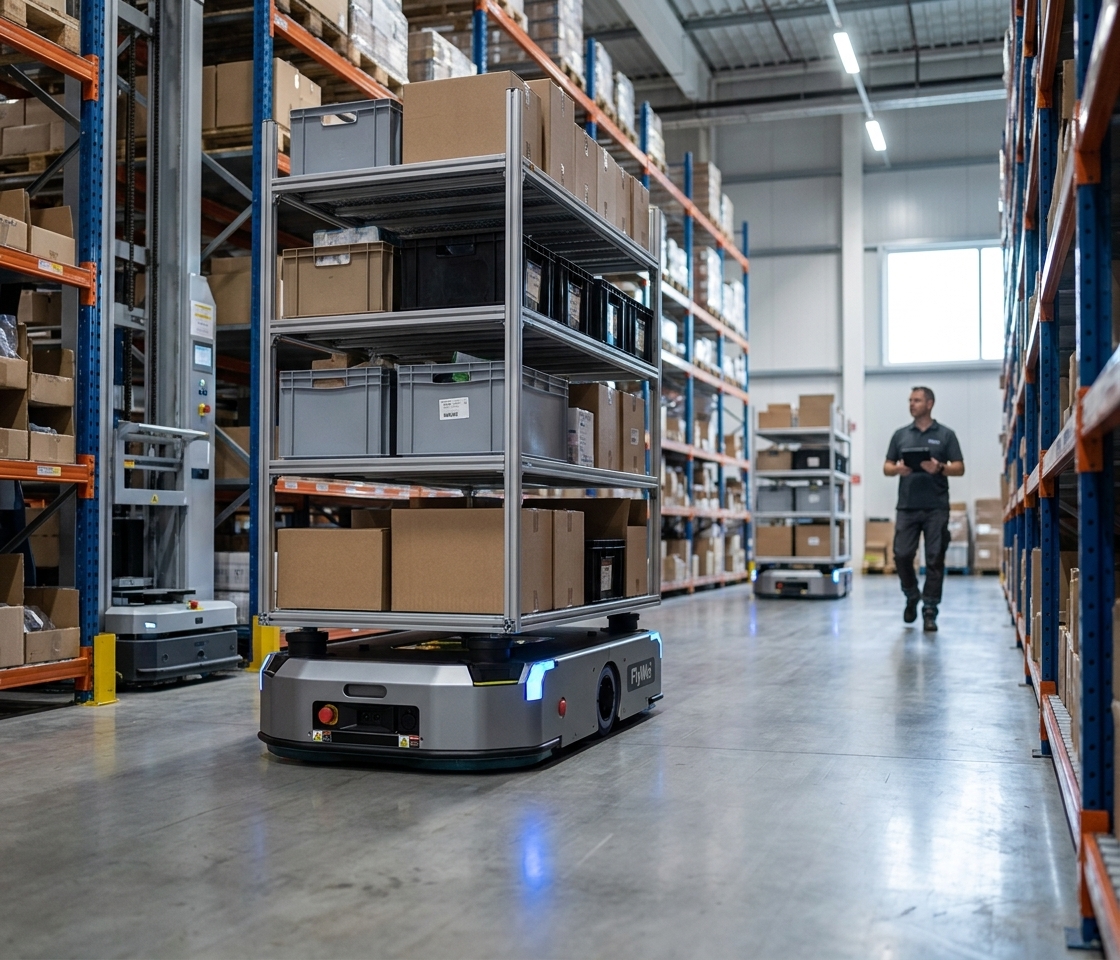
Goods-to-person (G2P) picking in the UK is the warehouse architecture where mobile robots, shuttles or vertical lifts bring inventory to a stationary operator rather than sending the operator down an aisle to retrieve it — a model that Logistics UK data shows can lift pick rates from a typical 60–80 lines per operator-hour to 280–410 lines per operator-hour at well-run UK distribution centres. For e-commerce supply-chain directors, that throughput delta is now decisive: order profiles in 2026 sit at roughly 1.6 average lines per parcel, peak surge factors of 4–5× over baseline are the norm rather than the exception, and the UK warehouse-labour pool tightened a further 2.1% year on year against a backdrop of rising National Living Wage. The question for goods-to-person UK buyers is no longer whether to deploy G2P — it is which architecture survives a five-year peak.
Why UK e-commerce supply-chain directors are now forced to choose
Three pressures converge on the UK supply-chain director in 2026. The first is order-profile shrinkage: single-line parcels now dominate channels that five years ago were 2.4 lines per order; that compresses the time per pick from 18 seconds to 11 seconds and exposes every wasted footstep. The second is labour: Logistics UK''s Skills and Employment tracking shows a 17,000-person net shortfall in warehouse operatives across the country, concentrated in Magna Park, DIRFT, SEGRO East Midlands Gateway, and Daventry — exactly the corridors that house UK e-commerce demand. The third is peak: Black Friday through Boxing Day now stretches into a seven-week peak window, and the in-shift hire model that 3PLs leaned on for a decade has broken — agency conversion has dropped sharply against pre-pandemic norms.
Against that, person-to-goods picking has a fixed ceiling: 60–80 lines per operator-hour with high travel-time wastage. Goods-to-person UK deployments invert the problem. The operator stays in a fixed cell, ergonomically optimised, while the robot fleet handles the travel. Pick rates of 280–410 lines per operator-hour are achievable inside three months of go-live, and the cell can be lit, climate-controlled and CCTV-monitored to a standard that drives operator retention. The trade-off is capital intensity and integration complexity. Supply-chain directors who picked the wrong architecture in 2018 — typically by buying the demo, not the brownfield reality — are still paying for it.
The four levers that fix UK e-commerce G2P
1. Pick-station design and operator ergonomics (operational)
Hardware sells the customer; the pick cell sells the operator. A well-designed G2P station presents the source tote at 920 mm working height, source-to-destination distance under 600 mm, two-handed reach within 350 mm, and a put-to-light wall that resolves a single-line parcel in 4.2 seconds. Supply-chain directors should specify pick-station throughput in lines per minute under sustained shift load — not under demo conditions — and demand the operator throughput curve at 240 minutes (post-fatigue). The cell also needs a brownfield fit: most UK 3PL mezzanines clear 4.0 m floor-to-soffit, which constrains ceiling-mounted pick lights and means batch-tote design must stay below 1.5 m stack. The operator throughput floor in the contract — typically 280 lines per hour at 95% accuracy — is the only number that actually matters at quarterly business reviews.
2. Lifting AMR fleet orchestration via M4 (technical)
The robot fleet is the easy part; orchestrating it across a multi-aisle, multi-pick-station floor is where deployments fail. A modern UK e-commerce DC runs 30–120 lifting AMRs concurrently — knee-height latent-jacking pucks that slip under wheeled racks, lift, and route to the pick cell. They share aisles with put-walls, tugger trains and human walkers. The orchestration layer needs three things at once: traffic-management latency under 200 ms, VDA 5050-compatible interfaces so the fleet is not vendor-locked, and live re-routing when a pick station goes amber. FlyWei''s M4 Platform handles dispatch, charge management, exception escalation and shift-handover reporting from a single pane of glass and is built for mixed-vendor fleets. Without that orchestration layer, fleet utilisation typically falls to 41–48% inside year two — the difference between a 280-pick-per-hour cell and a 410-pick-per-hour cell.
3. Brownfield retrofit reality (technical)
The single biggest delivery mistake in UK G2P is treating a brownfield retrofit like a greenfield build. UK distribution centres typically run beam heights between 4.0 m and 5.2 m clear; column grids sit at 12 m × 18 m; and the floor slab — usually a TR34-rated DM2 free-movement floor — has tolerance ±5 mm over 3 m. A shuttle ASRS or cube-storage system demands a 12 m+ ceiling clearance and a structural slab uplift that few existing UK DCs can take without a roof lift. Lifting AMRs, by contrast, work under existing pallet racking with no structural change: the puck slips into a 250 mm clearance, the racking stays in place, and aisles narrow from 3.0 m to 2.2 m with the AMR''s profile. That difference is typically £900k–£2.4m in capital saved on a 12,000 m² DC, and 14–22 weeks pulled forward on go-live.
4. Compliance overlay — ISO 3691-4 and ISO 10218 (regulatory)
UK procurement teams routinely miss the standards split. The driverless mobile element of a G2P deployment falls under BS EN ISO 3691-4:2023, which sets the safety case for autonomous industrial trucks and references LiDAR fields of view, emergency stop and operator-marked safety zones. The pick cell itself, when it includes a collaborative arm or a powered conveyance, crosses into PUWER 1998 and ISO 10218 for industrial robotics. The two standards are not interchangeable, and a single deployment will need risk assessments under both. UK procurement should require evidence of UKCA marking on the AMR fleet, a written ISO 3691-4 conformity statement, and a separate PUWER risk assessment for the pick cell. Buying on hardware spec alone — without the compliance dossier — is what leads to HSE improvement notices on day 21.
| Criterion | Lifting AMR (latent-jacking) | Shuttle ASRS | Cube storage |
|---|---|---|---|
| Capex band (12,000 m²) | £1.2–2.1m | £3.5–6.8m | £2.8–4.5m |
| Ceiling clearance required | 4.0 m+ | 12.0 m+ | 8.5 m+ |
| Brownfield retrofit | Native — no slab uplift | Requires roof lift or new build | Requires slab uplift |
| Peak surge flex (4–5×) | Add AMRs in 6–8 weeks | Fixed lane count | Fixed grid |
| Go-live (post-PO) | 14–22 weeks | 52–78 weeks | 34–48 weeks |
| OpEx leasing route | 3/5/7-year full-service | Finance lease only | Finance lease only |
| Pick rate (lines/op-hr) | 280–410 | 320–450 | 240–360 |
Lifting AMRs lift UK e-commerce pick rates from 60–80 to 280–410 lines per operator-hour without a roof lift — the only goods-to-person architecture that retrofits a brownfield UK mezzanine in under 22 weeks.
What FlyWei does for UK e-commerce supply-chain directors
FlyWei designs and integrates goods-to-person UK deployments for e-commerce distribution centres without the brownfield demolition tax. The fleet is built around latent-jacking lifting AMRs for goods-to-person picking and rotary-lift AMRs for orientation-sensitive items, both running natively under existing UK pallet racking with no slab uplift. The M4 Platform orchestrates the fleet, manages charging cycles, and reports utilisation, exception escalation and shift-handover to the operations team in real time; RDS handles the dispatch logic that gets each robot to the right pick cell at the right second. The lifting AMR fleet operates alongside FlyWei autonomous forklifts at the goods-in and outbound docks for pallet-level moves.
For UK e-commerce supply-chain directors comparing CapEx against OpEx, FlyWei''s full-service leasing wraps the fleet, the orchestration software, scheduled service, spares, software updates and a contractual 98% uptime guarantee into a single monthly figure — typically 28–34% lower over a five-year horizon than buying outright once depreciation, financing and service costs are normalised. Every FlyWei lifting AMR G2P deployment ships with a written ISO 3691-4 conformity statement and a separate PUWER risk assessment for the pick cell, signed off by UK-based FlyWei engineers who survey the site before any kit arrives.
FAQ
What is goods-to-person picking in a UK warehouse?
Goods-to-person (G2P) UK picking is the architecture where mobile robots or shuttles bring inventory to a stationary operator at a pick cell rather than the operator walking the aisle. UK e-commerce DCs typically lift pick rates from 60–80 lines per operator-hour to 280–410 lines per operator-hour after deployment.
When does a lifting AMR beat a shuttle ASRS in the UK?
Lifting AMRs win whenever the building is brownfield, ceiling clearance is under 8 m, peak volume swings 4× or more, and the buyer needs a go-live under six months. Shuttle ASRS wins only on greenfield builds with 12 m+ ceilings and stable, predictable volume.
What is the typical capex for UK G2P in a 12,000 m² e-commerce DC?
Lifting AMR G2P sits at £1.2–2.1m for a 12,000 m² UK e-commerce DC. Shuttle ASRS at the same footprint runs £3.5–6.8m once the structural slab and roof modifications are factored in.
Does goods-to-person picking comply with UK PUWER?
The driverless robot fleet falls under BS EN ISO 3691-4:2023; the pick cell falls under PUWER 1998 and, where collaborative arms are used, ISO 10218. UK buyers should require both a written ISO 3691-4 conformity statement and a separate PUWER risk assessment for the cell.
Can FlyWei lifting AMRs retrofit existing UK pallet racking?
Yes — FlyWei latent-jacking lifting AMRs operate under existing UK pallet racking with no slab uplift, working in aisles narrowed to 2.2 m. Most UK 3PL mezzanines need no structural modification before deployment.
What is the difference between G2P and person-to-goods picking?
Person-to-goods has the operator walking the aisle to retrieve items. Goods-to-person inverts that — the inventory is brought to a stationary operator. Walking time accounts for 55–65% of person-to-goods labour cost; G2P removes it.
How fast can FlyWei go live on a UK brownfield e-commerce DC?
FlyWei targets 14–22 weeks from purchase order to live operation on a brownfield UK e-commerce DC of 8,000–15,000 m². That includes the site survey, ISO 3691-4 conformity, PUWER risk assessment, fleet commissioning and operator training.
Is G2P robot leasing available in the UK?
Yes — FlyWei offers full-service goods-to-person UK leasing across 3, 5 and 7-year terms. The lease bundles the AMR fleet, M4 orchestration, scheduled service, spares, software updates and a 98% uptime guarantee. Most UK e-commerce buyers choose the 5-year term to align with peak-season tech refresh.
If picking the wrong G2P architecture for your 2026 peak is on your Q3 risk register, the cheapest correction is to validate the brownfield numbers before procurement closes.
Get a 48-hour feasibility read on your highest-volume flow, or compare your options on the FlyWei lifting AMR range sized for UK e-commerce mezzanines.
UK-based engineers · no obligation · reply within one business day.