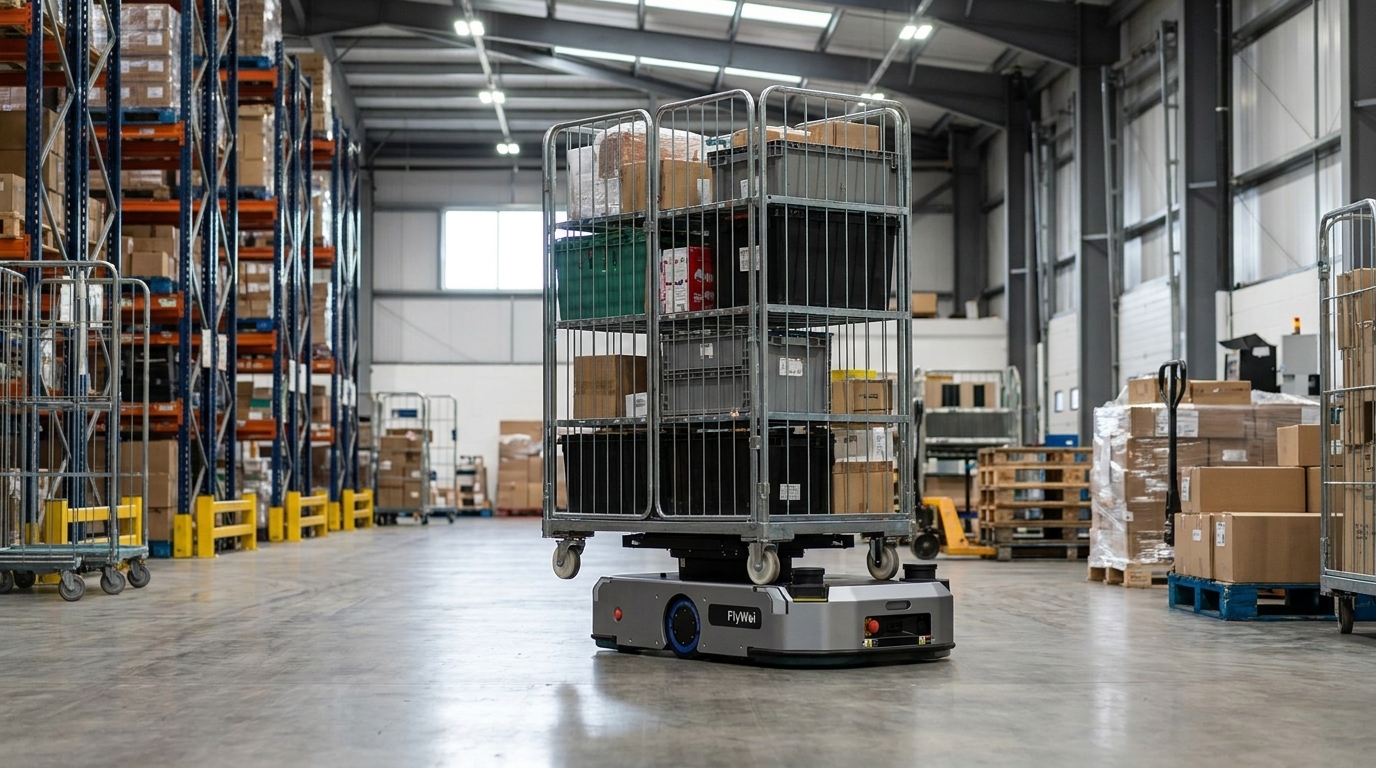
Goods to person UK grocery distribution is an intralogistics model where autonomous mobile robots deliver totes, cases or entire shelves to a stationary human picker, replacing the miles a walker used to cover across every shift. The 2023 revision of ISO 3691-4, the standard for autonomous industrial trucks, gives UK boards a clearer standards path to write into a robotics business case, and inside grocery DCs where mixed foot-and-forklift traffic runs across eighteen-hour operating days the model is also driving down the musculoskeletal caseload the Health and Safety Executive tracks. For a retail-DC operations director walking into Q3 2026, the pain is not theoretical. Range expansion has materially expanded active SKUs at many major grocers in recent years, night-shift agency rates on peak have climbed above baseline levels, and Christmas volumes now arrive at the outbound dock in narrower windows than the pick face was designed to serve. That gap is what pulls a goods-to-person conversation onto the Q3 investment tracker.
Why goods-to-person is landing in UK retail DCs now
Three signals converged in 2025 to put goods-to-person on the agenda across UK grocery, multi-channel and pure retail distribution centres. The first is labour: peak-shift agency rates at Magna Park, DIRFT and the SEGRO East Midlands Gateway have moved sharply above baseline in successive Q4s, and Logistics UK''s own workforce commentary consistently flags recruitment as the sector''s number-one operating risk. The second is range. Multi-channel grocery has materially expanded the active SKU population — chilled prepared foods, plant-based lines, private-label ready meals, seasonal ranges — and the pick face designed to serve the old range now stretches over aisle after aisle. Every new SKU adds a walking metre to the shift.
The third is compliance. HSE workplace-transport guidance and PUWER 1998 both put pressure on any operator running mixed traffic, and the 2023 revision of ISO 3691-4 for autonomous industrial trucks gives UK boards a clearer standards path to write into a robotics business case. Where a manual pick face used to be the safest choice on paper, in 2026 the case is closer to the reverse — a goods-to-person workstation, with the operator stationary and the traffic engineered around them, is now the lower-risk configuration for a busy multi-channel grocery DC.
Together these three signals — labour scarcity, SKU explosion and standards-led compliance — form the operating context that makes goods-to-person more than a novelty in 2026. Where five years ago a UK retail-DC ops director had to build a business case against scepticism, today the case is built against the counterfactual of doing nothing: keeping mile-long pick paths, absorbing rising agency spend, and hoping the workforce carries the range through another Christmas.
Goods to person is not a picking tactic; it is the decision to stop paying humans for movement they never should have carried.
The four levers a retail-DC ops director should pull
1. Redesign the pick face around stationary workstations (operational lever)
The first lever is not a robot — it is a floor plan. Goods-to-person works because the walking is eliminated, not because the machine is fast. Before any AMR lands, the ops team should carve the pick face into three zones: a fast-mover zone that stays manual on trolley or pallet, a slow-mover long-tail zone that migrates to G2P workstations, and a chilled zone with its own thermal envelope. Each G2P workstation becomes a 2-3 metre bay with a monitor, a barcode scanner and a put-to-light rack; the AMR docks on a defined footprint marked on the floor. Grocery DCs at Daventry and Burton-on-Trent that have started this migration typically convert the long-tail pick face first, keeping fast movers on their existing manual flow so peak throughput never dips during the retrofit. The mistake most retail DCs make is skipping this floor-plan step and buying the fleet first; the AMRs then arrive with nowhere natural to dock, no put-to-light logic wired in, and no clear handover choreography. The right sequence is workstation design, dock footprint, wiring, then vehicles — never the other way round.
2. Choose the right AMR class for the SKU shape (technical lever 1)
Not every G2P robot is the same machine. A latent-jacking AMR slides beneath a wheeled shelf or cart, picks up the whole rack and delivers it to the operator — the right shape for chilled ready-meal totes and light-weight ambient cartons. A heavy-lift jacking AMR handles pallet-sized racks — the right shape for beverages, tinned goods and bulk paper. A rotary-lift AMR turns the shelf in front of the operator so the correct pick face is always presented. A retail-DC ops director picking the wrong class ends up either with over-specified equipment sitting idle, or under-specified equipment struggling with the SKU it should never have carried. This is why the sizing conversation matters more than the brand comparison. A useful way to pressure-test the class choice is to run a two-week SKU-shape audit before the RFP goes out — walking the pick face, weighing sample carts, and tagging which lines are chilled, which are ambient, and which move on pallet. That audit determines the fleet ratio, and the fleet ratio determines the capex.
3. Orchestrate the fleet through a single control layer (technical lever 2)
A goods-to-person deployment fails not on the mechanics but on the traffic. Ten AMRs sharing an aisle with two forklifts and eight walkers is a coordination problem that a single-vendor scheduler cannot solve. The industry answer is ISO 3691-4-compliant functional safety at the vehicle level, plus a VDA 5050-speaking fleet manager that arbitrates between mixed-vendor fleets, and a robot-dispatch layer that prioritises workstation queues by SLA rather than first-in-first-out. FlyWei''s M4 fleet manager and RDS robot dispatch are built for exactly this decomposition: the safety runs on the machine, the routing runs on M4, and the workstation-level order priority runs on RDS. The operational effect is that peak throughput scales with fleet size instead of stalling at a jam. For a retail DC ops director this is what a modern fleet-management stack should already be doing on day one. If the fleet layer cannot speak VDA 5050 to third-party vehicles, the DC is locked into single-vendor economics forever — and single-vendor economics is exactly what a mixed-vendor grocery site needs to avoid.
4. Bring the fleet under PUWER, LOLER and ISO 3691-4 governance from day one (regulatory lever)
The final lever is the one that gets skipped and costs a DC six months later. Every G2P machine is work equipment under PUWER 1998; every lifting mechanism is a lifting appliance under LOLER 1998. That means a documented risk assessment, a scheduled thorough examination cycle, and an integration statement that shows how ISO 3691-4 requirements are met at the vehicle and at the fleet level. A retail DC that lands the machines before the compliance file is an HSE improvement notice waiting to happen. The right path is to specify the compliance envelope in the RFP, share it with an ACOP-literate integrator, and treat sign-off as a launch gate — not a follow-up. A tidy documentation set at go-live — risk assessments, thorough examination schedules, ISO 3691-4 conformity statement, PUWER-aligned inspection records — also shortens the insurance renewal conversation. Underwriters price uncertainty; a clean compliance file materially reduces that price. Insurers, boards and internal safety committees all read from the same file; getting it right at the start protects every subsequent decision the DC makes about growing the fleet.
| Lever | Type | Payback horizon | Risk if skipped |
|---|---|---|---|
| Pick-face redesign around stationary workstations | Operational | Weeks to months | AMRs run, walking doesn''t fall |
| AMR class matched to SKU shape | Technical | Months | Over-spec capex or throughput bottleneck |
| Single orchestration layer (M4 + RDS) | Technical | Inside the first peak | Traffic jams cap peak throughput |
| PUWER, LOLER, ISO 3691-4 governance from day one | Regulatory | Zero — pre-launch gate | HSE improvement notice, insurance rework |
What FlyWei does for UK retail DCs pursuing goods-to-person
FlyWei designs, supplies and integrates the AMR side of the goods-to-person stack for UK grocery and multi-channel retail distribution centres. That covers the physical fleet — latent-jacking AMRs for chilled ready-meal cart shuttling, heavy-lift jacking AMRs for pallet-scale beverage flows, and autonomous forklifts for the input and output ends where inbound reserve stock has to move to and from the goods-to-person zone. It also covers the intelligence — M4 fleet manager for cross-vendor traffic control, RDS robot dispatch for workstation-level priority, and the integration statement that maps the fleet against PUWER, LOLER and ISO 3691-4. UK-based engineers scope the site, size the fleet against the SKU curve, and stage the retrofit so peak throughput never dips. Where the capex profile is the friction, the same lifting-robot fleet is available as 3, 5 or 7-year robotics-as-a-service leasing, moving the whole build into operating cost — the shape that fits how retail-DC ops directors actually run their budgets. The playbook that FlyWei brings to a UK retail-DC engagement is not a catalogue drop — it is a scoping visit, a SKU-shape audit, a fleet-ratio proposal, and a phased retrofit plan the operations team can defend inside a Q3 board pack. That, plus a UK-based service and maintenance cadence, is what a retail DC ops director needs from a goods-to-person supplier in 2026.
Frequently asked questions
What is goods to person in a UK warehouse?
Goods to person is an intralogistics model in which autonomous mobile robots deliver totes, cases or entire shelves to a stationary human picker instead of the picker walking to the shelf. In a UK retail DC context it is used to compress pick paths, ease the musculoskeletal load on the workforce and stabilise throughput across the day.
Is goods to person the same as shelf-to-person or tote-to-person?
Shelf-to-person and tote-to-person are two implementation shapes of the broader goods-to-person model. Shelf-to-person moves a whole rack under a latent-jacking AMR; tote-to-person delivers a smaller container to the workstation. UK grocery DCs commonly run both — shelf-to-person for chilled cart flows, tote-to-person for slow-mover ambient long-tail.
How much floor space does a G2P workflow need?
A workable G2P zone can be carved out of an existing pick face without new build. Typical footprint is a 2-3 metre workstation bay per operator plus a docking area, with 1.6-2 metre AMR travel lanes. Retrofits at UK grocery DCs typically start with an 800-1500 square metre pilot phase.
What UK regulations apply to G2P robots?
The core UK regulatory envelope is PUWER 1998 for work equipment, LOLER 1998 for the lifting mechanism, and ISO 3691-4:2023 for autonomous industrial trucks. HSE workplace-transport guidance sits on top for mixed-traffic environments; BSI publishes the harmonised standards route.
Can a grocery DC start G2P without a full retrofit?
Yes. The lower-risk path is a phased retrofit — carve a slow-mover long-tail zone out of the existing pick face, land a small AMR fleet, and run it in parallel with the manual flow. Fast movers continue on their existing method until the phase-two migration.
What is the payback period for a UK G2P deployment?
Payback typically falls inside a 5-year robotics-as-a-service lease when the deployment is sized against real SKU shape and traffic. The largest single line-item is the walking-labour reduction; the second is the reduction in Christmas-peak agency spend.
If picker walk time and Christmas-peak agency spend are on your Q3 risk register, the fastest way to size a UK grocery-DC goods-to-person retrofit is a short on-site read.
Book a free 30-minute grocery-DC G2P readiness survey with a FlyWei engineer, or explore the fleet on our lifting robots page.
UK-based engineers · no obligation · reply within one business day.