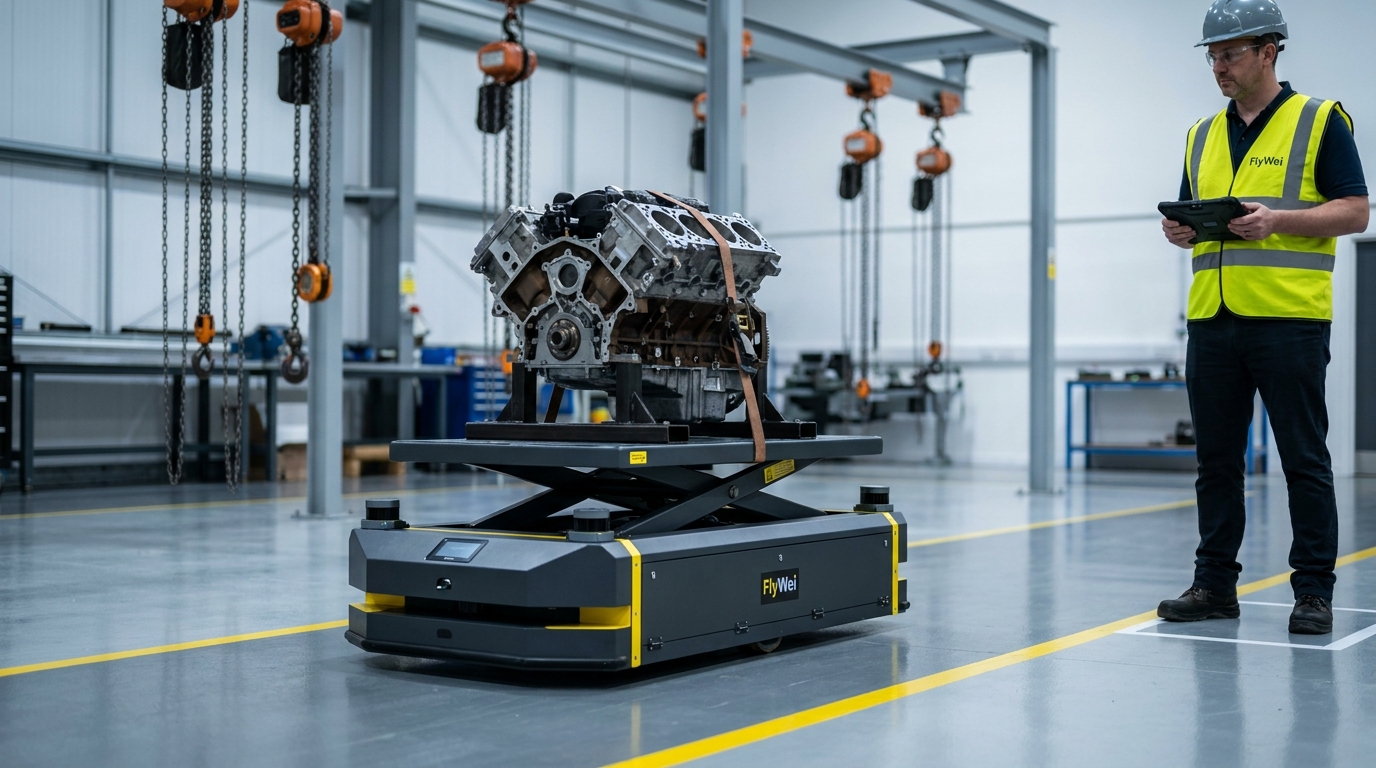
A heavy-lift AMR is an autonomous mobile robot designed to carry 800 kg to 2,000 kg payloads (engine blocks, transmission cases, motor castings) between machining cells, assembly stations and goods-out, without an operator, without overhead crane time, and without a forklift seat. The category is now formally codified by ISO 3691-4, the safety standard for driverless industrial trucks across the full 800 to 2,000 kg band that UK engineering plants typically run, so ops directors can specify against it the same way they would BS EN or ACOP L117 for manual fleets. For an operations director running a mid-sized UK engine or component plant in 2026, the operational pain is concrete: every shift, chain-hoist crews, kitting trolleys and manual forklifts contend for the same crowded aisle, takt-time pressure rises, and the recruitment pipeline for licensed truck operators shrinks again.
Why the chain-hoist and manual-forklift queue keeps growing
UK engineering plants (engine assembly, transmission, motor casting, aerospace component, heavy fabrication) share an inherited internal-logistics model that pre-dates autonomy. Sub-assemblies above the chain-hoist threshold moved by chain hoist or jib crane between machining cells. Mid-weight kits moved by hand-pump pallet trucks or counterbalance forklifts. Goods-in and goods-out handled by a separate truck pool with a licensed operator on every seat. The model worked when takt times were measured in minutes and labour was cheap. Neither is true in 2026.
Three pressures are now compounding inside the same aisle. First, the Provision and Use of Work Equipment Regulations 1998 (PUWER) and LOLER 1998 both impose continuing duties to control work-equipment risk and to inspect lifting operations: duties that get more expensive every time a hoist crew is asked to absorb extra cell-to-cell moves the line layout was not designed for. Second, the truck-driver pipeline in the UK has not recovered; Logistics UK tracks a persistent structural shortage of vocational drivers across its annual workforce reporting, and licensed forklift operators sit inside that same pipeline. Third, the engineering programme mix itself is changing: EV and downsized-ICE platforms have shorter run-lengths, more part variants, and tighter takt windows than the legacy V-engine programmes the existing fleet layout was sized for. Every aisle queue is now a takt penalty.
A heavy-lift AMR collapses two of those three pressures at once: it removes the hoist crew from cell-to-cell moves and removes the operator from the truck. The third pressure, programme variability, is solved at the orchestration layer, not at the robot.
The four levers that fix it
1. Operational: sequence internal moves around takt, not around hoist availability
The single largest gain from a heavy-lift AMR fleet is not the hardware. It is the right to plan internal moves around the line's takt window instead of around when the hoist crew is free. In a manual plant, cell-to-cell moves get batched because every hoist cycle costs a setup and every counterbalance move costs a licensed operator's time. In an orchestrated plant, moves get sequenced one-at-a-time, immediately when the cell finishes, because the robot's marginal cost per move is near-zero. That single change typically recovers a meaningful share of the line's takt budget without any other intervention.
The practical pre-work for an ops director is a takt audit before any robot lands. Map every internal move heavier than the chain-hoist threshold by frequency, by cell pair, and by current dwell-time-in-queue. Most of that queue is the prize. The remainder is usually hoist-only work that AMRs should not touch: overhead lifts above the robot envelope, fragile machined surfaces that need crane slings, or short-cycle distances where a human kitter is still faster. Being honest about that upfront protects the safety case and stops the ROI model over-promising.
2. Technical: a VDA 5050-compliant fleet brain, not a robot island
A single heavy-lift AMR on a fixed path is a glorified conveyor. A fleet of mixed-class robots (heavy-lift for engine sub-assemblies, latent-jacking AMRs for sub-assembly trolleys, autonomous pallet trucks for goods-in) sharing a single floor needs a fleet manager. FlyWei's M4 fleet manager orchestrates that mixed fleet against a VDA 5050-compliant interface, so the plant is not locked to one robot vendor and the existing WMS sees one move queue, not five.
The orchestration brain is also where the takt-window discipline lives. The fleet manager holds the priority rules (engine-block moves preempt kitting moves, goods-out preempts goods-in when the trailer is on the dock, fault recovery routes around a blocked aisle) so the line keeps moving without an operator standing over the screen. The robot is the easy part to buy. The fleet brain is what an ops director needs to specify hardest.
3. Regulatory: build the PUWER, ISO 3691-4 and LOLER safety case before Day 1
Heavy-lift AMRs are work equipment. They sit inside HSE's PUWER framework and, the moment they integrate with any lifting interface (cell tooling, jigs, scissor-lift handover stations) the LOLER inspection regime applies too. The safest path for a UK ops director is to specify against ISO 3691-4 in the tender document, write the PUWER risk assessment and the LOLER thorough-examination schedule before robot delivery, and rehearse the supervisor protocol on a chalked-out floor before any pallet moves.
Built this way, the safety case becomes a sales document for the next phase of the rollout rather than a compliance afterthought. The HSE auditor sees an ops director who specified to ISO 3691-4 from the tender stage, a LOLER schedule that pre-dates the lifting subsystem's commissioning, and a supervisor protocol rehearsed before Go-Live. That sequencing is also what unlocks insurer comfort on the project, without it, the premium loading on an autonomous fleet can eat most of the labour-line saving.
4. Commercial: tie the fleet to the existing ERP and WMS, not a bolt-on island
The fastest way to kill an AMR project after Year 1 is to leave it as a standalone island that the operator's existing ERP and enterprise WMS do not see. Heavy-lift AMR moves should appear as the same kind of transaction object the ERP already handles for manual moves (same order numbers, same kitting bills, same goods-out events) so finance, maintenance, and capacity planning all see the same throughput in the same tool.
The orchestration layer (M4 fleet manager and FlyWei's fleet dispatch) is what makes that integration tractable on the plant's existing stack. The integration usually sits on the WMS-to-fleet boundary, a thin transactional bridge, rather than a deep rewrite of either system. That keeps the operator's existing ERP unchanged, keeps the WMS upgrade path open, and means the robotics rollout is not caught in a parallel ERP programme it cannot afford to wait for.
| Internal-move workload | Manual hoist and counterbalance | Orchestrated heavy-lift AMR fleet |
|---|---|---|
| 800 to 2,000 kg cell-to-cell moves | Hoist crew plus licensed operator | Heavy-lift AMR, supervised |
| Takt-window response | Batched; multi-minute queue | Single-move; near-immediate dispatch |
| Operator licence overhead | Per truck, per shift | Supervisor only |
| PUWER and LOLER inspection burden | Per device, per cycle | Per fleet, scheduled |
| WMS visibility of moves | Paper kitting sheets | Real-time, orchestrated |
A heavy-lift AMR moves 800 to 2,000 kg engine sub-assemblies between machining cells without an operator and without overhead crane time: the orchestration layer is what turns that into plant-wide throughput.
What FlyWei does here
FlyWei supplies and integrates the heavy-lift AMR layer for UK engineering plants. The hardware sits across two classes: FlyWei autonomous counterbalance forklifts handle the 1.5 to 2 t palletised moves between goods-in, machining cells and goods-out, and FlyWei heavy-lift AMRs handle the 800 to 2,000 kg cell-to-cell sub-assembly moves that used to belong to the hoist crew. Both run under the same M4 fleet manager and the same fleet dispatch layer, so the plant is not stitching together two robot vendors' islands.
The integration starts with the takt audit, not the procurement. FlyWei's engineering team works with the ops director and the plant's safety lead to map the move profile, write the PUWER risk assessment, scope the LOLER thorough-examination schedule, and rehearse the supervisor protocol on a chalked floor before the first AMR ships. That sequencing means the ISO 3691-4 safety case is documented before Day 1, the WMS integration is signed off before commissioning, and the rollout's second-phase scope is already written by the time the first phase goes live. Talk through your plant's move profile with FlyWei and the team will return a takt-audit-ready scope inside two weeks.
Frequently asked questions
What payload class qualifies as a heavy-lift AMR?
In UK engineering practice, heavy-lift AMR covers 800 to 2,000 kg payloads: engine blocks, transmission cases, motor castings, gearbox housings, large fabrications. Below 800 kg, latent-jacking AMRs and tugger AMRs are usually a better fit. Above 2,000 kg, the work belongs to an autonomous counterbalance forklift specified to ISO 3691-4.
Does PUWER still apply to driverless trucks?
Yes. PUWER applies to all work equipment regardless of operator presence. A driverless truck is still work equipment, the duty-holder is still the employer, and the assessment, inspection and maintenance duties still apply. ISO 3691-4 is the safety-of-design standard; PUWER is the in-service duty. Both need to be on the documentation set before Go-Live.
What about LOLER if the AMR has a scissor-lift?
If the AMR raises a load, for example a scissor-lift mechanism that lifts engine sub-assemblies onto a cell tool, then LOLER's thorough-examination regime applies to that lifting function. The safest approach is to register the lifting subsystem in the LOLER schedule from Day 1 and inspect it on the standard six- or twelve-month cycle, the same way you would a workshop crane.
Can a heavy-lift AMR work safely on a mixed shop floor with operators on foot?
Yes: that is the standard operating context. ISO 3691-4 sets the detection, stopping and supervision requirements, and HSE workplace-transport guidance covers the segregation and signage approach. The supervisor protocol, typically one supervisor across multiple robots, and chalked safety zones during commissioning are what make it work in practice.
How long does a deployment take from contract to first orchestrated move?
For a mid-sized UK engineering plant, a phased rollout with takt audit, safety-case write-up, M4 fleet integration and first-cell commissioning typically lands inside a 12 to 16 week window. Adding a second or third cell after that is materially faster because the orchestration layer and safety case are already in place.
What payback window should an ops director plan for?
Most mid-sized UK engineering plants see payback within two to three years once the kitting layer, machining-cell feed and goods-out are all on the orchestrated fleet rather than the manual hoist-and-truck model. The biggest single driver is not the labour line: it is the takt-time recovery from removing the queue.
Will the heavy-lift AMR fleet integrate with my existing ERP and WMS?
The orchestration layer (M4 fleet manager and fleet dispatch) is built to expose moves as transactions the plant's existing ERP and enterprise WMS already understand: kitting numbers, goods-out events, maintenance work orders. The integration usually sits on the WMS-to-fleet boundary rather than rewriting either system.
Talk to FlyWei about specifying a heavy-lift AMR fleet against ISO 3691-4 and PUWER for your UK engineering plant.