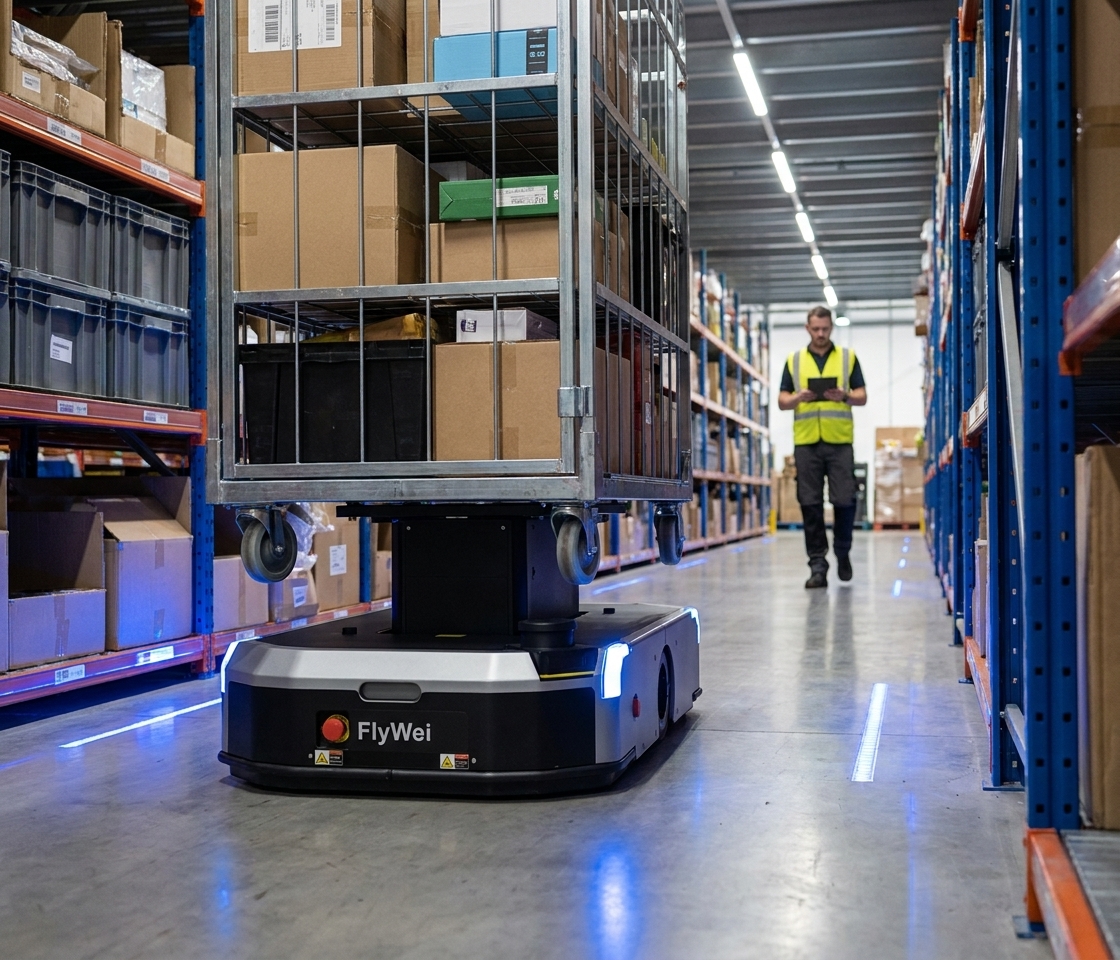
Humanoid robots vs AMR warehouse strategy is the 2026 capex choice between general-purpose bipedal machines, which remain in vendor pilots and currently hold no notified-body certification to ISO 3691-4, and purpose-built autonomous mobile robots, which already move pallets, totes and trolleys inside live UK e-commerce distribution centres and have shipped under PUWER 1998 duty-of-care for over five years. Nearly 30 fatal workplace-transport injuries are recorded across UK industry each year by HSE data, against the long-running FLT licence-holder shortage tracked by Logistics UK, together pushing warehouse automation to the top of every 2027 capex agenda. For an e-commerce Operations Director, the practical question is no longer should we automate, but do we hold back twelve months because a humanoid demo went viral, or do we commit now to purpose-built AMRs that already certify under PUWER 1998 and ISO 3691-4? That single timing decision now sits on every UK fulfilment Ops Director's Q3 risk register.
Why the humanoid-vs-AMR question is on every UK Ops Director's desk
Three structural forces have collapsed onto the same 2026 budget cycle. The UK warehouse labour pool has not recovered to pre-2023 levels, and HSE Workplace Transport casework continues to log lifting and load-shift events as a leading source of major-injury reports on UK fulfilment sites. The CFO sees a step-change in agency rates against a step-change in claims, and asks why the DC is not yet automated. At the same time, every general-tech publication has run a humanoid-walking video, so the same board is now asking whether the cheque about to be signed for an AMR fleet should be held back until the robot from the demo is available.
The honest answer, which sits inside the Operations Director's chair and not the CFO's, is that the demo robot does not yet move a pallet under load in a Magna Park aisle at three o'clock in the morning. Purpose-built autonomous mobile robots do. The harder question is therefore not whether humanoids will eventually matter — most UK warehouse engineers expect they will, in narrow tasks, on a multi-year horizon — but whether deferring the 2026 AMR programme to wait for them is a defendable use of the next twelve months of operating margin. For UK e-commerce fulfilment, the maths and the regulation say no.
The four levers that get the Ops Director to a defendable decision
Operational lever: decompose the missions before you decompose the robots
The single most common error in an automation business case is to compare humanoid against AMR as though they were two interchangeable solutions to one mission. They are not. A typical UK e-commerce DC runs roughly eight distinct robot-shaped missions: inbound pallet to reserve, replenishment from reserve to forward pick, tote conveyance to a packbench, returns flow back to grading, mezzanine put-away, rack maintenance, dock-door staging and yard moves. Roughly seven of those eight are pallet-shaped or tote-shaped — they want a flat deck under load, a stable jacking column or a reach mast, and they want it for ten or twelve hours per shift. None of them needs a hand. The eighth — single-item human-replacement picking from mixed-SKU shelves — is the only mission a humanoid arguably wins, and even there the current generation is slower than a tote-to-person AMR paired with a human at the packbench. Mapping the eight missions before sizing capex turns the humanoid-vs-AMR question into a budget allocation, not a vendor bake-off.
Technical lever: fleet orchestration so today's decision does not constrain tomorrow's
The fear behind the wait twelve months instinct is buying a closed AMR fleet that cannot accept new robot classes later. That risk is real if the operator commits to a single-vendor closed stack — and the orchestration layer is the lever that defuses it. FlyWei M4 is a robot-class-agnostic fleet manager that speaks VDA 5050 to any compliant robot, so the same site that runs purpose-built autonomous forklifts and AMRs today can dispatch a humanoid pilot in 2027 or 2028 without re-cabling the WMS. RDS handles the live dispatch logic — which mission goes to which robot, given current battery, traffic and SLA — and treats robot body as a swap-in attribute, not a hard constraint. A site that puts M4 and RDS down first treats the choice of robot body as a portfolio decision, not a one-shot bet. This is the lever that lets a UK board commit to AMR capex in 2026 without losing the option on humanoids in 2028.
Regulatory lever: only one of the two options certifies today
No humanoid robot ships with a notified-body assessment to ISO 3691-4, the safety standard for autonomous industrial trucks, in 2026. Purpose-built AMRs and autonomous forklifts do. The same is true for PUWER 1998 duty-of-care, LOLER 1998 for any lifting duty above ground level, and the BS EN 1525 transition into ISO 3691-4. A UK Operations Director who deploys a humanoid in a live warehouse aisle this year is signing a PUWER risk assessment with no precedent and no harmonised standard behind it. Insurers know this. Capex committees know this. The regulatory lever, in other words, does not just favour purpose-built AMRs on safety — it favours them on insurability, on duty-holder defensibility, and on the willingness of the HSE inspector to walk away after a routine site visit. That is not an academic distinction in a year when workplace transport sits near the top of the casework league table.
Commercial lever: the cost of waiting twelve months
A 100,000 sqft UK e-commerce DC carrying four forklift drivers and two pickers per shift across two shifts loses roughly £180,000 to £260,000 per year in labour cost to manual pallet flow alone, before agency premiums and absence cover. A four-vehicle FlyWei autonomous pallet-truck deployment under a 3, 5 or 7-year full-service lease typically clears the operating-cost crossover inside year one. Holding back the programme for the next robot generation therefore costs a Tier-2 UK fulfilment operator roughly the price of two pallet-truck AMRs in deferred savings — without buying back any of the regulatory or insurability ground above. The commercial lever, like the regulatory lever, points in the same direction: capex now on what certifies, and preserve optionality for what does not.
No humanoid robot holds notified-body certification to ISO 3691-4 for autonomous industrial truck duties in a UK warehouse in 2026; purpose-built AMRs and autonomous forklifts have shipped under PUWER 1998 duty-of-care for over five years.
Humanoid pilots vs purpose-built AMR fleets — the screenshot-this table
| Decision dimension | Humanoid robot (2026 pilot) | Purpose-built AMR or autonomous forklift |
|---|---|---|
| UK certification path | None to ISO 3691-4; no harmonised PUWER precedent | ISO 3691-4 plus PUWER and LOLER, established |
| Realistic mission today | Single-item picking demos, mixed-SKU shelves | Pallet, tote, replenishment, dock-to-stock, mezz put-away |
| Indicative payback, 100k sqft DC | None — pilot only, no SLA | 12 to 22 months, full-service leased |
| Hours per 24h on duty | 1 to 4 hours in scripted demos | 20 to 22 hours autonomous, charge-and-go |
| Lock-in if fleet manager is VDA 5050 | Pilot can join fleet later, no rip-and-replace | Mission portable to humanoid classes when ready |
| Insurability and HSE defensibility | Bespoke risk assessment, no peer precedent | Industry-standard PUWER file, peer benchmark |
| Implied capex risk profile | Pilot budget, expected to be re-spent | Operating-cost crossover inside year one |
What FlyWei does here
FlyWei designs, supplies and integrates purpose-built autonomous fleets for UK e-commerce fulfilment sites that need to move pallets, totes and trolleys in 2026 — not in 2028. The product stack covers the realistic mission set head-on: autonomous forklifts in counterbalanced, pallet-truck and reach-truck variants for pallet inbound, replenishment and put-away; lifting robots and AMRs for tote, sub-assembly and goods-to-person work; and the M4 fleet manager plus RDS dispatch layer that makes a mixed fleet behave as one system. Crucially, M4 speaks VDA 5050, so an Operations Director who commits to AMR capex now does not foreclose the option to add a humanoid pilot in 2027 or 2028 — the same orchestration layer simply dispatches a new robot class onto missions it can win. UK-based application engineers run the PUWER, LOLER and ISO 3691-4 paperwork end-to-end, a site survey takes around 30 minutes, and a 3, 5 or 7-year full-service lease lets the operating budget — not the capex committee — carry the run cost. The Operations Director who chooses purpose-built AMRs today does not lose the humanoid option tomorrow; they keep it, on their orchestration terms.
Frequently asked questions
Will humanoid robots replace AMRs in UK warehouses by 2028?
No credible analyst forecast has humanoid robots displacing purpose-built AMRs as the dominant pallet- or tote-moving class on a 2028 horizon. The realistic case is hybrid: humanoids in narrow single-item picking tasks, AMRs and autonomous forklifts for pallet, tote, replenishment, and dock-to-stock flow.
Is it safer to wait for humanoids before automating a UK DC?
It is not safer. PUWER and ISO 3691-4 give a duty-holder a defensible certification path for purpose-built AMRs today; humanoid deployments inside a live UK warehouse aisle currently carry a bespoke and unprecedented risk-assessment burden.
Which missions in an e-commerce DC suit purpose-built AMRs?
Pallet inbound to reserve, replenishment from reserve to forward pick, tote conveyance to packbench, returns flow back to grading, mezzanine put-away, dock-door staging and yard moves — roughly seven of the eight robot-shaped missions on a typical UK fulfilment site.
Which missions might humanoids eventually win?
Single-item human-replacement picking from mixed-SKU shelves is the most-cited candidate, where a bipedal form factor matches a shelf-and-bin environment designed for humans. Even there, current pick rates trail tote-to-person AMRs paired with a human at the packbench.
Does buying AMRs now lock me out of humanoid robots later?
Not if the orchestration layer is robot-class-agnostic. FlyWei M4 uses VDA 5050, so a compliant humanoid pilot in 2027 or 2028 can join the existing fleet without re-cabling the WMS or rebuilding the dispatch logic in RDS.
What is a realistic payback for a UK e-commerce AMR programme in 2026?
A four-vehicle autonomous pallet-truck deployment on a 100,000 sqft UK DC, under a 3, 5 or 7-year full-service lease, typically clears the operating-cost crossover inside year one, with full payback inside 12 to 22 months depending on shift pattern.
How long does a feasibility read take?
A FlyWei UK application engineer can complete a 30-minute on-site survey and return a 48-hour feasibility note covering mission map, vehicle count, PUWER risk profile and indicative lease cost. Book one via the contact page.
If the humanoid-vs-AMR question is sitting on your Q3 capex risk register, the cheapest way to make it a decision rather than a debate is to put a UK engineer in front of your DC for half an hour.
Book a free 30-minute site survey with a UK-based FlyWei application engineer, or read more about the autonomous forklift product range that already handles the pallet and put-away missions inside today's UK e-commerce fulfilment centres.
UK-based engineers · no obligation · reply within one business day.