Industrial robot servicing is the scheduled and reactive maintenance regime that keeps an autonomous forklift or AMR fleet safe, compliant and productive across its working life — covering firmware updates, LiDAR calibration, drive-train inspection, battery health checks and functional-safety recertification. Under PUWER 1998 regulation 5 (legislation.gov.uk), that upkeep is a legal duty on the operator, not a nice-to-have. For a UK engineering ops director running a mixed fleet of counterbalanced autonomous forklifts, reach trucks and latent-jacking AMRs across a heavy-industrial DC, the everyday pain shows up as a five-to-ten-day lead-time on a non-standard spare, an out-of-hours callout no one can staff, or an SLA the vendor honours in San Diego but not in Sunderland. Each of those is a throughput hit that lands on your OEE plan long before it lands on the safety file, and it is what an industrial robot servicing programme has to solve first.
In the UK, industrial robot servicing on an autonomous forklift is a legal duty under PUWER 1998 regulation 5, which obliges the operator to keep the equipment in efficient working order and good repair throughout its working life — not a discretionary maintenance choice.
Why the UK engineering DC service model breaks down
A brownfield engineering distribution centre — a Tier-1 automotive parts hub near Daventry, an engine-component satellite around Burton-on-Trent, or a heavy-industrial spares warehouse in the Magna Park cluster — rarely fails at the robot. It fails at everything wrapped around the robot. Four causes recur.
Captive OEM contracts with a thin UK service arm. Fleets acquired via a global OEM often route service through a national partner network. When that network is dense in Bavaria or California and thin in the English Midlands, the SLA on paper diverges sharply from the SLA in practice. The HSE does not care where the engineer flew in from (hse.gov.uk); the ops director does.
Non-standard spares with unforgiving lead-times. Bespoke lift attachments, jacking modules, safety laser scanners and drive-wheel assemblies are not stocked on a UK shelf by default. A five-to-ten-day air-freight lead-time is the norm and a sea-freight backlog stretches it further. Every hour that spare is in transit is a truck standing on the epoxy floor.
Cross-trained UK labour is scarce. Engineers who can safely certify both a mechanical lift path and a functional-safety controller are a small population; Logistics UK and the wider industry have flagged the skills shortage for years. Vendors that rely on the operator sending someone for level-two intervention move the labour problem, not the labour cost.
Walled-garden fleet managers. Every OEM ships its own dashboard, so an ops team with two brands sees two truths. Without a common view — ideally standardised on VDA 5050 messaging so any fleet manager can talk to any robot — the service team cannot see faults developing, cannot predict them, and cannot ship the right part before it is asked for.
The four levers that fix industrial robot servicing
None of these levers are radical. They are the operational, technical, regulatory and commercial disciplines a mature UK engineering programme applies to every other class of asset — press lines, overhead cranes, roller conveyors — applied to the autonomous forklift and AMR fleet.
1. Operational lever: a four-tier service cadence
The single highest-leverage change is codifying the service cadence the fleet actually needs, then evidencing it. A workable UK model runs on four tiers: daily supervisor checks (visual, LiDAR window, safety-scanner cover, wheel condition — recorded on a tablet), weekly technician round (drive-train, battery cycle log, alignment, firmware version audit), quarterly deep service (lift-chain, hydraulic seals, sensor recalibration, comms stack), and an annual functional-safety recertification tied to ISO 3691-4 clauses on driverless industrial trucks (iso.org). Every check goes into a maintenance file that would satisfy a PUWER inspection without a scramble. That evidence trail is the same discipline the HSE (gov.uk) applies to any other lifting equipment on the site, so it lands cleanly with the safety team as well as engineering.
2. Technical lever: telemetry, remote diagnostics and VDA 5050
A servicing regime built on annual paperwork alone is a lagging indicator. The technical lever is real-time: a fleet manager streaming battery temperature, motor current, LiDAR return quality and fault codes off every robot into one pane. Predictive-maintenance rules — SoC drift 8% over the last 40 cycles flags for a capacity test — fire tickets before the truck stands down. A dispatch layer (a modern RDS-style service handles cross-brand messaging via VDA 5050) then routes the ticket to the nearest qualified engineer with the right spare loaded in the van. That is how a UK fleet shrinks mean-time-to-repair from hours to under one, and it is what the operational cadence above needs to be sustainable at scale.
3. Regulatory lever: PUWER, LOLER and ISO 3691-4
Three duties overlap on any autonomous forklift. PUWER 1998 regulation 5 requires equipment be maintained in efficient working order and good repair throughout its working life (legislation.gov.uk). LOLER 1998 layers thorough examinations on the lifting components — forks, chains, mast — at defined intervals (legislation.gov.uk). ISO 3691-4 sets the functional-safety expectations specific to driverless industrial trucks, supported by BSI guidance for UK operators (bsigroup.com). A UK engineering ops director building a servicing spec should name all three in the contract, with the vendor accountable for the parts they control (safety-rated controllers, laser scanners) and the operator accountable for the daily and weekly checks. Blur that line and the enforcement risk goes to the operator every time, because PUWER is a duty on the person in control of the work equipment.
4. Commercial lever: service SLA and full-service leasing
The commercial lever is where most fleets bleed hours. A reasonable spec has three numbers on the front page: 4-hour remote-diagnostic response, next-business-day on-site attendance in mainland UK, and a stocked-in-country parts pool covering more than 90% of ticketed faults on a documented consumables list. Anything softer than that is not a UK-grade servicing contract for a productive fleet. Full-service leasing — 3, 5 and 7-year terms — folds all of this into the monthly rate, so servicing stops being a capex negotiation every twelve months and starts being a fixed operating cost the finance team can plan around.
| Model | Response time | UK parts stock | Compliance evidence | Typical annual cost profile |
|---|---|---|---|---|
| Ad-hoc callout, no contract | 3–10 days | None; freight per job | Operator scrambles pre-inspection | Lowest headline, highest total (downtime) |
| OEM basic service contract | 48–72h on-site | Central EU shelf | Vendor supplies certificates ad hoc | Mid; parts often outside cover |
| UK-led managed service SLA | 4h remote / NBD on-site | Stocked in-country pool | Rolling PUWER + LOLER file | Predictable; tied to uptime target |
| Full-service leasing (3/5/7-year) | 4h remote / NBD on-site | Included in the rate | Included, audited each anniversary | Single monthly line, opex |
What FlyWei does here
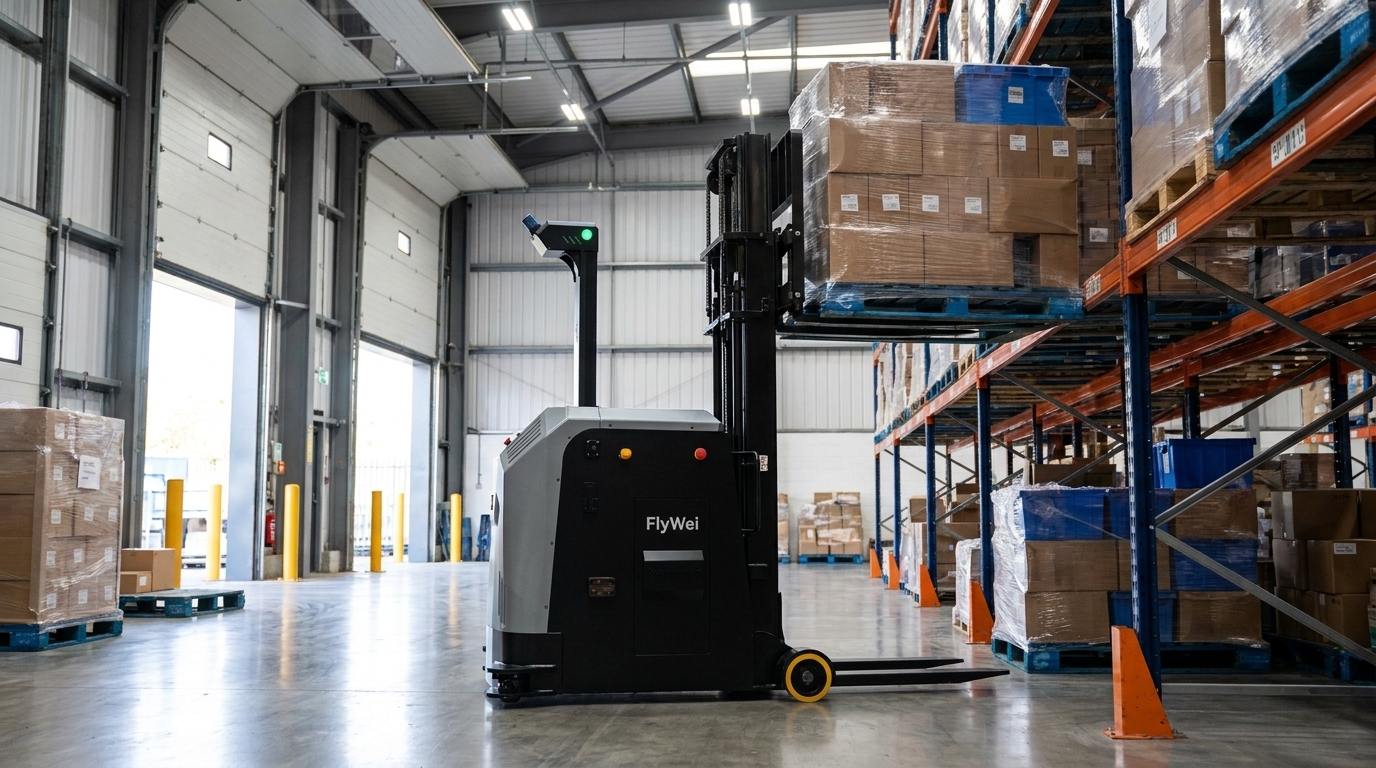
FlyWei designs and integrates the autonomous forklift and AMR fleets this servicing regime is built for, and runs a UK-based engineering team that delivers the four-tier cadence itself. Counterbalanced autonomous forklifts, reach trucks, stacker trucks, latent-jacking AMRs and heavy-lift scissor AMRs are supplied under a common technology platform, so a single maintenance file, a single fleet-manager pane and a single dispatch process cover the whole mixed fleet.
The M4 fleet manager streams telemetry off every robot: battery state-of-charge trend, motor current, LiDAR return quality, safety-scanner status and mission timing. RDS robot dispatch takes tickets from M4 and routes them — via VDA 5050 messaging where the operator already runs a mixed-vendor floor — to the right engineer with the right part loaded. Spares for the FlyWei autonomous forklift platform (drive wheels, laser scanners, safety controllers, jacking modules) are stocked in the UK, so a five-to-ten-day air-freight window collapses to a next-business-day dispatch.
For engineering ops directors weighing capex against opex, FlyWei full-service leasing (3, 5 and 7-year terms) bundles the machine, the M4 licence, the four-tier industrial robot servicing cadence and the parts pool into a single monthly line — turning a discretionary maintenance conversation into a fixed operating cost with a stated uptime SLA behind it. Cross-industry context sits under FlyWei solutions for engineering, drinks, cold chain and pharma DCs.
Industrial robot servicing FAQ
What is industrial robot servicing on an autonomous forklift?
The combined scheduled and reactive maintenance programme for the mechanical, electrical, software and functional-safety components of an autonomous forklift or AMR — daily visual checks through firmware updates, LiDAR calibration and annual safety-controller recertification.
Is industrial robot servicing a legal requirement in the UK?
Yes. PUWER 1998 regulation 5 places a legal duty on the employer to keep work equipment in efficient working order and good repair throughout its working life. LOLER 1998 adds a duty of thorough examination on lifting components at defined intervals.
How often should an autonomous forklift be serviced?
A workable UK cadence is four-tier: daily supervisor checks, a weekly technician round, a quarterly deep service and an annual functional-safety recertification aligned to ISO 3691-4. Two- and three-shift duty cycles may compress the quarterly interval.
What SLA should a UK engineering DC demand from a robot vendor?
Three numbers on the front page: 4-hour remote diagnostic response, next-business-day on-site attendance in mainland UK, and an in-country parts pool covering the documented consumables list. Anything softer is not a UK-grade servicing contract for a productive fleet.
Does full-service leasing include industrial robot servicing?
With FlyWei full-service leasing (3, 5 and 7-year terms) it does — the four-tier cadence, spares, M4 fleet-manager licence and annual functional-safety recertification are folded into a single monthly rate, so servicing becomes a fixed opex line rather than a capex negotiation every twelve months.
Who is qualified to service an autonomous forklift in the UK?
The person in control of the work equipment holds the PUWER duty, but competent technicians should hold both mechanical MHE credentials and functional-safety training aligned to ISO 3691-4. Vendors should evidence this competence in the service contract, not just assert it.
What is the difference between PUWER and LOLER servicing?
PUWER covers the whole machine as work equipment; LOLER covers the lifting components specifically (forks, chains, mast) with mandatory thorough examinations at set intervals. Both apply to an autonomous forklift and should be scheduled together in the maintenance file.
If unplanned robot downtime is quietly shaving three points off your Q3 OEE plan, the fix is a servicing model built for how UK engineering DCs actually run — not an SLA templated in another timezone.
Book a free 30-minute site survey with a FlyWei UK engineer, or go straight to the fleet we service and lease at FlyWei autonomous forklifts. UK-based engineers · no obligation · reply within one business day.