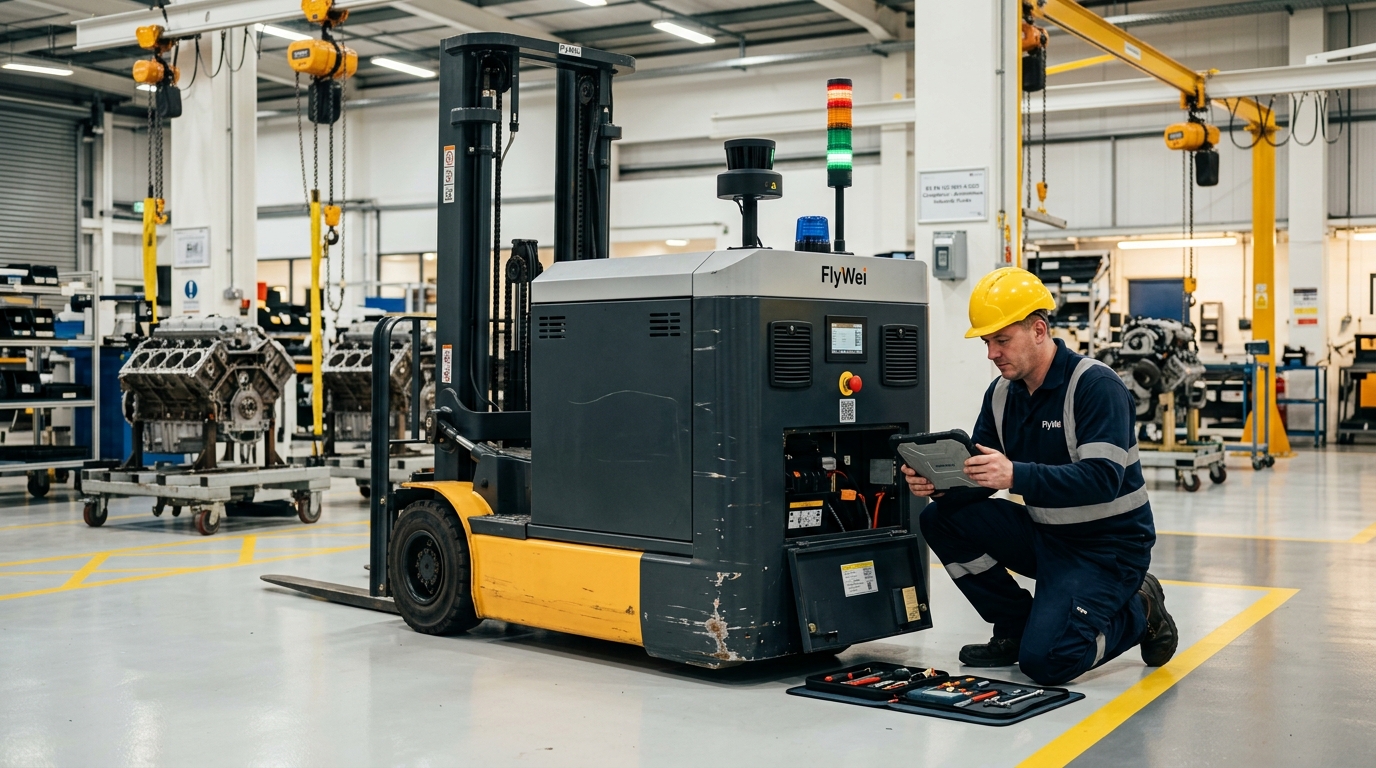
Industrial robot servicing is the structured discipline of keeping autonomous forklifts, AMRs and lifting robots running to spec, covering preventive checks, remote diagnostics, spares logistics and a binding service-level agreement. For a UK engineering plant moving engine sub-assemblies, transmission cases or chassis parts across a 24/5 shift, a single robot hour lost can cascade into a missed line-side delivery. Under PUWER 1998, every autonomous forklift in a UK engineering plant must be kept in efficient working order and inspected on a planned schedule: a duty that sits with the operator, not the vendor, per HSE guidance on work equipment. The HSE also treats powered industrial trucks as one of the highest-risk pieces of work equipment in British industry. Warehouse managers at UK engineering sites tell us the buying decision is rarely the bottleneck; the aftercare model (slow spares, a vague SLA, no remote diagnostics) turns a £180,000 autonomous forklift into a costly science project.
Why aftercare breaks in UK engineering warehouses
UK engineering plants (engine assembly, drivetrain, casting, forging, off-highway equipment) have always lived with a brutal cost of downtime. A paused engine line at Burton-on-Trent or a Coventry transmission cell can burn through five-figure cost-of-quality before the shift handover. Autonomous forklifts and heavy-lift AMRs were supposed to take a chunk of that risk away: predictable cycle times, no driver shortage, no near-miss with a pedestrian. In practice, three forces conspire against the warehouse manager.
First, the procurement conversation is dominated by the headline machine. The chassis, the LiDAR stack, the payload rating, the ROI deck. Aftercare gets ten minutes at the end of a four-hour pitch, and the contract that ships into legal review carries vague language: "best-effort response", "next-available engineer", "subject to parts availability". None of that maps to a PUWER inspection schedule, and none of it survives a Tuesday-morning fault on a critical line.
Second, the spares chain is built around overseas central warehousing. A drive motor, a steer encoder, a load-handling proximity switch, common-failure items, are often pulled from a single European hub. A 48-hour air-freight is presented as quick service. For an engineering plant on tight Just-In-Sequence delivery to the line, 48 hours is a production catastrophe.
Third, the data is locked up. Without a proper telemetry feed into a fleet manager, the operator cannot tell a battery-conditioning event from a degrading motor bearing, and neither can the service contractor. Faults get diagnosed in the aisle, with the truck cold, by an engineer who arrived twelve hours after the line stopped. Logistics UK has repeatedly flagged maintenance literacy as a sector-wide skills gap; engineering warehouses feel it acutely.
The four levers that fix industrial robot servicing in UK engineering plants
Lever 1: Rewrite the SLA around line-side uptime, not engineer attendance (operational)
The single most expensive clause in most autonomous-forklift service agreements is the response-time clause: measured in hours from fault ticket to engineer arrival. It rewards the wrong behaviour. A warehouse manager does not need an engineer on site; they need the machine moving. Replace attendance-time with a fleet-uptime guarantee: a percentage of scheduled production hours that the contracted fleet must be available for tasking, with credits applied per percentage point missed and a cap on rolling monthly downtime. Bake in a maximum number of consecutive lost shift hours per truck before an escalation clock starts. Define how planned PM time is excluded, it should be, but cap PM windows so the contractor cannot pad them. Insist on a quarterly service review at director level. The contract becomes operational, not theatrical, and the conversation each quarter is about real fleet performance.
Lever 2: Demand a telemetry-first remote diagnostics stack (technical)
Every fault that can be diagnosed from a screen instead of an aisle is a fault that resolves faster. A modern autonomous-forklift fleet should publish granular telemetry (battery state-of-health, motor temperature, error codes, mission completion ratios, near-miss events) to a fleet manager such as FlyWei's M4, with a robot-dispatch layer like fleet dispatch software orchestrating task hand-off. From the warehouse manager's desk, a degrading drive bearing should generate a maintenance ticket two weeks before it becomes a fault. A VDA 5050 fleet-control layer makes the integration vendor-neutral, so the operator is not held hostage if a robot variant is swapped. Insist on an open API to the plant's CMMS so PM jobs flow into the work-order system. This is the single highest-leverage technical investment in an autonomous-fleet contract, and it shows up in mean-time-to-repair numbers within a quarter.
Lever 3: Anchor the PM schedule on PUWER and ISO 3691-4 (regulatory)
British engineering operations are PUWER duty-holders for every powered industrial truck on the floor, autonomous or not. PUWER 1998 requires planned preventive maintenance, competent-person inspection and a clear evidence trail. ISO 3691-4 sets the safety design baseline for driverless industrial trucks, including periodic verification of safety-rated sensors and emergency-stop circuits. ACOP L117 and the HSE workplace-transport pages spell out the inspection cadence. The service contract should explicitly cite these documents, schedule the inspections to align with them, and produce a paperless evidence pack: accessible to the SHEQ team and auditable by the HSE if asked. The warehouse manager who treats PUWER as the spine of the PM contract avoids the failure mode where compliance and reliability are run as separate workstreams.
Lever 4: Pool spares regionally, not per-site (commercial)
An engineering plant in Daventry should not be waiting for a steer encoder from Hamburg. The spares model that works for UK engineering is a regional spares pool: a managed cache of high-failure-rate items held within a four-hour van drive of the cluster of customer sites it serves. The Midlands engineering corridor, including Magna Park, DIRFT and SEGRO East Midlands Gateway, is dense enough to make this economic for any vendor running more than fifteen trucks in the region. Negotiate spares-pool access into the SLA, with a guaranteed first-call inventory list. Pair it with a small on-site consignment of true wear items (castor wheels, fork sensors, charging contactors) and the eight-hour fault becomes a forty-minute swap. The commercial pattern is straightforward: ring-fence the cost in the SLA, then charge it back to consumption.
What FlyWei does here
FlyWei supplies, integrates and services autonomous-fleet solutions for UK engineering plants: from autonomous forklifts moving engine blocks and transmission cases, through heavy-lift AMRs handling sub-assemblies, to the lifting robots that pick parts at line side. Every machine ships with a UK-resident service contract anchored on fleet uptime, not engineer attendance: the SLA is written in PUWER and ISO 3691-4 language, the PM schedule is publishable for HSE review, and the spares pool is held regionally so a Midlands plant gets a four-hour swap, not a 48-hour airfreight. Remote diagnostics run on the same M4 fleet manager the operations team uses for tasking: every fault that telemetry can pre-empt is opened as a PM ticket, not a production stop. FlyWei fleet dispatch software orchestrates task hand-off across mixed fleets so a single truck in PM does not strand the cell. FlyWei's UK engineers carry the BSI-aligned competent-person credentials, and the contract is a single throat to choke: no triangulation between platform vendor, integrator and aftercare contractor. Explore the full solutions catalogue for the engineering-plant configuration most teams start with.
"Under PUWER 1998, every autonomous forklift in a UK engineering plant must be kept in efficient working order and inspected on a planned schedule: a duty that sits with the operator, not the vendor."
Frequently asked questions
What is industrial robot servicing for autonomous forklifts in a UK engineering plant?
It is the integrated discipline of preventive maintenance, remote diagnostics, spares logistics and SLA management for the autonomous-fleet element of warehouse and lineside operations. Under PUWER 1998 and ISO 3691-4 it is the operator's legal duty, executed through a competent contractor.
How often should an autonomous forklift be inspected under PUWER?
HSE workplace-transport guidance points to planned preventive maintenance plus a competent-person inspection on a schedule justified by use intensity. Typical engineering-plant fleets run a daily pre-use check, a monthly inspection, and a thorough examination at least annually, with safety-system verification per ISO 3691-4.
What should the service-level agreement actually guarantee?
The SLA should guarantee a fleet-uptime percentage against scheduled production hours, with credits per percentage point missed, a cap on consecutive lost shift hours per truck, and named escalation timelines. Engineer attendance time alone is the wrong metric.
Why does remote diagnostics matter so much for engineering plants?
Because line-side delivery is unforgiving. Telemetry from the fleet manager turns a degrading bearing or sensor into a planned swap rather than a production-stopping fault, shrinking mean-time-to-repair from hours to minutes.
How should spares be located for a UK engineering operator?
Regionally. A spares pool sitting within a four-hour van drive of the Midlands engineering corridor (Daventry, Magna Park, DIRFT, SEGRO East Midlands Gateway) beats overseas air-freight every time. Pair it with a small on-site consignment of true wear items.
Who signs off on a competent-person inspection?
An engineer with the training, experience and independence required by PUWER and ACOP L117. The contract should name the qualification standard, typically BSI-aligned competent-person credentials, and require sign-off documentation accessible to the SHEQ team.
Can FlyWei service mixed fleets where some trucks are not FlyWei?
The M4 fleet manager and FlyWei fleet dispatch software use open interfaces (VDA 5050 where applicable) so a mixed-fleet operator can run the same uptime SLA across vehicles, though service depth varies by platform.
Ready to put PUWER-anchored servicing under your autonomous fleet? Talk to FlyWei: UK engineers, regional spares pool, fleet-uptime SLA, single throat to choke.