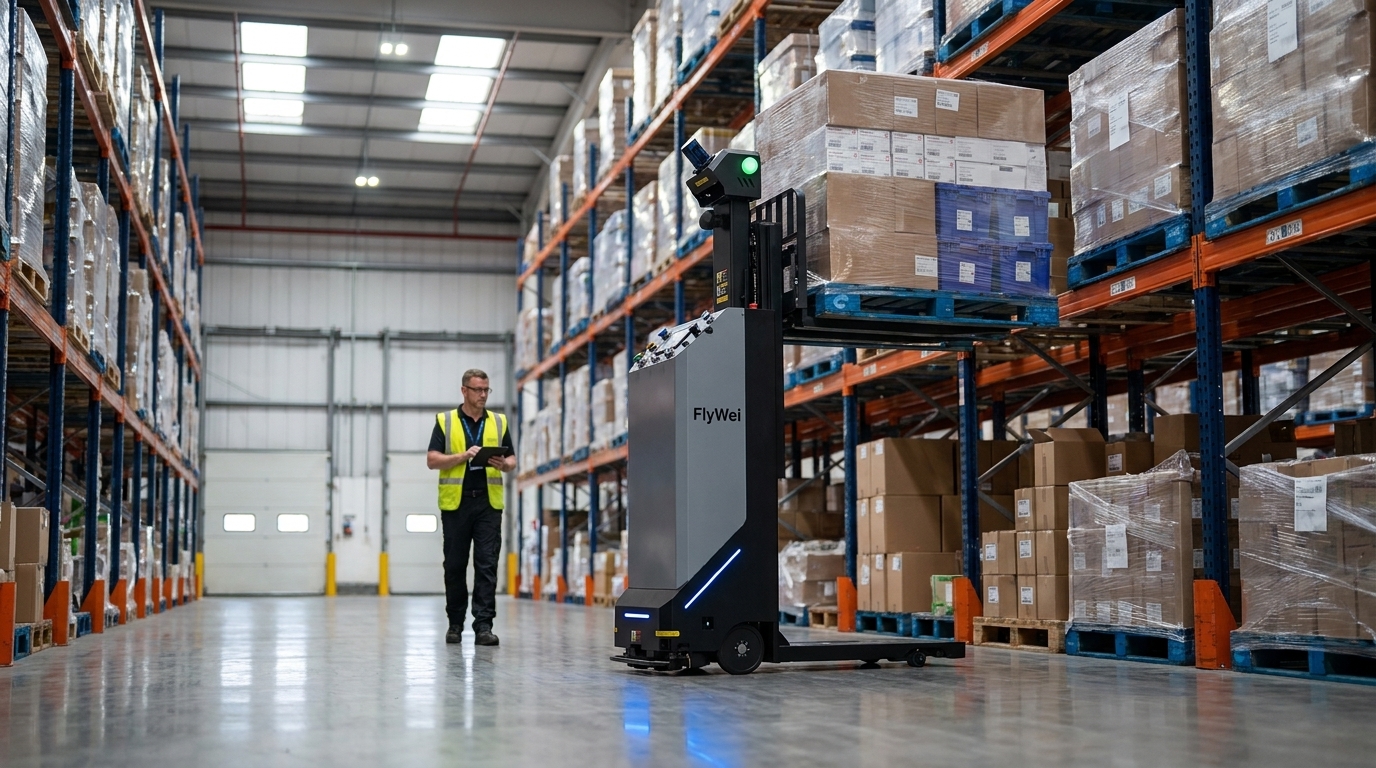
Industrial robot servicing is the disciplined programme of preventive maintenance, remote monitoring, spare-part rotation and rapid on-site response that keeps a fleet of autonomous forklifts, AMRs and lifting robots inside its uptime commitment. In UK pharmaceutical distribution, that discipline is not optional. The Health and Safety Executive records that workplace transport incidents cause around 14 fatalities and roughly 1,300 major injuries each year in Great Britain (HSE workplace transport statistics), and PUWER 1998 legally binds every warehouse manager to keep powered work equipment in efficient working order. For a Warehouse Manager running an MHRA-regulated distribution centre in Burton-on-Trent or the Magna Park pharmaceutical corridor, a robot fleet that misses a scheduled service window does more than dent throughput — it threatens the GDP audit trail. In that context, industrial robot servicing has to be treated as a compliance line, not a maintenance cost line.
Why unplanned robot downtime hits pharma warehouses harder
Pharmaceutical distribution has three operational realities that turn ordinary robot downtime into a compliance event. First, the MHRA Good Distribution Practice regime demands documented, contemporaneous evidence that temperature-controlled products remain within specification from goods-in to goods-out. Every hour a lifting robot sits idle in a chilled aisle is an hour when pallets either miss their pick window or leave the temperature envelope. Second, PUWER 1998 makes the employer — not the equipment supplier — the duty-holder for keeping powered work equipment in efficient working order. A vendor''s slow response does not shift that duty back. Third, the mix in a modern pharma DC is now genuinely mixed: counterbalanced autonomous forklifts moving bulk pallets from goods-in, latent-jacking AMRs shuttling picking totes, narrow-aisle stackers feeding the mezzanine — each with different failure modes and different service intervals.
Layer over that the sparse-part reality. Regional dealers no longer keep deep spares stock for legacy manual trucks, let alone for a growing autonomous fleet. Trade bodies including Logistics UK have flagged how thinly-stocked the service network has become. The result: a bearing that would have been swapped in an afternoon in 2015 now becomes a five-day parts wait, and five days is exactly the length of the audit finding a pharma Warehouse Manager cannot afford.
The four levers that fix it
Lever 1 — Publish the preventive-maintenance schedule inside the QMS (operational)
The single most valuable move for a Warehouse Manager is to write the preventive-maintenance rhythm into the Quality Management System before the robots are commissioned, not after. That means the daily walk-round check, the weekly wheel-and-guard inspection, the monthly LiDAR calibration and the quarterly battery capacity test each appear as a scheduled QMS task with an owner, an artefact and a sign-off. When MHRA inspects, that schedule is the evidence trail. When a machine stops, that schedule is the operational muscle-memory that catches it early. Every UK site running a mixed fleet should be able to hand an inspector one A3 page that shows the last twelve months of scheduled servicing on every asset — and reconcile it against fleet telemetry.
Lever 2 — Instrument the fleet so failures announce themselves (technical)
The technical lever is telemetry. A robot that reports drive-motor current, LiDAR reflectivity, battery internal resistance and torque error rate at one-second granularity into a modern fleet manager can move a warehouse from break-fix to predict-and-prevent. Bearings show up as a slow rise in current draw two weeks before failure. LiDAR degradation shows up as a stepping down of point-cloud density. Batteries announce their retirement four to six weeks before they leave a robot stranded mid-aisle. FlyWei''s M4 fleet manager exposes these signals in a dashboard the engineering team can read, and its VDA 5050 event stream feeds them into whatever CMMS the plant already runs — no rip-and-replace.
Lever 3 — Structure PUWER and ISO 3691-4 duties around a documented rhythm (regulatory)
The regulatory lever is discipline against the two most-cited standards for autonomous industrial trucks in the UK: PUWER 1998 and ISO 3691-4:2020. PUWER requires that inspection, thorough examination and safety-critical function tests happen at defined intervals, with documented outcomes. ISO 3691-4 sets the additional safety architecture requirements for driverless industrial trucks — safety scanners, emergency-stop response times, warning devices. A Warehouse Manager who runs the daily / weekly / monthly / annual cadence against both standards, with an owner per interval, will not be surprised by an inspection and will not be surprised by an unexplained stop. It is also the fastest way to shorten the loop between an incident and root-cause, because the evidence chain is already there.
Lever 4 — Move to a full-service lease so someone else carries the SLA (commercial)
The commercial lever is procurement structure. In a break-fix world, downtime is your problem, spares are your problem, engineer availability is your problem. In a full-service lease, the vendor carries a contractual response time, holds spares against your specific fleet on your specific site, and takes economic pain if their SLA slips. For the Warehouse Manager who owns uptime but not the capex budget, this is often the cleanest route through the internal Capex committee: monthly opex, one accountable vendor, and a service obligation that survives contract renewal. Leases at 3, 5 and 7 years suit different refresh cycles — three years for high-cycle pick trucks, seven for reach and counterbalance assets that run below three shifts.
| Model | Typical response | Spares held | Audit trail | Best for |
|---|---|---|---|---|
| Break-fix (call-out) | 2–5 working days | None — ordered on failure | Weak — receipts only | Very small fleets, non-critical flows |
| Time & materials (annual) | Next business day | Vendor central stock only | Partial — invoices + reports | Single-shift operators, tolerant flows |
| Full-service SLA (fixed-fee) | 4 hours on-site | Consignment stock at your site | Strong — QMS-ready | MHRA / cold chain / 24-hour DCs |
| Full-service lease | 4 hours on-site + swap-out cover | Consignment + swap unit | Strongest — single contract | Warehouse Managers who own uptime, not tools budget |
In an MHRA-regulated distribution centre, industrial robot servicing is not a maintenance cost line — it is a compliance line, and the difference shows up in the audit report, not the maintenance ledger.
What FlyWei does here
FlyWei designs, supplies and integrates autonomous forklifts and lifting robots for UK pharmaceutical warehouses, and services them under a UK-based engineering desk. Every asset is instrumented into the M4 fleet manager, which pushes telemetry, health scores and predictive alerts through a VDA 5050 event stream your CMMS can subscribe to. RDS — the FlyWei robot dispatch layer — ensures that when a machine flags itself as due for service, the fleet re-routes work without a human intervention. Spare parts are held on consignment at the site under full-service contracts, and swap-out units are kept ready for the safety-critical assets so a scheduled PUWER inspection can happen without shutting down the aisle. The FlyWei service team writes to the site''s QMS templates so every intervention is contemporaneous, signed and audit-ready. For Warehouse Managers commissioning their first autonomous fleet in a pharma DC — whether in Burton-on-Trent, the Magna Park pharmaceutical cluster, a DIRFT Daventry rail-linked DC or a chilled site off the M6 corridor — the FlyWei model is designed for the audit, not the sales cycle.
FAQ
What does industrial robot servicing actually cover?
Preventive maintenance on a defined interval (daily / weekly / monthly / annual), safety-critical function testing under ISO 3691-4, LiDAR and safety-scanner calibration, battery capacity checks, drive-motor current baselining, firmware updates, corrective repair to a contractual response time, and consumables. The best programmes are pre-scheduled inside the QMS and paired with fleet telemetry that anticipates failure.
How often should autonomous forklifts be serviced in a pharma DC?
A typical rhythm for a 24-hour MHRA-regulated site is: daily operator walk-round (about 5 minutes), weekly engineering check (about 30 minutes), monthly preventive-maintenance visit, quarterly deep service, and annual thorough examination under PUWER 1998. Telemetry-driven maintenance can compress the monthly visit into a condition-based intervention when component wear signals stay flat.
Who carries the PUWER duty for an autonomous fleet — the operator or the vendor?
The employer (the operator of the DC) is the duty-holder under PUWER 1998. A service contract with a vendor does not transfer that duty. It can, however, be structured so the vendor delivers the inspection, test, and documentation that the employer needs to discharge their PUWER duty cleanly.
What is the typical response time on a full-service SLA?
A UK-market benchmark for MHRA-regulated sites is a four-hour on-site response, backed by consignment spares stock on the customer''s site so the response is a fix, not a diagnosis visit. Anything longer than that is unlikely to protect a temperature-controlled pick window.
Can full-service leasing be structured to include maintenance and spares?
Yes — that is the default. UK full-service leases at 3, 5 and 7 years fold capex, preventive maintenance, service SLA, consignment spares and swap-out cover into one monthly opex line. This is the cleanest procurement structure for a Warehouse Manager who owns operational uptime but is asked to keep capex flat.
Does telemetry replace the need for scheduled physical inspection?
No. Telemetry catches condition changes that a walk-round would miss, but ISO 3691-4 and PUWER 1998 both require physical inspection, functional test and documented sign-off at defined intervals. Telemetry augments the schedule — it does not replace it.
If unplanned autonomous forklift downtime is on your Q3 risk register for the MHRA-regulated pharma DC you run, the cleanest way to test the fix is to walk your site with an engineer who has already commissioned this pattern in UK pharma.
Book a free 30-minute site survey with the FlyWei UK engineering desk, or scope a fleet-and-service structure directly on our full-service leasing page — 3, 5 and 7-year terms include preventive maintenance, consignment spares and swap-out cover.
UK-based engineers · No obligation · Reply within one business day.