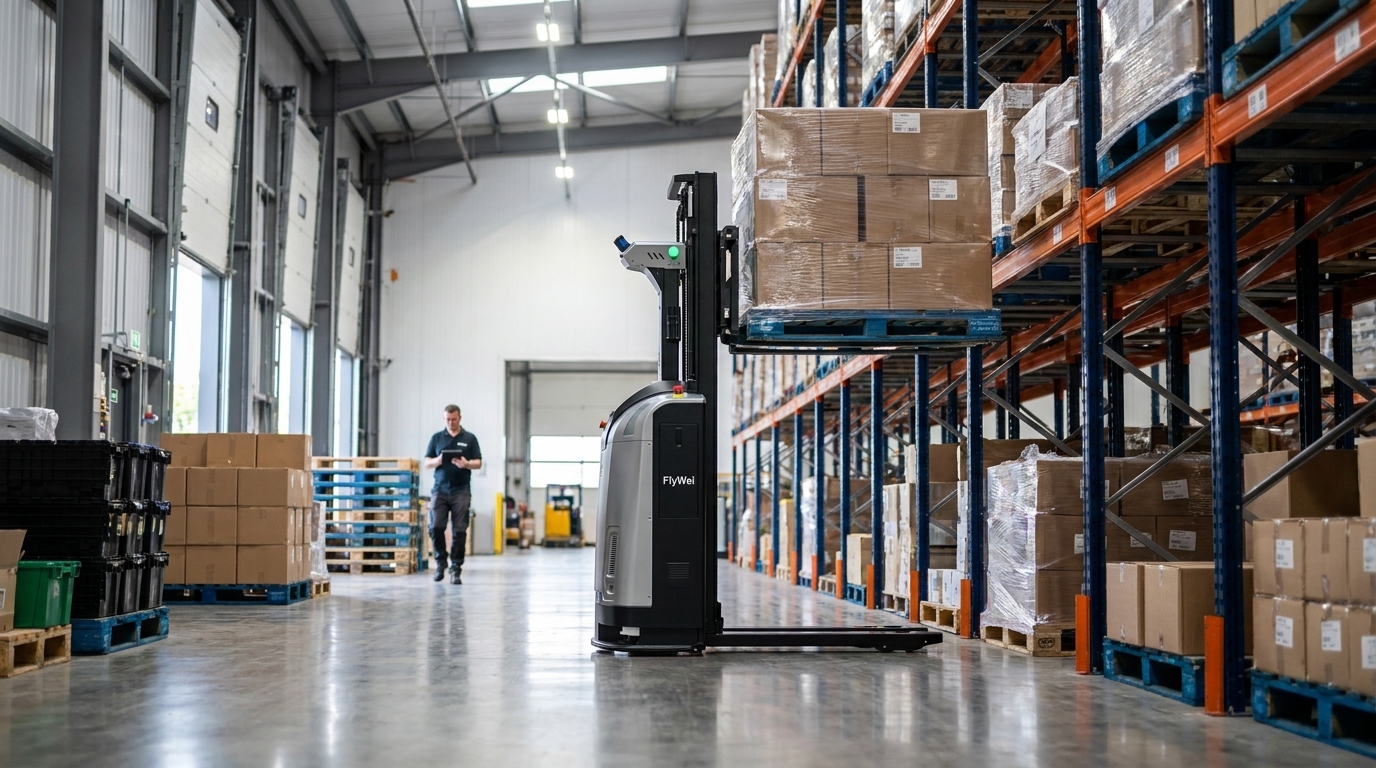
Intralogistics in the UK is the discipline of orchestrating the internal flow of goods, packaging and pallets between goods-in, storage, production and dispatch inside a single facility — increasingly under the control of autonomous forklifts, lifting AMRs and a fleet manager rather than staffed forklift moves. Under PUWER 1998, every piece of that work equipment must be inspected at suitable intervals by a competent person, and every self-driving industrial truck placed on the UK market must comply with BS EN ISO 3691-4 (HSE PUWER guidance). For a UK pharma plant director running an MHRA-regulated site in Burton-on-Trent, Magna Park or SEGRO East Midlands Gateway, that reality collides with three 2026 pressures: rising GDP audit intensity, thinner engineering benches, and a peak that never leaves a 24-hour hole to reconfigure flow. In UK pharma, intralogistics has become a plant-level control problem, not a forklift-driver rota problem — and the plants that treat it that way keep their audit trail clean.
Why intralogistics has become a plant-level control problem in 2026
Until recently, UK plant directors could treat internal material flow as somebody else's job: the operations manager owned forklift utilisation, HR owned the driver rota, and QA owned the audit paperwork. Three converging shifts have collapsed that separation.
First, MHRA GDP inspections are demanding tighter documentary evidence that every lift, every put-away and every reject-quarantine move is traceable to a piece of equipment with a current thorough examination and a named competent operator (HSE workplace transport). Paper truck-sheets do not survive a modern audit. Second, Logistics UK's ongoing skills work confirms UK operators cannot hire specialist reach-truck drivers at the pace peak season demands — so any plant leaning on human-only intralogistics is one absence away from a stockout (Logistics UK). Third, the industry standard for autonomous industrial trucks — BS EN ISO 3691-4 — has moved from optional to expected, so plants that continue to run mixed manual and legacy AGV fleets face rising insurance and inspection costs (ISO 3691-4).
The upshot: internal material flow is no longer a background operational metric. It is a plant-level control loop — and if the loop is not instrumented, orchestrated and auditable end-to-end, it becomes the site's biggest audit exposure and its biggest hidden cost.
The four levers that fix intralogistics for a UK plant
1. Operational lever — appoint one intralogistics owner, dispel the vocabulary confusion first
The single biggest reason UK plants underperform on intralogistics is that nobody owns the whole flow. Warehouse ops owns racking and inbound; production owns line-side; QA owns quarantine; logistics owns outbound. Each layer has different KPIs, different vendors and different exception paths. Step one is naming an intralogistics owner at director level, with a mandate that spans goods-in to dispatch. That owner also has to dispel three chronic vocabulary muddles inside the business: intralogistics is not a synonym for logistics (which is inter-site), it is not the same as materials handling (which is the equipment layer), and it is not WMS (which is the system-of-record). Intralogistics is the choreography — the map plus the timetable plus the audit trail — under which racking, MHE and WMS all serve the same throughput target. Naming that owner unlocks the next three levers.
2. Technical lever — a fleet manager plus a dispatch layer, spoken to via VDA 5050
Once one director owns the flow, the next question is what to instrument. Modern UK intralogistics runs on a two-tier control stack: a fleet manager (traffic, charging, health, audit log) and a dispatch layer (order-to-move translation, WMS integration, priority arbitration). The fleet manager is where the plant director sees a single map of every autonomous forklift and lifting AMR under supervision, including PPM state, next-thorough-examination date and current mission. The dispatch layer is where WMS moves and MRP replenishments become concrete robot missions with expected completion times. Both tiers must speak VDA 5050 so the plant is not locked into a single robot vendor — a plant director in 2026 who cannot mix a counterbalanced autonomous forklift with a latent-jacking AMR under one orchestration umbrella is planning tomorrow's rip-and-replace project. FlyWei's M4 fleet manager and RDS dispatch are built on exactly this two-tier model.
3. Regulatory lever — PUWER + LOLER + BS EN ISO 3691-4 as one integrated regime
UK plant directors used to treat forklift compliance as three separate paperwork trails: PUWER for the truck itself, LOLER for the lifting attachments, and internal risk assessments for the aisle layout. Autonomous intralogistics collapses those into one integrated regime. Every autonomous industrial truck put into service in the UK must meet BS EN ISO 3691-4, which sets the safety architecture for perception, protective stops and speed control. Every unit and every attachment must still be inspected under PUWER 1998, and any lifting attachment must be thoroughly examined under LOLER 1998 (PUWER 1998). The practical implication for a plant director: choose an intralogistics platform whose fleet manager exports PUWER and LOLER inspection records automatically into a UK-hosted logbook. That single feature converts an MHRA audit finding from a two-day paperwork chase into a five-minute logbook export.
4. Commercial lever — full-service leasing to align capex, service and PPM in one contract
Even with the right owner, the right control stack and the right regulatory regime, the traditional capex-plus-service-contract model still forces UK plant directors to negotiate hardware, software licences, spares, uptime SLA and PPM with different counter-parties on different renewal cycles. Full-service leasing collapses that into one three, five or seven-year contract. Fixed monthly OpEx, service and spares included, UK-based engineers, PPM logged into the same fleet manager the plant already uses. FlyWei's leasing programme is the preferred financial route for procurement and capex committees that want intralogistics on the P&L, not a capex line.
Comparison — legacy manual intralogistics vs a fleet-managed autonomous stack
| Dimension | Legacy manual intralogistics | Fleet-managed autonomous intralogistics |
|---|---|---|
| Peak-season resilience | Bounded by driver rota and absence rate | Bounded by fleet size and charging profile (a capacity problem, not a hiring problem) |
| MHRA audit trail | Paper truck-sheets, reconstructed on demand | Automatic move-by-move logbook, exportable in minutes |
| Cost profile | Capex on trucks, HR cost on drivers, insurance on driver risk | Fixed monthly OpEx via full-service leasing, insurance profile falls with BS EN ISO 3691-4 conformance |
| PPM and thorough examination | Managed via a third-party maintenance contract with a separate paperwork trail | Automated schedule with PUWER and LOLER records held in the fleet manager |
| Vendor lock-in risk | Low at hardware level, high at driver-training level | Low if platform speaks VDA 5050 across mixed robot fleets |
In UK pharma, intralogistics has become a plant-level control problem, not a forklift-driver rota problem — and the plants that treat it that way keep their audit trail clean.
What FlyWei does inside a UK pharma plant's intralogistics stack
FlyWei designs, supplies and integrates the two-tier control stack UK pharma plant directors need. On the hardware side, FlyWei autonomous forklifts cover the pallet and reach-truck moves between goods-in, quarantine, storage and dispatch, while FlyWei lifting AMRs handle carton and tote moves between racking and pick-face. Both are BS EN ISO 3691-4-conformant and carry the safety architecture UK plants and their insurers now expect. On the software side, M4 orchestrates the fleet — traffic, charging, health, audit logbook — and RDS translates WMS instructions into concrete robot missions with priority arbitration. Commercially, FlyWei offers a three, five or seven-year full-service lease that folds hardware, software licences, spares, uptime SLA and UK engineering response into a fixed monthly OpEx — and every service record lands automatically into the same M4 logbook a plant director already reviews. Together, the stack removes the driver-rota constraint on plant throughput and puts the intralogistics loop firmly under plant-level control. To see the full sector fit inside pharma, cold chain, drinks and 3PL, browse the FlyWei solutions library.
Frequently asked questions about intralogistics UK
What does intralogistics mean in the UK context?
In the UK context, intralogistics means the discipline of orchestrating internal material flow — receiving, put-away, replenishment, picking, VAS and dispatch — inside a single warehouse, DC or manufacturing plant. It sits between the WMS (system of record) and the MHE (equipment), and it is increasingly delivered by autonomous forklifts and lifting AMRs under a fleet manager.
How is intralogistics different from logistics or materials handling?
Logistics moves goods between sites, on trucks, across borders. Materials handling is the equipment layer — forklifts, conveyors, cranes. Intralogistics is the choreography that sits above materials handling and below WMS: what moves, when, by which asset, with what safety and audit trail.
Does PUWER 1998 apply to autonomous forklifts in a UK plant?
Yes. PUWER 1998 applies to every piece of work equipment in a UK workplace, including autonomous forklifts and lifting AMRs. Equipment must be inspected at suitable intervals by a competent person, and formal records held on site.
Which standard governs self-driving industrial trucks placed on the UK market?
BS EN ISO 3691-4 sets the safety architecture for autonomous industrial trucks, covering perception, protective stops and speed control. UK plants specifying autonomous MHE in 2026 typically require conformance to BS EN ISO 3691-4 in the contract.
Do I need LOLER 1998 as well as PUWER for autonomous MHE?
If the autonomous unit or its attachment is used to lift a load, LOLER 1998 also applies — with a thorough examination schedule for lifting equipment on top of PUWER inspections. A well-designed fleet manager records both trails in one logbook.
Can intralogistics be paid for as OpEx instead of capex?
Yes. Full-service leasing over three, five or seven years converts autonomous forklifts, lifting AMRs, fleet-manager licences, spares, PPM and UK engineering response into a fixed monthly OpEx line, aligning capex committees and plant directors around the same number.
How do UK pharma plants keep intralogistics audit-ready under MHRA GDP?
By ensuring every move, PPM event and thorough examination is captured in a UK-hosted fleet manager whose logbook is exportable directly to auditors. The paper truck-sheet era does not survive a modern GDP inspection.
If plant-level intralogistics is on your Q3 risk register — driver-rota exposure, MHRA GDP paperwork, or a peak with no reconfiguration window — FlyWei can help you scope the first move.
Get a 48-hour feasibility read on your highest-volume flow from a UK-based FlyWei engineer, or explore full-service leasing to see how an OpEx-only intralogistics stack lands on your P&L.
UK-based engineers. No obligation. We reply within one business day.